How Car Tech Elevates the Driving Experience Today
Car tech pays off when it cuts workload, sharpens control, or reduces fatigue. For most buyers, the best first picks are adaptive cruise, blind-spot monitoring, and an easy infotainment interface. Skip that filter and you can end up paying for gimmicks that add cost, distractions, and repair risk without making daily driving better. This guide breaks down which technologies are worth the money, how they work, and when each one fits city, highway, family, or enthusiast use.
What car tech actually changes behind the wheel
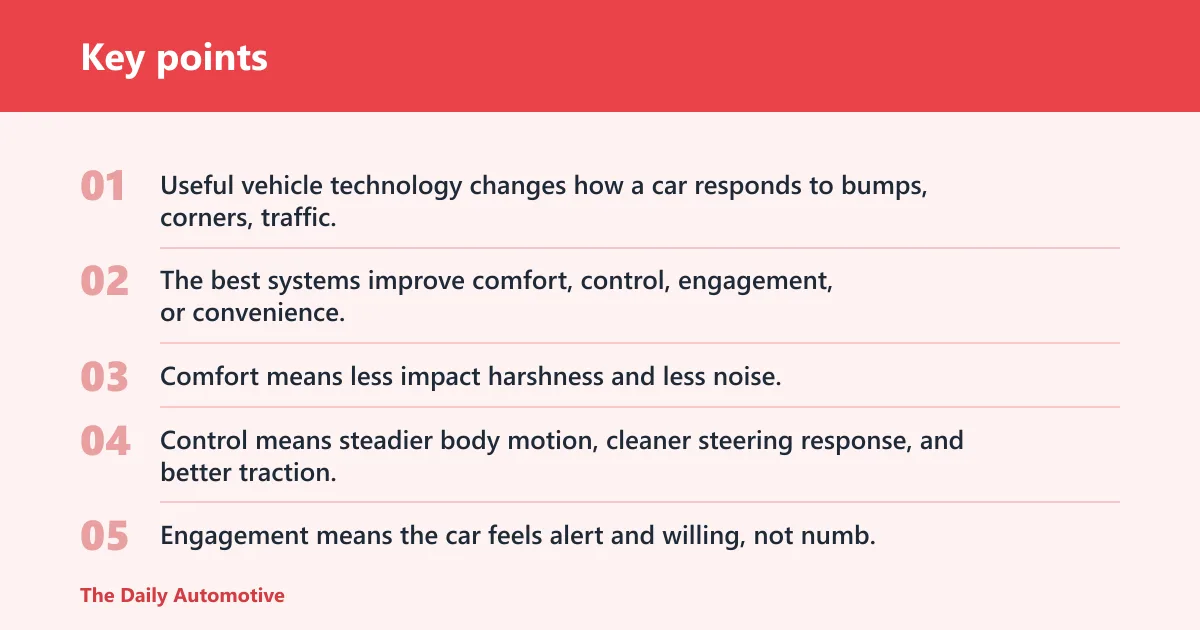


Useful vehicle technology changes how a car responds to bumps, corners, traffic, and long hours in the seat. The best systems improve comfort, control, engagement, or convenience; the worst ones add menus, sensors, and cost without changing the drive much. Your job is to sort the two.
Comfort, control, engagement, and convenience are different outcomes
Comfort means less impact harshness and less noise. Control means steadier body motion, cleaner steering response, and better traction. Engagement means the car feels alert and willing, not numb. Convenience means ownership tasks are easier, from remote services to navigation and diagnostics.
Those categories do not always overlap. A quiet cabin can feel calm but detached. A sharp steering setup can feel lively but tiring on broken pavement. A connected app can simplify ownership while doing nothing for cornering. That separation matters more than badge language.
Why some features improve the drive and others mostly improve the brochure
Features with direct mechanical or physical effects usually pay off first. Adaptive damping changes how the car absorbs impact. Steering calibration changes how quickly the nose reacts. NVH work changes the amount of shake and noise that reaches the cabin. By contrast, some screen graphics and drive-mode names mainly change perception.
Picture a commuter on patched city streets: a better damper tune is felt every mile, while a performance-themed animation appears only when the ignition wakes up. The first earns its cost. The second may not.
📊 Monza markets driving experiences with Ferrari, Lamborghini, Porsche, and Formula 1 single-seaters. Source: Monzanet.
How does car technology improve the driving experience?
Car technology improves the driving experience when it lowers fatigue, smooths rough surfaces, or gives the driver more confidence in braking, turning, and lane changes. The clearest gains come from suspension tuning, steering calibration, cabin isolation, and a few driver-assistance systems that reduce workload without getting in the way.
Smoother impacts and less road noise on rough pavement
On broken pavement, the big win is not speed. It is control over impacts. Better damping keeps a wheel from crashing into a pothole, then rebounding sharply. Better cabin isolation reduces the boom and thump that make a car feel cheap, even if the seat itself is soft.
More stable steering and body control in corners and lane changes
When a car holds its line better, the driver makes fewer corrections. That matters in sweeping ramps, quick lane changes, and downhill corners. A chassis that limits pitch and roll feels calmer, and calm often reads as quality.
Better long-distance comfort and lower fatigue on repeat commutes
Repeat commutes expose small flaws. A buzzing seat, a busy steering rack, or a suspension that jitters over expansion joints becomes tiring fast. Tech that lowers those small irritants can matter more than outright horsepower for someone who spends an hour a day in traffic.

Which features make a car feel more comfortable?
The best comfort features reduce impact harshness, vibration, and repeated body motion. Adaptive suspension, refined spring and stabilizer bar tuning, hydro bushings, and NVH work all help, but they do different jobs. A buyer should not treat them as the same thing.
Adaptive suspension and electronically adjustable damping
Adaptive suspension uses electronically adjustable damping to vary how firmly the shocks control motion. In one setting, the car can feel compliant over sharp edges. In another, it can hold the body flatter in corners. Some systems also use road-preview capability so the car can react before the wheel hits the bump.
That is useful on mixed roads. It is less useful if the calibration is too busy, because a system that changes character too often can feel unnatural. The best versions smooth the road without making the car floaty.
Ride and handling tuning, including spring and stabilizer bar refinement
Ride and handling tuning is the broader chassis work underneath the software. Spring rates, stabilizer bars, damping curves, and bushing choices determine whether a car settles after a bump or fidgets over every seam. Good tuning finds a balance between comfort and stability.
Rear-seat comfort is part of that balance. A setup that feels acceptable in the driver’s seat can still be harsh for passengers in the back if the rear axle reacts too sharply. Families should pay attention to that detail on a test drive.
Hydro bushings and what fluid-based damping changes in real use
Hydro bushings use fluid-based shock absorption to reduce vibration transfer through suspension links. Genesis says the facelifted GV70 uses hydro bushings on the front tension arm and rear crossmember, and that they reduced rear-seat vibrations by about 40%. That kind of change is subtle on paper and obvious over time.
The effect is not magic. It will not turn a firm SUV into a pillow. It can, however, take the sting out of sharp edges and make the cabin feel more settled on coarse pavement.
NVH and why cabin vibration matters as much as seat padding
NVH means noise, vibration, and harshness. It is a refinement metric, not a luxury buzzword. A car can have supportive seats and still feel tiring if the steering wheel buzzes, the floor sends in tremors, or road roar fills the cabin at speed.
Ride comfort and NVH are related, but they are not the same. Ride comfort is about what the suspension does to bumps. NVH is about what reaches your ears, hands, and feet after the chassis has done its work.
What car tech makes driving more comfortable on rough roads?
Adaptive damping, hydro bushings, and strong NVH control help most on rough roads because they reduce the jolt, shake, and noise that wear drivers out. Preview suspension can help too, but only if the road conditions match the system’s sensors and calibration. The benefit is real, not universal.
How camera-based suspension systems work
Preview Electronic Control Suspension is described as using a front camera and navigation map data to anticipate road conditions. Genesis says the facelifted GV70 uses those inputs, and that the system helps before and after a speed bump. That means the suspension can prepare for the impact and settle the body sooner.
Such systems are strongest when the road geometry is predictable. They are weaker on patchwork repairs, sudden potholes, or snow-covered surfaces that hide the hazard. If the system misreads the road, the result can feel busy or overactive.
When preview systems help and when they are overkill
Preview suspension earns its keep on commuter routes with repeated speed bumps, broken asphalt, and long highway stints. It matters less on smooth roads, where there is little for it to anticipate. It also adds sensor dependence, so calibration and repair complexity are worth considering before paying extra.
Suppose a buyer spends most of the week on suburban streets with fresh pavement. In that case, a standard well-tuned suspension may deliver most of the comfort for less money and less risk.
Which features help a car feel more stable and controlled?
Steering calibration, body-motion control, and predictive suspension shape stability more than raw grip numbers do. Variable gear ratio steering can make a car feel easier to place. Preview suspension can reduce pitch and keep the body composed. Together, they change how the car feels in motion.
Variable gear ratio steering and why response changes with angle
Variable gear ratio steering changes steering response with angle. Near center, it can feel calmer and less twitchy on the highway. As lock increases, the rack can respond more quickly, which helps with parking, tight turns, and evasive maneuvers.
That dual behavior is helpful if it is tuned well. If the calibration is too aggressive, the car can feel nervous around center or oddly quick at the wrong time. The best systems disappear into the background.
How pitch motion reduction changes braking, turn-in, and cresting hills
Pitch motion is the forward-and-back movement of the body under braking and acceleration. Reducing it helps the car stay composed when stopping, turning in, or cresting a hill. That can make the vehicle feel more planted and easier to place.
It also helps passengers. Less nose dive and less rearward squat usually means fewer abrupt movements for people in the cabin, especially on uneven roads.
Does performance tech make driving more exciting?

Yes, but only when the technology changes the way the car delivers power, traction, or feedback. A hybrid performance powertrain can add response and efficiency at the same time. Sound systems may raise excitement too, but the effect is weaker if the audio is synthetic or disconnected from the actual engine behavior.
Hybrid performance powertrains and the Acura NSX example
The Acura NSX is a useful example because the old car was listed at 270 hp and 3100 lbs, while the later NSX was listed at 573 hp and 3800 lbs. The review also said the later car cost about $160,000, compared with $85,000 in 1995, and that it was four-wheel drive and built mostly in Ohio. That mix shows how performance tech can change the whole package, not just one number.
Hybrid systems can improve response by filling torque gaps and supporting traction management. In a performance car, that can make acceleration feel immediate and usable rather than peaky.
What 4WD capability adds to traction and confidence
Four-wheel drive can help put power down more cleanly, especially when the road is cold, damp, or uneven. It can also make a car feel more secure leaving a corner. That said, AWD is not free: it can add weight, cost, and repair complexity.
For buyers who rarely push hard, the extra traction may matter less than good tires and clean chassis tuning. For buyers who do use the throttle, it can make the car easier to exploit.
When engine sound technology adds engagement and when it feels fake
Engine sound augmentation can make a cabin feel more alive at low speed or under light throttle. It is most convincing when it supports the car’s actual behavior rather than masking it. When the sound is too obvious, it can feel like theater instead of feedback.
That is why buyers should listen with the audio system off and the windows up and down. If the sound still feels thin or forced, extra speakers will not fix the problem.
When does connected tech help, and when is it just extra cost?
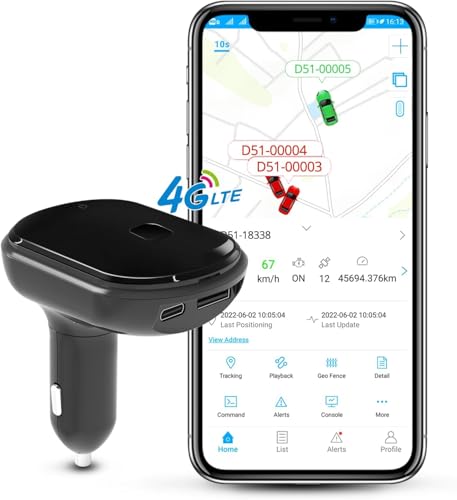
Connected services help when they improve safety access, service access, or day-to-day convenience. OnStar connected services, for example, can support in-vehicle connectivity and ownership tasks that matter outside the showroom. The downside is subscription dependence, software complexity, and the risk of paying ongoing fees for modest value.
OnStar connected services and ownership convenience
Connected services can help with remote functions, emergency communication, diagnostics, and trip planning. In daily use, that can save time and reduce hassle. It is most useful for owners who keep a car longer and actually use the features.
If the system duplicates what a phone already does well, the value drops. Buyers should compare the cost of ownership, not only the first-year feature list.
Safety and service access that matter in daily use
Safety access matters when the car can notify assistance, simplify a service visit, or help locate the vehicle. Service access matters when the owner can check status without a trip to the dealer. Those functions have real use in family cars and commuter vehicles.
Subscription risk, software dependence, and repair concerns
Connected systems often add ongoing cost. They also create software and calibration dependencies. If a module fails, the repair may involve more than a switch or fuse. Sensor calibration can add time and expense after windshield work, suspension work, or collision repair.
That is why connected features deserve the same scrutiny as any other option. Convenience is only convenience if it stays affordable.
What matters on a track or performance-drive day?
On a circuit, the best tech helps the driver stay consistent, see the car’s reactions clearly, and avoid mistakes. High-performance circuit driving rewards predictable braking, clear steering, and stable body control. Tech that filters too much can slow learning, but the right tools can make a faster, safer session.
High-performance circuit driving and what tech helps lap consistency
Track work is a racetrack environment, so it tests reflex and skill under repeatable load. A stable brake pedal, consistent damping, and clear steering feedback matter more than flashy screens. The goal is repeatability, not novelty.
Monza markets driving experiences with Ferrari, Lamborghini, Porsche, and Formula 1 single-seaters, and says PURESPORT is the only company authorized to organize GT and single-seater driving experiences there. It also describes Monza as one of the most famous racing circuits in the world. That is the kind of setting where driver confidence and instruction matter as much as hardware.
Supercar track instruction, driving position coaching, and safety-focused guidance
Professional instructor guidance can make a supercar more rewarding immediately. Driving position coaching matters because seat height, reach, and pedal alignment affect braking and turn-in. Safety-focused instruction also helps the driver avoid overdriving cold tires, overheated brakes, or unfamiliar controls.
Driver aids can help on track if they catch mistakes without shutting the experience down. They can also slow skill development if they intervene too early or hide the car’s balance from the driver.
Driving Experience Tech Scorecard
Use this scorecard to compare features by real driving payoff, not by hype. A high comfort score means the feature matters on rough roads and long commutes. A high ownership-complexity score means more calibration, more repair risk, or more cost. That last column can change the value of the whole option package.
| Feature | Comfort | Control | Engagement | Daily usability | Ownership complexity |
|---|---|---|---|---|---|
| Adaptive suspension | High | High | Medium | High | Medium |
| Preview Electronic Control Suspension | High on broken roads | High | Medium | Medium | High |
| Ride and handling tuning | High | High | Medium | High | Low |
| Hydro bushings | Medium to high | Medium | Low | High | Medium |
| Variable gear ratio steering | Low | High | Medium | High | Medium |
| Hybrid performance powertrain | Medium | High | High | Medium | High |
| OnStar connected services | Low | Low | Low | High | Medium |
| Track instruction | Low | High | High | Low | Low |
How to use the scorecard to compare mainstream cars with performance models
For a commuter or family buyer, prioritize comfort, daily usability, and low complexity. For a canyon-road or track buyer, place more weight on control and engagement. Expensive performance models can score high on excitement while still being poor value if the tech is costly to repair or adds little in ordinary traffic.
Simple test-drive checklist for each feature before you buy
- Drive the car on patched pavement and judge impact harshness.
- Listen for tire roar, dash buzz, and steering-wheel vibration at highway speed.
- Turn into a tight parking space and note steering effort and response near center.
- Brake hard from moderate speed and feel for pitch motion or instability.
- Switch drive modes and see whether the changes are useful or only theatrical.
- Ask about sensor calibration, tire size effects, and repair costs for the option you want.
- For connected features, confirm subscription terms and what still works if service expires.
- If track use matters, take the car through a few quick direction changes and check for early electronic intervention.
What tech features are worth paying for in a performance car?
The features most worth paying for are the ones that improve the car’s repeated behavior: adaptive suspension, strong chassis tuning, good steering calibration, and a powertrain that adds usable response. Sound systems and novelty screens rank lower unless they materially improve feedback or day-to-day use.
A common first-timer mistake is paying for the loudest option package rather than the one that best suits the roads actually driven. A canyon car needs control. A highway car needs calm. A track toy needs consistency and restraint from its aids.
Frequently asked questions
Does engine sound technology make driving more exciting?
It can, but only when the sound matches the car’s real behavior. Authentic intake or exhaust tuning usually feels better than artificial sound. If the sound is obviously pumped in or disconnected from throttle response, the effect can feel fake rather than engaging.
What is the difference between ride comfort and NVH?
Ride comfort is about how the suspension handles bumps, dips, and body motion. NVH is about noise, vibration, and harshness inside the cabin. A car can ride softly but still feel loud or shaky, so the two should be judged separately on a test drive.
Which driving tech matters most in everyday traffic?
In everyday traffic, the best tech is the kind that reduces workload without demanding attention. That usually means adaptive cruise, blind-spot monitoring, a clear infotainment interface, and a suspension that calms rough pavement. Fancy performance features matter less when the car spends most of its time in queues and stop-and-go traffic.
Products related to this article
Sponsored / affiliate links. As an Amazon Associate I earn from qualifying purchases. I may earn additional commission from eligible campaigns.