How Much is a Car Door: Uncovering Hidden Costs
A replacement car door usually costs $500 to $2,500 installed, but the real bill can run higher once paint, glass, regulators, wiring, and calibration are added. Skip those items and you can end up with wind noise, a color mismatch, windows that act up, and a claim that blows past your budget. This guide breaks down shell price, transfer labor, paint blending, electronics, and insurance deductibles so you can estimate the out-the-door cost.
Typical cost range

Professional car door replacement typically costs $800 to $2,500, and some estimates place it at more than $3,000. That spread is why the part price alone can mislead you. The installed total depends on whether you need a bare shell, a complete assembly, paint work, and extra labor for transfer and alignment.
The bill climbs fastest when quotes leave out separate line items. A car door shell can be priced apart from installation and paint, and a used door or shell may cost $150 to $700+. Removal and installation can add $200 to $600+, while refinishing and paint blending can add $400 to $1,000+.
If you are comparing quotes, compare the same scope. One shop may quote a shell only. Another may quote a finished, installed, color-matched door with all hardware transferred.
What changes the bill fastest
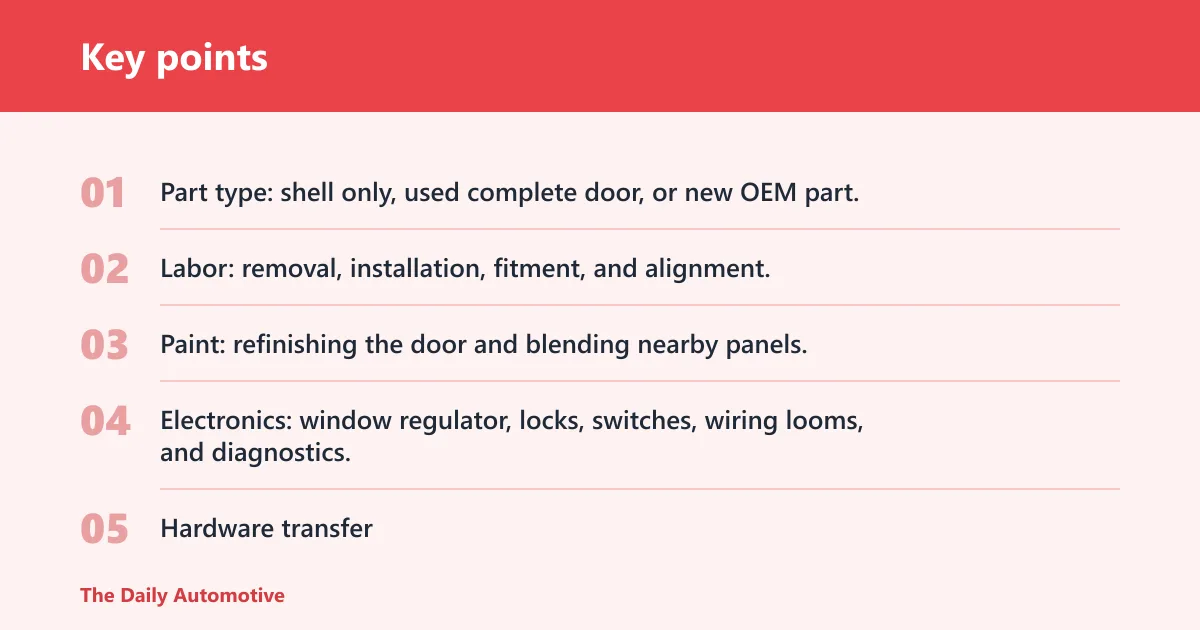
- Part type: shell only, used complete door, or new OEM part.
- Labor: removal, installation, fitment, and alignment.
- Paint: refinishing the door and blending nearby panels.
- Electronics: window regulator, locks, switches, wiring looms, and diagnostics.
- Hardware transfer: glass, trim, handle, mirror, and clips.
Car door costs worksheet
This worksheet turns a parts quote into a landed-cost estimate. Fill in the lines that match your vehicle and then add the totals. The goal is not a perfect shop invoice; it is a realistic budget before the teardown reveals extra work.
| Line item | Fill-in amount | Notes |
|---|---|---|
| Part type | $________ | Used door, new shell, or OEM complete assembly |
| Removal and installation | $________ | Commonly 3 to 6 labor hours total |
| Paint and blending | $________ | Door refinish and possible adjacent-panel blend |
| Transferable hardware | $________ | Glass, regulator, lock, trim, handle, mirror |
| Non-reusable clips and trim | $________ | Broken retainers, seals, fasteners, emblems |
| Electrical diagnostics | $________ | Module resets, wiring checks, calibration if needed |
| Supplement allowance | $________ | Extra labor or parts found after teardown |
| Insurance deductible impact | $________ | Deductible owed only if the claim applies |
Formula: part + installation + paint/blending + transferred hardware + clips/trim + diagnostics + supplement allowance + deductible = estimated out-the-door cost.
How to use the worksheet
- Write down the exact door type: shell, used assembly, or OEM replacement.
- Add the quote for labor, not just the part.
- Include paint and blend work if the shop says the color match needs it.
- Ask which hardware transfers and which pieces must be replaced.
- Set aside a supplement buffer, especially on late-model vehicles.
- Add your deductible if you plan to file a covered insurance claim.
What is included in a door shell?
A car door shell is the bare metal structure. It usually excludes glass, trim, wiring, locks, speakers, mirror hardware, and most internal components. That is why a shell can look inexpensive on paper and still lead to a much larger installed bill.
New OEM doors are made to the vehicle manufacturer’s specifications, but that does not mean they arrive complete. OEM parts can be sold as shell-only, which means your shop still has to transfer or replace the missing pieces before the door is ready for paint and installation.
Bare shell versus complete assembly
A complete door assembly may include glass, locks, wiring, and trim, often sourced used or salvaged. That can reduce transfer labor, but condition varies. A rusty latch, a scratched glass panel, or a missing wire loom can erase the savings quickly.
A shell is often the better fit when the outer door is damaged but the internal components still work. A complete assembly makes more sense when the original door has bent structure, broken mounts, or too many missing parts to justify rebuilding.
Parts that are usually reused or transferred
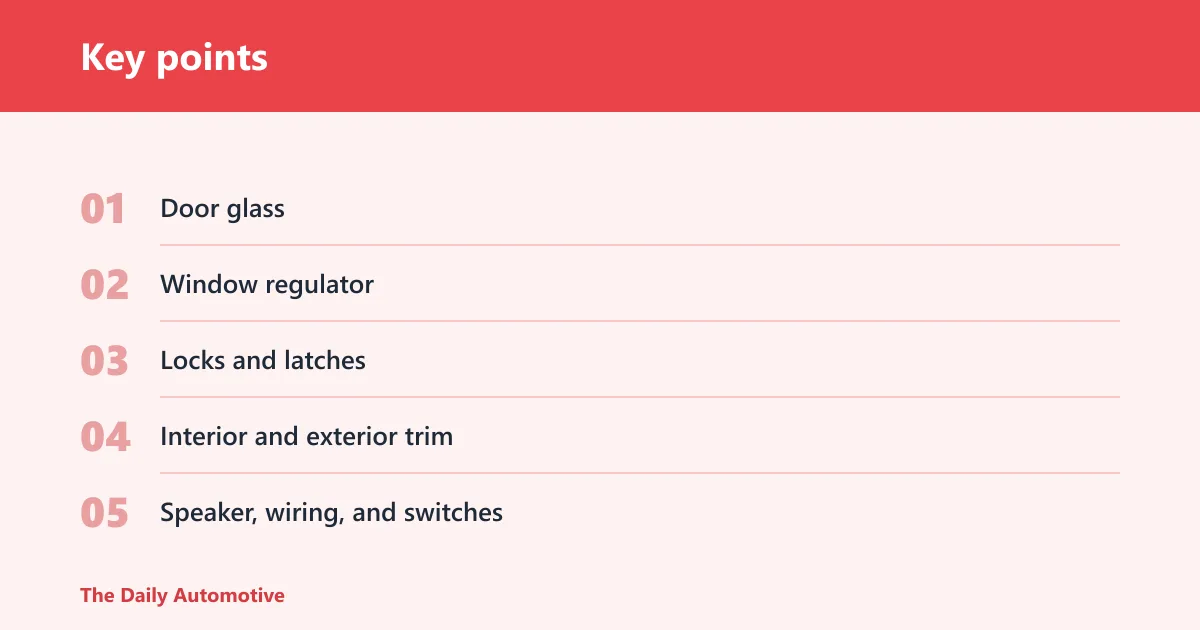
- Door glass
- Window regulator
- Locks and latches
- Interior and exterior trim
- Speaker, wiring, and switches
- Mirror and mirror wiring
Hardware that often has to be replaced
Clips, vapor barriers, seals, and broken trim pieces often cannot be reused. If the old door was smashed or corroded, fasteners may break during removal. That small pile of parts can add cost in a way a basic quote never shows.
New OEM, used, or salvage?
New OEM parts usually cost the most up front, but they offer the clearest fit expectation because they are made to the vehicle manufacturer’s specifications. Used and salvage doors can cut the parts bill, yet the final cost depends on condition, missing hardware, and how much transfer work the shop must do.
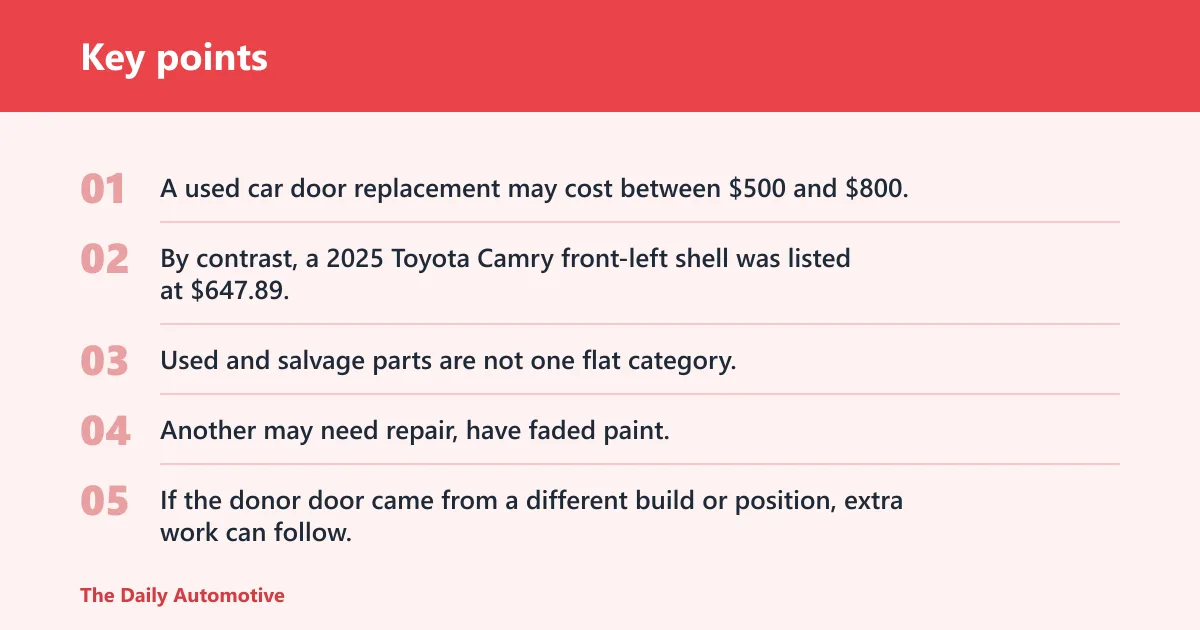
By contrast, a 2025 Toyota Camry front-left shell was listed at $647.89, and the same Camry shell listing showed an MSRP of $979.70.
Fitment and condition matter
Used and salvage parts are not one flat category. One door may arrive straight and clean. Another may need repair, have faded paint, or lack the exact hardware your trim level uses. If the donor door came from a different build or position, extra work can follow.
Here is the practical question: does the lower part price still win after labor? If a used door saves $300 on paper but adds hours of transfer work and paint correction, the final bill may end up close to a new shell.
Driver-side doors often cost more
Driver-side doors are often more expensive because they tend to carry more switches, wiring, and mirror-related hardware. On many vehicles, that side also sees more use, which raises the chance of wear in the handle, latch, and window controls. Parts availability can also vary by position and trim.
Suppose a compact sedan needs a front-left door after a parking-lot impact. If the mirror, switch panel, and regulator all transfer cleanly, the estimate may stay near the lower range. If the door wiring is damaged and the window no longer indexes properly, the repair climbs fast.
Why labor adds up
Car door replacement may require three to six hours of labor. That time covers removal, test fitting, alignment, transfer of parts, and final adjustment. If the replacement door does not sit correctly on the first pass, labor time increases.
Fitment matters because a door is not only a panel. It has to open and close cleanly, seal against wind and water, and line up with the fender, rocker, and quarter panel. Even a small alignment miss can lead to noise, rubbing, or a door that does not latch right.
Transfer labor for glass, trim, and wiring
Transfer work is where a quote often grows. Glass must be removed carefully. Regulators and switches must be moved or matched. Wiring may need checks, especially if the door uses power locks, power windows, heated mirrors, or other electrical equipment.
Electrical components can add cost in more than one way. A damaged wire loom may need repair. A replaced regulator may need setup or testing. Some vehicles also need diagnostics after a door module or switch panel is disturbed.
When repair beats replacement
Replacement is not always the best answer. If the damage is limited to the skin, handle, lock, or glass, repair can be the cheaper route. A dented outer skin or broken latch does not always justify a full door swap.
A common first-timer mistake is treating every dented door as a replacement job. If the shell is straight and the inner structure is intact, a body shop may be able to repair the panel, replace one broken component, and save both labor and paint money.
Does paint and blending cost extra?
Yes. Refinishing and paint blending can add $400 to $1,000+ to the bill. That work is often required because a new or used door rarely matches the surrounding panels perfectly, especially when the original finish has faded with age and sunlight.
Color match is the reason. A fresh panel can look slightly different from the fender or quarter panel next to it. Blending adjacent panels helps the repair disappear in normal light, but it adds time, materials, and sometimes more masking and prep.
Why adjacent panels may need blending
- Old paint has faded unevenly.
- Metallic or pearl finishes shift under light.
- The replacement part came from a different vehicle or plant batch.
- Small color differences become obvious at door edges.
Paint cost is easy to miss in a part-only quote. If the shop says the door will be sprayed off the car, then blended into the fender or rear door, budget for that work as part of the real repair price, not as an optional extra.
Frequently asked questions
How much does it cost to replace a car door?
The final bill depends on whether the quote includes only the shell or also labor, paint, hardware transfer, and electronic work. Parts-only pricing is never the full story.
What makes a car door replacement so expensive?
The cost comes from several layers: the door itself, removal and installation, paint, blending, and the transfer of glass, trim, wiring, and locks. If the vehicle has power features or damaged mounting points, labor time rises and the estimate follows. A missing clip can matter more than it looks.
Is it cheaper to replace a car door with used parts?
Sometimes, but not always. A used door or shell may cost less up front, yet fitment issues, missing hardware, or paint correction can erase the savings. Used parts work best when the donor door is straight, complete, and from the correct trim and position.
Does a car door replacement include paint and labor?
Not always. Some quotes cover only the shell or assembly, while others include installation and refinishing. Ask whether the estimate includes removal, alignment, paint, blending, and any extra work for switches, regulators, or diagnostics. A shell price alone is not the finished repair price.
Can I replace just the door skin instead of the whole door?
Yes, if the damage is mostly outer-sheet metal and the inner structure is still sound. That can be cheaper than a full replacement. If the frame is bent, the latch mounts are damaged, or the door no longer aligns cleanly, a full replacement may be the better fix.
Should I go to a dealership or body shop for a door replacement?
Both can do the job, but they price it differently. Dealerships may be a better fit for OEM parts and model-specific electronic concerns. Body shops often handle paint, blending, and damage repair more directly. Ask for the same scope from both so you can compare installed totals, not parts-only numbers.
Insurance can help, but it does not remove all cost. If the damage is covered, the deductible still applies. Supplement risk matters too, because a teardown may reveal broken clips, bent brackets, or damaged wiring that were not visible in the first estimate. That can leave you paying more than expected even on a claim.
Check the claim type before you approve the work. A collision claim, a comprehensive claim, and a liability claim can produce different out-of-pocket results. If the repair estimate is close to your deductible, paying privately may be simpler than filing a claim that does little for your budget.
Products related to this article
Sponsored / affiliate links. As an Amazon Associate I earn from qualifying purchases. I may earn additional commission from eligible campaigns.