How Much Does a Car Climate Control Diagnostic Cost?
A car climate-control diagnostic usually costs about $100 to $250, with more complex dealer- or module-level testing sometimes higher. The exact bill depends on whether the problem is refrigerant-side, airflow-related, or tied to controls and sensors. This guide breaks down what each diagnostic path includes, why some cost more, and when a higher price is justified.
Typical cost range
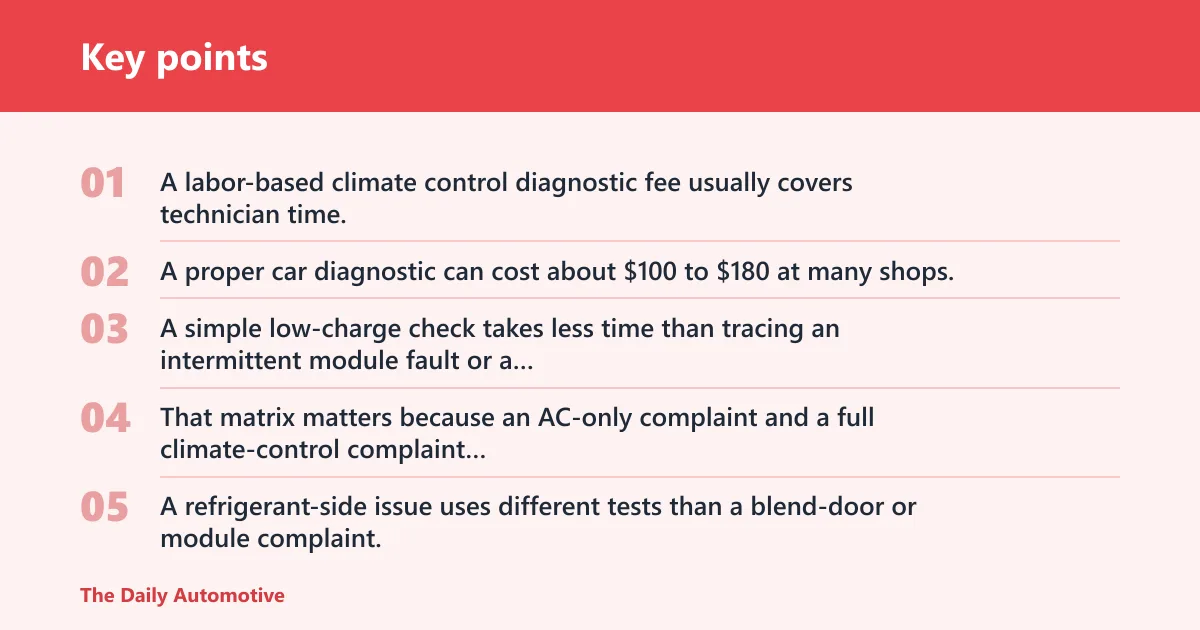


A labor-based climate control diagnostic fee usually covers technician time, the right test equipment, and the judgment needed to choose the next step. A proper car diagnostic can cost about $100 to $180 at many shops, with broader AC or HVAC checks often landing in a wider roughly $50 to $200+ range depending on the vehicle and shop type.
The spread comes from the type of complaint. A simple low-charge check takes less time than tracing an intermittent module fault or a dual-zone blend-door problem.
Climate control diagnostic pricing matrix
| Symptom | Likely subsystem | First test a good shop should perform | Tools usually justified | Expected shop time | Fair price band | Fee usually deductible from repair? |
|---|---|---|---|---|---|---|
| Warm air or no cooling | Refrigerant-side fault, compressor, condenser, evaporator, hoses | Visual inspection plus pressure testing | Pressure gauges, leak detection, scan tool if the system is electronically controlled | 30 minutes to 1.5 hours | $100–$250, often higher if leak detection is needed | Often yes |
| Weak airflow or no blower | Blower motor, resistor, wiring, cabin filter, control head | Check airflow at vents, then verify blower command and power | Scan tool, multimeter, actuator or motor command tests | 45 minutes to 2 hours | $120–$220 | Often yes |
| Temperature stuck on one side | Blend door actuator, blend door, temperature sensor, heater core symptoms | Command temperature change and watch vent response | HVAC scan tool, actuator sweep, bi-directional controls | 1 to 2.5 hours | $120–$240 | Often yes |
| Intermittent operation or no HVAC communication | Climate control module, network, sensor, power or ground fault | Scan for HVAC fault codes and module communication | HVAC scan tool, network testing, actuator sweep | 1.5 to 3 hours | $180–$350 | Sometimes |
That matrix matters because an AC-only complaint and a full climate-control complaint are not the same job. A refrigerant-side issue uses different tests than a blend-door or module complaint, and the bill should reflect that difference.
Say your midsize sedan blows warm air on both sides after sitting overnight. A shop may begin by checking system pressures with manifold gauges, then move to leak detection if the readings point that way. That is a different bill from a cabin-temperature complaint that needs actuator sweeps.
Suppose the driver’s side stays cold while the passenger side stays warm in a dual-zone SUV. The first clue is usually not a refrigerant shortage; it is a temperature-control or actuator issue, which requires scan-tool commands and actuator testing before replacement.
The fee usually climbs when the shop has to move beyond a quick visual check. Brand-specific scan tools, hard-to-access components, late-model electronics, and R-1234yf service equipment can all justify a higher price.
What is included in the test?
A climate control diagnostic should begin with checking the complaint against the dash controls and vent response, then move to pressure checks, leak detection, scan-tool checks, and component testing as needed.
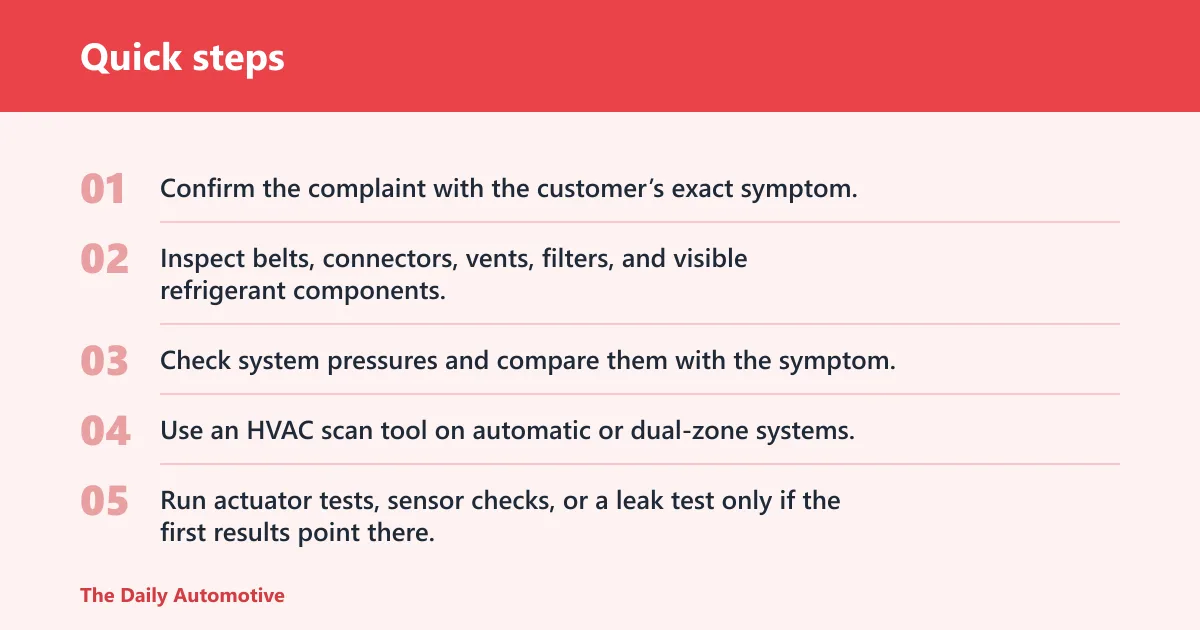
For refrigerant-side complaints, a shop should inspect the compressor, condenser, evaporator, hoses, and visible fittings for oil residue, damage, or pressure behavior that points to a leak. For automatic systems, the shop should read HVAC fault codes and verify whether the control head can command doors, fans, and temperature changes.
- Confirm the complaint with the customer’s exact symptom.
- Inspect belts, connectors, vents, filters, and visible refrigerant components.
- Check system pressures and compare them with the symptom.
- Use an HVAC scan tool on automatic or dual-zone systems.
- Run actuator tests, sensor checks, or a leak test only if the first results point there.
Likewise, evac-and-recharge work is a service step, not a substitute for diagnosis.
What drives the fee up
Local labor rates drive a lot of the spread.
Brand-specific scan tools and procedures can justify dealer pricing. Some manufacturers require HVAC software access, guided tests, or module coding that generic readers cannot do. That matters most on late-model automatic systems with networked climate modules.
Why do dealer diagnostics cost more?
Dealer diagnostics cost more because the labor rate is usually higher, and the equipment is more specific to that brand. That can be worth it when the car needs factory-level HVAC communication, module programming, or model-specific actuator routines that an independent shop may not have.
Independent shops often have lower labor rates and can handle many refrigerant leaks, blower faults, and simple actuator failures well. Dealers have an edge when the complaint involves proprietary scan data, software procedures, or a system that depends on brand-specific calibration after repairs.
Luxury and high-complexity systems
Luxury cars often use more sensors, more actuators, multi-zone controls, and tighter packaging around the HVAC case. That extra hardware takes longer to verify. If the vehicle uses dual-zone automatic climate control, the diagnosis can require separate checks for each side.
What makes climate control diagnostics more expensive on luxury cars is usually not the badge alone. It is the number of control paths, the need for scan-tool access, and the time spent proving whether the fault is a sensor, actuator, module, or refrigerant issue.
Refrigerant-side faults and pricing
Refrigerant-side testing focuses on charge level, pressure behavior, and leak location. A low-charge complaint can point to the evaporator, condenser, compressor, hoses, or a fitting leak, and the diagnostic often expands into leak detection if the initial pressure readings do not explain the loss.
R-134a and R-1234yf systems do not cost the same to service or diagnose. R-1234yf systems usually cost more because the equipment and handling requirements are stricter, and that difference can show up in the diagnostic quote as well as the repair estimate.
When a leak test gets added
Leak detection is often added when pressures are low, the system has lost performance over time, or visible evidence points to refrigerant loss without an obvious source. UV dye or an electronic leak detector is common.
That add-on should be billed separately when it is a distinct step.
A common first-timer mistake is approving a recharge before the leak is found. If the system is leaking, the cold air may return briefly, then disappear again. The more disciplined path is to find the loss point first, especially on R-1234yf systems where service costs are higher.
Core component checks
Evaporator, condenser, compressor, and hose faults usually start with inspection and pressure behavior, then move to leak confirmation or control checks. Small hose leaks can be cheaper to fix than compressor problems, while an evaporator leak often requires much more labor because the part sits deep in the HVAC case.
Those are the jobs where a “cheap diagnostic” can turn into an expensive repair path. The diagnostic fee is still useful, because it tells you whether the failure is in the refrigerant circuit or somewhere else entirely.
Control modules and actuator faults
Blend door actuator diagnosis is a different job from refrigerant testing. The shop must command temperature changes, watch door movement, and verify that the actuator, sensor, and control module agree. A bad actuator can mimic a heater core problem or a temperature sensor fault.
HVAC scan tools matter here because they can read climate control fault codes, test actuators, and verify sensor behavior. A generic OBD2 scanner may show engine or emissions data, but it often misses the HVAC module detail needed on automatic or dual-zone systems.
Can you diagnose climate control problems yourself with an OBD2 scanner?
An OBD2 scanner can help if the system stores a broad fault code, but it usually stops short of full HVAC testing. It will not always read the climate module, command blend doors, or verify pressure transducers and actuator movement the way a proper HVAC scan tool can.
For a manual system with a simple blower issue, a scanner may not add much. For a late-model automatic system, it can miss the exact fault path entirely, which is why a generic code pull is not enough by itself.
Frequently asked questions
What symptoms mean I need a climate control diagnostic?
Warm air, weak airflow, a temperature that stays stuck on one side, intermittent fan operation, strange clicking behind the dash, or a system that will not respond to button commands all justify a diagnostic. The key is matching the symptom to the test path before replacing parts.
How long does an AC or climate control diagnostic take?
Simpler refrigerant checks are faster; module, actuator, and intermittent faults usually take longer.
Is a diagnostic fee credited toward the repair?
Many shops credit the fee back toward repair costs if you authorize the work. Ask in writing whether the credit applies to the same visit, whether it applies only to labor, and whether any add-on tests are separate.
What should I ask before paying a diagnostic fee?
Ask which symptom path the shop will test first, what the fee includes, whether a scan tool or leak detector is part of it, and whether extra tests are billed separately. You should also ask whether the shop is diagnosing refrigerant loss, actuator movement, or module communication.
When is a smoke test or leak test added to the bill?
A leak test is usually added when the first pressure check points to a leak, but the source is not visible. It is a justified add-on for refrigerant-side complaints and related duct or seal leaks, not a required step for every HVAC complaint.
Why do dealer diagnostics cost more than independent shops?
Dealers usually charge higher labor rates. That can be worth it for brand-specific scan tools, module programming, or factory procedures, but an independent shop may be the better value for a basic refrigerant leak or blower fault.
Products related to this article
Sponsored / affiliate links. As an Amazon Associate I earn from qualifying purchases. I may earn additional commission from eligible campaigns.