Deep Cycle Battery for Car Audio: AGM vs Lithium Guide
For high-power car audio, choose AGM if your charging system is stock or voltage is unstable; choose Lithium only if you can support a lithium-compatible charge profile and protect the alternator, wiring, and enclosure space. Pick the wrong battery and you will get dimming lights, clipped output, heat, and shorter battery life instead of steadier bass. This guide compares AGM and Lithium by voltage support, charging behavior, install limits, and real audio use cases.
| Factor | AGM | Lithium | Winner |
|---|---|---|---|
| Charging behavior | More forgiving with factory-style charging and mixed daily use | Charges fast, but wants a compatible BMS and charge profile | AGM |
| Voltage stability under heavy load | Better than a flooded starter battery; still sags sooner than Lithium | Flatter voltage curve and higher usable capacity for sustained draw | Lithium |
| Cold-weather use | More tolerant in winter conditions | Charging can be limited in low temperatures | AGM |
| Weight and packaging | Heavier; often 40–60 lbs | Lighter; often 20–30 lbs | Lithium |
| Best fit for large builds | Strong option below about 2,500 watts RMS | Better suited above 2,500 watts RMS | Lithium |
| Install tolerance | Spill-proof, vibration resistant, and easier to place in daily-driver builds | Needs more attention to BMS behavior, temperature, and charging hardware | AGM |
Why car audio batteries fail
Stock starter batteries are built for short, high-current starts, not for repeated discharge while an amplifier pulls current for minutes. Under load, system voltage drops, headlights dim, and the amplifier gets closer to clipping because the supply is no longer steady.
Voltage sag under load
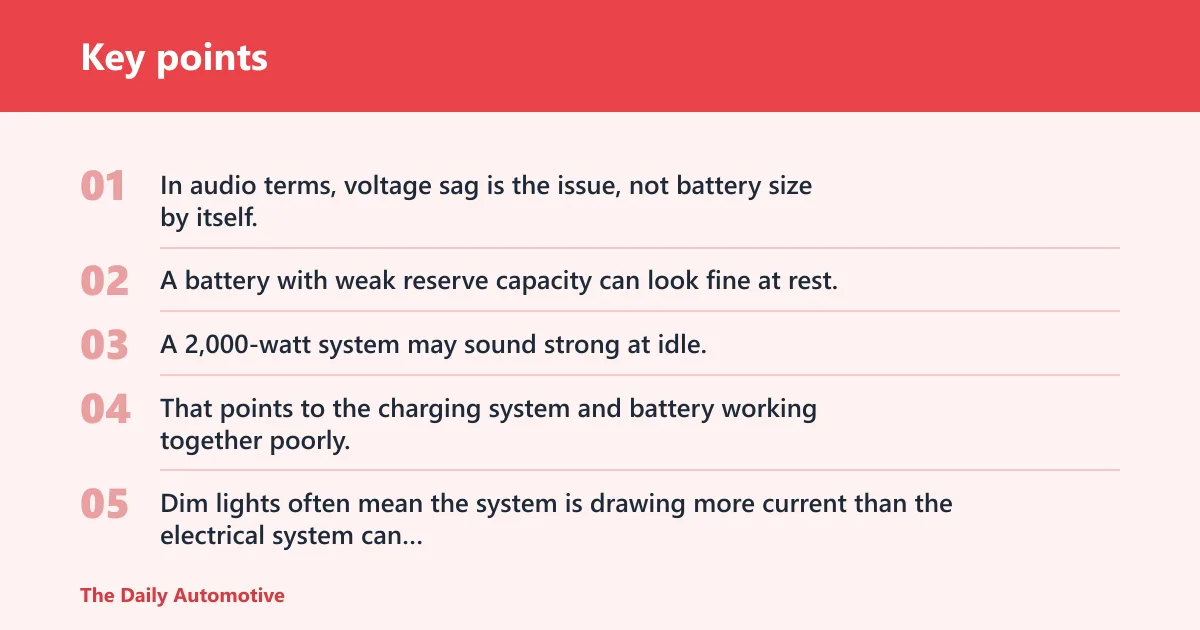
In audio terms, voltage sag is the issue, not battery size by itself. A battery with weak reserve capacity can look fine at rest, then fall off fast once bass hits and the alternator is already near its limit.
A 2,000-watt system may sound strong at idle, but the lights can dip when the kick drum lands. That points to the charging system and battery working together poorly, not to speaker size alone.
What clipped bass and dim lights mean
Dim lights often mean the system is drawing more current than the electrical system can hold at stable voltage. Clipped bass can follow because the amplifier loses headroom when voltage falls.
A battery can hold voltage for a while, but it cannot fix a weak alternator by itself. If the charging system cannot refill the battery after hard playback, the battery is only a short buffer.
Deep cycle battery basics
A deep cycle battery is built for repeated discharge and recharge, which matters when you listen with the engine off or sit in traffic with a high draw system. For car audio, amp-hours and reserve capacity matter more than cranking amps because they describe how long the battery can support the load.
Amp-hours versus reserve capacity
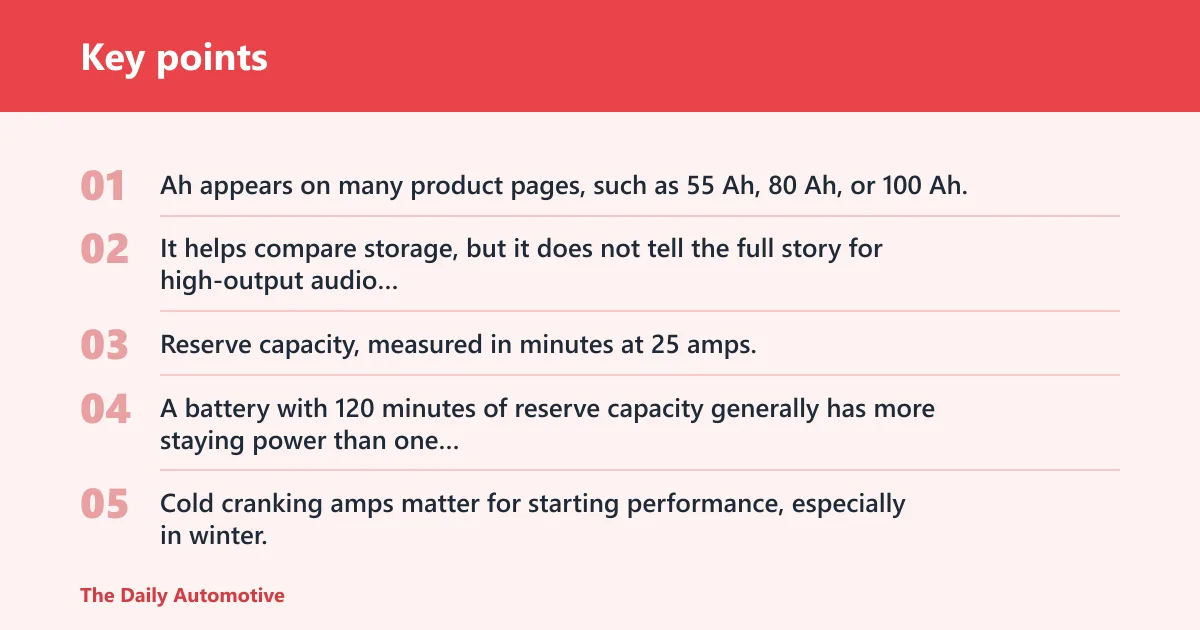
Ah appears on many product pages, such as 55 Ah, 80 Ah, or 100 Ah. It helps compare storage, but it does not tell the full story for high-output audio because discharge rate and voltage behavior matter too.
Reserve capacity, measured in minutes at 25 amps, is often a better clue for how long voltage stays up under audio use. A battery with 120 minutes of reserve capacity generally has more staying power than one with a lower RC figure, even if the Ah numbers look similar.
Where CCA fits
Cold cranking amps matter for starting performance, especially in winter. They matter less than reserve capacity for audio performance because a car audio battery is judged on sustained current draw, not a one-time start.
That is why some competitor pages list 750 CCA or 680 CCA and still leave the audio buyer guessing. For a sound system, RC and usable capacity tell a more useful story.
Daily-driver versus engine-off use
For a daily driver, a dual-purpose AGM often makes sense because it handles starting and audio use in the same package. For long engine-off listening sessions, Lithium can be the stronger choice if the charging system and temperature conditions fit its requirements.
Why stock starter batteries fail in high-power audio systems
Starter batteries are made to deliver a brief burst, then hand the job back to the alternator. They are not meant to sit in deep discharge while bass plays and the vehicle stays parked.
That mismatch is why voltage falls fast in serious audio builds. The battery may still start the car, but it will not hold bus voltage steady for long under sustained amplifier demand.
AGM battery for car audio
AGM batteries use absorbed glass mat construction inside a sealed lead-acid case. They are spill-proof, vibration resistant, and better at deep-cycle use than flooded batteries, which makes them common in daily-driver and mid-level systems.
Where AGM fits best
AGM is the safer default when the vehicle keeps a factory-style charging setup or when the owner wants fewer charging variables. It also fits well when the battery must live in a trunk, under a seat, or in another place where vibration and packaging matter.
Fullriver’s published guidance points to high-performance AGM or lithium as the right class for car audio, and that matches the practical split: AGM is usually the more forgiving option when the system is not extreme.
Where AGM falls short
AGM is heavier than Lithium and usually charges more slowly. In very large audio systems, that extra weight does not buy the same usable capacity or voltage stability that a properly supported Lithium setup can provide.
Its cycle life is also lower than Lithium in the comparison table used by many buyers: 300–500 cycles versus 2000–5000 cycles for Lithium. That does not make AGM a bad choice; it means AGM is the shorter-life, simpler-install option.
Lithium battery for car audio
In car audio, Lithium usually means LiFePO4. It is lighter, charges fast, and holds a flatter voltage curve, which helps large amplifiers stay fed during hard use.
Why Lithium helps large systems
One common recommendation is Lithium for systems above 2,500 watts RMS, while a good AGM is often treated as the better match below about 2,500 watts RMS. That split is not a law, but it tracks the load and recovery demands of larger systems.
Lithium’s usable capacity is part of the appeal. A 6 amp-hour unit like the D4S LTO 6.0 can still be useful in the right audio build because it charges quickly and keeps voltage flatter than many lead-acid setups.
BMS and temperature limits
Lithium needs a compatible battery management system and a charge profile that the battery expects. If the BMS sees a fault, it can shut the battery down, which is a sharp failure mode if the system depends on it for voltage support.
Cold weather matters too. Lithium charging limits in low temperatures are a real constraint, and under-hood heat is another reason to be careful with placement. A battery that is perfect on paper can become a poor fit if it sits in a hot engine bay or sees winter charging.
AGM vs lithium for car audio?
AGM is the better default for mixed daily driving, stock alternators, and easier installs. Lithium wins when the system is large, the charging profile is set up for it, and the build needs better usable capacity and faster recovery than lead-acid can provide.
Best fit by wattage
If the system is under roughly 2,500 watts RMS, AGM is usually the more practical pick. Above that, Lithium starts to make more sense because the demand on the charging system rises fast and voltage recovery becomes more important.
Best fit by engine-off time
If you listen with the engine off for short periods, AGM can cover the job in a daily-driver build. If the system must support longer parked sessions, Lithium’s flatter voltage curve and higher usable capacity can be the better answer.
Best fit by climate and mounting location
Cold climates lean toward AGM because Lithium charging can be restricted. Under-hood placement also leans AGM unless the Lithium battery and BMS are specifically suited to heat, because the engine bay is a harsher place for battery electronics.
Imagine a trunk-mounted 1,500-watt system in a commuter car with a stock alternator. AGM is the cleaner choice if the owner wants fewer charging changes and a simpler install. Change only one variable, and the answer can flip: move that same system to 3,500 watts with a stronger alternator, and Lithium becomes far more attractive.
Deep cycle battery decision matrix
| System wattage | Engine-off listening | Climate | Alternator output | Mounting location | AGM | Lithium | Winner |
|---|---|---|---|---|---|---|---|
| Under 2,500 watts RMS | Brief parked listening | Cold or mixed seasons | Stock or mild upgrade | Under hood or cabin | Fits well | Works, but may be more than needed | AGM |
| Above 2,500 watts RMS | Longer parked sessions | Warm climate | High-output alternator | Trunk or custom rack | Can work with support | Better voltage support | Lithium |
| Mid-power daily driver | Short engine-off use | Any normal climate | Factory alternator | Under seat | Easy fit | Possible, but less necessary | AGM |
| Competition-style burst use | Short, repeated hits | Warm weather | Strong charging system | Trunk, spare-tire well, or rack | Can work, but heavier | Best match for fast recovery | Lithium |
How to read the matrix
The table is not a wattage-only chart. It combines runtime, climate, charging support, and installation location because those factors decide whether the battery can actually hold voltage in the car.
A battery that looks strong on capacity alone can still fail the build if it cannot tolerate the local temperature or the vehicle’s charging profile.
Charging and install checks
Charging matters as much as chemistry. A high-output alternator helps large audio builds recover voltage under load, and the battery type has to match the charging behavior the alternator and regulator can provide.
High-output alternator needs
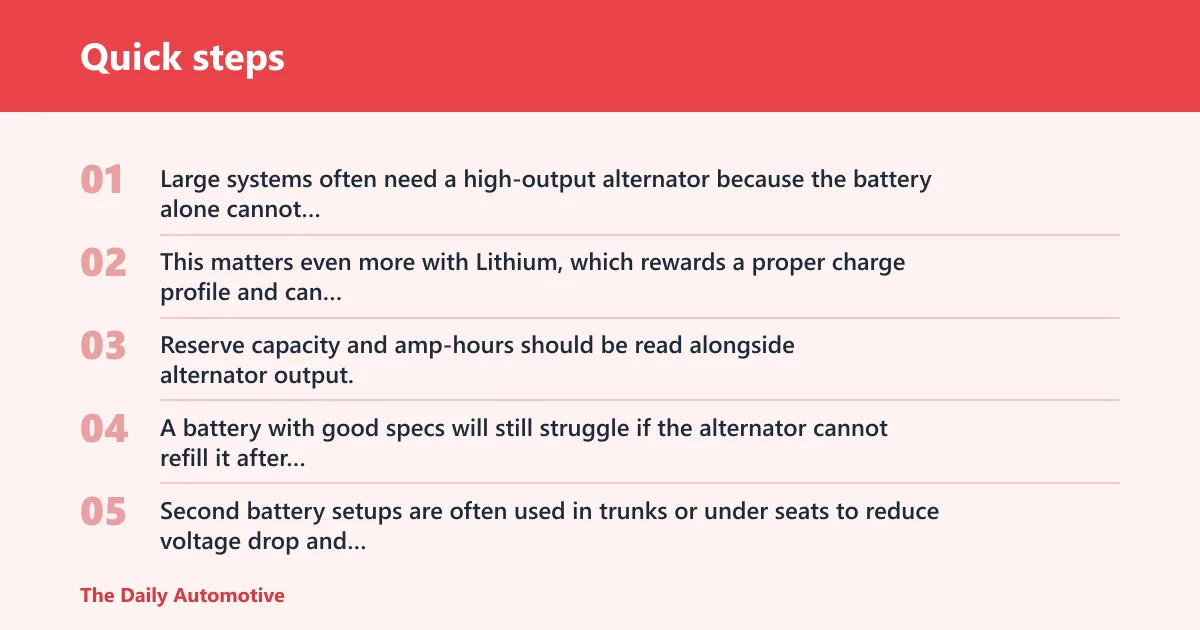
Large systems often need a high-output alternator because the battery alone cannot replace the current being used for long. This matters even more with Lithium, which rewards a proper charge profile and can expose weak charging hardware faster than AGM.
Reserve capacity and amp-hours should be read alongside alternator output, not by themselves. A battery with good specs will still struggle if the alternator cannot refill it after hard use.
Wiring, fusing, and isolation
Second battery setups are often used in trunks or under seats to reduce voltage drop and support larger amplifiers. They usually go with upgraded wiring, fuse protection, and isolation so the batteries do not fight each other or backfeed in the wrong way.
Follow the vehicle and product manual. Jump-starting and battery work follow the manual’s connection order, and fuel, coolant, and electrical work need ventilation, no sparks, and the battery disconnected.
Under-hood versus trunk placement
Under-hood placement is harder on Lithium because heat and charging behavior matter more. Trunk placement is often easier for either chemistry, but it increases the need for correct wiring and fused protection because the run to the amplifier is longer.
Do not guess at mounting hardware or enclosure clearances. Check the manufacturer’s listing for your model, and make sure the location matches the battery’s physical size and thermal limits.
What is the best deep cycle battery for car audio?
The best deep cycle battery for car audio is the one that matches your charging system, runtime needs, and climate. AGM is the safer all-around choice for many daily drivers, while Lithium is the better fit for larger systems that need faster charging and flatter voltage support.
Verdict: AGM or Lithium?
Choose AGM if you have a trunk-mounted 1,500-watt system in a commuter car with a stock alternator and want a cleaner choice with fewer charging changes and a simpler install.
Choose Lithium if you have a 3,500-watt system with a stronger alternator and need better usable capacity and faster recovery for longer parked sessions.


Frequently asked questions
What battery is best for a 2000 watt car audio system?
For a 2000 watt car audio system, AGM is usually the practical first choice if the vehicle still has a stock or mildly upgraded charging system. If the build has strong charging support, Lithium can make sense, especially when the system needs sharper voltage recovery and the install space is tight.
Do I need a second battery for my car audio system?
You often need a second battery when the amplifier load is high enough to cause voltage drop during listening, especially in trunk-mounted or engine-off setups. It is most useful when paired with upgraded wiring and the right isolation so the electrical system stays stable.
Can a lithium battery go under the hood in a car audio build?
Sometimes, but under-hood placement is a tougher environment for Lithium because heat and charging behavior matter. If the battery and BMS are not rated for that location, AGM is usually the safer fit there.
How do I charge an AGM or lithium car audio battery?
AGM can usually work with many factory-style charging systems, though proper charging still matters. Lithium needs a compatible charge profile and BMS support, and a high-output alternator becomes more important as system demand rises.
Will a deep cycle battery stop voltage drop in my car audio system?
It can reduce voltage drop, but it will not fix a charging system that is too weak for the load. A deep cycle battery helps hold voltage longer, yet alternator capacity, wiring, and fuse protection still decide how stable the system stays.
How long does an AGM battery last in a car audio setup?
AGM cycle life is commonly listed at 300–500 cycles in comparison tables, but real service life depends on depth of discharge, heat, and charging quality. In a car audio setup, good charging habits and moderate discharge usually matter more than a single number on the label.
What is the difference between reserve capacity and amp-hours for car audio?
Ah tells you nominal storage, while reserve capacity tells you how many minutes the battery can support a 25-amp draw before voltage falls too far. For car audio, RC often gives a clearer picture of engine-off listening time and voltage support than Ah alone.
Products related to this article
Sponsored / affiliate links. As an Amazon Associate I earn from qualifying purchases. I may earn additional commission from eligible campaigns.