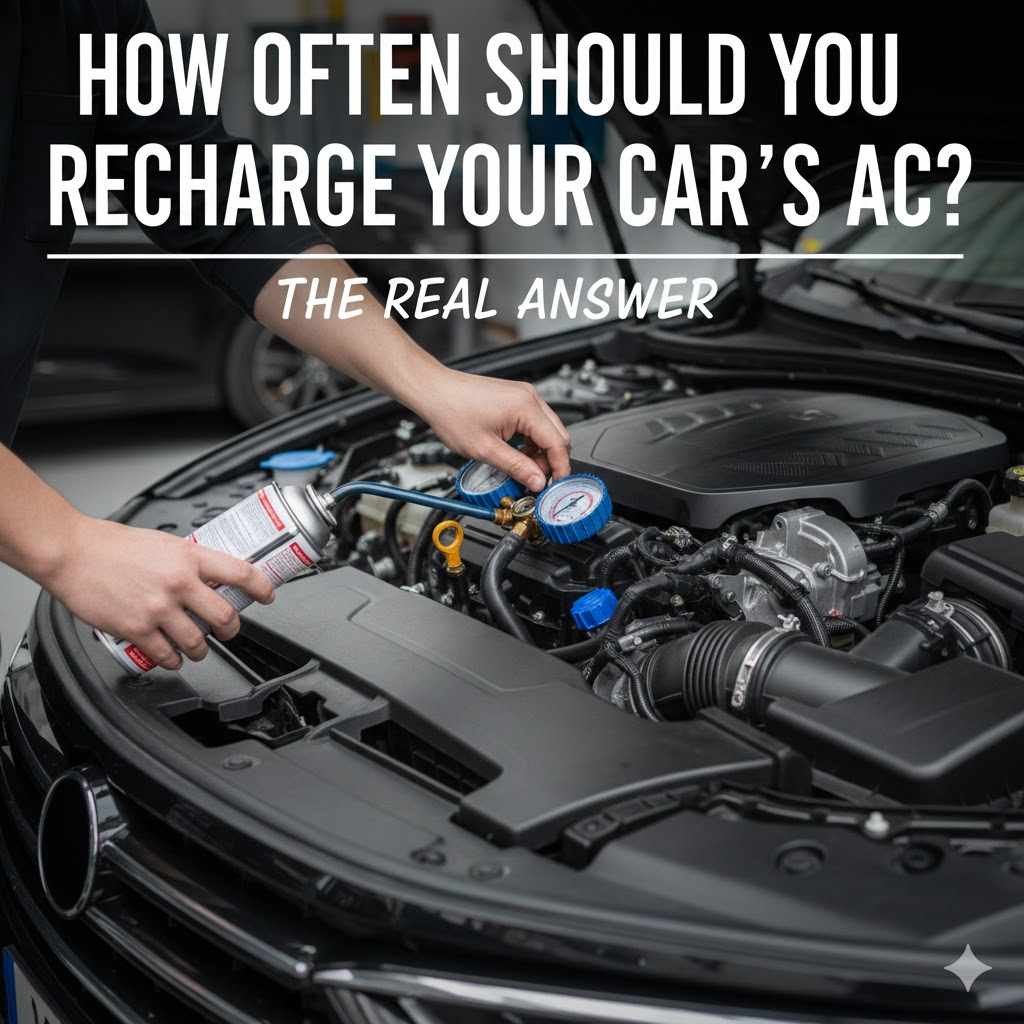
How Often Should You Recharge Your Car’s AC? The Real Answer
Unlike engine oil, your car’s air conditioning system is sealed and does not consume refrigerant. Therefore, it should never need a recharge unless there is a leak. If your AC is blowing warm air, the root cause is almost always a leak that must be repaired first. Recharging without fixing the leak is only a temporary fix.
Is there anything worse than getting into a hot car on a sweltering day, only to be blasted with warm air from your vents? It’s frustrating, uncomfortable, and can make any drive miserable. Many people think this means their AC just needs a “top-up,” like filling a gas tank. But it’s not that simple.
Don’t worry, you’ve come to the right place. I’m Md Meraj, and I’m here to clear up the confusion around car AC systems. We’ll walk through why your AC isn’t cooling, what “recharging” really means, and how you can make smart, money-saving decisions. Let’s get you back to enjoying a cool, comfortable ride.
Let’s start by busting a huge myth. Many drivers believe that recharging a car’s air conditioner is a regular maintenance task, something you do every year or two. This is not true. Your car’s AC is a sealed, closed-loop system. Think of it like the refrigerator in your kitchen—you don’t add more coolant to it every year, do you? It just works.
Your car’s AC system operates on the same principle. The refrigerant, the special chemical that cools the air, cycles through the system over and over again. In a perfectly healthy system, this refrigerant should last the entire life of your vehicle without ever needing to be refilled or recharged. So, if someone tells you that you need a routine AC recharge, be skeptical. The only reason your AC would need more refrigerant is if some has escaped.
What Does “Recharging” Your Car’s AC Actually Mean?
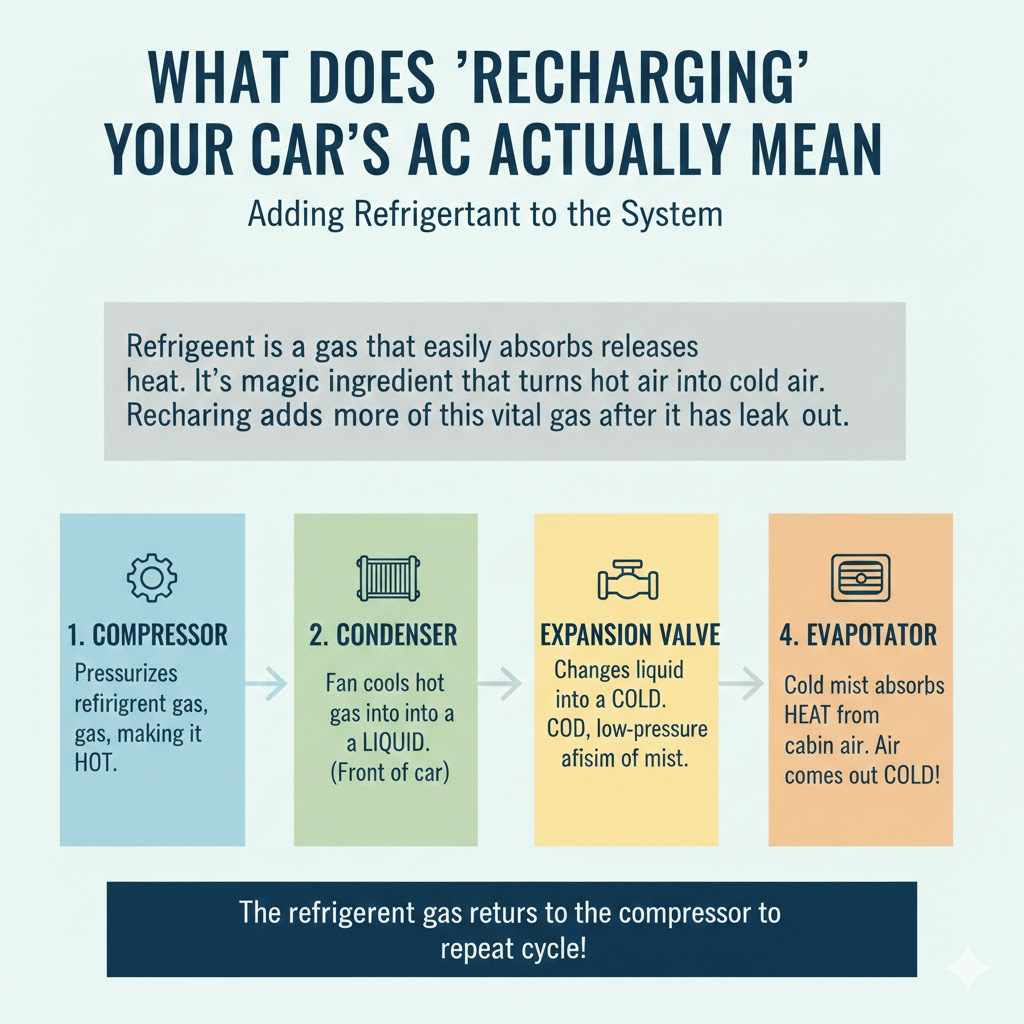
When we talk about “recharging” a car’s AC, we are talking about adding more refrigerant to the system. Refrigerant is a gas that can easily absorb and release heat. It’s the magic ingredient that allows your AC to turn hot air into cold air.
Here’s a very simple breakdown of how it works:
- The compressor pressurizes the refrigerant gas, making it hot.
- It then flows to the condenser (the radiator-like part at the front of your car), where a fan helps it cool down and turn into a liquid.
- This high-pressure liquid goes through an expansion valve, which turns it into a very cold, low-pressure mist.
- This cold mist flows into the evaporator (located inside your dashboard), absorbing heat from the cabin air that is blown over it.
- The air comes out of your vents nice and cold, and the now-warmed refrigerant gas heads back to the compressor to start the cycle all over again.
Recharging is the process of putting more of this vital refrigerant back into the system after it has leaked out.
Signs Your Car’s AC Needs Attention (Not Just a Recharge)
If your AC isn’t performing well, it’s a symptom of an underlying problem. Simply adding more refrigerant without finding and fixing the cause is like putting air in a tire with a nail in it—it will just go flat again. Here are the key warning signs to watch for.
Blowing Warm or Lukewarm Air
This is the most obvious sign. If the air coming from your vents isn’t as cold as it used to be, or if it’s just plain warm, it usually means the system is low on refrigerant. A low level of refrigerant can’t absorb enough heat from the cabin air, leading to poor cooling.
AC Clutch Isn’t Engaging (No “Click” Sound)
When you turn on your AC, you should hear a distinct “click” from the engine bay. This is the sound of the AC compressor clutch engaging, which means the compressor is starting to work. If you don’t hear this click, it could mean the system is so low on refrigerant that a safety switch is preventing the compressor from turning on to protect it from damage.
Strange Noises When AC is On
Listen carefully when you turn on the AC. Do you hear any rattling, buzzing, or grinding sounds? These noises can indicate a serious problem, such as a failing compressor. A compressor can fail due to old age, but it can also fail if the refrigerant level is too low, causing a lack of proper lubrication.
Water Leaking Inside the Cabin
It’s normal to see a small puddle of water under your car on a hot day when the AC is running. This is just condensation dripping from the evaporator. However, if you see water pooling on the floor mats inside your car, it means the drain tube for that condensation is clogged. This can lead to mold, mildew, and electrical problems.
Visible Leaks or Oily Residue
The refrigerant in your AC system is mixed with a special oil to lubricate the compressor. If there’s a leak, this oil will often escape along with the refrigerant. Look around the AC components in your engine bay (hoses, connections, the compressor itself). If you see a greasy, oily film, you’ve likely found the source of your leak.
| Symptom | Possible Cause | What It Means for You |
|---|---|---|
| Air is not cold, just cool | Slightly low on refrigerant due to a small leak | Your system has a small leak that needs to be found and fixed. |
| Air is warm; no cooling at all | Very low on refrigerant; compressor may not be turning on | There’s a significant leak or another component has failed. |
| Grinding or rattling noise | Failing compressor or clutch | This is a serious issue. Turn off the AC and see a mechanic immediately. |
| Musty or moldy smell | Mold growth on the evaporator coil | The system needs to be cleaned, and you should check the cabin air filter. |
Why Your Car AC Loses Refrigerant: The Real Culprit is a Leak
As we’ve established, refrigerant doesn’t just “get used up.” If your system is low, it has a leak. These leaks can be tiny and develop slowly over years, or they can be large and empty the system in a matter of days. Your car vibrates, endures temperature swings, and gets jostled around on the road—all of which can cause wear and tear on the AC components.
Common leak points include:
- Rubber Hoses: Over time, rubber hoses can become brittle, crack, and develop tiny pinhole leaks.
- Seals and O-Rings: There are many connection points in the AC system sealed with rubber O-rings. These can dry out and shrink, allowing refrigerant to seep out.
- Compressor Shaft Seal: The seal around the compressor’s spinning shaft can wear out, creating a common leak point.
- Condenser: Located at the front of the car, the condenser is vulnerable to damage from road debris like rocks, which can puncture it.
- Evaporator Core: This part is hidden deep inside your dashboard. Leaks here are less common but are much more difficult and expensive to repair.
The DIY AC Recharge: Is It a Good Idea for You?
You’ve probably seen the DIY AC recharge kits at your local auto parts store. They come in a can with a hose and gauge and promise a quick, cheap fix. For a very small, slow leak, they can sometimes buy you another season of cool air. However, they come with significant risks, especially for beginners.
Pros of a DIY Recharge
- Cost-Effective: A DIY kit is much cheaper than a visit to the mechanic.
- Convenient: You can do it in your own driveway in under 30 minutes.
- Temporary Solution: It can get your AC working again quickly for a short period.
Cons and Risks of a DIY Recharge
- Doesn’t Fix the Leak: The biggest issue is that you are not fixing the underlying problem. The refrigerant will just leak out again.
- Risk of Overcharging: Adding too much refrigerant is just as bad as having too little. It can create extremely high pressures in the system, potentially damaging the expensive compressor. The gauges on DIY kits are not very accurate.
- Introducing Contaminants: If not done correctly, you can introduce air and moisture into the AC system. Moisture can mix with refrigerant to form a corrosive acid that eats away at components from the inside out.
- Using the Wrong Product: Some kits contain “leak sealer” additives. While they might plug a tiny hole, they can also clog up critical components like the expansion valve, leading to a much more expensive repair down the road.
- Safety Risks: Refrigerant can cause frostbite if it contacts your skin and is harmful if inhaled. Always wear safety glasses and gloves. The Environmental Protection Agency (EPA) also has strict regulations about handling refrigerants due to their environmental impact.
| Factor | DIY Recharge Kit | Professional Mechanic |
|---|---|---|
| Cost | Low ($40 – $70) | Higher ($150 – $400+) |
| Accuracy | Low (Inaccurate gauges) | High (Precise charging by weight) |
| Leak Detection | None | Yes (UV dye, electronic sniffers) |
| Long-Term Fix | No, it’s a temporary patch | Yes, addresses the root cause |
| Safety | Moderate risk to you and your car | Safe and handled by certified pros |
When to Call a Professional Mechanic
While a DIY recharge might seem tempting, there are many situations where heading straight to a trusted mechanic is the smartest, safest, and ultimately cheapest choice. Call a professional if:
- You suspect a large leak (your AC stopped working suddenly).
- Your AC compressor is making loud grinding or squealing noises.
- You tried a DIY kit and it didn’t work or made the problem worse.
- You are not comfortable working on your car or handling chemicals.
- You want the problem fixed correctly the first time.
How Professionals Recharge Your Car’s AC (And Why It’s Different)
A professional AC service is far more than just “topping off” the refrigerant. A certified technician uses specialized equipment to do the job right.
- Inspection and Diagnosis: First, they will inspect the entire system to identify the problem. This often involves checking for leaks.
- Leak Detection: To find the leak, they will often inject a special UV dye into the system. After running the AC for a bit, they can use a blacklight to see exactly where the fluorescent dye is escaping. They may also use a highly sensitive electronic “sniffer” that beeps when it detects refrigerant gas.
- Recovery and Evacuation: Once the leak is found and repaired, they will use a recovery machine to safely remove all of the old refrigerant from your system. Then, they use a powerful vacuum pump to “evacuate” the system. This boils away any moisture that has gotten inside, which is a critical step to prevent corrosion.
- Recharging by Weight: This is the most important part. Every car has a specific amount of refrigerant it needs, measured by weight (e.g., 1.5 lbs). The technician uses a digital scale to add the exact, precise amount required for your vehicle. This ensures optimal performance and safety.
- Performance Test: Finally, they will test the system to make sure it’s blowing cold and that the pressures are correct, confirming the repair was successful.
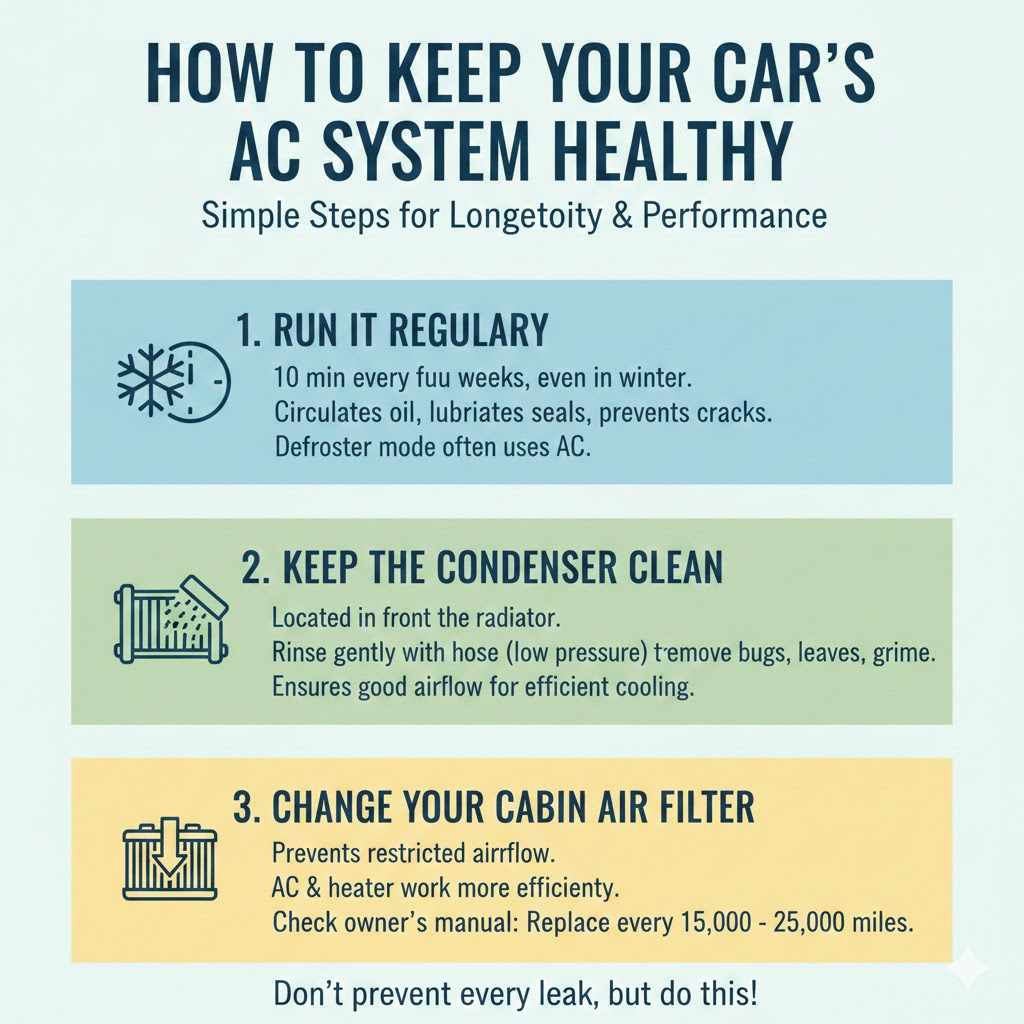
How to Keep Your Car’s AC System Healthy
While you can’t prevent every leak, you can take a few simple steps to help your AC system last longer and perform better.
- Run It Regularly: Even in the winter, run your AC for about 10 minutes every couple of weeks. This circulates the oil in the system, which helps keep the seals lubricated and prevents them from drying out and cracking. Using your defroster setting often accomplishes this, as most cars automatically run the AC compressor in defrost mode to dry the air.
- Keep the Condenser Clean: The condenser sits in front of your radiator. It can get clogged with bugs, leaves, and road grime. Gently rinse it with a hose (don’t use high pressure) when you wash your car to ensure good airflow, which helps it cool the refrigerant efficiently.
- Change Your Cabin Air Filter: A clogged cabin air filter restricts airflow into your car, making your AC and heater work harder. This can make you think your AC is failing when it’s really just being starved of air. Check your owner’s manual and replace it every 15,000 to 25,000 miles.
Frequently Asked Questions (FAQ)
1. How much does a professional car AC recharge and repair cost?
The cost can vary widely. A simple inspection and recharge service might range from $150 to $250. However, if a leak needs to be repaired, the cost will depend on which part has failed. Replacing a simple hose might be an extra $100, while replacing a compressor or evaporator could cost over $1,000.
2. Can I just add more refrigerant to my car’s AC myself?
You can, using a DIY kit, but it’s generally not recommended. It doesn’t fix the leak, and there’s a high risk of overcharging the system or causing further damage. It’s a temporary fix at best and can lead to more expensive repairs later.
3. What is the difference between R-12, R-134a, and R-1234yf refrigerants?
These are different types of refrigerants used over the years. R-12 (Freon) was used in cars made before 1994 and is now banned for its environmental impact. R-134a was the standard from the mid-90s until the mid-2010s. Most new cars today use R-1234yf, which is more environmentally friendly. You cannot mix them; your car must use the specific type it was designed for.
4. How long does a professional AC service take?
A straightforward evacuation and recharge can take about an hour. If the mechanic needs to diagnose and repair a leak, it can take several hours or even a full day, depending on the location of the leaking part.
5. Is it safe to drive with a broken AC?
Yes, it’s generally safe. A non-working AC won’t affect your car’s ability to drive. However, if the compressor has seized or is making loud grinding noises, the serpentine belt that runs it could break, which can cause other problems like loss of power steering or alternator function. In that case, you should get it fixed immediately.
6. Why does my car AC smell bad when I turn it on?
A musty or moldy smell is usually caused by bacteria and mold growing on the evaporator core inside your dashboard. This happens when moisture and darkness combine. You can often fix this with a special AC system cleaning spray or by having a professional service it. Also, make sure your cabin air filter is clean.
Your Guide to a Cool and Comfortable Drive
Navigating car maintenance can feel overwhelming, but understanding your car’s AC system doesn’t have to be. The most important thing to remember is that a healthy AC system should never need a recharge. If it’s blowing warm air, it’s a cry for help—a sign that there’s a leak that needs a proper fix.
While a DIY can of refrigerant might offer a tempting quick fix, it’s like putting a bandage on a problem that needs stitches. You might get temporary relief, but the issue will return, and you could even cause more harm than good. Taking the time to understand the signs, check for simple issues like a dirty cabin filter, and knowing when to call a professional will save you money, time, and a lot of sweaty frustration in the long run.
By treating the root cause instead of just the symptom, you ensure your car is ready to keep you cool and comfortable for many summers to come. Drive safe, and stay cool!