How Do Gears Work in a Car? Mechanics of Gear Ratios Explained
Gears work in a car by changing the ratio between how fast the engine spins and how fast the wheels turn, trading speed for torque (or torque for speed) at every gear change.
A car engine only produces useful power across a narrow range of RPM. Gears solve that problem by letting a small, fast-spinning gear drive a larger, slower-turning gear (or the reverse), so the engine can stay in its efficient range no matter how fast the car itself is moving. Lower gears multiply torque for starting and climbing; higher gears multiply speed once the car is already rolling.
Below is exactly what happens inside the transmission when a gear engages, why manual and automatic gearboxes use different hardware to do it, and what it means when a gear starts to slip or grind.
How Gears Trade Speed for Torque (Gear Ratio Explained)
Every pair of meshing gears has a gear ratio: the number of teeth on the driven gear divided by the number of teeth on the driving gear. If a small 20-tooth gear on the engine side drives a larger 40-tooth gear on the wheel side, that is a 2:1 ratio. The output shaft turns at half the input speed, but with roughly twice the torque, since the two gears are transmitting the same amount of power.
That speed-for-torque tradeoff is the entire reason gears exist in a car. First gear in a manual transmission is often built around a ratio in the neighborhood of 3:1 to 4:1 (the exact number varies by make and model), which is why it can pull a heavy car away from a dead stop or up a steep grade. Fifth or sixth gear is closer to 1:1 or even slightly below it (an “overdrive” ratio), which is why the engine can cruise at a relaxed, fuel-efficient RPM at highway speed.
The Types of Gears Inside a Car’s Transmission
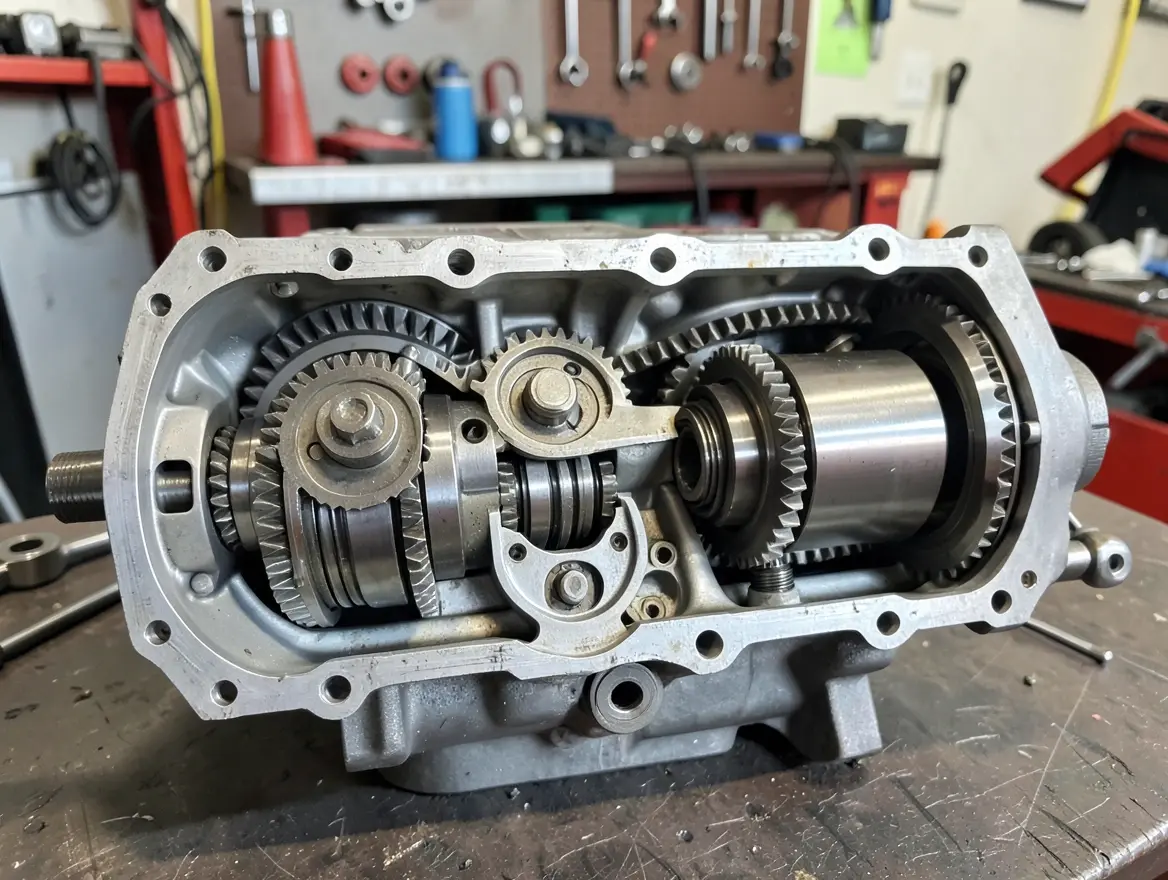
Not every gear in a transmission is cut the same way, and the shape of the teeth changes how the gear behaves under load.
Spur Gears
Spur gears have straight teeth cut parallel to the gear’s axis. They are the simplest and cheapest gear to manufacture, and they handle heavy loads well, but because the teeth engage all at once along their full width, they tend to be noisier than other gear types. Reverse gear in most manual transmissions is still a spur gear, which is part of why reverse sounds whinier than the forward gears.
Helical Gears
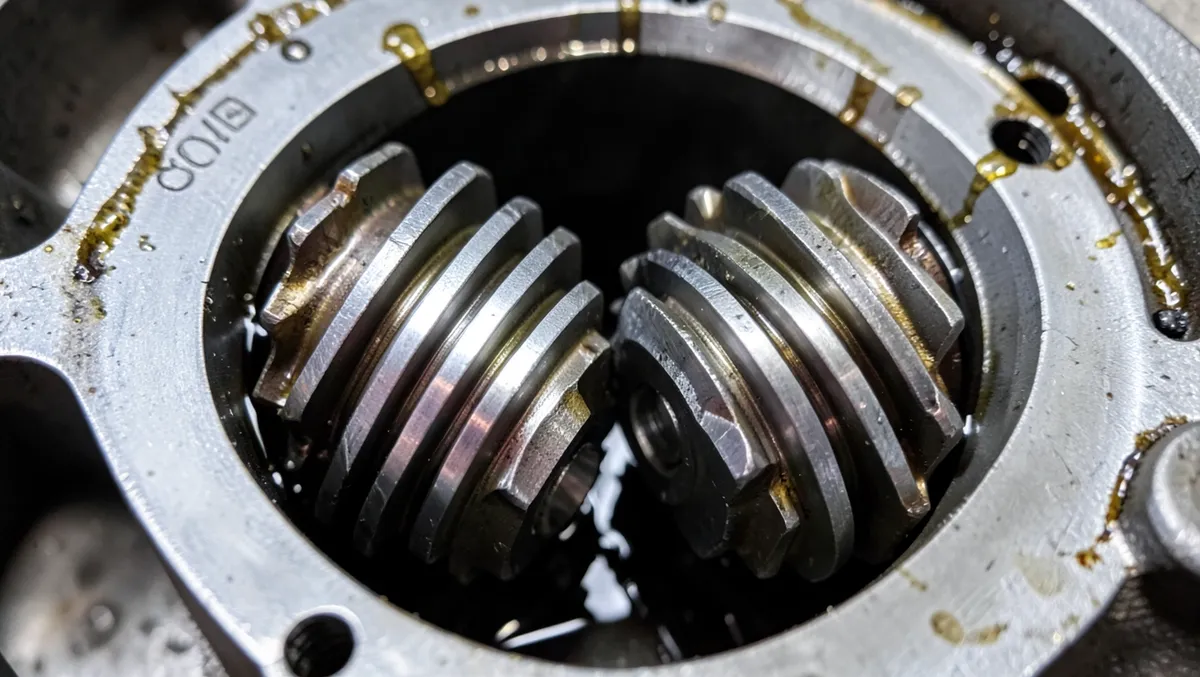
Helical gears cut their teeth at an angle, so each tooth engages gradually rather than all at once. That gradual engagement makes them quieter and lets them carry more load smoothly, which is why most of the forward gears in both manual and automatic transmissions are helical. The tradeoff is that the angled teeth create a small amount of sideways (axial) thrust, so helical gearsets need thrust bearings to keep everything located correctly on the shaft.
Planetary Gears
Automatic transmissions rely on a different arrangement entirely: a planetary gearset, made up of a central sun gear, several planet gears that orbit it, and an outer ring gear that surrounds them all. By holding one of those three members stationary (using a clutch pack or a band) while the other two are free to turn, the transmission can produce several different gear ratios from one compact set of gears, without a driver ever touching a clutch pedal.
How a Manual Transmission Uses Gears
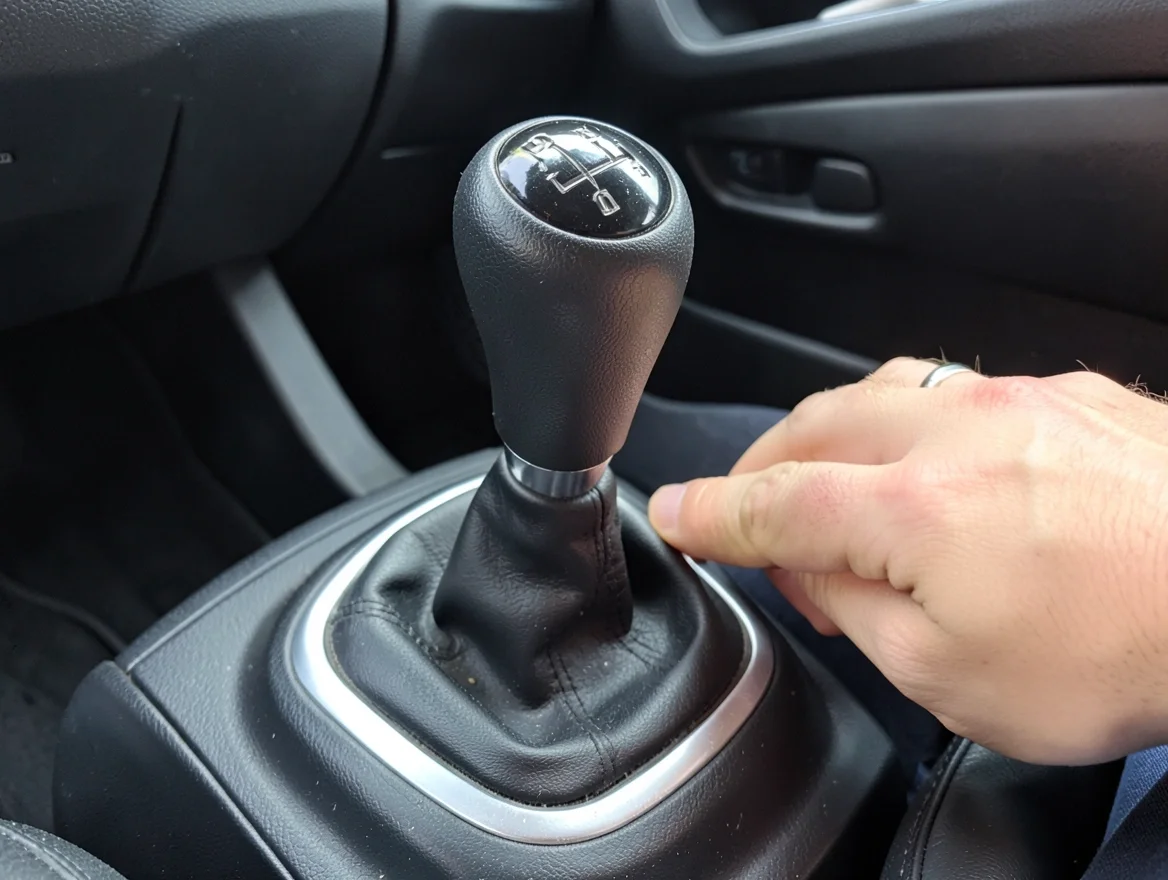
In a manual transmission, the driver decides which gear ratio is engaged. Pressing the clutch pedal separates the engine from the transmission input shaft for a moment, which is what lets the gear stick move between ratios without grinding. Inside the gearbox, moving the stick slides a collar that locks a specific gear to the output shaft.
Before that collar locks in, a synchromesh ring does the real work: it’s a small friction cone that speeds up or slows down the gear you’re shifting into so it matches the speed of the output shaft. Without synchromesh, the two gears would be spinning at mismatched speeds and would grind instead of engaging cleanly, which is exactly what happens on a worn or damaged synchro. Releasing the clutch reconnects the engine to that newly-selected gear, and power flows through it to the wheels.
How an Automatic Transmission Chooses Gears
An automatic transmission does the same job with no clutch pedal at all. In place of a clutch, it uses a torque converter — a fluid coupling that lets the engine keep idling while the car sits still in gear, and that actually multiplies torque briefly when accelerating from a stop.
Behind the torque converter sits the planetary gearset described above. A transmission control unit constantly reads engine load, throttle position, and vehicle speed, then tells a valve body which internal clutch packs and bands to apply so the planetary gears deliver the ratio the computer wants. That is the entire reason an automatic transmission can shift gears without the driver’s input: the computer is choosing which member of the planetary gearset to lock, dozens of times per drive.
Continuously variable transmissions (CVTs) and dual-clutch gearboxes are two newer alternatives that change how that gear selection happens mechanically. If you’re trying to decide which transmission type is the right fit for your own driving, our guide to what gears in a car actually do breaks down manual, automatic, CVT, and dual-clutch systems side by side.
What Each Gear Position Actually Does
On a manual shifter, the gear positions are laid out in an H-pattern, typically 1 and 2 on the left leg, 3 and 4 in the middle, 5 (and 6, if the car has it) on the right, with reverse tucked in its own slot, often requiring you to push down or pull up a collar first. On an automatic, the same idea is compressed into the PRNDL selector: Park, Reverse, Neutral, Drive, and sometimes Low or a manual-shift gate.
There’s no single mph number that applies to every car’s gears, because gear ratios and final drive ratios differ by make, model, and engine. As a rough guide, first gear covers pulling away from a stop, second and third handle city-speed acceleration, and the top one or two gears are built for steady highway cruising rather than acceleration. In a truck or towing vehicle, a low or “high” gear range (sometimes labeled separately from the normal gears) exists specifically to keep the engine turning fast enough to make torque when hauling a heavy load or descending a steep grade, at the cost of a much lower top speed in that range.
Common Signs Your Car’s Gears Are Wearing Out
Gears and the parts that engage them do wear out, and the symptoms are usually easy to notice before a transmission fails outright.
Gear Slippage
Slippage feels like the engine revving up without a matching increase in road speed, as if the gear briefly lost its grip. Worn synchronizer rings, worn clutch plates, or low/degraded transmission fluid are the usual causes. Because it can leave you without power exactly when you need it (merging, passing, climbing), it’s worth having checked promptly rather than waiting.
Grinding or Whining Noises
A grinding noise on a manual shift almost always points to a worn synchro or a clutch that isn’t fully disengaging. A whine that changes pitch with road speed on an automatic can mean low fluid, a failing pump, or worn bearings inside the gearset. Both are worth diagnosing early: clutch and transmission repairs get considerably more expensive the longer worn parts are left to grind against each other.
Frequently Asked Questions
What Does the Gear 1, 2, 3, 4, 5 Mean?
Each number is a different gear ratio between the engine and the wheels. Gear 1 has the lowest ratio for maximum torque at low speed, used for starting and climbing. Each higher number reduces that ratio step by step, trading torque for speed, so 5th gear delivers the least torque multiplication but lets the engine run at its most relaxed, efficient RPM at highway speed.
What Does 1st, 2nd, and 3rd Gear Do?
First gear provides the most torque multiplication, for pulling away from a stop or climbing a steep grade. Second gear reduces that multiplication to build speed once the car is already moving, commonly used in stop-and-go city driving. Third gear reduces it further still, bridging the gap between city speeds and highway cruising.
Is Gear 1 High or Low?
Gear 1 is a low gear. “Low” gears have a higher numerical gear ratio and deliver more torque at lower road speed, which is exactly what’s needed to get a stationary car moving or to climb a steep hill without stalling.
What Is a High Gear in a Car?
A high gear is one with a low numerical gear ratio, close to or even below 1:1. It multiplies torque the least but allows the highest road speed for a given engine RPM, which is why the top gear in most cars (5th, 6th, or an automatic’s overdrive) is reserved for steady highway cruising rather than acceleration.
What Gear Should I Use for What Speed?
There’s no universal speed-to-gear chart, since gear ratios differ between vehicles, but the pattern is consistent: use the lowest gear only to get moving, shift up through the middle gears as you accelerate through city and suburban speeds, and settle into the highest gear once you’re holding a steady highway speed. In an automatic, the transmission handles this shifting for you based on throttle position and road speed.
Are There Really Physical Gears in a Car?
Yes, in a manual, automatic, or dual-clutch transmission, there are real metal gears meshing together inside the gearbox. The one exception is a continuously variable transmission (CVT), which uses a belt or chain running between two variable-diameter pulleys instead of a fixed set of gears, allowing it to change its ratio smoothly rather than in discrete steps.
Conclusion
Gears work in a car by changing the ratio between engine speed and wheel speed, letting a small engine climb hills in a low gear and then cruise efficiently in a high one without ever leaving its ideal RPM range. Whether that ratio change happens through a driver-operated clutch and synchromesh, or a computer-controlled planetary gearset and torque converter, the underlying physics is the same speed-for-torque tradeoff. Paying attention to slipping, grinding, or whining is the simplest way to catch a wearing gearset before it turns into a full transmission repair.
Products related to this article
Sponsored / affiliate links. As an Amazon Associate I earn from qualifying purchases. I may earn additional commission from eligible campaigns.