How to Buy Cars at Auction Without License: Insider Secrets Revealed
You can buy at auction without a dealer license through public auctions, some lender or government sales, or by using a licensed broker; dealer-only auctions usually bar direct bidding. Miss the rules and you can lose your deposit, forfeit the car, or end up with title problems that block registration. This guide breaks down each legal path, the paperwork you need, how to fund the purchase, and where the title risk sits.
Can you buy cars at auction without a license?
Yes, sometimes. A dealer license blocks direct access to dealer-only lanes, but it does not block every auction format. Public auto auctions, some government sales, and certain online platforms may accept unlicensed buyers if you register, meet payment rules, and satisfy proof-of-funds checks.
What changes by state is the access gate, not the payment method. Some auctions let you bid in person after prequalification, while others require a deposit, a bidder badge, or a credit card hold before you can even enter the lane.
What a dealer license actually blocks
A dealer license mainly blocks direct bidding at dealer-only auctions and access to wholesale lanes reserved for licensed businesses. It also blocks some private-lane online bidding accounts that require a dealer credential at signup. That restriction matters because many off-lease, fleet, and trade-in vehicles move through those lanes.
What non-licensed buyers may still do legally
Unlicensed buyers may still bid at public auctions, buy through a licensed broker, use a proxy bidder where the auction allows it, or purchase a car after the auction if the seller releases unsold inventory to retail buyers. Those options are legal only when the auction terms and state rules permit them.
When state rules change the answer
State laws can vary on auction payment requirements and on who may register to bid. One state may require proof of identity and a bidder deposit; another may require a license-equivalent registration step. Read the auction’s own terms and the state DMV rules before you rely on any lane access.
Public auction access vs dealer-only lanes
Public auto auctions are open to non-dealers more often than dealer-only auctions, but they still set registration, payment, and title rules. Dealer-only auctions usually limit attendance and bidding to licensed dealers, dealer employees, or approved business agents. Do not assume every auto auction is public.
Public auto auction rules and buyer registration
Public auctions often require you to register before bidding, show government ID, and agree to payment deadlines. Some auctions ask for proof of funds or a prequalification step before they release a bidder number. Others require a deposit, often about 10%, before you can bid.
Live sales happen in the lane, while online sales may ask for account approval first. In both formats, bidders may need to prequalify before they are allowed to bid, and the auction can block your account if your deposit or documentation is incomplete.
Dealer-only auction restrictions and eligibility
Dealer-only auctions usually restrict attendance, bidding, or both. Some let non-dealers attend as guests, but only licensed dealers or approved business buyers can place bids. Even when a public observer can enter, that does not create a right to buy.
Live bidding vs online bidding
Live bidding moves fast and often requires immediate lane decisions. Online bidding can give you a few more minutes to review photos and condition reports, but the payment clock is still short. Some online sales still require a deposit, a card hold, or bidder approval before the auction opens.
Four legal ways to bid without a dealer license
There are four common legal paths for a non-licensed buyer: public auction direct bid, dealer-broker purchase, proxy bidder, and private seller after-auction holdback. The right path depends on how fast you can fund the purchase, how much title risk you can accept, and whether you need someone else to bid for you.
Public auction direct bid
This is the simplest route when the auction accepts the public. You register, prequalify if required, place your bids, and settle according to the auction’s payment window. It works best when you can provide proof of funds and pay with a cashier’s check or another accepted method.
Dealer-broker purchase
A licensed dealer or auction broker can bid on your behalf at a dealer-only auction or a closed lane. You pay the broker’s fee, plus the auction’s buyer premium and any admin charge. This path adds access, but it also adds another layer of paperwork and trust.
Proxy bidder
A proxy bidder places bids for you under an arrangement the auction allows. The proxy may be a broker, a dealer, or another approved bidder. This can work when you cannot attend, but you still need funds ready and clear instructions on your maximum bid and payment timing.
Private seller after-auction holdback
Sometimes an auction vehicle that does not sell, or an inventory unit released after the sale, becomes available through a private sale process. That route can avoid the live bidding rush, but it may still carry auction-style paperwork, limited inspection, and a compressed closing window.
Auction car decision matrix
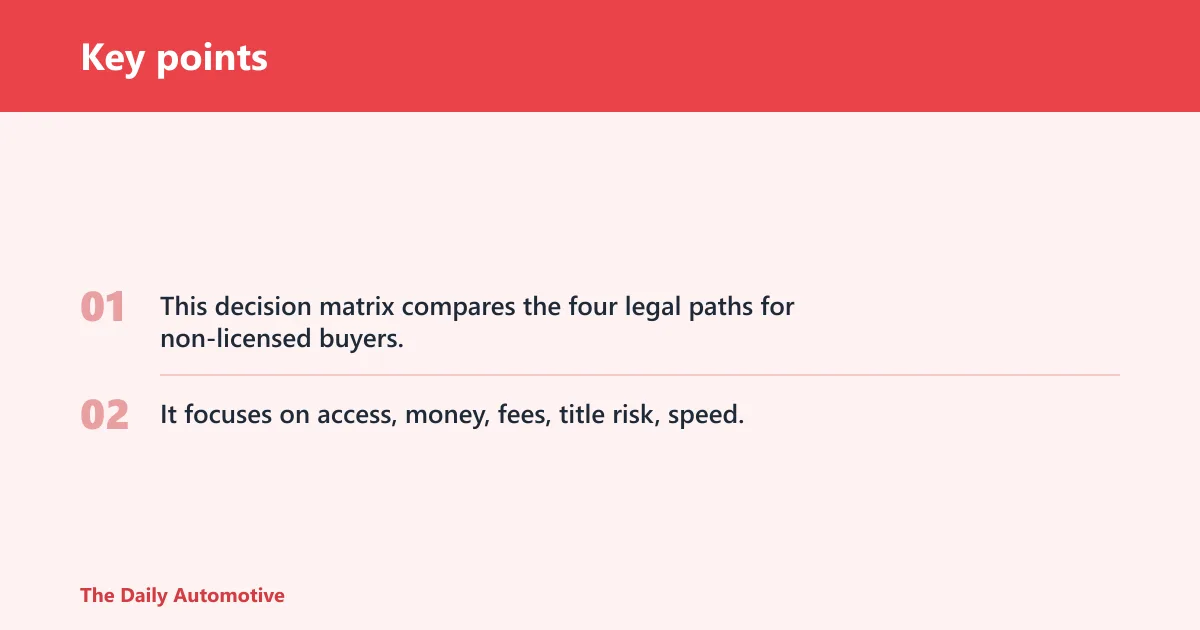
This decision matrix compares the four legal paths for non-licensed buyers. It focuses on access, money, fees, title risk, speed, and common failure points so you can match the route to your budget and timeline.
| Path | Access requirements | Upfront funds needed | Typical fees | Title risk | Speed to close | When this path fails |
|---|---|---|---|---|---|---|
| Public auction direct bid | Public registration, ID, bidder approval, sometimes proof of funds | Deposit plus balance; many auctions ask for about 10% up front | Buyer premium, registration fee, admin fee, possible late fee | Medium; missing title or salvage branding can delay registration | Fast if payment clears within the auction window | Fails if the auction is dealer-only, if the bidder misses payment, or if title documents are incomplete |
| Dealer-broker purchase | Broker agreement, identity check, funds proof, dealer-authorized bidding | Broker deposit or full funding before bid | Broker fee, buyer premium, auction fees, transport | Medium to high; broker can still buy a problematic title unit | Fast if the broker already has lane access and approval | Fails if the broker cannot access the lane, the seller rejects the bid, or funds do not clear on time |
| Proxy bidder | Proxy authorization, bidder approval, clear max bid, funds ready | Usually a deposit or committed balance before bidding | Proxy fee, buyer premium, admin fee, card hold risk | Medium; same title issues as the underlying auction sale | Fast to bid, but not always fast to title | Fails if the proxy is not approved, if the auction disallows third-party bidding, or if payment deadlines are missed |
| Private seller after-auction holdback | Seller approval after the sale, retail paperwork acceptance | Full purchase funds or financing approval | Possible admin fee, title fee, taxes, transport, inspection | Varies; can still involve missing title or branding issues | Moderate; depends on seller release timing | Fails if the vehicle is not released, title work is incomplete, or the seller refuses post-sale terms |
What documents and funds you need
Most auctions care about two things: who you are and whether you can pay. Expect to show government ID, proof of funds, and sometimes a bank letter, statement, or credit card hold. The exact package depends on the auction and the state.
Proof of funds and prequalification
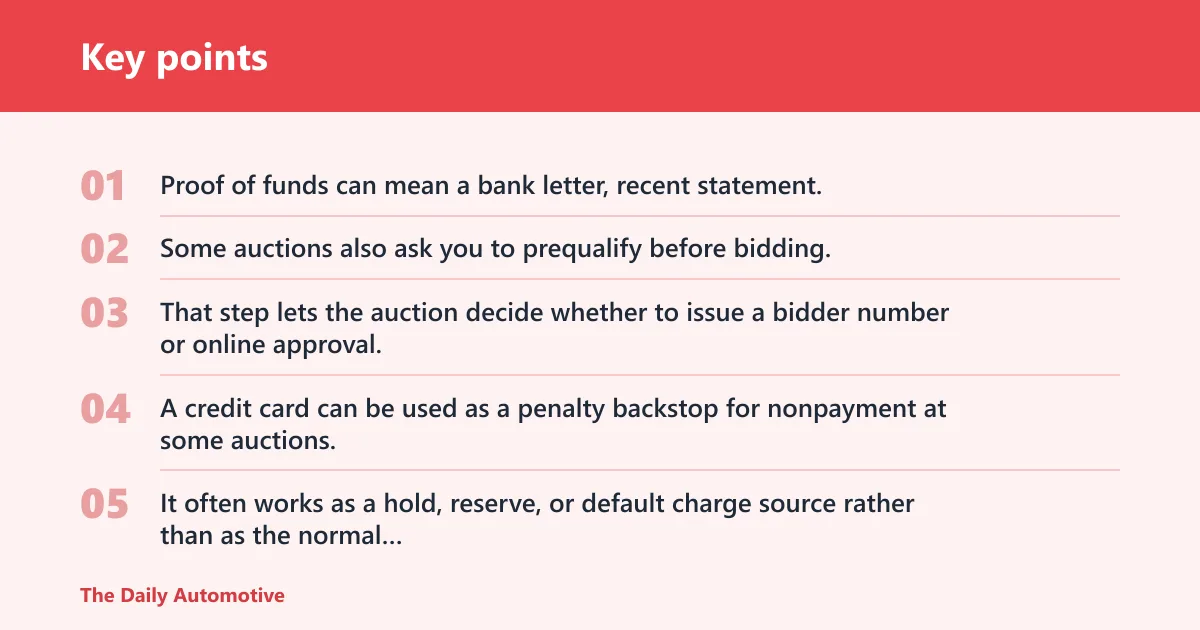
Proof of funds can mean a bank letter, recent statement, or a lender preapproval letter that shows the money is available. Some auctions also ask you to prequalify before bidding. That step lets the auction decide whether to issue a bidder number or online approval.
A credit card can be used as a penalty backstop for nonpayment at some auctions, but that does not mean the card is your main settlement method. It often works as a hold, reserve, or default charge source rather than as the normal way to pay for the vehicle.
Auction deposit rules
Buyers may only need to put down about 10% at the auction, but the deposit can be higher or lower depending on the sale. Some deposits are refundable if you do not win; others become part of the purchase price only if you close. Miss the deadline and the auction can charge you.
Cashier’s check timing and balance payment
A cashier’s check is a common settlement method, especially at public sales that want cash-equivalent payment. Many auctions accept it for the balance after the sale, not for a live bid. Some auctions allow a few days or weeks to pay the balance; others want same-day payment.
Do not assume every auction accepts personal checks or card payments for the full amount. Auction sales are often cash-only, unlike conventional purchases, and the settlement window may be short enough that your bank transfer cannot clear in time.
Bidder fee and buyer premium math
The sticker on the car is not the total price. Add the buyer premium, bidder fee, registration fee, admin fee, taxes, transport, inspection, and title work. A car that looks affordable at the block can become much more expensive after those line items stack together.
Say your winning bid is about $12,000 and the buyer premium is 10%. That adds $1,200 before tax, transport, and title work. If the auction also charges an admin fee and a registration fee, your cash need rises before you move the car.
Can you finance an auction car fast enough?
Sometimes, but speed is the problem. Hard money lenders can move quickly for auction-style purchases, yet they usually base approval on collateral, equity, and short terms. Standard auto loans often fail here because the lender wants more time for underwriting than the auction will give.
Hard money loan basics
A hard money loan can close fast enough for some auction deals because the lender focuses on the asset and the exit plan. That speed comes with higher interest and shorter repayment terms. It is a tool for timing, not a cheap substitute for normal financing.
Why standard auto loans often fail here
Most conventional lenders want a clear VIN, a clean title path, and enough time to finish underwriting. Auction purchases may involve a short deadline, a salvage-branded title, or a missing title. Those facts can stop approval even when the car itself is worth the money.
When cash-equivalent funding is still required
Even if a lender will fund the deal, the auction may still demand a deposit or certified payment instrument right away. That means you may need cash-equivalent funds before the lender sends the final wire. In practice, financing often has to sit beside ready cash, not replace it.
What happens after you win the bid?
Winning the bid does not end the process. You still need to pay on time, complete title paperwork, and satisfy the auction’s release rules. If you miss the payment deadline, the auction can charge you and keep the car from leaving the lot.
Balance payment deadlines
Some auctions let you pay the balance in a few days or weeks; others require same-day payment. The clock starts when the hammer falls, not when you feel ready. Always confirm when the balance is due and what payment forms the auction will accept.
Default penalties if you cannot pay
If you win and do not close, the auction can charge you. You may lose your deposit, face a card charge, or be barred from future bidding. The car may return to sale, and the auction may apply default fees under its terms.
A common first-timer mistake is winning a $9,500 sedan, then discovering the title is not ready and the balance is due before the bank loan clears. The auction does not usually wait for the buyer’s preferred timeline. That is how a deal turns into a penalty notice.
Title transfer, VIN checks, and DMV registration
Title transfer timing depends on the auction, the seller, and the state DMV. Some states require VIN verification before registration, especially when the title is missing, branded, or from out of state. Build in time for DMV review, because a delayed title can delay legal driving.
How to reduce title and condition risk
Title risk and condition risk are separate problems. A car can run well and still be hard to register. It can also have a clean-looking title packet and still need major repair work. Treat both as part of the purchase.
Missing title and salvage branding
Missing title inventory is a major failure point. So is salvage branding that affects insurance, resale, and registration in some states. Check whether the title is present, whether the VIN matches every document, and whether the state will accept the brand for registration.
Inspection limits and arbitration rules
Auction inspections are often limited and fast. Some sales offer lane previews, brief start-up checks, or condition reports, but those are not a warranty. Arbitration rules may help with major misrepresentation, but they rarely cover every mechanical issue you find later.
Suppose a compact SUV looks clean in the photos but has a missing key and a warning light on the dash. If the auction allows only a short preview, that problem can turn into a towing bill and a repair bill after you already paid the premium. The auction terms decide how much relief you get, if any.
Transport, taxes, and total cost checks
Add transport if the car is not drivable. Add taxes and registration fees before you bid, not after. If you are crossing state lines, check whether your home state needs extra paperwork for VIN verification or title transfer. That paperwork can cost more time than the bid itself.
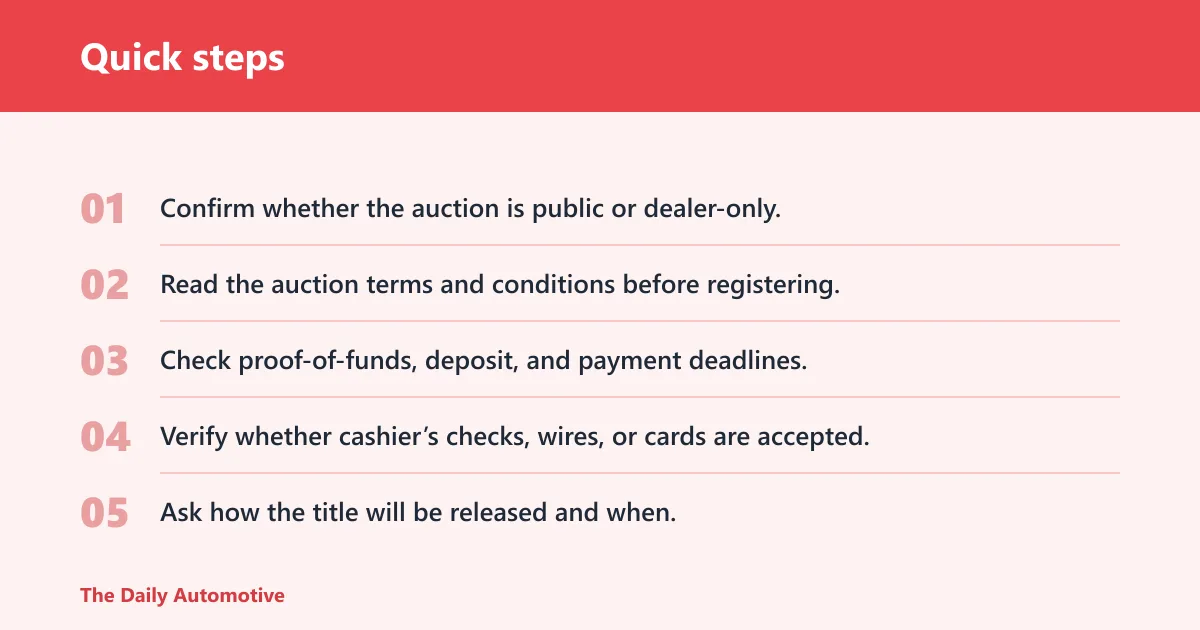
- Confirm whether the auction is public or dealer-only.
- Read the auction terms and conditions before registering.
- Check proof-of-funds, deposit, and payment deadlines.
- Verify whether cashier’s checks, wires, or cards are accepted.
- Ask how the title will be released and when.
- Estimate buyer premium, admin fees, taxes, transport, and DMV costs.
- Know the default penalty if you cannot close.
Frequently asked questions
How do I bid at a car auction without a dealer license?
Start by confirming that the sale is open to the public. Then register, submit any proof-of-funds documents, and secure your deposit or bidder approval. If the auction is dealer-only, you need a broker or proxy arrangement that the auction itself accepts.
What documents do I need to buy a car at auction?
Most auctions ask for government ID, bidder registration, and proof of funds. Some also want a bank letter, statement, prequalification notice, or credit card hold. If you win, expect title and payment paperwork that may need a signature before the vehicle is released.
Do you need cash to buy a car at auction?
Often, yes in cash-equivalent form. Auctions commonly accept cashier’s checks, wires, or certified funds rather than personal checks. Some require a deposit first and the balance later. The exact payment method depends on the auction terms and the state’s rules.
Can I finance a car bought at auction?
Sometimes, but fast funding is the challenge. Hard money loans can move quickly for auction-style purchases, while standard auto loans often move too slowly or reject title-risk vehicles. Even with financing, the auction may still want a deposit or immediate settlement method.
What happens if I win an auction but can’t pay?
The auction can charge you, keep your deposit, and block you from future bidding. The car may be re-listed, and additional fees can apply. If a card was used as a backstop, the auction may charge it under the sale terms.
Products related to this article
Sponsored / affiliate links. As an Amazon Associate I earn from qualifying purchases. I may earn additional commission from eligible campaigns.
 EaseRide License Plate Cover, 2 Pack Clear License Plate Protector, Unbreakable Plastic Protective Shield with Screws Caps for Front Rear Car Tags, Fits Standard US Plate
 Scosche Bluetooth FM Transmitter for Car Radio, Bluetooth Car Adapter with 20W USB-C Fast Car Charger and Aux Port for Wireless Music Streaming, Hands-Free Calls, Siri and Google Assistant