Car Engine Rebuild Cost: What It Really Costs
A remanufactured replacement often runs roughly $4,000 to $9,000. Skip that math and you can sink thousands into an engine that still leaves weak resale value. This guide breaks down rebuild scope, hidden charges, and value thresholds so you can compare rebuild, remanufactured, and new-engine options.
Typical cost range
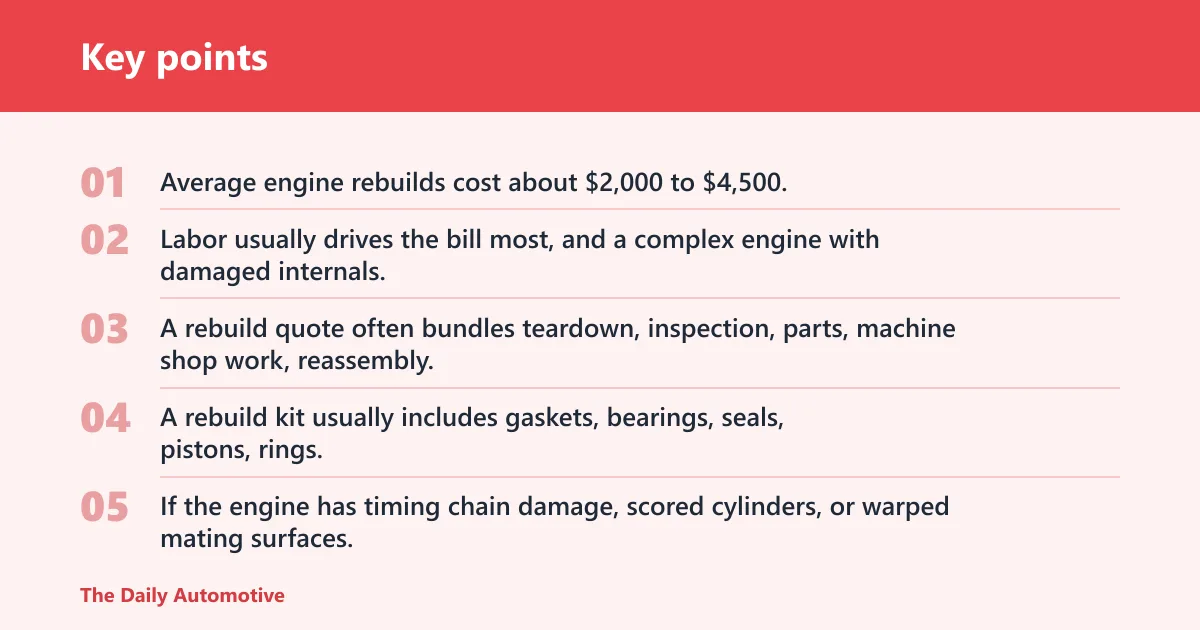


Average engine rebuilds cost about $2,000 to $4,500, and standard passenger car rebuilds commonly land at $2,500 to $4,500. The range hides a lot. Labor usually drives the bill most, and a complex engine with damaged internals, extra machine work, or a high shop rate moves fast toward the upper end.
What the bill usually includes
A rebuild quote often bundles teardown, inspection, parts, machine shop work, reassembly, and fluids. A rebuild kit usually includes gaskets, bearings, seals, pistons, rings, and timing components. If the engine has timing chain damage, scored cylinders, or warped mating surfaces, the quote rises because the parts list gets longer and the machine work gets heavier.
Most engine rebuilds require 20 to 40 labor hours, and one guide puts a rebuild at 15 to 25 labor hours. Labor can account for 50 to 70 percent of total rebuild cost. That is why two shops can quote very different numbers for the same engine.
Why quotes differ so much
Shop type matters. Independent shops often price lower than dealerships because their labor rate is usually lower, though the bill still depends on engine layout and the time needed to remove and reinstall the engine. A transverse V6 in a tight engine bay takes longer than a simple inline-four with easy access.
Vehicle age and mileage matter too. High-mileage engines often reveal extra wear after teardown, which turns a planned rebuild into a longer list of parts and labor. Turbocharged, diesel, rotary, and luxury engines usually sit above the basic passenger-car range because they need more specialized work, pricier parts, or both.
What changes the price?
Engine size, design, and damage level drive the bill more than any single headline average. A 4-cylinder gasoline rebuild is listed at $2,500 to $4,500, a V8 engine rebuild at $4,500 to $8,500, and a diesel engine rebuild at $6,000 to $12,000. Bigger, tighter, and more complex engines cost more to remove, machine, and reassemble.
Engine size and layout
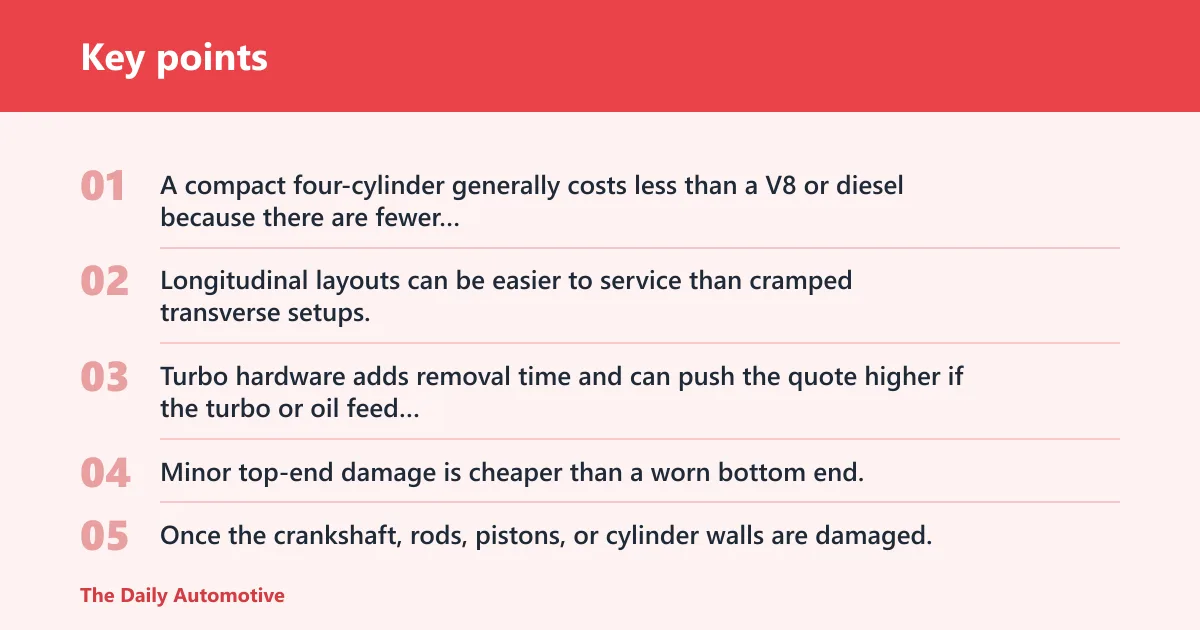
A compact four-cylinder generally costs less than a V8 or diesel because there are fewer parts and less labor time. Longitudinal layouts can be easier to service than cramped transverse setups, but access varies by vehicle. Turbo hardware adds removal time and can push the quote higher if the turbo or oil feed parts need replacement.
Damage inside the engine
Minor top-end damage is cheaper than a worn bottom end. Once the crankshaft, rods, pistons, or cylinder walls are damaged, the price rises quickly because machining and more parts are needed. A rebuild may also need fresh timing parts, water pump service, and replacement fasteners if the old hardware cannot be reused safely.
Suppose a 2.4-liter sedan shows coolant in the oil and low compression on two cylinders. If the damage is limited to the heads and gasket surface, a top-end repair may be enough. If the cylinders are scored and the bearings are wiped, the job moves into short-block or full rebuild territory, which changes the economics fast.
Shop rate and region
Hourly labor rate can swing the final total by a large margin. A shop that charges more per hour can still be the better value if it diagnoses accurately and avoids repeat teardown. A lower rate does not help if the engine needs extra disassembly because the first inspection missed hidden damage.
Make, model, and mileage
Make and model affect parts pricing, access, and labor time. A common sedan engine usually costs less to rebuild than a rare performance engine or a luxury model with expensive sensors and packaging constraints. Mileage matters because worn bearings, timing components, and seals often justify broader work once the engine is already apart.
Top-end rebuild cost
A top-end rebuild is estimated at $1,000 to $2,500. It focuses on the upper part of the engine: valve work, head gasket replacement, seal work, and related labor. This is the right scope when the lower end still has acceptable compression and oil pressure, but the heads or sealing surfaces have failed.
Valves, head gasket, and seals
Top-end work may include valve inspection, valve seals, valve job work, resurfacing the head, and replacement of the head gasket and related seals. If the engine overheated, warped heads or damaged gaskets are common reasons to stop at this level. If the block and rotating assembly are healthy, this can be a sensible repair.
When a top-end fix is enough
This scope makes sense when the engine runs, but one or more cylinders have lost compression because of head damage, a blown gasket, or valve wear. It is not the right answer if the engine knocks, has metal in the oil, or shows severe bottom-end wear. Those signs point beyond the top end.
Short-block rebuild cost
A partial short-block rebuild is estimated at $2,000 to $4,000. This scope covers the lower engine block, pistons, rings, bearings, and associated machine work when needed. It applies when the top end may also need attention, but the main problem is in the block, rotating assembly, or cylinder walls.
Block, pistons, rings, and bearings
A short-block rebuild usually means the engine is partially stripped so the block can be cleaned, measured, and rebuilt with fresh pistons, rings, and bearings. Crankshaft condition matters here. If the crank is worn or scored, crank grinding may be required before assembly.
Machine work often required
Machine shop services commonly include boring, honing, resurfacing, crank grinding, and balancing. These services matter because worn cylinders or out-of-spec rotating parts cannot be reused as-is. Every extra machining step adds cost, but skipping one can shorten engine life and lead to a repeat failure.
Full engine rebuild cost
A full rebuild can cost $2,500 to $8,000+. This is the most complete rebuild scope. It includes complete disassembly, inspection, all major internals, and the machine work needed to bring the engine back within spec. It is the costliest rebuild path because it addresses nearly every wear point at once.
Complete teardown and inspection
Full rebuilds go beyond heads or the block alone. The engine is fully stripped, measured, cleaned, and checked for wear, cracks, warpage, and out-of-spec parts. If the teardown reveals cracked pistons, damaged rods, worn cam surfaces, or bad journals, the quote rises because the rebuild kit is no longer enough on its own.
Picture a V8 pickup with oil pressure loss, bearing noise, and heavy blow-by. A partial repair will not solve the root problem if the crank and bearings are damaged. A full rebuild may restore the engine, but the total often climbs into the same band as a quality replacement engine plus installation.
Why full rebuilds cost more
Full rebuilds need more labor, more measured parts, and more machine time. They also create more opportunity for surprise damage during teardown. That is why a low opening estimate can grow after the shop finds worn cylinders, cracked heads, or a crankshaft that needs machining or replacement.
Engine replacement cost
How much to replace car engine depends on whether you choose a remanufactured unit or a new one. A remanufactured engine is listed at $5,000 to $9,000, which often puts it in the same neighborhood as a major rebuild. New engines usually cost more than remanufactured ones, especially for newer vehicles and performance applications.
Remanufactured versus new engines
Remanufactured engines are rebuilt to factory standards by a separate supplier, which helps control labor risk for the installer. New engines are the most expensive option and are usually chosen when a model is new enough that supply is available and the owner wants the longest possible service horizon. Core charges can apply in both cases.
When replacement beats rebuilding
Replacement makes more sense when the engine needs extensive internal work, the car already needs other expensive repairs, or the vehicle value is too low to justify a large rebuild. If the body, transmission, or electronics also need money soon, the smarter move is often to stop adding major mechanical risk to an aging car.
Install, core charges, and warranty
The installed price can climb because of removal, installation, fluids, programming, and the core charge on the old engine. A replacement engine may save time compared with a full rebuild, but the total still depends on labor rate and vehicle layout. Warranty terms also matter because a longer warranty can justify a higher quote.
Rebuild kit and machine work costs
Parts alone do not explain the bill. A rebuild kit usually includes gaskets, bearings, seals, pistons, rings, and timing components, and those parts must match the engine code and wear condition. If the machine shop finds out-of-spec surfaces, the quote rises because fresh parts are not enough without machining.
Machine shop services
Boring corrects worn cylinders. Honing sets the final surface finish. Resurfacing restores flat mating surfaces. Crank grinding fixes journal wear. Balancing helps the rotating assembly run smoothly. Those services are common in rebuild work, and each one adds time and cost to the estimate.
Hidden costs that surprise owners
Hidden items often include diagnostics, teardown labor, fluids, timing parts, core charges, and any broken fasteners or sensors discovered after disassembly. A shop may quote a broad starting range, then revise the total after inspection shows deeper damage. That is normal on older engines, but the estimate should spell out what is excluded.
- Confirm the symptom with a compression test, leak-down test, and oil inspection if the shop recommends it.
- Ask which repair scope applies: top-end, short-block, or full rebuild.
- Request the parts list, machine work list, and labor hours separately.
- Check whether the quote includes fluids, timing components, core charges, and diagnostics.
- Get quotes from multiple shops, then compare the total to the car’s value and any near-term repair needs.
Engine cost decision table
Use this table to sort the quote by repair scope, not by a single average. The break-even rule is simple: if the repair total is near half the car’s value, or the car needs several other major repairs soon, replacement or selling the vehicle often makes more sense than a deep rebuild.
| Engine condition | Likely repair scope | Expected cost band | Warning signs | Smarter move |
|---|---|---|---|---|
| Top-end damage only | Heads, valves, gasket, seals | $1,000 to $2,500 | Overheating, coolant loss, low compression in one or two cylinders | Rebuild if the block and bottom end test healthy |
| Short-block wear | Block, pistons, rings, bearings, machine work | $2,000 to $4,000 | Knocking, low oil pressure, blow-by, metal in oil | Rebuild if the vehicle is worth well above the repair total |
| Full internal wear | Complete teardown, major internals, machine work | $2,500 to $8,000+ | Knock plus smoke, poor compression, multiple damaged parts | Compare rebuild to remanufactured replacement before approving work |
| Severe engine failure | Remanufactured replacement engine | $5,000 to $9,000 | Seized engine, cracked block, widespread internal damage | Replacement often beats a full rebuild |
| Latest or specialty engine | New replacement engine | Usually above remanufactured pricing | Low supply, warranty preference, complex electronics | Choose new only if the car value and ownership horizon justify it |
Frequently asked questions
How much to get engine rebuilt
A typical engine rebuild runs about $2,500 to $4,500 for many passenger cars, with broader averages from $2,000 to $4,500. The final bill depends on labor time, machine work, and how much internal damage the shop finds after teardown. Larger or more complex engines cost more.
How much for rebuilt engine
A rebuilt engine often falls in the same price band as a rebuild job, but the total changes with scope. A remanufactured replacement is listed at $5,000 to $9,000, which can be more predictable than rebuilding a damaged engine in place. Installation and core charges can add more.
How much does a rebuilt engine cost?
How much a rebuilt engine costs depends on whether you mean the engine alone or installed in the car. If the engine is rare or diesel, expect more.
How much to replace car engine
Replacing a car engine commonly costs more than a basic rebuild and often lands near $5,000 to $9,000 for a remanufactured unit. New engines usually cost more. The installed price also depends on labor rate, core charge, electronics, and whether the replacement needs programming.
How much is a car engine replacement?
A car engine replacement is usually priced by engine type and source. A remanufactured replacement often runs $5,000 to $9,000, while a new engine can be higher. If the car has major mileage and other repairs coming soon, replacement may still be the better financial call.
How much for engine rebuild
How much for an engine rebuild depends on scope. Ask the shop to separate parts, machine work, labor, and hidden charges.
How much does an engine replacement cost?
An engine replacement cost varies from remanufactured to new, with remanufactured units commonly listed at $5,000 to $9,000. That total can move higher with labor, fluids, core charge, and vehicle-specific programming. For older cars, compare the quote to the car’s value before approving work.
How much does replacing an engine cost?
Replacing an engine can cost less than a full rebuild if the old engine has severe internal damage. It can also cost more if you choose a new engine or if installation is difficult. A good rule is to compare the total to half the vehicle’s value and future repair needs.
Products related to this article
Sponsored / affiliate links. As an Amazon Associate I earn from qualifying purchases. I may earn additional commission from eligible campaigns.