Are Car Auctions Good: Unveiling Hidden Deals & Risks
An auction usually makes sense only if the total landed cost, including buyer fees, transport, title work, and likely repairs, stays about 10% to 15% below the same car’s retail price. Skip that math and a “cheap” bid can become an overpriced, hard-to-return mistake. This guide shows how to set an all-in purchase ceiling and compare it with auction fees, transport, and repair risk before you bid.
Are car auctions good for regular buyers?


They can be, but only for regular buyers who can price risk before they bid. Auctions work best for buyers who want more selection, faster buying, and a clear bidding process, especially if they can inspect quickly and judge repair exposure from a condition report and vehicle history.
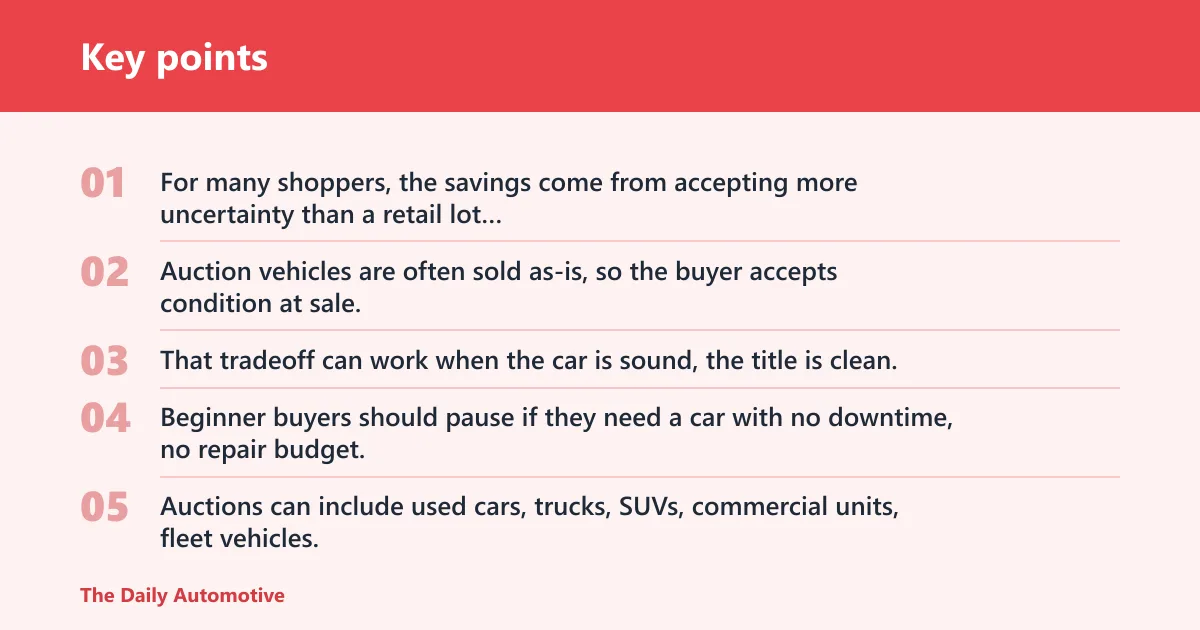
For many shoppers, the savings come from accepting more uncertainty than a retail lot usually allows. Auction vehicles are often sold as-is, so the buyer accepts condition at sale. That tradeoff can work when the car is sound, the title is clean, and the final cost still stays below retail after every fee is counted.
Who should think twice?
Beginner buyers should pause if they need a car with no downtime, no repair budget, or no room for paperwork delays. Auctions can include used cars, trucks, SUVs, commercial units, fleet vehicles, repossessions, and government surplus vehicles, but not every listing is ready to drive home.
A practical buy-or-walk rule is that if the hammer price plus fees, transport, taxes, title work, and likely repairs bring the total to within about 10% of retail, it is usually worth walking away. The lower number has to be meaningfully lower, because auction risk is already part of the price.
How auction prices work
The hammer price is only the winning bid. The final price usually includes a buyer’s premium, admin fees, taxes, title and registration work, transport, and whatever the car needs to become usable. That gap is why the cheapest bid is rarely the cheapest car.
Some auctions add buyer’s premium fees of 5% to over 20% on top of the sale price. A buyer’s premium of 10%+ can push up the final auction cost quickly, and it applies before the buyer pays for moving the car or repairing it.
| Bid | Buyer’s premium | Admin fee | Transport | Taxes | Title/registration | Inspection | Immediate repairs | Financing cost | All-in cost |
|---|---|---|---|---|---|---|---|---|---|
| $8,000 | $800 | $200 | $350 | $640 | $250 | $75 | $900 | $180 | $11,395 |
What risks can hide behind a low bid?
The biggest risks are not visible in the hammer price. As-is sale terms usually mean no warranty, the buyer assumes defects after the sale, and recourse is limited or unavailable once the auction closes. That is why a low bid can hide a costly problem.
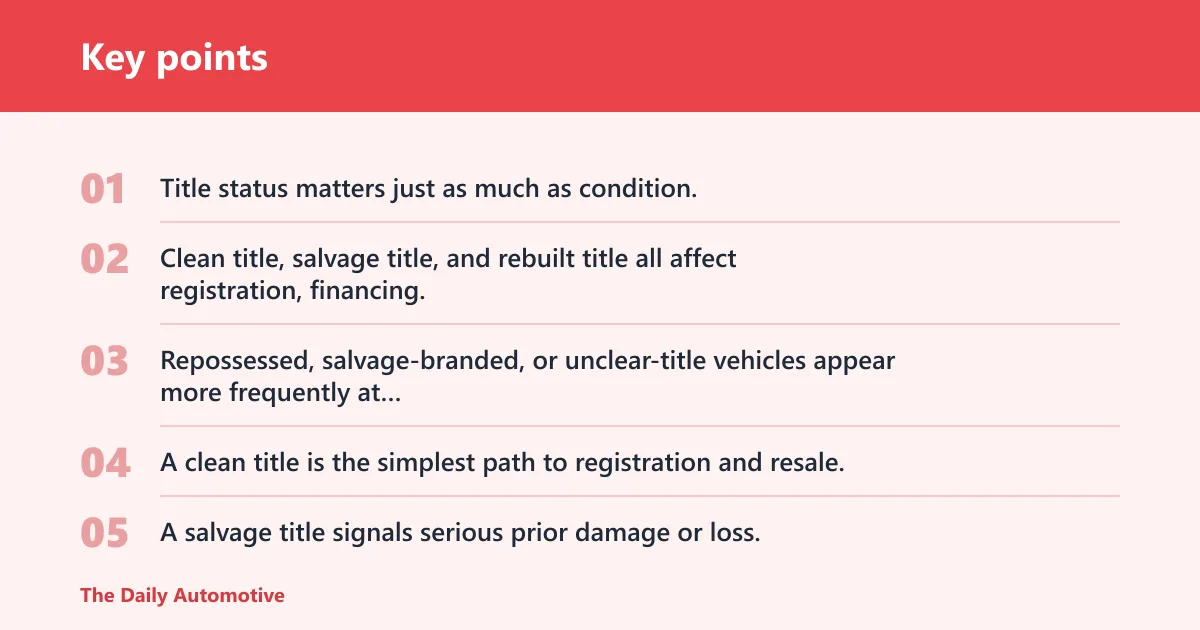
Title status matters just as much as condition. Clean title, salvage title, and rebuilt title all affect registration, financing, and resale. Repossessed, salvage-branded, or unclear-title vehicles appear more frequently at auction, so the paperwork deserves the same attention as the sheet metal.
Title status and resale impact
A clean title is the simplest path to registration and resale. A salvage title signals serious prior damage or loss, and many states restrict registration until repairs and inspections are complete. A rebuilt title means the car passed a process to return to the road, though resale value is commonly lower than that of a comparable clean-title car.
Even when a rebuilt vehicle is legal to register, lenders and buyers may treat it cautiously. That can shrink the pool of future buyers and make the exit price harder to predict.
Flood, frame, and odometer red flags
Condition reports can list body damage, electrical issues, warning lights, odometer readings, and fluid leaks, but they do not always catch everything. Flood clues, frame damage, warning lights, and odometer mismatches are among the most expensive problems to miss before bidding.
Suppose a compact SUV shows a clean-looking exterior, but the condition report notes electrical issues and a warning light. That single line can point to a deeper repair bill, especially if the car also has signs of water intrusion or an odometer reading that does not match its wear.
Auction deal worksheet
Use this worksheet before you bid. The point is not to guess the lowest price; it is to set the highest all-in number you can live with after fees, transport, taxes, title work, inspection, repairs, and financing are added.
| Line item | Amount | Notes |
|---|---|---|
| Hammer price | $ | Winning bid only |
| Buyer’s premium | $ | Often 5% to over 20% |
| Admin fee | $ | Listing or processing charge |
| Transport | $ | Tow or shipping |
| Taxes | $ | State and local requirements |
| Title/registration | $ | Paperwork and plate costs |
| Inspection cost | $ | Preview check or paid inspection |
| Immediate repairs | $ | Brakes, tires, fluids, battery, sensors |
| Financing cost | $ | Interest, lender fees, or cash advance costs |
| Walk-away maximum | $ | All-in ceiling before bidding |
Car auctions good checklist
- Title status is clean, salvage, rebuilt, or unclear.
- Flood clues are present or missing.
- Frame damage is listed or suspected.
- Warning lights are on.
- Odometer reading matches the car’s wear and records.
- Keys are included, including any spare or smart key.
Set your walk-away maximum
Your walk-away maximum is the most you can bid while still staying below your target all-in cost. If the budget only works when nothing goes wrong, the bid is too high. Auctions reward discipline more than optimism.
A common first-timer mistake is bidding to a number that ignores transport and immediate repairs. A $6,500 hammer price can become a $9,000 problem fast if the car needs a tow, a battery, and a set of tires before it can be registered.
What should you check before bidding?
Check quickly, because auctions can come with limited inspection time before bidding. Most auctions also limit or bar test drives, so you need to look for clues that point to expensive failure, not just cosmetic wear. The preview window is short, and you may need to make decisions fast.
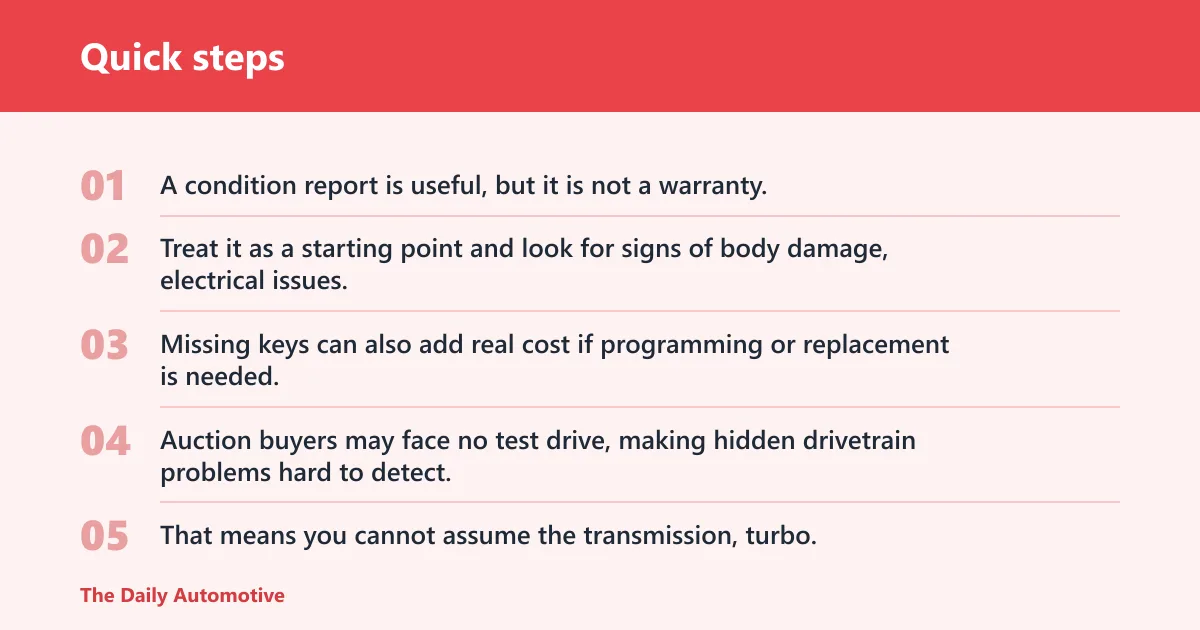
A condition report is useful, but it is not a warranty. Treat it as a starting point and look for signs of body damage, electrical issues, warning lights, odometer readings, and fluid leaks. Missing keys can also add real cost if programming or replacement is needed.
Inspection window and no test drive
Auction buyers may face no test drive, making hidden drivetrain problems hard to detect. That means you cannot assume the transmission, turbo, or cooling system is healthy just because the car starts and idles during preview.
Without a drive, look for startup noises, fluid under the car, mismatched panels, tire wear, broken glass, and dashboard warnings. If the auction allows only a short preview, use it on the items most likely to affect repair cost and resale.
Missing keys, warning lights, and leaks
Missing keys can mean more than inconvenience. Some modern vehicles need programming, and a lost smart key can add both delay and expense. Warning lights deserve equal attention, because a stored code or active light can signal engine, emissions, ABS, or airbag issues.
Fluid leaks are another clear stop sign. Oil, coolant, transmission fluid, and brake fluid each point to different risks, and an auction sale usually gives limited or no recourse after the purchase clears.
How do public, dealer-only, and online auctions differ?
Public auctions are open to anyone, while dealer-only auctions require a dealer’s license. Online auctions can widen access, but they also add shipping costs and can make condition judgment harder when the buyer cannot inspect in person. Risk changes as access and visibility change.
The auction type changes the buyer pool, the preview rules, and the chance of bidding pressure. Public auctions are easier to enter. Dealer-only auctions can offer more inventory, but the gatekeeping is strict. Online auctions add convenience, but shipping and photos can hide real-world problems.
Access rules and inspection limits
Public auctions are often the easiest for a regular buyer to enter, but that does not mean the easiest to buy safely. Dealer-only auctions usually demand professional credentials, and some online platforms require deposit rules, strict payment timing, or limited preview access.
Online auctions can create a false sense of distance from the risk. The car still arrives with its title status, repair needs, and transport bill. Online auctions can add shipping costs that materially raise the true purchase price.
Risk level by auction type
- Public auction: easiest access, but often the same as-is risk and short inspection window.
- Dealer-only auction: tighter access, broader inventory, and the same need for fast judgment.
- Online auction: convenient bidding, but shipping, photos, and timing can widen the gap between bid and reality.
Can you return a car bought at auction?
Usually no. Returns are rare because auction vehicles are often sold as-is, with no warranty and limited or no recourse after the sale. Once payment clears, the buyer typically owns the defects, paperwork burden, and transport issue together.
Returns are more likely to turn into a paperwork dispute than a simple buyer’s-remorse refund. If the title is wrong, the vehicle description is materially inaccurate, or the sale terms were violated, the buyer may have a claim. Those cases are narrower than many shoppers expect.
What to do before payment clears
Before paying, confirm title status, seller documents, pickup timing, and whether your lender will fund the purchase on the auction’s schedule. Not all lenders fund auction vehicles, and fast payment deadlines can make a good bid fail if financing is not pre-arranged.
Most auction purchases require fast payment, transport, taxes, and registration to be budgeted in advance. If any one of those pieces is missing, the deal can become expensive or impossible to complete.
Frequently asked questions
Are car auctions a good idea for regular buyers?
Yes, but only for regular buyers who can set an all-in ceiling and accept as-is risk. Auctions fit shoppers who want selection and speed, but they are better when you can judge repair exposure, handle fast payment, and still beat retail by a healthy margin.
What are the hidden risks of buying a car at auction?
The biggest hidden risks are title problems, flood damage, frame damage, warning lights, odometer issues, and repair costs that appear after the sale. Because recourse is limited, a low hammer price can hide a much higher total cost once transport and paperwork are added.
How much do auction buyer’s fees add to the price?
Some auctions add buyer’s premium fees of 5% to over 20% on top of the sale price. A buyer’s premium of 10%+ can materially change the final cost, especially once admin fees, taxes, transport, and title work are added to the winning bid.
Can you test drive a car at auction?
Usually not. Auction buyers may face no test drive, and many auctions allow only a short inspection window. That makes it harder to spot drivetrain problems, so you should rely on the condition report, visible wear, warning lights, leaks, and vehicle history before bidding.
What should I check before bidding on an auction car?
Check title status, condition report notes, warning lights, odometer readings, fluid leaks, flood clues, frame damage, and whether the keys are present. Then factor in transport, taxes, registration, and likely repairs before setting your maximum bid. If the total is too close to retail, walk away.
How do salvage and rebuilt titles affect auction purchases?
Salvage and rebuilt titles can reduce resale value, complicate registration, and narrow financing options. A salvage title often signals major damage history, while a rebuilt title means the car has been repaired and inspected enough to return to the road, but not without lingering market penalties.
Products related to this article
Sponsored / affiliate links. As an Amazon Associate I earn from qualifying purchases. I may earn additional commission from eligible campaigns.