
How To Determine Left Side Of Car: An Essential Secret
To determine the left side of a car, always imagine you are sitting in the driver’s seat and facing forward. Your left hand will always point to the vehicle’s left side, and your right hand will point to the right side. This rule is the universal standard in the auto industry, regardless of where you are standing.
Have you ever tried to order a car part online? You see options like “left side mirror” or “right headlight.” Suddenly, a simple question becomes confusing. Is “left” my left as I face the car, or the car’s left? This small mix-up can lead to buying the wrong part, wasting time, and feeling frustrated. It’s a common hurdle for new car owners and DIY enthusiasts.
But don’t worry, you’re not alone in this. There is a simple, universal rule that mechanics and manufacturers use, and once you learn it, you’ll never be confused again. In this guide, I’ll walk you through this essential secret step-by-step. You’ll learn exactly how to determine the left and right side of any car, every single time, with total confidence.
Why Knowing Your Car’s Left and Right Is So Important
It might seem like a tiny detail, but understanding the correct orientation of your car is one of the most fundamental skills for any driver or aspiring DIYer. Getting it right saves you from headaches, wasted money, and even unsafe repairs. Let’s look at why this simple piece of knowledge is a true game-changer.
- Ordering the Correct Parts: This is the most common reason you’ll need to know your car’s left from its right. Parts like headlights, taillights, side mirrors, and even window regulators are side-specific. An “LH” (Left Hand) part will not fit on the right side of your vehicle. Ordering correctly the first time saves you from the hassle of returns and project delays.
- Following Repair Tutorials Accurately: Whether you’re watching a YouTube video or reading a repair manual, all instructions will refer to the car’s left and right sides. If a guide says to “loosen the bolt on the front left caliper,” doing this on the wrong side can lead to confusion and mistakes.
- Communicating Clearly with Mechanics: When you take your car in for service, being able to accurately describe a problem helps the technician diagnose it faster. Telling your mechanic, “I hear a rattling noise from the rear right wheel area,” is far more effective than saying, “It’s coming from the back on the side not behind me.” This clarity can save on diagnostic time and costs.
- Understanding Vehicle Inspection Reports: When you get a safety inspection or a pre-purchase inspection, the report will list issues with specific locations, such as “worn tire on the front left” or “oil leak on the right side of the engine.” Understanding these references allows you to know exactly what needs attention.

The Golden Rule: The Driver’s Seat Is Your Guide
Here it is—the essential secret that simplifies everything. In the automotive world, all orientation is determined from one single perspective: as if you are sitting in the driver’s seat looking forward through the windshield.
That’s it. It’s that simple.
It doesn’t matter if you are standing in front of the car, behind it, or looking at it from the side. The car’s left is always the side that would be to your left if you were driving. The car’s right is always the side that would be to your right.
Think of it like your own body. Your left hand is always your left hand, no matter which way you turn. A car’s orientation works the exact same way. The driver’s seat is the brain, and everything is oriented from that position.
A Simple Step-by-Step Method to Never Get It Wrong Again
Let’s lock this concept in with a simple mental exercise. Follow these steps, and you’ll build an instinct for it.
- Close your eyes and picture your car. Imagine you are opening the driver’s door and sitting down behind the steering wheel.
- Look forward. In your mind’s eye, you are looking straight ahead through the windshield, with your hands on the steering wheel.
- Identify your left and right. Your left arm and hand are now on the vehicle’s left side. Your right arm and hand are on the vehicle’s right side.
- Memorize this orientation. The side with the steering wheel (in the US) is the left. The side with the front passenger seat is the right. This never, ever changes.
So, if you’re standing at the trunk and looking toward the front of the car, the taillight on your right is actually the car’s left taillight. Why? Because it’s on the left side from the driver’s perspective.
Left-Hand Drive (LHD) vs. Right-Hand Drive (RHD): Does It Change Anything?
This is where many people get tripped up, but the core rule remains the same. The terms “Driver’s Side” and “Passenger’s Side” can be confusing because they depend on the country’s driving laws. However, “Left” and “Right” are universal constants.
A Left-Hand Drive (LHD) vehicle has the steering wheel on the left side. This is standard in countries like the United States, Canada, and most of Europe.
A Right-Hand Drive (RHD) vehicle has the steering wheel on the right side. This is used in countries like the United Kingdom, Australia, India, and Japan.
So, does this change the car’s left side? No, it does not. The left side of the car is always the left side from the driver’s forward-facing perspective. What changes is which side is called the “driver’s side.”
Understanding the Terminology
To make this crystal clear, let’s break it down in a table. This will help you distinguish between the fixed “left/right” and the variable “driver/passenger” sides.
| Term | In a Left-Hand Drive (LHD) Car (e.g., USA) | In a Right-Hand Drive (RHD) Car (e.g., UK) |
|---|---|---|
| Car’s Left Side | This is the Driver’s Side. | This is the Passenger’s Side. |
| Car’s Right Side | This is the Passenger’s Side. | This is the Driver’s Side. |
| The Golden Rule | The car’s left is always left (from the driver’s seat). | The car’s left is always left (from the driver’s seat). |
The key takeaway is this: Auto parts manufacturers sell parts based on the car’s universal left and right, not the “driver’s side” which can change. That’s why they use abbreviations like “LH” (Left Hand) and “RH” (Right Hand). This ensures a part for the left side of a Honda Civic will fit the left side whether the car was sold in New York or London.
Common Parts and Their “Left” or “Right” Designation
Now, let’s apply this knowledge to the real world of car parts. When you’re shopping online or at an auto parts store, you’ll see these terms constantly. Knowing the rule makes decoding them effortless.
Here are some of the most common side-specific parts you might encounter:
- Headlight Assembly: A car has one on the left and one on the right.
- Taillight Assembly: Located at the rear corners, these are also left/right specific.
- Side Mirrors: These are almost always sold as “Left” or “Right.”
- Fenders: The body panels over the front wheels.
- Control Arms: A key suspension component.
- CV Axles: These deliver power to the wheels.
- Window Regulators and Motors: The mechanisms that move your windows up and down.
On websites, these are typically labeled with abbreviations. Here’s a quick guide to what they mean.
Common Abbreviations:
- LH: Left Hand
- RH: Right Hand
- L: Left
- R: Right
- Driver Side: Be careful with this one! It usually assumes an LHD vehicle if you’re shopping on a US-based site, but “LH” is a more precise term.
- Passenger Side: Similarly, this usually means the right side on US sites.
Here is a table showing how this works for a standard LHD car, like those driven in North America.
| Part Name | Location on a US Car | Universal Term |
|---|---|---|
| Headlight Assembly | Driver’s Side | Left Headlight / LH |
| Headlight Assembly | Passenger’s Side | Right Headlight / RH |
| Side View Mirror | Driver’s Side | Left Side Mirror / LH |
| Taillight Assembly | Passenger’s Side | Right Taillight / RH |
| Front Fender | Driver’s Side | Left Fender / LH |
| Rear Wheel | Passenger’s Side | Right Rear Wheel / RR |
Practical Scenarios: Putting Your Knowledge to the Test
Let’s walk through a few common situations where this knowledge becomes your superpower. Seeing it in action will help you feel more confident.
Scenario 1: Ordering a Side Mirror Online
The Problem: Your driver’s side mirror on your Toyota Camry in California was clipped in a parking lot and needs replacing. You go online to find a new one.
The Solution:
- You remember the Golden Rule: the driver’s seat perspective.
- Since your car is in the US, it’s an LHD vehicle. The driver’s seat is on the left side of the car.
- You confidently search for a “Left Side Mirror” or “LH Side Mirror” for your car’s model and year.
- You ignore any confusing thoughts about your own left or right as you look at the screen. You know the part is for the car’s permanent left side.
You place the order, and the correct part arrives at your door.
Scenario 2: Following a YouTube Repair Video
The Problem: You’re saving money by changing your own brake pads. The tutorial you’re watching says, “First, we’ll start on the front left wheel.”
The Solution:
- You’re standing in your garage, looking at the front of your car. Your instinct might be to go to the wheel on your right.
- But you pause and remember the rule. “Front left” means the front wheel on the driver’s side (for an LHD car).
- You walk over to the correct wheel and proceed with the repair, following the instructions perfectly.
You avoid doing the repair on the wrong side and having to start over.
Scenario 3: Talking to Your Mechanic
The Problem: You hear a weird humming sound while driving, and it seems to be coming from the back of the car, behind the passenger seat.
The Solution:
- When you call the auto shop, you use precise language.
- You tell the service advisor, “I’m hearing a humming noise that seems to be coming from the rear right wheel area. It gets louder as I speed up.”
- The mechanic now has a specific starting point for diagnosis, thanks to your clear description. According to the National Highway Traffic Safety Administration (NHTSA), clear communication about vehicle problems can contribute to more effective and safer repairs.
Your confidence and clarity help streamline the repair process.
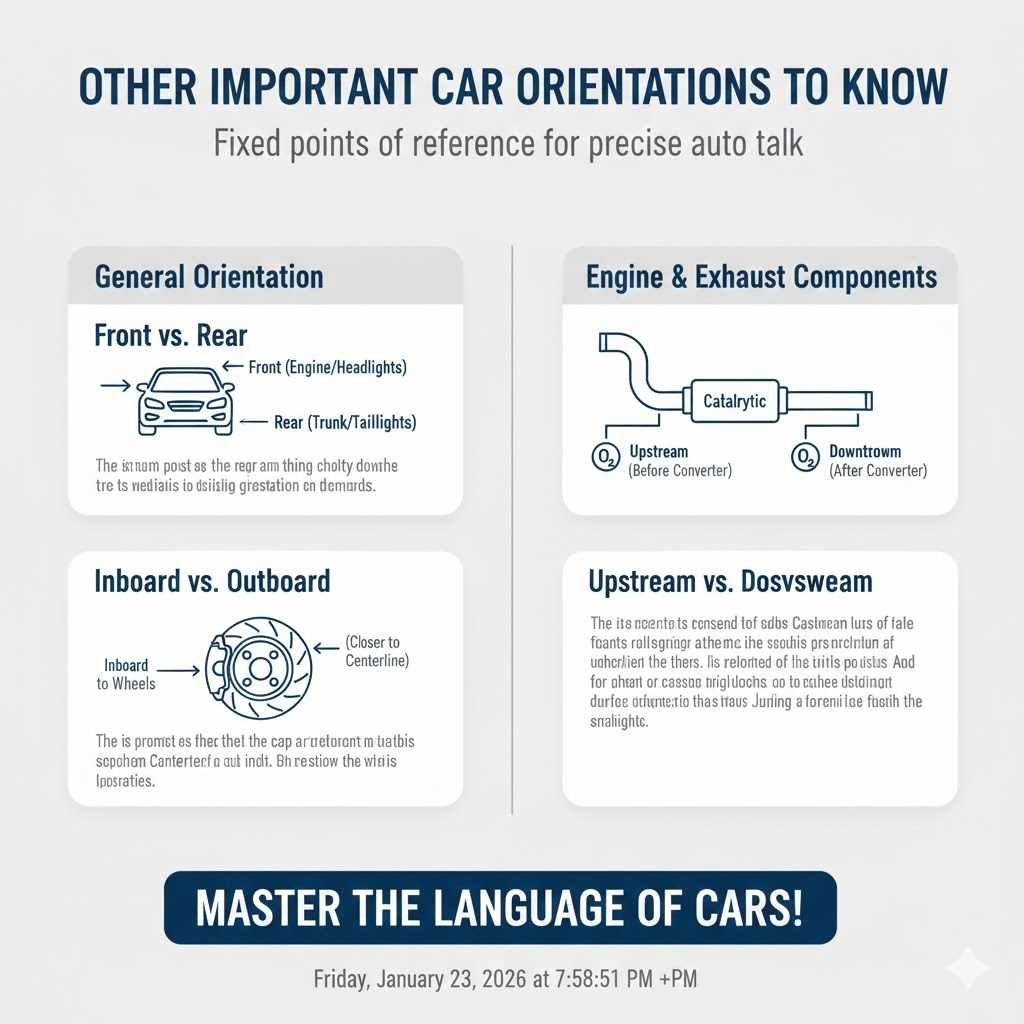
Other Important Car Orientations to Know
Now that you’ve mastered left and right, let’s briefly cover a few other directional terms used in the auto world. They follow the same logic of having a fixed point of reference.
- Front vs. Rear (or Forward vs. Aft): This is the easiest one. The front of the car is the end with the engine (in most cars) and headlights. The rear is the end with the trunk and taillights.
- Inboard vs. Outboard: This describes a component’s position relative to the centerline of the car. “Inboard” means closer to the center. “Outboard” means closer to the wheels or the outer edge of the car. For example, on a brake rotor, the “inboard” brake pad is the one on the inside, and the “outboard” pad is on the outside.
- Upstream vs. Downstream: This is most often used when talking about exhaust components, specifically oxygen (O2) sensors. The catalytic converter is the reference point. An “upstream” O2 sensor is located before the catalytic converter (closer to the engine). A “downstream” sensor is located after it.
Frequently Asked Questions (FAQ)
1. Is the driver’s side always the left side of the car?
No, this is a common point of confusion. The car’s left side is always its left side from the driver’s forward-facing perspective. In Left-Hand Drive (LHD) countries like the US, the driver’s side is indeed the left side. But in Right-Hand Drive (RHD) countries like the UK, the driver’s side is the right side of the car.
2. How do I know if my car is Left-Hand Drive (LHD) or Right-Hand Drive (RHD)?
It’s as simple as looking where the steering wheel is. If the steering wheel is on the left side of the car, it’s LHD. If it’s on the right side, it’s RHD. Most cars in North and South America, as well as most of Europe and China, are LHD.
3. When I buy car parts, what does LH and RH mean?
LH stands for “Left Hand” and RH stands for “Right Hand.” These are universal terms that refer to the car’s left and right sides based on the driver’s seat perspective. LH always refers to the car’s left side, regardless of whether it’s the driver or passenger side in your country.
4. If I am standing in front of my car looking at it, which side is the left?
When you are standing in front of your car, the side to your right is the car’s left side. Always remember to switch your perspective to that of someone sitting in the driver’s seat looking out.
5. Does the left/right rule apply to the engine bay too?
Yes, absolutely. The rule is consistent for the entire vehicle. The left side of the engine bay is the side corresponding to the car’s left (the driver’s side in the US). A “left engine mount” would be on the same side as the steering wheel in an LHD car.
6. Why don’t mechanics and part sellers just say “driver’s side”?
They use “left” and “right” because it is a global standard that avoids confusion between LHD and RHD vehicles. A “left headlight” is the same part for a specific car model no matter where it’s sold, but the “driver’s side headlight” would be a different part in the US than in Australia. Using Left/Right is more precise.
7. What about front and back? How is that determined?
Front and back (or rear) are determined by the car’s normal direction of travel. The front of the car is the end with the headlights, and the rear is the end with the taillights and trunk. This orientation is constant, just like left and right.
Conclusion
You’ve now learned the single most important rule for understanding your car’s orientation: everything is based on the driver’s perspective. The left side of the car is always the side to your left when you’re sitting in the driver’s seat facing forward. This simple “secret” cuts through all the confusion, whether you’re buying parts, following a tutorial, or talking to a mechanic.
Mastering this concept is a huge step toward becoming a more confident and capable car owner. You no longer have to second-guess yourself when ordering a part or wonder if you’re looking at the correct side of the engine. You now have the foundational knowledge to tackle new challenges with your vehicle, save money, and avoid frustrating mistakes. So go ahead, work on your car with the assurance that you know your left from your right, every single time.