How to Open BMW X1 Trunk from Inside
If the BMW X1 tailgate won’t open, start with the key fob and the interior release, then fold the rear seatbacks to reach the cargo area, and use the trunk’s manual emergency release only if the latch is dead. Forcing the tailgate or guessing at the latch can break trim, wiring, or the lock actuator. This guide gives you a symptom-based path for powered release failure, manual emergency release, and rear-seat access.
BMW X1 trunk access basics
The quickest fix depends on what is failing: powered opening, cabin access, or the latch itself. On a 2024 BMW X1, the cargo area can be opened from outside with the rear button, and the key may open it by holding the cargo-area button for about 1 second. If power is missing, the manual path matters more than repeated button presses.
Opening the tailgate vs reaching cargo from the cabin
“Open the trunk from inside” can mean two different jobs. You may need the tailgate to unlatch, or you may only need access to cargo through the rear seatback pass-through. Those are not the same repair path, and mixing them up wastes time.
If the tailgate release works, use the powered system. If it does not, look for a rear-seat route before you crawl into the cargo area. The cabin route is for access, not always for opening the tailgate latch itself.
What changes by model year and equipment
BMW X1 trunk controls vary by model year and equipment. The 2024 owner’s manual is 392 pages and the file size is 5 MB, which is a reminder that the official procedure can differ by trim and market. Do not assume a 2024 X1 follows the same release setup as an earlier model or a different trim.
Some X1s use power release logic that depends on battery health, switch settings, and the state of the latch. Others may include a manual emergency release in the cargo area. Always check the owner’s manual for the exact vehicle, especially if the tailgate, rear seats, or valet setting behave differently than expected.
How do you open it from inside?
Start with the powered release if the vehicle has power, because that is the cleanest path. If the tailgate still will not unlatch, the next move is usually rear-seat access to the cargo area, not force. A dead battery, a locked-out switch, or a bad latch can change which route works.
Use the interior release if the car has power
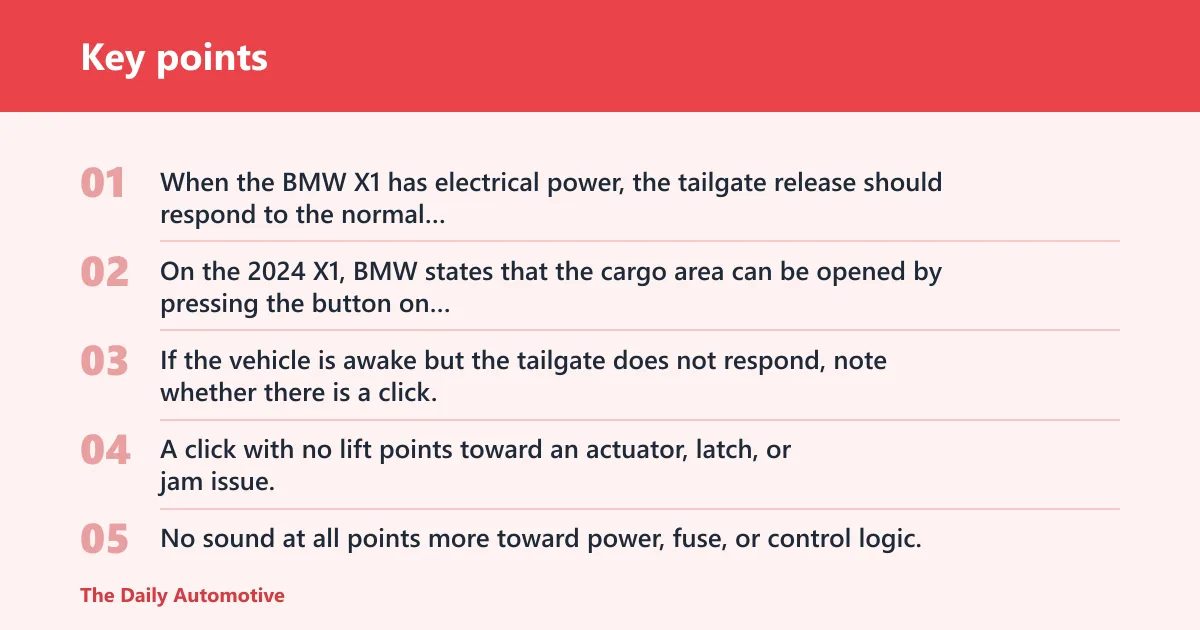
When the BMW X1 has electrical power, the tailgate release should respond to the normal control path before you attempt anything mechanical. On the 2024 X1, BMW states that the cargo area can be opened by pressing the button on the outside of the cargo area, and the key can open it by holding the cargo-area button for about 1 second.
If the vehicle is awake but the tailgate does not respond, note whether there is a click, a delayed release, or complete silence. That detail matters. A click with no lift points toward an actuator, latch, or jam issue. No sound at all points more toward power, fuse, or control logic.
Use the rear-seat pass-through when the tailgate will not release
If the tailgate will not open but the cabin is accessible, fold down the rear seatbacks and reach the cargo area from inside. BMW X1 cargo capacity is 25.7 cubic feet behind the rear seats and 57.2 cubic feet with the rear seats folded, so the seatback route can give enough room to reach bags, tools, or the release area.
Do not climb fully into the cargo area unless you must. That can trap you if the tailgate is stuck shut and can damage trim or the seatback latch if you pull from the wrong angle. Use the pass-through only to reach the cargo side, not as a shortcut to brute-force the latch.
Can the key fob open the trunk?
Yes, if the vehicle is awake and the signal can reach the car. The BMW key fob trunk button is a legitimate first check, and for the 2024 X1 BMW says to hold the cargo-area button for about 1 second. If the fob works inconsistently, range, battery strength, or a valet setting may be involved.
Press-and-hold trunk button checks
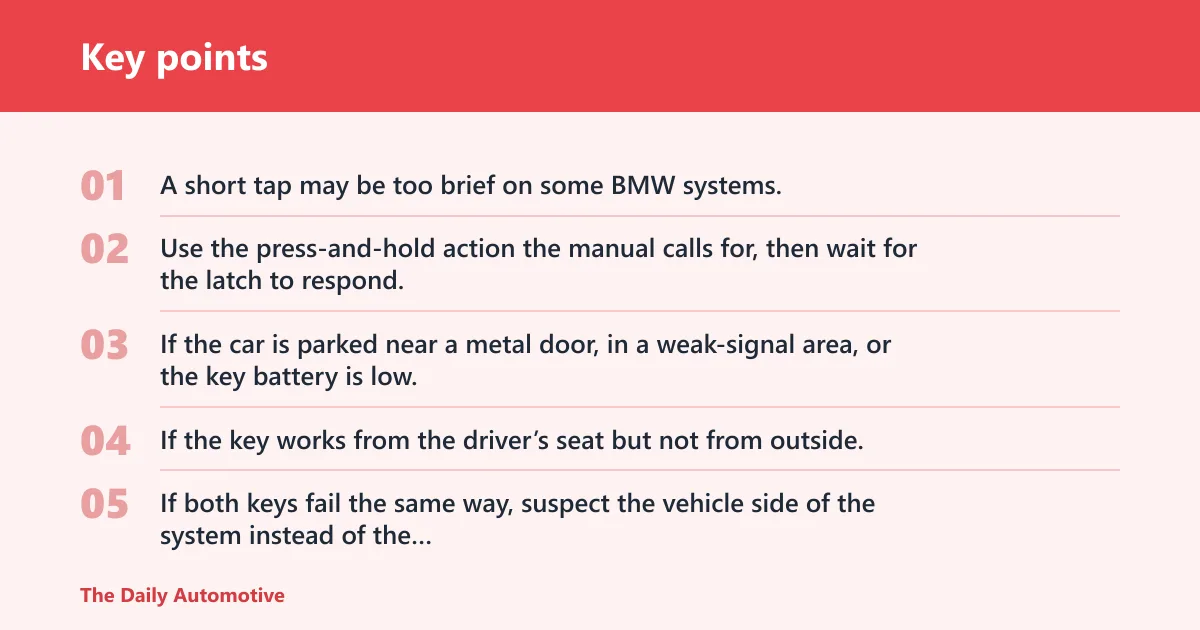
A short tap may be too brief on some BMW systems. Use the press-and-hold action the manual calls for, then wait for the latch to respond. If the car is parked near a metal door, in a weak-signal area, or the key battery is low, the fob may not wake the tailgate reliably.
If the key works from the driver’s seat but not from outside, the issue may be proximity rather than a broken trunk release. Try a second key if available. If both keys fail the same way, suspect the vehicle side of the system instead of the transmitter.
When proximity or a weak battery blocks the signal
BMW key fobs depend on range and vehicle power state. A weak key battery can stop the cargo-area command from reaching the car, and a dead vehicle battery can leave the electronic tailgate function unavailable entirely. In that case, the key may still unlock doors mechanically or with a blade, but the tailgate logic can stay offline.
Say your X1 has sat for a week and the dash is dark. The fob may still click the locks, yet the tailgate stays shut because the body electronics do not have enough voltage to drive the release. That is the point where charging or jump-starting becomes the first real repair step.
BMW X1 trunk troubleshooting matrix
Use the symptom first, then match the likely cause. This keeps you from checking the fuse box when the real problem is a valet lock, or crawling through the rear seats when the battery is simply dead. Stop DIY when the latch is jammed, wiring is exposed, or the tailgate needs trim removal.
| Symptom | Likely cause | Best next step | When to stop DIY |
|---|---|---|---|
| Dead battery | Loss of electronic tailgate function | Charge or jump-start the vehicle, then retry the release | Stop if the battery is swollen, leaking, or will not hold charge |
| Key fob works but button does not | Weak fob battery, signal issue, or disabled tailgate control | Try the second key, then check the valet setting and owner’s manual | Stop if the tailgate works inconsistently or shows electrical faults |
| Tailgate clicks but will not lift | Latch, actuator, or mechanical bind | Check for obstruction, then inspect for a jammed latch or wiring issue | Stop if the latch needs trim removal or the motor strains repeatedly |
| Rear seats accessible but trunk unreachable | Seatback pass-through usable, tailgate still locked | Fold the rear seats and reach cargo from the cabin only as needed | Stop if you need to force panels or crawl into a tight space |
| Valet lock engaged | Tailgate lock function is active | Check the glove box or central armrest for the switch, then disable it | Stop if the switch location is unclear or the tailgate still stays locked |
Where is the emergency release handle?
If the BMW X1 has an emergency release, it is inside the trunk and is often a brightly colored loop or handle meant to disengage the latch manually. BimmerTech notes that a BMW trunk can be opened manually from inside by reaching the emergency release handle. Use it only after you gain cargo-area access and confirm the tailgate is actually stuck.
Inside-trunk location and what the handle looks like
The emergency release is typically located where cargo-area access makes sense, not at the exterior release point. Its job is to disconnect the latch from the inside when the electronic system fails. The handle is usually bright so it stands out in an emergency, even in a dark cargo area.
Because location can vary by model year, do not assume every X1 places the handle in the same spot. Check the cargo-area trim, the owner’s manual, and the area near the latch hardware. If you cannot find it quickly, do not tear into panels looking for it.
How to use the manual latch release without damage
Pull the emergency release only enough to free the latch. Do not yank hard or pry the trim around it. If the handle releases the lock but the tailgate still sticks, the problem is likely a mechanical bind, frozen seal, or failed actuator rather than the release handle itself.
BimmerTech also notes that a BMW trunk may open with a key blade when the electronics fail. That does not replace the emergency release handle, but it is a useful clue that some failures are mechanical access problems rather than a total lock failure.
What should you check if the trunk still will not open?
After the simple checks, move in order: battery, fuse, wiring, then latch hardware. That sequence fits the most common no-open complaints. A dead battery can shut down the tailgate entirely, and a blown fuse or damaged wire can stop the release signal even when the rest of the car still seems alive.
Battery, fuse, and wiring checks
Start with vehicle battery voltage if the X1 shows any signs of electrical weakness. If the car cranks slowly or the interior electronics are strange, the trunk may simply be power-starved. Next, inspect the trunk release fuse, but remember that fuse box location can vary by model year and equipment.
Do not assume a fuse check is the full answer. A blown fuse can be the symptom of a short or a failing actuator. If the fuse blows again after replacement, stop and let a technician trace the circuit before more damage is done.
When a jammed latch or actuator points to repair
A tailgate that clicks but will not lift often points to a latch or actuator that is moving partway and failing under load. If the latch is binding, the release may sound normal while the gate stays shut. That is usually a repair job, not a key-fob problem.
Suppose the tailgate opens with the fob one day, then clicks on the next attempt and stays shut. That pattern is more consistent with a weak actuator or a mechanical bind than with a random electronic glitch. At that point, the safer move is roadside assistance or a shop visit.
Valet lock settings and owner’s manual checks
BMW’s valet switch or tailgate lock function can disable cargo-area access. The same source describes it as a tailgate lock located in the glove box or central armrest, though the exact location can vary by model. If the switch is active, the trunk may seem broken when it is only locked out.
The owner’s manual is the official reference for cargo-area instructions and control locations. That matters because the X1’s tailgate logic, emergency release access, and switch placement can change with model year. Check the manual before prying panels or assuming a component has failed.
Frequently asked questions
How do I open a BMW X1 trunk from inside?
Use the powered release first if the vehicle has power, then fold down the rear seats if you only need cabin access to the cargo area. If the tailgate itself will not release, the manual emergency release inside the trunk is the last step, not the first.
How do I open a BMW X1 trunk manually?
If the electronics fail, access the cargo area through the cabin, then use the emergency release handle if the vehicle is equipped with one. The same source notes that a BMW trunk can be opened manually from inside by reaching that handle. Do not force the exterior button repeatedly when the system is dead.
What should I do if my BMW X1 trunk won’t open?
Check the key fob, then the vehicle battery, then the valet setting, then the fuse. If the rear seats fold down, use that route to reach the cargo area without damaging the tailgate trim. Stop if the latch clicks but never moves, because that usually needs repair.
Where is the emergency release on a BMW X1 trunk?
It is inside the cargo area and is usually a brightly colored handle or loop near the latch area. Exact location can vary by model year, so use the owner’s manual if you cannot spot it immediately. Do not confuse it with the exterior release button.
Can I open the BMW X1 trunk with the key fob?
Yes, on the 2024 X1 BMW says the cargo area can be opened by holding the cargo-area button for about 1 second. That only helps if the key battery is healthy and the vehicle has power. A weak fob battery or dead car battery can block the signal.
Does the BMW X1 have a valet switch for the trunk?
Some BMW setups use a tailgate lock or valet switch, and BimmerTech places that control in the glove box or central armrest. If it is engaged, the trunk may stay shut even though the rest of the car responds normally. Check the owner’s manual before assuming failure.
Products related to this article
Sponsored / affiliate links. As an Amazon Associate I earn from qualifying purchases. I may earn additional commission from eligible campaigns.