How to Rotate Tires on Front-Wheel Drive Cars
Learning How to Rotate Tires on Front-Wheel Drive Cars might seem a bit tricky at first, especially if you’re new to car maintenance. This is because front-wheel drive cars have a specific way their tires wear down. The front tires do a lot of the work, steering and powering the car.
This means they often wear out faster than the rear ones. But don’t worry! It’s a straightforward process that can save you money and make your tires last much longer.
This guide will walk you through it step by step, making it easy for anyone to do at home.
Understanding Tire Rotation Basics
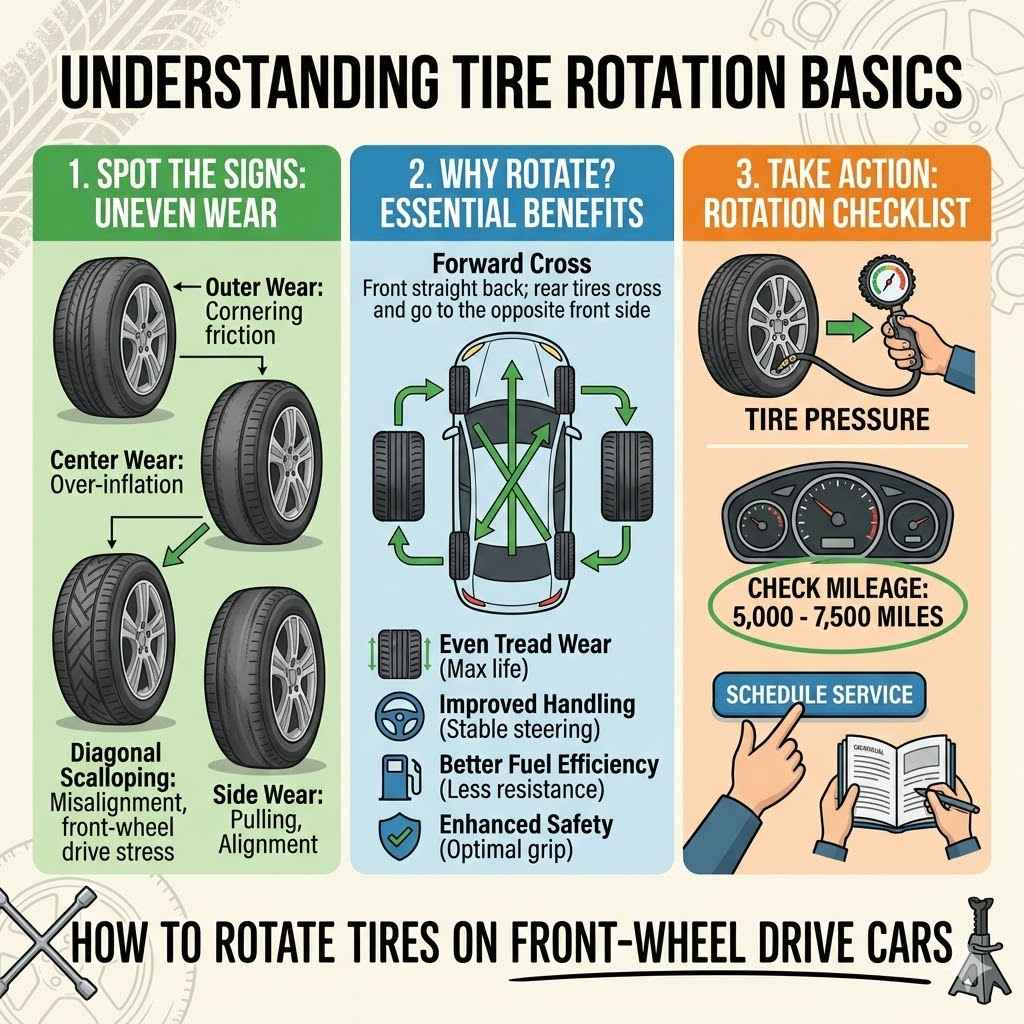
Tire rotation is a key part of car upkeep. It involves moving your tires from one position on the car to another. This simple act helps ensure that all four tires wear down evenly.
When tires wear evenly, they last longer, which means you buy new tires less often. It also improves your car’s handling and fuel efficiency. For front-wheel drive cars, the front tires often bear more stress.
They handle steering and the engine’s power. This leads to quicker wear on the front. Rotating them evens this out.
Why Tire Wear Matters
Uneven tire wear can cause several problems. It makes your tires unsafe over time. Worn tires have less grip, especially in wet conditions.
This can lead to longer stopping distances. It can also affect your car’s balance and how it steers. Imagine your tires wearing down much faster on one side than the other.
That would make your car pull to one side. This is not good for control. Plus, when tires wear out unevenly, you might have to replace a set before they are truly all used up.
This costs more money.
Tire rotation is recommended by most car makers. They usually suggest doing it every 5,000 to 7,500 miles. This is about the same time as most oil changes.
Checking your car’s owner’s manual is always a good idea. It will give you the exact mileage for your car. Keeping up with this simple maintenance task is one of the best ways to get the most life out of your tires.
It’s a small effort for big savings and better performance.
The Front-Wheel Drive Tire Rotation Pattern
For front-wheel drive vehicles, a specific pattern is generally followed. This pattern is designed to move the tires to positions where their wear characteristics are best suited. The main goal is to balance the wear across all four tires.
In a front-wheel drive setup, the front tires tend to wear faster due to steering forces and the engine’s weight. They also experience greater wear from acceleration and braking. The rear tires typically wear more evenly.
Therefore, the rotation strategy aims to bring the less worn rear tires to the front.
Standard Front-Wheel Drive Rotation Method
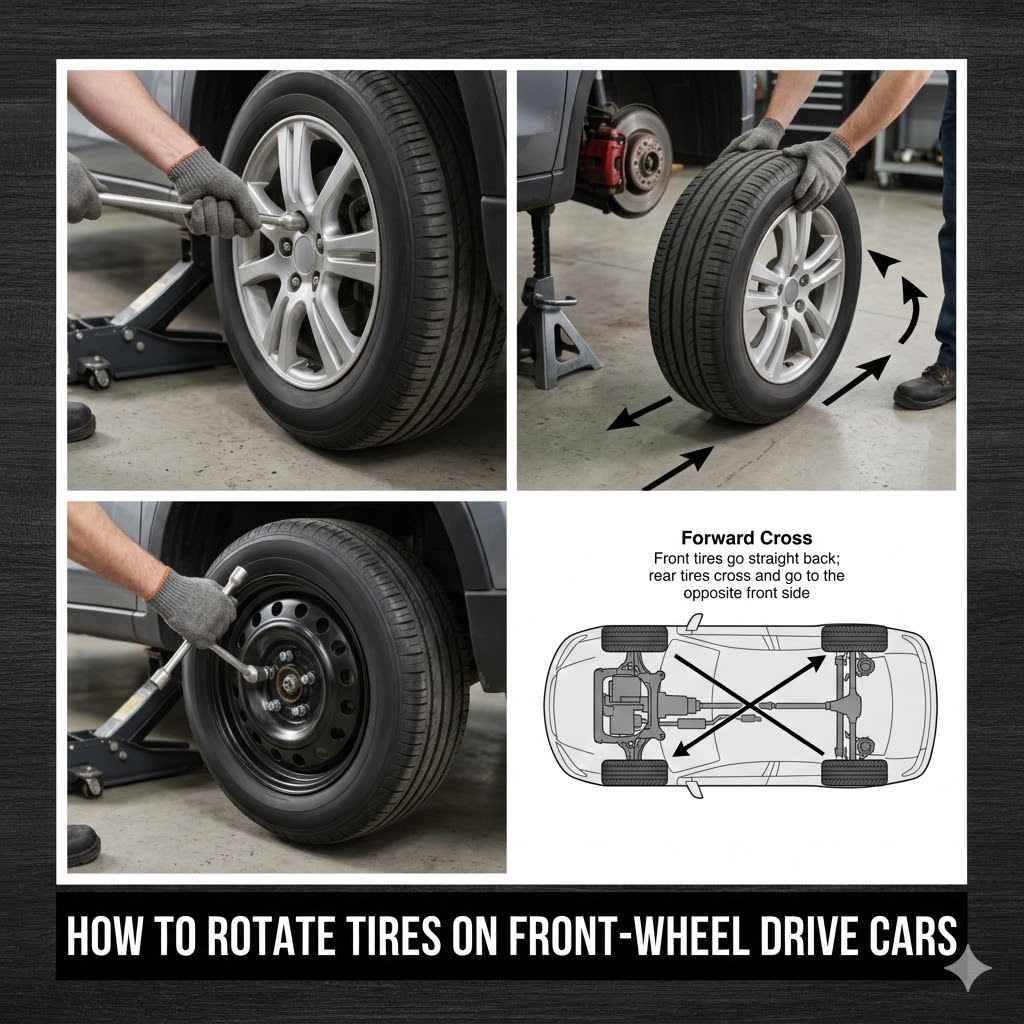
The most common method for front-wheel drive cars is the “rearward cross” pattern. In this method, the front tires are moved straight back to the rear. The rear tires are then moved to the opposite front corners.
This means the left rear tire goes to the right front, and the right rear tire goes to the left front. This pattern helps to even out the wear by moving the tires that wear slower to the positions that wear faster.
This pattern ensures that all four tires experience a mix of front and rear driving conditions. It addresses the tendency for front tires to wear more on the edges and shoulders due to cornering forces. Moving them to the rear allows them to wear more evenly across their tread surface.
Similarly, moving the rear tires forward helps them to pick up some of the extra wear they might experience in their original position.
Here’s a visual breakdown of the rearward cross pattern for a front-wheel drive car:
- Front Left Tire moves to Rear Left position.
- Front Right Tire moves to Rear Right position.
- Rear Left Tire moves to Front Right position.
- Rear Right Tire moves to Front Left position.
This cross pattern is highly effective for balancing wear on front-wheel drive vehicles.
Alternative Rotation Patterns
While the rearward cross is standard, other patterns exist. Some sources suggest a simple “front to back” swap for all-wheel drive or rear-wheel drive cars. However, for front-wheel drive, the cross pattern is usually preferred.
Another pattern, often called the “forward cross,” involves moving front tires to the rear and rear tires straight to the front. This is generally more suitable for rear-wheel drive vehicles. It’s important to stick to the pattern recommended for your specific drivetrain.
Using the wrong pattern can sometimes worsen uneven wear. For instance, if you simply swap front and rear tires on a front-wheel drive car (front to back, back to front), the front tires would still be on the front, experiencing the same heavy wear. The rear tires would go to the front, potentially wearing out faster than they would have otherwise.
This is why understanding the specific needs of your front-wheel drive car is crucial.
It’s also worth noting that if your tires are directional, meaning they are designed to spin in only one direction, the rotation pattern changes. You can only move them front to back on the same side of the car. You cannot cross them over to the opposite side.
Always check your tire sidewalls for an arrow indicating the direction of rotation.
How to Rotate Tires Step by Step
Performing a tire rotation yourself can be a rewarding DIY task. It requires some basic tools and a safe working space. Safety is the most important aspect of this process.
Always ensure the car is on a flat, level surface. Engaging the parking brake firmly is essential. You’ll also need wheel chocks to prevent the car from rolling.
Make sure you have a good jack and jack stands. Never rely solely on a jack to support the vehicle.
Gathering Your Tools and Supplies
Before you start, gather everything you need. This includes your car’s owner’s manual, which will confirm the recommended rotation pattern and jacking points. You will need a floor jack or a good quality car jack.
Jack stands are a must for safety. A lug wrench or a tire iron that fits your lug nuts is required. You might also need a torque wrench to tighten the lug nuts to the correct specification.
Wheel chocks, or sturdy blocks of wood, are vital for safety. Gloves can help keep your hands clean.
It’s also a good idea to have a brush to clean off dirt and debris from the wheels and hubs. Some people like to apply a little anti-seize compound to the lug studs, though this is optional. Ensure your spare tire is in good condition and properly inflated, just in case.
Having a small container to hold the lug nuts as you remove them will prevent them from getting lost.
Jacking Up and Removing Wheels
First, locate the jacking points on your car. These are usually reinforced areas on the frame. Consult your owner’s manual for their exact location.
Place wheel chocks behind the rear wheels if you are working on the front, or in front of the front wheels if you are working on the rear. This prevents the car from rolling.
Place the jack under the designated jacking point. Lift the car high enough to place a jack stand securely under the frame near the jacking point. Once the jack stand is in place, slowly lower the car onto the jack stand.
Never get under a car supported only by a jack. Repeat this process for all four wheels if you are removing them simultaneously, or one corner at a time if preferred.
Once a wheel is safely supported by a jack stand, use your lug wrench to loosen the lug nuts. Turn them counterclockwise. You don’t need to remove them completely yet.
Just loosen them about half a turn. After loosening all lug nuts on a wheel, you can fully unscrew them by hand and remove the wheel. Place the removed wheel aside.
Swapping Tires and Reinstalling
Now it’s time to swap the tires according to the pattern you’ve chosen for your front-wheel drive car. For the rearward cross, the front left tire moves to the rear left position, and the rear left tire moves to the front right. Ensure you’re placing the correct tire in the correct spot.
This might involve some heavy lifting, so take care.
Once the tires are in their new positions, you can start reinstalling the wheels. Place a wheel onto the lug studs. Thread the lug nuts back on by hand, tightening them as much as you can.
Make sure they are snug before lowering the car.
After all wheels are in place and lug nuts are hand-tight, slowly lower the car off the jack stands. Once the car is fully on the ground, use your lug wrench or torque wrench to tighten the lug nuts in a star pattern. This ensures the wheel is seated evenly.
Tighten them to the manufacturer’s recommended torque setting. You can find this in your owner’s manual.
Final Checks and Next Steps
After tightening all the lug nuts, double-check them to ensure they are secure. It’s a good practice to re-torque the lug nuts after driving about 50-100 miles. This is because the wheel can settle onto the hub after initial tightening.
Also, check your tire pressure in all four tires and adjust as needed.
Remember to store your old tires properly. If you plan to do this regularly, you’ll want to keep them in a clean, dry place. Marking the tires with chalk indicating their original position can be helpful for future rotations.
This process, when done correctly, significantly extends the life of your tires.
Benefits of Regular Tire Rotation
Regular tire rotation offers a multitude of advantages for your vehicle and your wallet. It’s a simple maintenance task that pays dividends in the long run. The primary benefit is extended tire life.
By ensuring even wear, you maximize the usable mileage of each tire. This means you’ll be replacing tires less frequently, saving money on new sets.
Extended Tire Lifespan
The most significant benefit is that regular tire rotation can increase the lifespan of your tires by up to 20%. This is a substantial saving, as tires can be a considerable expense. For a set of tires that might last 40,000 miles without rotation, you could potentially get 48,000 miles or more with consistent rotation.
This is achieved by moving tires that wear faster to positions where wear is slower and vice-versa.
Consider a scenario where front tires on a front-wheel drive car wear out after 30,000 miles, while the rear tires still have plenty of tread left. Without rotation, you might have to replace all four tires prematurely. However, if rotated, the less worn rear tires move to the front, and the worn front tires move to the rear.
This allows the rear tires to wear down more evenly and the front tires to also get more use before needing replacement.
Improved Vehicle Performance and Safety
Beyond just saving money, even tire wear contributes to better vehicle performance and safety. Properly rotated tires ensure your car handles predictably. This is especially important during cornering and emergency maneuvers.
When tires wear evenly, they maintain their optimal grip on the road surface. This reduces the risk of skidding or losing control, particularly in adverse weather conditions like rain or snow.
Unevenly worn tires can lead to a car pulling to one side. This makes steering more difficult and can cause driver fatigue on longer trips. Furthermore, tires with inconsistent tread depth have reduced traction.
This can significantly increase braking distances, putting you and others at risk. Regular rotation helps maintain balanced traction and braking performance across all four wheels.
Better Fuel Economy
It might seem counterintuitive, but rotating your tires can also help improve your fuel economy. Tires that are worn unevenly create more rolling resistance. This means your engine has to work harder to keep the car moving.
More engine effort equals more fuel consumption.
When tires wear evenly, they present a more consistent rolling surface to the road. This reduced rolling resistance allows your engine to operate more efficiently. The difference may seem small on a per-trip basis, but over the lifespan of your tires and many miles driven, it can add up to noticeable savings at the pump.
For example, a car that typically gets 25 miles per gallon could see a slight increase, perhaps to 26 or 27 miles per gallon, with optimally worn tires.
When to Consider Professional Tire Rotation
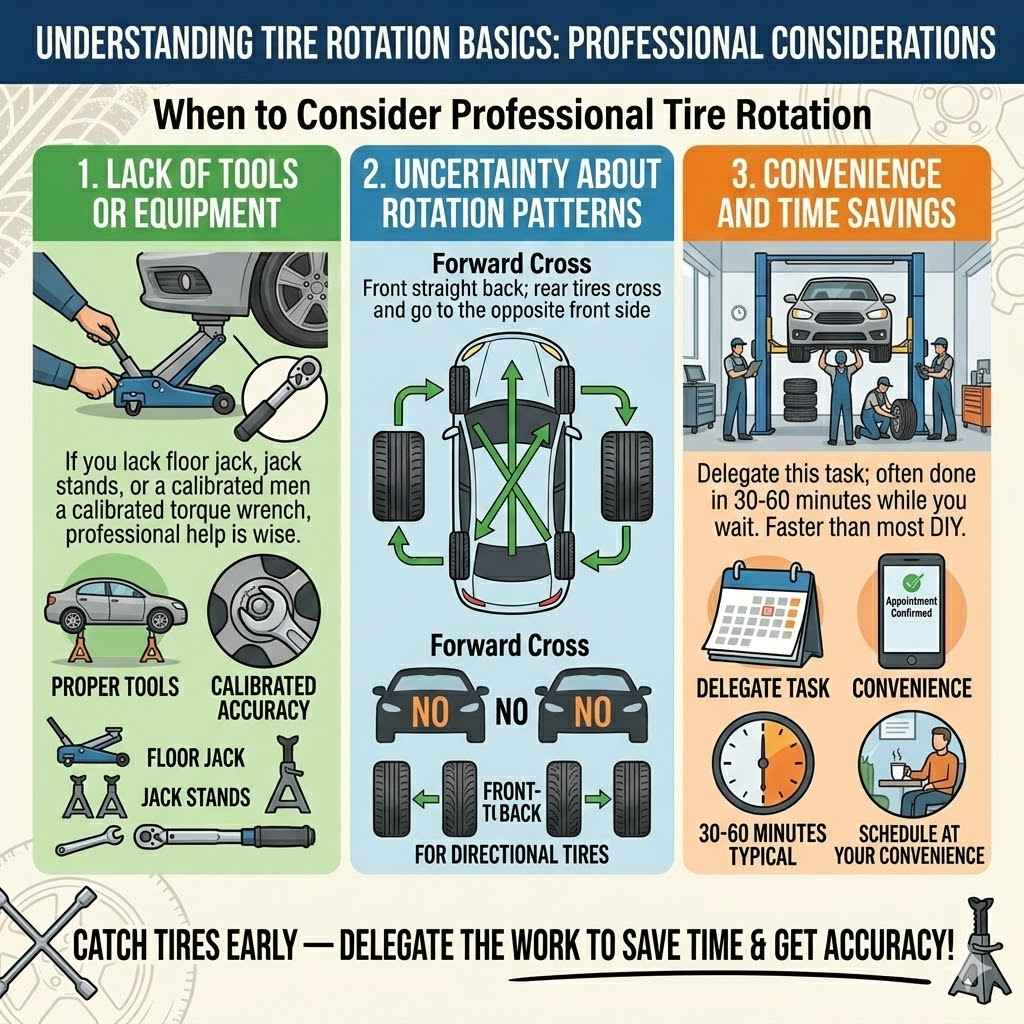
While DIY tire rotation is achievable, there are times when seeking professional help is a wise choice. If you lack the necessary tools, space, or confidence, a mechanic can handle it quickly and efficiently. Professionals also have specialized equipment, like lifts that can raise the entire vehicle, making the process faster.
Lack of Tools or Equipment
One of the primary reasons to opt for professional service is the absence of proper tools. A reliable floor jack, sturdy jack stands, and a torque wrench are crucial for safety and correctness. If you don’t own these or aren’t comfortable using them, it’s best to let a professional do the job.
They have the right equipment calibrated for accuracy.
For example, a torque wrench is essential for tightening lug nuts to the exact specification recommended by the car manufacturer. Overtightening can damage the studs or the wheel itself, while undertightening can lead to a wheel coming loose. Professionals ensure this critical step is done perfectly.
Uncertainty About Rotation Patterns
Different vehicles have different drivetrain configurations (front-wheel drive, rear-wheel drive, all-wheel drive) and sometimes specific tire types (directional, asymmetric). Each may require a slightly different rotation pattern. If you’re unsure about the correct pattern for your specific car and tire combination, a mechanic can readily identify and perform the appropriate rotation.
This prevents potential issues from incorrect swapping.
For instance, if you have directional tires, they can only be rotated front-to-back on the same side of the car. Crossing them over to the opposite side would require dismounting the tire from the rim and remounting it in the reverse direction, which is a more complex job typically done during tire replacement. A professional will know these nuances.
Convenience and Time Savings
For many people, the convenience and time savings offered by professional tire service are significant factors. Juggling car maintenance with work, family, and other commitments can be challenging. Taking your car to a tire shop or mechanic allows you to delegate this task.
You can often get it done while you wait, or schedule it at your convenience.
A professional tire shop can typically perform a tire rotation in 30-60 minutes. This is often faster than a DIY job for someone unfamiliar with the process, especially considering the time to gather tools, set up safely, and clean up afterward. This allows you to get back to your day with one less chore on your plate.
Frequently Asked Questions
Question: How often should I rotate my tires on a front-wheel drive car?
Answer: It is generally recommended to rotate your tires every 5,000 to 7,500 miles, or about once a year. Always check your car’s owner’s manual for the specific recommendation for your vehicle.
Question: Can I rotate my tires myself?
Answer: Yes, you can rotate your tires yourself if you have the proper tools like a jack, jack stands, and a lug wrench, and if you follow safety procedures carefully. Ensure the car is on a level surface and use wheel chocks.
Question: What happens if I don’t rotate my tires?
Answer: Not rotating your tires can lead to uneven wear, causing them to wear out faster, reducing their lifespan, affecting handling, and potentially decreasing fuel efficiency. It can also compromise safety.
Question: What is the standard rotation pattern for front-wheel drive cars?
Answer: The most common pattern for front-wheel drive cars is the rearward cross, where front tires move straight back and rear tires cross over to the opposite front corners.
Question: Can I rotate my directional tires myself?
Answer: Yes, but you can only move directional tires from front to back on the same side of the car. You cannot cross them to the opposite side without remounting them, which is usually done by professionals.
Conclusion
Keeping your tires in good shape is simple with regular rotation. For front-wheel drive cars, moving tires in a specific pattern ensures they wear evenly. This simple step saves you money by making tires last longer.
It also makes your car safer to drive and can improve gas mileage. Follow the guide for a smooth process.