Best Torque Wrenches for Car Tires (2026): We Compared
For many cars and SUVs, a 1/2-inch click torque wrench in the 30 to 150 lb-ft range is often a good choice. For a roadside kit, a shorter 3/8-inch model in the same range is easier to stash. Set torque wrong, and you can strip studs, bend brake rotors, or leave a wheel loose. This guide compares four torque wrench picks by wheel-service use case: commuter car, family SUV, heavy truck, and trunk kit.
Quick comparison
| Product | Badge | Best for | Price | ||
|---|---|---|---|---|---|
 |
LEXIVON Torque Wrench 1/2-Inch Drive Click 10~150LEXIVON | Our pick | 1/2-Inch Drive · 10-150 ft-lb · Click | $44.97
Price as of 24 Oct 2026
|
View |
 |
GEARWRENCH 1/2" Drive Micrometer Torque Wrench 30-250GEARWRENCH | Upgrade pick | 1/2" Drive · 30-250 ft-lbs · Micrometer | $126.65
Price as of 24 Oct 2026
|
View |
The trade-off is simple: a wider range covers more vehicles, but a tool that starts too high can feel clumsy on passenger-car lug nuts near the bottom of the scale. For wheel work, fit the vehicle first, then think about storage space and the lighting you have where you work.
How we chose
We compared the options against four wheel-service needs: passenger cars, crossovers and SUVs, light trucks, and trunk kits. The main filters were torque range, drive size, accuracy claim, adjustment lock, readability, and whether the package makes sense as a bare wrench or a kit with sockets and accessories.
We also looked at how each model behaves near the low and high ends of its range. That matters because a lug spec at the edge of a wrench’s range is harder to use cleanly and leaves less room for repeat work.
Finally, we favored tools that match real tire work: a clear scale, a storage case, and a head design that can handle repeated wheel service without feeling flimsy.
LEXIVON torque wrench: best for commuter cars
The LEXIVON LX-183 is the better fit for most passenger cars because its 10-150 ft-lb range covers typical lug specs with room to spare. It is a 1/2-inch drive click wrench, pre-calibrated to ±4%, and it includes a dual-range scale that is easier to read than many basic micrometer layouts.
Based on the published details, this is the kind of wrench that makes sense when your car’s lug nuts sit around the common 80-100 ft-lb band. It is broad enough for many cars and light trucks, yet still low enough to stay useful at the bottom end of wheel work.
The main drawback is accuracy headroom. ±4% is acceptable for most wheel jobs, but it is not the tightest figure in this comparison. If you want the tighter published spec for more repeated shop-style use, the GEARWRENCH option below has the edge.
GEARWRENCH torque wrench: best for mixed fleets
The GEARWRENCH 85066 suits mixed household garages because its 30-250 ft/lb range reaches farther upward than the LEXIVON while still staying in the 1/2-inch class that fits common tire work. Its published ±3% accuracy is tighter than the LEXIVON’s, which matters if you want a little more confidence near a vehicle’s listed lug spec.
This is the stronger pick when one tool has to cover a commuter car, a crossover, and occasional truck duty. The quick adjustment changes also help when you are moving from one wheel spec to another without wanting to fight the setting each time.
The drawback is that the lower end starts at 30 ft-lb, so it is not the best match for smaller fasteners or very low torque jobs. It is also the more expensive option here, and the extra range adds some bulk that a simple trunk kit may not need.
Which one should you buy?
If your garage mostly sees compact sedans and midsize cars, start with the LEXIVON. Its 10-150 ft-lb range better matches the low and middle end of wheel torque without wasting capacity you will never use.
If your driveway includes a crossover, SUV, or light truck, and you want one wrench for all of them, the GEARWRENCH is the safer long-term buy. The 30-250 ft/lb span gives you more reach at the top end, and the tighter ±3% claim is a meaningful step up for wheel work.
If you are building a roadside kit, neither of these should be treated as a full substitute for a compact emergency set with sockets and a breaker bar. A trunk tool needs to be short, easy to store, and simple to grab in poor light. That usually favors a smaller package with only the pieces you will actually use at the roadside.
A common first-timer mistake is buying a huge wrench because the package looks more capable. If your lug spec is near 90 ft-lb and you rarely service anything larger than a sedan, extra range can add weight and awkwardness without making wheel work better.
Passenger car fit matrix
| Scenario | Minimum acceptable torque range | Ideal drive size | Preferred wrench type | What to avoid |
|---|---|---|---|---|
| Passenger car | About 60-120 ft-lb | 1/2-inch | Click wrench | Overly large ranges that start too high |
| Crossover / SUV | About 80-140 ft-lb | 1/2-inch | Click or digital | Short range tools that leave little headroom |
| Light truck | About 100-160 ft-lb | 1/2-inch | Split-beam or click | Low-ceiling wrenches that top out too early |
| Roadside kit | About 80-120 ft-lb | 3/8-inch or compact 1/2-inch | Click wrench with clear scale | Bulky sets that are hard to store in the trunk |
A roadside kit is worth the extra bulk only if you actually want to do a spare swap away from home. If the wrench lives in a trunk, the case matters more than a wider range, because loose tools get rattled, buried, and harder to find when you need them fast.
Click wrench: best overall for tire changes
A click torque wrench is the standard choice for wheel work because it gives you an audible and tactile signal at the target torque. That makes it easy to stop at the right point without staring at a display, and it is still the most familiar style for DIY tire changes.
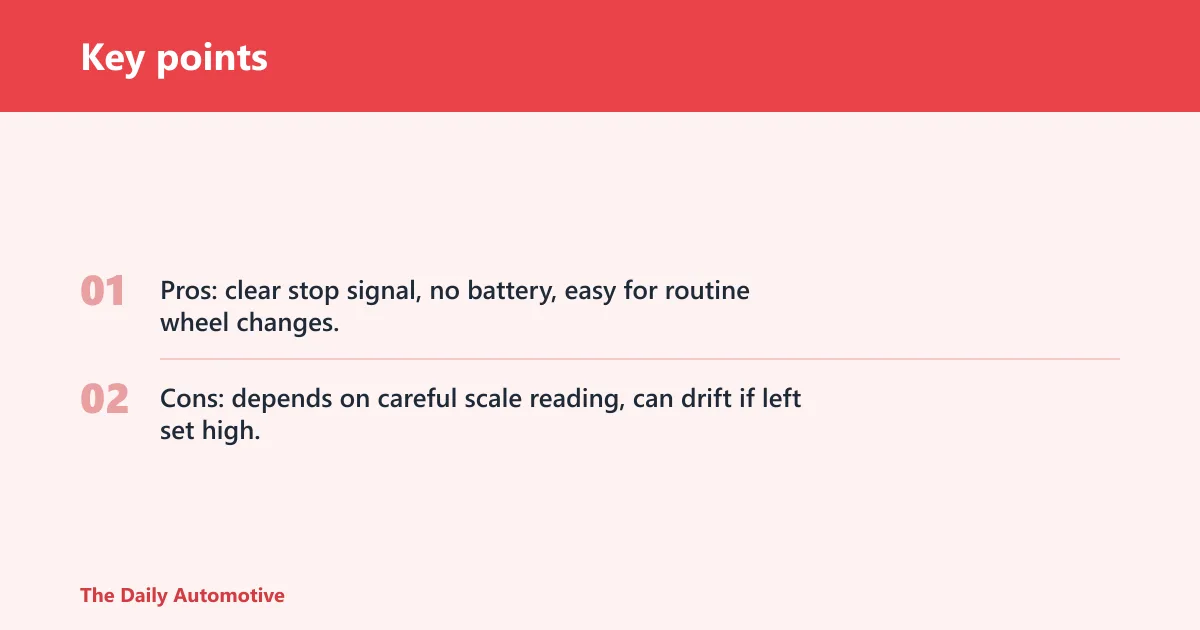
For lug nuts, the click style is usually the best starting point when you want one tool for basic car maintenance. It works well in garages, it does not need a battery, and it suits repeated wheel service if you keep the scale clean and the setting locked before use.
The drawback is that it rewards careful reading. If the handle is oily, the marking is hard to see, or the scale is crowded, it is easier to mis-set than many buyers expect. A click wrench also depends on calibration, so storage and adjustment habits matter.
Range and drive size
The common tire size is 1/2-inch drive, and that is usually the safest starting point for wheel work on cars and light trucks. It matches the leverage most people need for lug nuts without forcing you into a heavy-duty tool that is too large for ordinary rotation work.
Typical passenger car lug nuts are around 80-100 ft-lb. That is why a wrench that covers roughly 10-150 ft-lb or 30-150 lb-ft is so common in this category. The low end needs to be low enough for the car, and the high end needs enough room for SUVs and some trucks.
Pros and cons
- Pros: clear stop signal, no battery, easy for routine wheel changes, common 1/2-inch sizing.
- Cons: depends on careful scale reading, can drift if left set high, and lower-end readability can be awkward in dim light.
Split-beam wrench: best for durability
A split-beam torque wrench uses a spring-free design, so it does not need zeroing after use. That makes it appealing for garage tools that get grabbed often and stored for long periods, because there is less routine adjustment and fewer small parts to wear out.
This design is worth considering if you service wheels often and want a tool that keeps its setting behavior simple. The lack of a reset step is useful when you are moving from one wheel to another and do not want to wonder whether the wrench was returned to zero.
The drawback is that split-beam tools tend to be larger and less compact than a basic click wrench. For a roadside kit, that extra bulk is usually a penalty, not a benefit.
No-zeroing convenience
Because the mechanism is spring-free, a split-beam wrench avoids the common storage habit that can wear down some click wrenches if they are left under tension. That is not magic, but it does simplify ownership for people who want a durable garage tool with fewer handling rules.
Where the bulk is worth it
Bulk makes more sense in a garage than in a trunk. If the wrench lives near your jack, breaker bar, and socket set, a larger body is acceptable. If it has to share space with jumper cables and emergency gear, compactness wins.
Digital wrench: best for readability
A digital torque wrench is the clearest option when the numbers are hard to read or the garage is dim. The LED display can show the target directly, and audible or visual alerts make it easy to stop without squinting at a small scale mark.
This is the best choice when the question is not speed but readability. If you work in poor light, have trouble reading tiny marks, or want a direct number display for repeat settings, digital is easier to follow than a printed micrometer scale.
The drawback is dependency on power and electronics. Batteries add another thing to check, and digital tools are not automatically better if the display is slow to wake up or if you want a simple grab-and-go wrench that can sit in a trunk for months.
When clear numbers matter more
Digital tools make sense when you need to set and confirm torque in one glance. That can matter if you are working outside at dusk, or if you are trying to keep wheel service consistent across several vehicles with different lug specs.
Battery and storage considerations
A digital wrench should be stored where the display and battery contacts stay protected. If the tool spends long periods in the car, temperature swings and dead batteries become more relevant than they are for a garage-only wrench.
Torque kit: best for roadside use
A torque kit is the better fit when you need sockets, extensions, and a breaker bar in one place. That extra bulk is useful for a trunk because a roadside tire change often starts with a stubborn lug, and a bare torque wrench does not remove anything by itself.
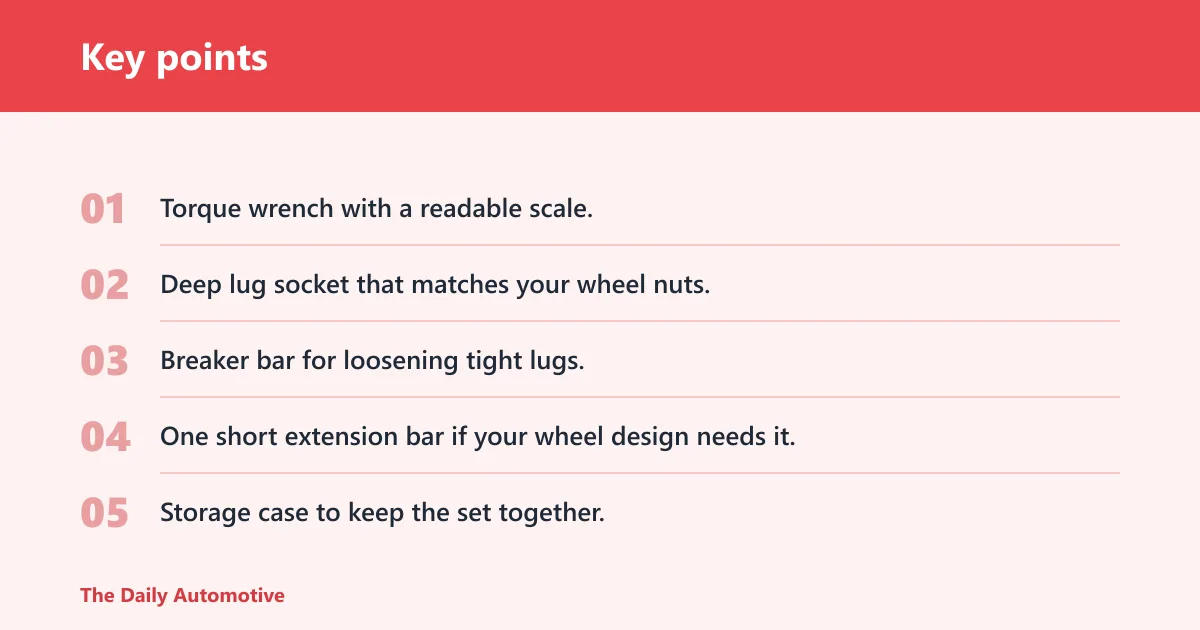
For the trunk, a kit should stay focused. Keep only the deep socket sizes that match your vehicle, a short extension bar if clearance is tight, and a breaker bar for loosening before final torque. The rest is weight you will not enjoy carrying.
A garage-only setup can be larger because storage is easier and the accessories are always within reach. In a roadside kit, the best package is the one you can find quickly and use without emptying half the trunk.
What to keep in the trunk
- Torque wrench with a readable scale.
- Deep lug socket that matches your wheel nuts.
- Breaker bar for loosening tight lugs.
- One short extension bar if your wheel design needs it.
- Storage case to keep the set together.
When a bare wrench is better
If you already keep a full socket set in the garage, a bare wrench is usually the smarter buy. Extra accessories make sense only when the tool must travel with you, and they do not help if the trunk kit becomes too heavy or too crowded to use fast.
What torque range do I need for lug nuts?
SUVs and trucks often need higher ranges, which is why many buyers should look for a ceiling above 150 ft-lb if the vehicle list is mixed.
The floor matters too. If the low end starts too high, you lose usefulness on lighter cars. If the ceiling is too low, the wrench may be fine for a sedan but useless for a truck or a heavily loaded SUV. Range is a fit question, not just a spec.
Say your sedan calls for 89 ft-lb and the wrench starts at 30 ft-lb. That is a comfortable fit. Suppose your light truck needs 140 ft-lb and the wrench tops out at 150 ft-lb. That still works, but it leaves little room if you later service a heavier vehicle.
Low-end and high-end edge cases
When a lug spec sits close to the low end of the wrench, the tool can feel less precise to set and harder to use consistently. When the spec sits near the top, you are working in a narrower band, and that leaves less margin for error or future vehicle changes.
How much range and accuracy do you need?
For wheel work, ±4% accuracy is often acceptable, especially for a general-purpose home garage tool. If you want tighter control for repeated wheel service, ±3% is a better target, and that is one reason the GEARWRENCH stands out on paper.
The practical rule is straightforward: if the wrench will see routine car tire changes, ±4% is usually fine when the scale is clear and the range fits the vehicle. If you service several vehicles or want a more confidence-heavy tool, buy tighter specs and keep the setting habit disciplined.
A traceable calibration certificate is worth paying for when the wrench will see frequent use, when you want documentation, or when you plan to share the tool between vehicles with different lug specs. For casual use, a pre-calibrated wrench can be enough if the range and build are right.
When ±4% is acceptable
±4% is acceptable for most DIY wheel changes because the bigger risk is usually choosing the wrong torque entirely, not being off by a tiny amount within the tool’s published tolerance. That said, it is still worth using the correct socket, a clean wheel face, and an even tightening pattern.
When tighter specs are worth it
Choose tighter specs when you regularly service SUVs or trucks, when the wrench is shared, or when you want less uncertainty near the vehicle’s published lug torque. The closer the lug spec is to the edge of the wrench range, the more a tighter tool spec becomes useful.
What should you check before buying?
Check the ratchet head, the lock, the storage case, and the calibration claim before you buy. Those details matter more in real wheel service than marketing language, because they affect how the wrench feels on a real lug nut and how well it holds up in storage.
Ratchet head and tooth count
A reversible or fixed ratchet head changes how easy the wrench is to position on tight wheels. A 72-tooth head on some kits can help in cramped wheel wells because it needs less swing room, but durability still matters if you rotate tires often.
Locking adjustment mechanism
A locking adjustment mechanism keeps the setting from drifting by accident. Push-to-set, pull-to-lock, and locking collar designs all try to solve the same problem: you do not want the wrench to creep out of spec while it rattles around in a case or trunk.
Storage case and calibration certificate
A storage case helps protect the calibration and keeps the wrench organized with its accessories. A calibration certificate is more useful when the wrench will be used often or shared across vehicles, while a simple pre-calibrated tool can be enough for occasional home tire swaps.
Choose LEXIVON if… / Choose GEARWRENCH if…
Choose LEXIVON if… you mostly service passenger cars, want a more compact range that fits the common 80-100 ft-lb zone well, and prefer a lower-cost click wrench with a clear dual-range scale. It is also the better pick if you want a straightforward 1/2-inch wheel tool without paying for extra ceiling you may not use.
Choose GEARWRENCH if… you service a mixed garage with cars, crossovers, and some truck work, want the tighter ±3% accuracy claim, or need more top-end headroom. It is the better long-term buy when one wrench has to cover more than one vehicle class.
What happens if you overtighten lug nuts?
Overtightening lug nuts can stretch studs, damage threads, warp brake rotors, and make roadside wheel removal much harder later. It can also leave you with uneven clamping force, which is exactly why a torque wrench matters: it helps avoid both overtightening and under-tightening.
Under-tightening is not safer. A wheel that is not clamped correctly can loosen in use, which is why wheel torque should be set to the vehicle maker’s spec and rechecked with a proper tool after service.
Frequently asked questions
What torque wrench size is best for car tires?
A 1/2-inch drive torque wrench is the best starting point for car tires because it matches common lug nut work and has enough strength for many passenger cars and light trucks. For a trunk kit, a shorter 3/8-inch option can be easier to store, but 1/2-inch is the common wheel-service size.
What is the difference between click, digital, and split-beam torque wrenches?
Click wrenches give an audible and tactile signal at the set torque. Digital wrenches show the number on a display and add alert tones or lights. Split-beam wrenches use a spring-free design, so they do not need zeroing after use and are often favored for durability.
How accurate does a torque wrench need to be for wheels?
For wheel work, ±4% is usually acceptable for general DIY use, while ±3% is better if you want tighter control or will service multiple vehicles often. Accuracy matters, but the right torque range and a readable scale are just as important in practice.
Can one torque wrench work for cars, SUVs, and trucks?
Yes, one wrench can cover all three if the range is wide enough. A 30-250 ft/lb tool, such as the GEARWRENCH listed here, gives more headroom for trucks and SUVs than a tighter car-focused wrench. The trade-off is that it may feel less ideal for low-end passenger-car work.
Do I need a calibration certificate for a torque wrench?
You do not always need one, but it is worth having if the wrench will be used often, shared between vehicles, or chosen for repeat wheel service. A traceable calibration certificate adds confidence beyond a simple accuracy claim, especially when the tool will be relied on for safety-critical fasteners.
What should I look for in a torque wrench for roadside tire changes?
Look for a readable scale, a compact case, the correct sockets, and enough range for your vehicle’s lug spec without excessive bulk. A roadside kit should be easy to grab in low light, so a clear click wrench with a secure storage case is usually the practical choice.
Products related to this article
Sponsored / affiliate links. As an Amazon Associate I earn from qualifying purchases. I may earn additional commission from eligible campaigns.
 QUENCHING Split Beam Torque Wrench Set 3/8" & 1/2" Drive, 20–250 ft-lb, ±4% Accuracy, No Reset Required, Precision Torque Tool for Automotive Technicians, Lug Nuts & Suspension Work
 Upgraded Torque Wrench Set 8PCS, 1/4 3/8 1/2 inch Drive Click Torque Wrench, 10-230in.lb, 5-50ft.lb, 10-180ft.lb, 72-Tooth Dual Scale, ±3% Accuracy, 5 Adapters, for Bike, Moto, Car Repair and Maint