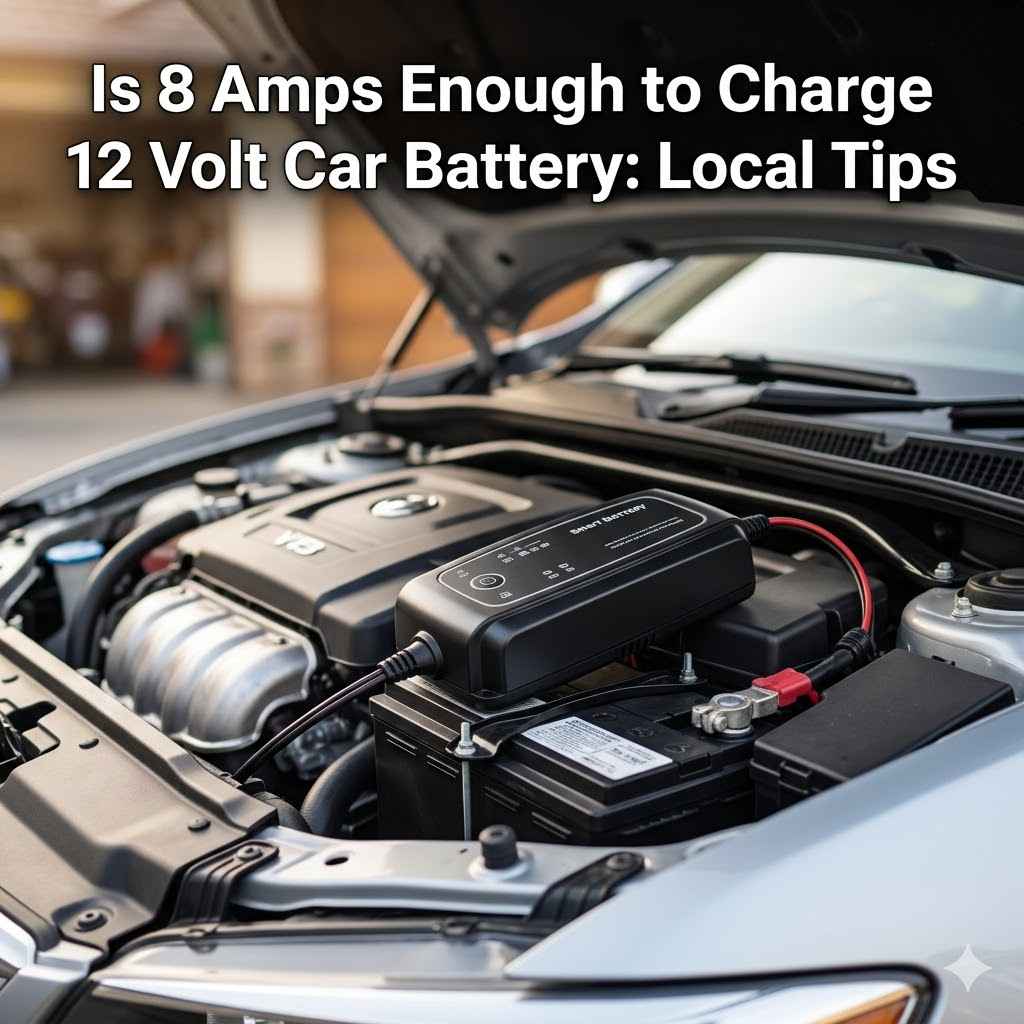
Is 8 Amps Enough to Charge 12 Volt Car Battery: Local Tips
Many folks wonder, Is 8 Amps Enough to Charge 12 Volt Car Battery: Local Tips. It sounds like a simple question, but getting it wrong can cause issues for your car battery. It’s easy to feel confused when you’re just starting out with car maintenance.
Don’t worry though, we’ll break it down in a way that’s super easy to follow. We’ll show you exactly what you need to know to keep your battery healthy. Get ready for some clear, step-by-step help.
How Much Amperage Do You Need for a 12 Volt Car Battery Charge
This section explores the core question: what amperage level is truly effective for charging a 12-volt car battery. We will look at the basic science behind battery charging and how amperage plays a role in the speed and completeness of the charge. Understanding these fundamentals is key to making informed decisions about your car’s power source.
Understanding Amperage in Battery Charging
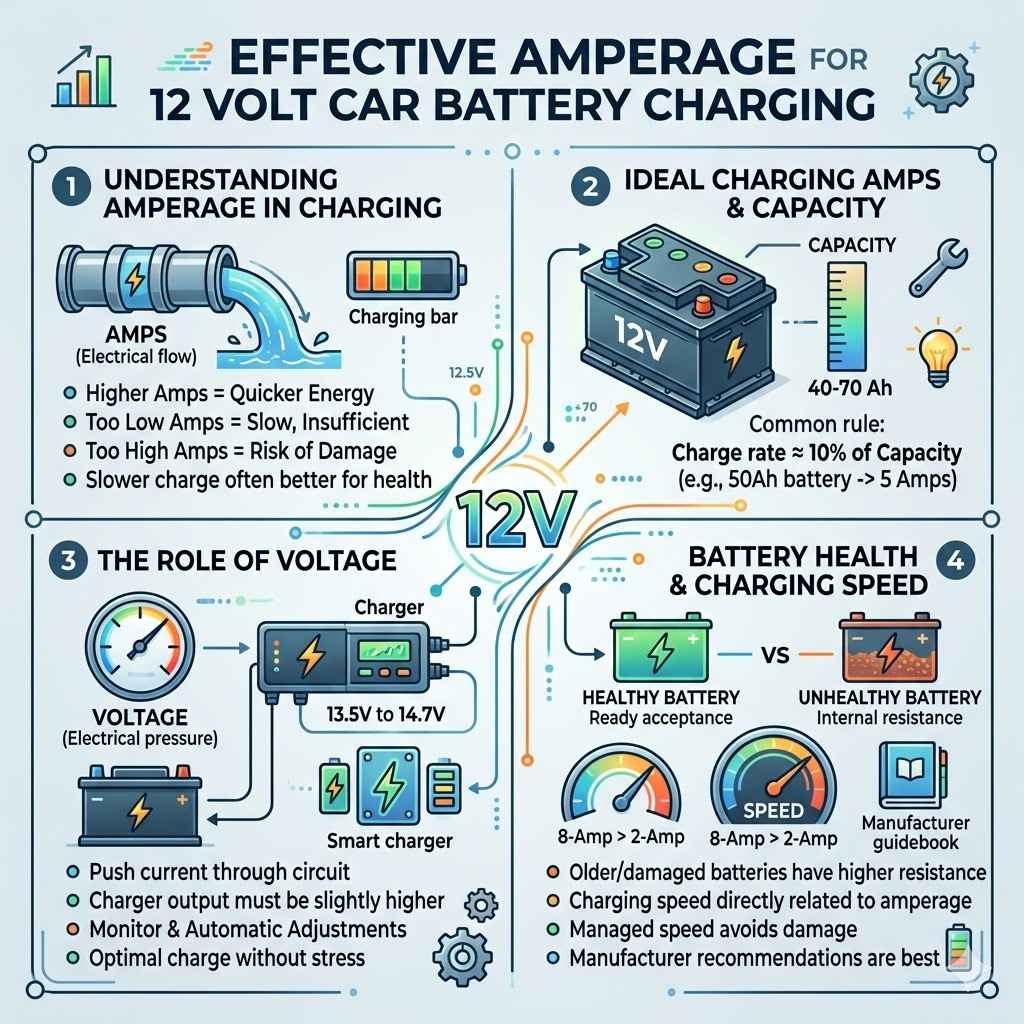
Amperage, often called amps, is a measure of electrical current. Think of it like the flow of water in a pipe. A higher amperage means more electrical “water” is flowing to the battery at any given moment.
When you’re charging a battery, the amperage determines how quickly energy is being supplied to it. Too little amperage, and the charge can take a very long time, or even be insufficient. Too much amperage, and you risk damaging the battery.
For a 12-volt car battery, the ideal amperage for charging depends on several factors. These include the battery’s current state of charge, its capacity (measured in amp-hours), and the type of charger being used. Generally, a slower charge is often better for the long-term health of the battery.
This is because it allows the chemical reactions inside the battery to occur more effectively without generating excessive heat.
Many car batteries have a capacity ranging from 40 to 70 amp-hours. A common rule of thumb is to charge a lead-acid battery at a rate that is about 10% of its capacity. So, for a 50 amp-hour battery, this would mean a charging rate of around 5 amps.
However, more powerful chargers can offer higher amperage for faster charging, but this needs careful management.
The goal is to replenish the battery’s stored energy. When a battery is deeply discharged, it needs a steady supply of current to bring it back up. If the amperage is too low, the battery might not reach a full charge, leaving you with less power than you need for starting your car or running accessories.
This can lead to problems like frequent dead batteries.
The Role of Voltage in Charging
Voltage is the electrical “pressure” that pushes the current through the circuit. A 12-volt car battery operates within a specific voltage range. When charging, the charger needs to supply a voltage that is slightly higher than the battery’s current voltage to force current into it.
For a typical 12-volt car battery, a charger might output between 13.5 to 14.7 volts, depending on the charging stage.
This slightly higher voltage is what overcomes the battery’s internal resistance and its current state of charge. If the voltage is too low, current won’t flow effectively, and charging will be slow or stop altogether. If the voltage is too high, it can cause the battery to overheat, gas excessively, and degrade its internal components prematurely.
Modern smart chargers are designed to monitor both voltage and amperage. They adjust these parameters automatically throughout the charging process. This ensures the battery receives the optimal charge without being overstressed.
They often start with a higher amperage and voltage to quickly bring up a discharged battery and then taper down as the battery gets closer to full. This careful control is crucial for battery longevity.
Understanding the interplay between voltage and amperage is vital. It’s not just about one or the other, but how they work together to safely and efficiently replenish the battery’s power. A charger that correctly matches the battery’s voltage requirements while providing appropriate amperage is essential for optimal performance and lifespan.
Battery Health and Charging Speed
A battery’s current health significantly impacts how it responds to charging. An older battery, or one that has been regularly subjected to deep discharges or extreme temperatures, may not be able to accept a charge as efficiently as a new one. Its internal resistance might be higher, meaning it resists the flow of current more strongly.
This resistance can affect both the speed and the maximum capacity the battery can reach during charging. A healthy battery will readily accept a charge and reach its full potential. An unhealthy battery might appear to charge, but its capacity will be diminished, and it may not hold a charge for long.
Charging speed is directly related to amperage. A higher amperage charger can deliver more energy in a shorter amount of time. For instance, an 8-amp charger will likely charge a battery faster than a 2-amp charger.
However, this speed comes with a caveat: it needs to be managed carefully to avoid damaging the battery.
Battery manufacturers often provide recommended charging rates. These recommendations are based on extensive testing to ensure both effective charging and battery longevity. Sticking to these guidelines is generally the safest approach.
If you’re unsure, always consult your car’s owner manual or the battery manufacturer’s specifications.
Sometimes, a very slow charge might be necessary for severely discharged or older batteries. This gentle approach allows the battery chemistry to stabilize without overheating. It’s a trade-off between time and battery health.
For most regular charging needs, a moderate amperage is sufficient.
When Is 8 Amps Enough to Charge 12 Volt Car Battery Locally
This section directly addresses the common query: Is 8 Amps Enough to Charge 12 Volt Car Battery: Local Tips. We will explore scenarios where 8 amps is a suitable charging rate, considering typical car battery sizes and conditions encountered by drivers in various local environments.
Assessing Battery Size and Capacity
Car batteries come in different sizes and capacities, usually measured in amp-hours (Ah). A typical passenger car battery might have a capacity between 40 Ah and 70 Ah. Larger vehicles like trucks or SUVs may have batteries with higher capacities, perhaps 70 Ah to 100 Ah or more.
The capacity tells you how much energy the battery can store and deliver. For example, a 50 Ah battery can theoretically provide 5 amps for 10 hours, or 10 amps for 5 hours, before being fully depleted. This is a simplified view, as battery performance varies with discharge rate and temperature.
When considering an 8-amp charger, its suitability depends on the battery’s Ah rating. For a battery in the 40-70 Ah range, an 8-amp charge rate is generally considered moderate to fast. This rate is often sufficient to charge a moderately discharged battery within a few hours.
If you have a smaller battery, such as those found in compact cars or motorcycles (though this post focuses on car batteries), 8 amps might be too high, potentially leading to faster charging but also increased risk of damage if not managed by a smart charger. Conversely, for very large truck batteries with capacities over 100 Ah, 8 amps might be on the slower side, taking longer to fully charge.
Local conditions and battery usage patterns also play a role. If your car is used for frequent short trips where the battery doesn’t get a chance to fully recharge, you might need a more robust charging solution. However, for typical daily use, 8 amps can be a good compromise between charging speed and battery health.
Typical Scenarios for 8 Amp Charging
An 8-amp charger is a versatile tool for many common car battery charging needs. It’s often found in basic trickle chargers or more advanced automatic battery maintainers.
Consider a scenario where your car battery is slightly low. Perhaps you left the headlights on overnight, or the car has been sitting unused for a week. In this case, the battery isn’t deeply discharged but needs a boost.
An 8-amp charger can effectively replenish this lost charge relatively quickly, often within 3-6 hours, depending on the exact state of discharge and battery capacity.
Another scenario is periodic maintenance. If your car is a second vehicle that’s not driven daily, or if you live in a colder climate where batteries perform less efficiently, using an 8-amp charger for a few hours once a month can keep the battery topped up. This prevents it from sulfating, a process where lead sulfate crystals build up on the battery plates, reducing its capacity and lifespan.
For car enthusiasts who might occasionally drain their battery testing audio equipment or other accessories, an 8-amp charger offers a balance. It’s faster than a low-amp trickle charger but less aggressive than a high-amperage industrial charger. This makes it suitable for home use by the average car owner.
It’s important to pair an 8-amp charger with a battery that can handle this rate. Most standard 12-volt car batteries can tolerate an 8-amp charge, especially if the charger is a “smart” or “intelligent” charger. These chargers monitor the battery and adjust the amperage and voltage accordingly to prevent overcharging or overheating.
When 8 Amps Might Be Insufficient
While 8 amps is often adequate, there are situations where it might not be enough for optimal charging or might take too long to be practical.
Deeply discharged batteries are a prime example. If your car battery has been completely drained, perhaps due to a parasitic drain or a prolonged period of disuse, it holds very little charge. To bring such a battery back to a healthy state, a higher amperage charger might be more efficient.
While an 8-amp charger can eventually charge a deeply discharged battery, it could take 12-24 hours or even longer, depending on the battery’s capacity.
Very large batteries, such as those found in heavy-duty trucks, RVs, or boats, have significantly higher amp-hour ratings (often 100 Ah and above). While 8 amps might eventually charge them, it would be an extremely slow process. For these larger batteries, chargers with 10, 15, or even 20-amp output are typically recommended to achieve a reasonable charging time.
Also, if you need to charge a battery very quickly due to an urgent need to start your vehicle, an 8-amp charger might not be fast enough. In such emergency situations, a higher-amperage charger or a jump start might be necessary. However, using high amperage for extended periods without proper management can risk damaging the battery.
Lastly, the condition of the battery itself plays a role. If a battery is old, damaged, or has a lot of internal sulfation, it may not accept a charge efficiently. In such cases, even a higher amperage might not fully restore its capacity.
It might be time to consider replacing the battery.
Factors Affecting Charging Time and Effectiveness
Several elements influence how quickly and well your 12-volt car battery charges, beyond just the amperage of the charger. Understanding these factors helps you predict charging times and ensure you’re getting the most out of your charging efforts.
Temperature Impact on Battery Charging
Temperature is a critical factor affecting battery charging speed and effectiveness. Batteries, especially lead-acid types commonly used in cars, operate best within a specific temperature range.
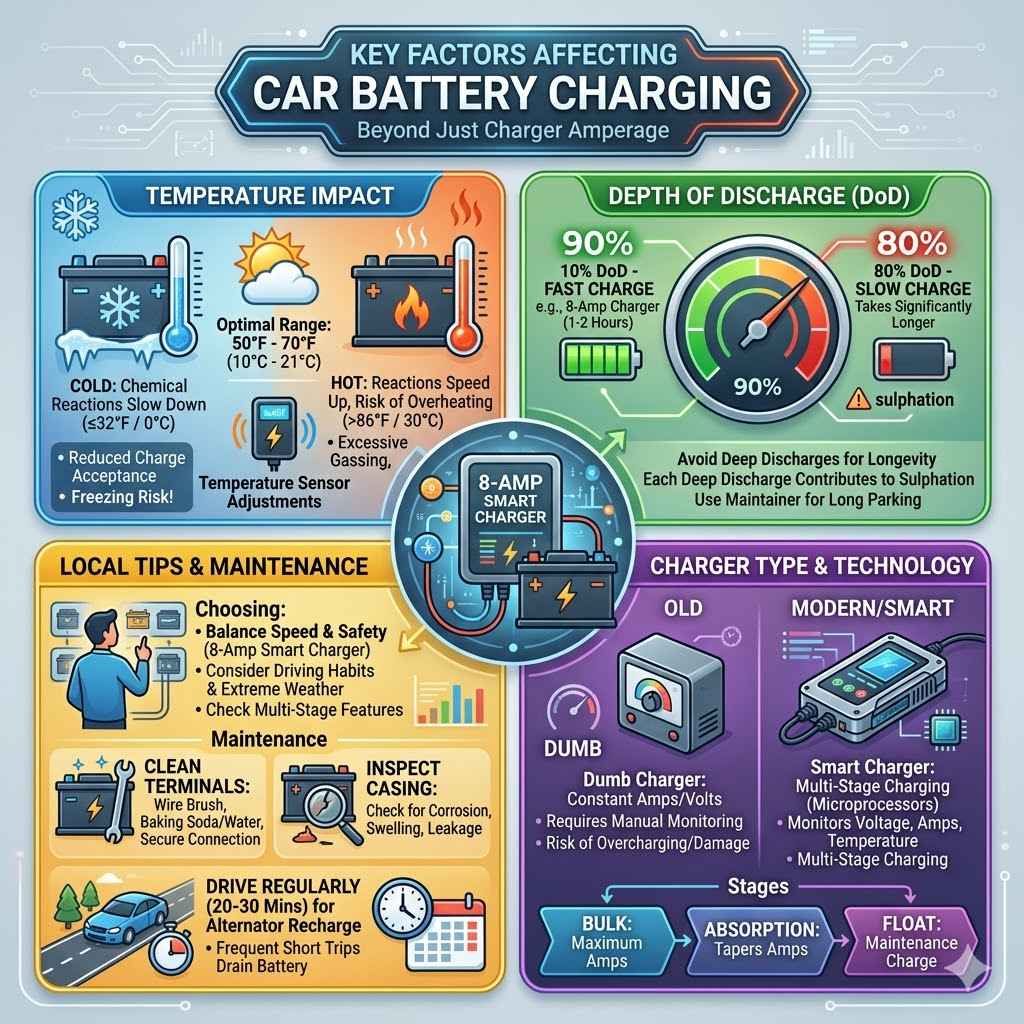
When temperatures are very cold, the chemical reactions inside the battery slow down considerably. This means the battery’s ability to accept a charge is reduced. A charger might be supplying the correct amperage, but the battery simply can’t absorb the energy as quickly.
In freezing temperatures, a battery can even freeze, causing irreparable damage.
Conversely, when temperatures are very hot, the chemical reactions speed up, but this can lead to overheating during charging. High temperatures increase the risk of the battery gassing excessively, losing water content, and potentially swelling or even exploding. Overcharging in hot weather is particularly dangerous.
Most smart chargers have built-in temperature sensors that adjust the charging rate accordingly. If the battery gets too hot, the charger will reduce the amperage and voltage to prevent damage. Similarly, in very cold conditions, it might slightly increase the voltage to compensate for the slower chemical reactions.
This automatic adjustment is a key feature of modern chargers.
For optimal charging, it’s best to charge a car battery in a cool, well-ventilated area, ideally between 50°F and 70°F (10°C to 21°C). If you must charge in extreme temperatures, using a charger with temperature compensation is highly recommended to protect your battery.
Depth of Discharge
The depth of discharge (DoD) refers to how much of the battery’s total capacity has been used. A battery that is only slightly discharged will charge much faster than one that is completely drained.
For instance, if your battery only lost 10% of its charge (meaning 90% capacity remains), an 8-amp charger might bring it back to full in just an hour or two. However, if the battery is discharged by 80% (leaving only 20% capacity), that same 8-amp charger will take significantly longer to replenish the energy.
A common mistake is leaving the car parked for extended periods or making very short trips, which leads to a gradual increase in the depth of discharge without sufficient opportunity for the alternator to fully recharge the battery during driving. Over time, this can lead to a battery that is frequently operating at a lower state of charge.
Deep discharges are particularly hard on lead-acid batteries. Each time a battery is deeply discharged, it can contribute to sulfation, a process that reduces the battery’s ability to hold a charge. While an 8-amp charger can certainly work to recharge a depleted battery, frequent deep discharges will shorten the battery’s overall lifespan, regardless of the charger used.
For maximum battery longevity, it’s best to avoid deep discharges as much as possible. If you anticipate your car being parked for a long time, consider using a battery tender or maintainer that provides a very low, constant charge to keep the battery topped up.
Charger Type and Technology
The type of battery charger you use significantly impacts its effectiveness and safety. Not all chargers are created equal, and modern technology offers much better battery management than older models.
Older “dumb” chargers often provide a constant amperage and voltage, regardless of the battery’s needs. This can lead to overcharging, overheating, and damage to the battery if left connected for too long. These types of chargers might deliver 8 amps constantly, which is why manual monitoring and disconnection were essential.
Modern “smart” or “intelligent” chargers employ microprocessors to monitor the battery’s voltage, amperage, and even temperature. They use multi-stage charging protocols:
- Bulk charging: Delivers maximum amperage to bring the battery up quickly.
- Absorption charging: Reduces amperage as the battery gets closer to full to avoid overcharging.
- Float charging: Provides a very low maintenance charge to keep the battery topped up without overdoing it.
An 8-amp smart charger is much more effective and safer than a basic 8-amp dumb charger. The smart charger will start at 8 amps (or even higher initially) and then automatically reduce the output as the battery reaches full charge, preventing damage. This makes it suitable for a wider range of battery conditions and charging durations.
Battery maintainers are another type of charger, often with lower amperage (e.g., 1-2 amps), designed to keep a battery fully charged over long periods without overcharging. These are ideal for vehicles that are not driven regularly.
When considering an 8-amp charger, opt for a smart charger. This ensures that the 8 amps are utilized efficiently and safely throughout the charging cycle, protecting your investment in the car battery.
Local Tips for Car Battery Charging
Many people find themselves asking Is 8 Amps Enough to Charge 12 Volt Car Battery: Local Tips, especially when dealing with common issues in their immediate surroundings. Here, we share practical advice tailored for everyday drivers and local conditions.
Choosing the Right Charger for Your Needs
Selecting the correct battery charger is crucial for maintaining your car’s battery health. For most car owners, an 8-amp smart charger strikes a good balance between speed and safety. These chargers are readily available and suitable for a variety of situations.
Consider your typical driving habits. If you drive your car daily for moderate distances, your car’s alternator is usually sufficient to keep the battery charged. A charger is more for occasional top-ups or when the battery has been unexpectedly drained.
If you live in a region with extreme weather, like very cold winters or very hot summers, a smart charger with temperature compensation is highly recommended. These chargers adapt their output to the ambient temperature, preventing overcharging in heat and ensuring better charging in cold.
For vehicles that sit for long periods, a battery maintainer with a lower amperage (1-2 amps) might be a better choice. It keeps the battery fully charged without the risk of overcharging, extending its lifespan. However, if you need to bring a depleted battery back to life, an 8-amp smart charger is more capable.
When buying, look for chargers that mention “multi-stage charging” or “smart charging.” These features ensure the battery is charged safely and effectively. Also, check the charger’s compatibility with different battery types (e.g., flooded lead-acid, AGM, gel), as cars use various battery technologies.
When to Seek Professional Help
While many battery charging tasks can be handled at home, there are times when it’s best to consult a professional mechanic or auto shop.
If your battery frequently dies, even after charging, it might be a sign of a larger problem. This could be a faulty alternator, a parasitic electrical drain (where something is silently drawing power from the battery when the car is off), or the battery itself is at the end of its life. A mechanic can perform diagnostic tests to pinpoint the exact issue.
When dealing with severely damaged batteries, such as those that are cracked, leaking, or have swollen casings, do not attempt to charge them yourself. These batteries can be hazardous. Professionals have the proper equipment and safety protocols to handle them.
If you’re unsure about the type of battery your car has or the correct charging procedures, seeking advice from a local auto parts store or a mechanic is a wise step. They can provide specific recommendations based on your vehicle and its battery.
Also, if you have attempted to charge the battery and it still doesn’t hold a charge or the car won’t start, professional help is needed. There could be underlying electrical issues in the vehicle that a simple charger cannot resolve. A mechanic can thoroughly inspect your car’s electrical system.
Maintaining Battery Health Between Charges
Keeping your car battery healthy doesn’t just involve charging; regular maintenance is key. This helps prevent premature battery failure and ensures your car starts reliably.
Regularly check your battery terminals for corrosion. Corrosion can prevent a good electrical connection, hindering both charging and power delivery. Clean the terminals with a wire brush and a mixture of baking soda and water if you see any white or blue powdery build-up.
Ensure the terminals are securely fastened after cleaning.
Inspect the battery case for any signs of damage, swelling, or leakage. If you notice any of these issues, the battery needs immediate replacement. A damaged battery is a safety hazard.
Avoid leaving accessories plugged in or lights on when the engine is off for extended periods. This includes phone chargers, dashcams, or interior lights. If you suspect a parasitic drain, have it diagnosed and repaired by a mechanic.
Drive your car regularly for at least 20-30 minutes at a time. This allows the alternator enough time to fully recharge the battery. Frequent short trips, where the engine is started and stopped multiple times without reaching optimal operating temperature or sufficient driving time, can slowly drain the battery.
In extremely cold climates, consider a battery blanket or insulated cover. These accessories help maintain a more stable temperature for the battery, improving its performance and charge-holding capacity during winter.
Frequently Asked Questions
Question: Can I use an 8 amp charger on a small car battery?
Answer: For most standard 12-volt car batteries, an 8-amp charger is generally acceptable, especially if it’s a smart charger. However, for very small batteries, like those in some compact cars or if you are specifically referring to motorcycle batteries, 8 amps might be too high if not managed by a smart charger that can regulate the output. Always check your battery’s manual for recommended charging rates.
Question: How long does it take an 8 amp charger to charge a dead car battery?
Answer: Charging time for a dead car battery with an 8-amp charger can vary significantly. Factors like the battery’s amp-hour capacity, its actual state of discharge, and its overall health play a big role. For a moderately discharged battery (around 50 Ah), it might take 3-6 hours.
A completely dead battery could take 12-24 hours or more. A smart charger will adjust its output to finish safely.
Question: Will an 8 amp charger damage my car battery?
Answer: An 8-amp charger can potentially damage a car battery if it’s a basic, “dumb” charger that delivers a constant 8 amps without regulation. However, modern “smart” or “intelligent” chargers are designed to prevent damage. They monitor the battery and reduce amperage as it gets closer to full charge.
If you have a smart 8-amp charger, it is generally safe for most 12-volt car batteries.
Question: Is it better to charge a car battery slowly or quickly?
Answer: For the long-term health and lifespan of a lead-acid car battery, a slower, more controlled charge is generally better. It allows the chemical reactions within the battery to occur more effectively and reduces the risk of overheating and damage. While a higher amperage charger can charge faster, it needs to be a smart charger to manage the process safely.
Question: What is the maximum amperage I should use to charge a 12 volt car battery?
Answer: A common guideline for lead-acid batteries is to charge at a rate of about 10% of the battery’s amp-hour capacity. So for a 50 Ah battery, 5 amps is ideal. However, many smart chargers can safely deliver higher amperage (like 8 amps or more) because they regulate the output throughout the charging cycle.
Always consult your battery manufacturer’s recommendations. Avoid chargers with excessively high amperage if they lack smart features.
Summary
In short, an 8-amp charger is often sufficient for charging a 12-volt car battery, especially when it’s a smart charger. It offers a good balance of speed and safety for typical needs. Always consider your battery’s size and condition, and remember that temperature and depth of discharge affect charging time.
Choosing a smart charger with features like temperature compensation is key for battery health. Regular checks and proper usage will keep your car battery ready to go.