Is AF Designs Aerosol Car Paint Good Quality?
AF Designs aerosol car paint can work for small touch-ups when the color code matches and the can lays down an even, dry film; it is a weaker choice for full-panel refinishing or hidden, factory-level color match. A poor pick leaves visible mismatch, rough texture, or early chipping. This guide checks match accuracy, finish, durability, and where AF Designs fits against better-known aerosol paints.
Top pick for color-code touch-ups

For a color-critical touch-up, Dupli-Color Perfect Match is the clearest benchmark because it is built around factory color-code matching and uses an EZ Touch 360° fan spray nozzle. FlyDunk also lists an 8 oz can size, touch-dry in 30 minutes, and ready to handle in 1 hour, which gives you a useful speed baseline when comparing AF Designs to a known standard.
AF Designs belongs in the same conversation only if its product page gives you the same buying signals: a specific color code, a defined substrate list, a stated recoat window, and clear spray behavior. If those details are missing, you are judging a can by packaging, not quality.
Quick picks
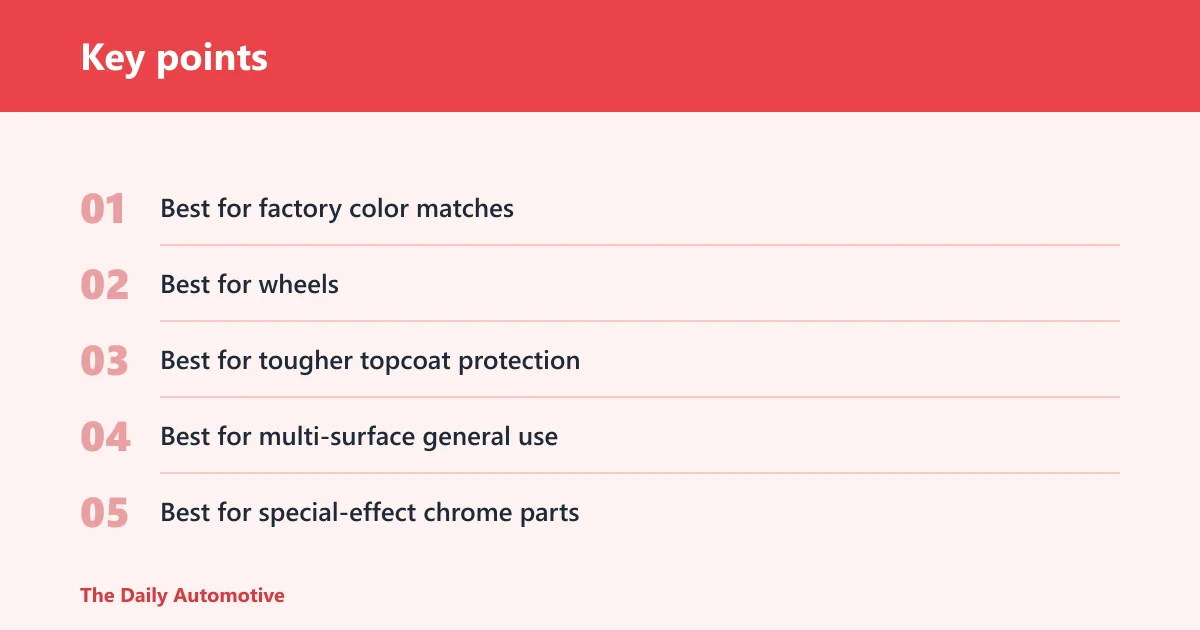
- Best for factory color matches: Dupli-Color Perfect Match, because the brand ties the can to a vehicle color code and a fan-style nozzle.
- Best for wheels: NADAMOO aluminum wheel spray paint, which FlyDunk lists as two 13 oz cans for aluminum or steel rims.
- Best for tougher topcoat protection: Eastwood 2K clear coat, which Jack’s Tire Shop describes as a long-lasting, durable clear finish.
- Best for multi-surface general use: Rust-Oleum 2X Automotive Enamel, with a 5-in-1 dial and fast-drying acrylic formula.
- Best for special-effect chrome parts: Dupli-Color Metalcast, which creates an anodized coating effect in blue and red variants.
- Best for interior vinyl or fabric: Dupli-Color vinyl and fabric coating spray paint, aimed at seats, dashboards, and door panels in flat black or gloss black.
Dupli-Color Perfect Match for color-code jobs
This is the reference point for a buyer who wants a can that behaves like a factory-matched touch-up product. The value is not only the match claim; it is the combination of factory color-code matching, a defined nozzle style, and published dry-time information that helps you compare it against other aerosol paints.
If AF Designs does not list the exact car color code or a close cross-reference, it is not in the same class for visible bodywork. A can can spray well and still be the wrong color.
NADAMOO aluminum wheel spray paint for wheels
NADAMOO wheel paint is aimed at wheel refinishing, not body-panel color correction. FlyDunk lists it as two 13 oz cans, and the product focus is aluminum or steel rims with corrosion and UV protection in a gloss black finish.
That wheel-specific positioning matters. Wheel paint has to tolerate heat, grime, and close-up viewing from multiple angles. A body touch-up can sometimes hide a slight mismatch. A wheel cannot.
Eastwood 2K clear coat for tougher finishes
A 2K clear coat belongs in the durability conversation because it is generally considered a stronger protective topcoat than standard clear. Jack’s Tire Shop describes it as a long-lasting, durable clear finish, which is the right kind of claim to look for when a repair needs more gloss retention, UV resistance, and chip resistance.
Use a 2K clear when the color coat is correct but the finish needs extra protection. That matters more for repaired panels, wheels, and trim than for a small hidden scuff.
What makes aerosol car paint good quality?
Good aerosol paint is judged by more than brand name. Color-code accuracy, even atomization, consistent film build, proper recoat timing, adhesion to the target surface, and finish durability after curing all matter. If one piece is weak, the repair can fail even when the color looks close in the can.
Color match and metallic control
The first quality test is whether the can actually corresponds to your vehicle’s color code. Check the label on the door jamb or the vehicle data plate before you buy. If the code is wrong, the spray can be excellent and still look off in daylight.
Metallics are a separate issue: a paint can match the code and still lay metallic flake unevenly, which can create a blotchy or banded finish. That is why a good product page should tell you whether it is meant for OEM panel repair, a wheel, a chrome-effect part, or an interior surface.
Atomization, film build, and coverage
Spray control tells you whether the paint will build a uniform coat or spit, fog, and run. Jack’s Tire Shop notes Rust-Oleum 2X Automotive Enamel uses a 5-in-1 spray pattern dial, which is a useful example of the type of control buyers should look for in any aerosol can.
Coverage matters too. A larger can is not automatically better, but a can with vague yield claims gives you little planning help. For a touch-up, the real question is whether the can can lay down thin coats without patchiness. For a full panel, you need enough usable material to keep the wet edge consistent.
Recoat timing, adhesion, and finish durability
Recoat timing affects both appearance and adhesion. Apply too soon and the solvent may disturb the layer below. Wait too long and the next coat may not bond as intended. Good product directions spell out the window clearly.
Durability depends on the formula and the surface beneath it. Standard aerosol paint often works for spot repairs, but wheels, trim, and exposed panels take more abuse. If the product does not explain primer and clear compatibility, assume you need more prep and more caution.
How do I know if aerosol paint will match my car color?
A spray can is more likely to match your car color when it is tied to the exact color code on the vehicle label or data plate. Do not trust a generic color name alone. A code mismatch can be obvious in sunlight, especially on silver, white pearl, red, and metallic finishes.
- Find the color code on the door jamb label, under-hood label, or vehicle data plate.
- Match that code to the can listing, not just the color name.
- Check whether the can is for OEM paint, a wheel finish, or an interior coating.
- Verify the recommended primer and clear before spraying.
- Compare the product’s stated use case with the repair size.
Say your car uses a pearl white code and the can listing only says “white.” That is a warning sign. A plain white aerosol can be too flat, too warm, or too bright, and the mismatch will show most clearly on the edge of the repair.
Can aerosol paint give a durable finish on a car?
Yes, but only within limits. Aerosol paint can give a durable finish on spot repairs, trim, wheels, and small panels when the surface is prepped correctly and the coating system is matched to the job. It is less convincing for a large body panel where blending, film consistency, and long-term gloss retention matter more.
Standard aerosol versus 2K clear
Standard aerosol clear is usually the weaker link in the stack. A 2K clear coat is often the better durability choice when the repair sits in sun, takes road grime, or needs a harder final film. That stronger clear does not fix a poor color match, but it can improve the life of a correct repair.
Suppose a front bumper scuff gets a color coat that matches well, then a standard clear that softens under wash chemicals. The color may be right, but the finish can haze, dull, or mark too easily. A 2K clear is the better fit for that kind of exposure.
Failure signs to watch
- Orange peel: the surface looks dimpled instead of smooth.
- Poor metallic laydown: the flake looks streaky or cloudy.
- Wrong color tone: the repair looks too dark, too light, or too warm.
- Solvent reaction: the coat wrinkles, lifts, or softens the layer below.
- Runs and sags: the film is too wet or sprayed too close.
- Flaking: adhesion failed because of prep, substrate, or timing.
How do you choose aerosol paint for your car?
Choose aerosol paint by matching the can to the surface, the repair size, and the finish you need. Metal, plastic, chrome, OEM panels, wheels, trim, and interior pieces all have different prep and adhesion demands. A can that works on one surface can fail on another.
Match the can to the surface
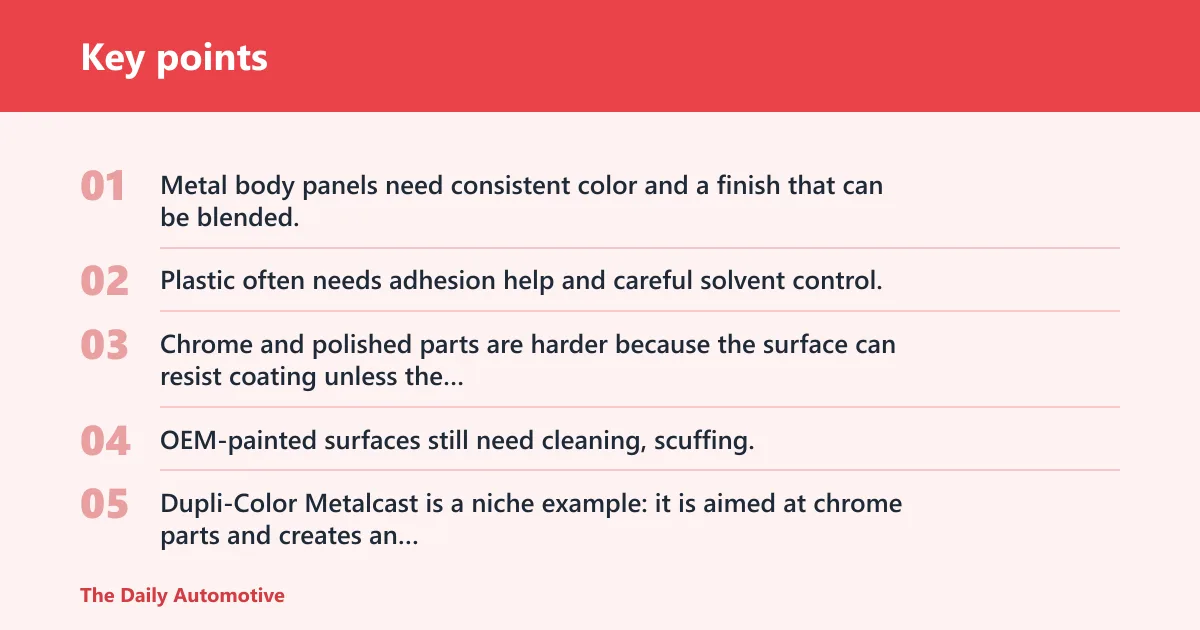
Metal body panels need consistent color and a finish that can be blended. Plastic often needs adhesion help and careful solvent control. Chrome and polished parts are harder because the surface can resist coating unless the product is made for that use. OEM-painted surfaces still need cleaning, scuffing, and compatibility checks before recoating.
Dupli-Color Metalcast is a niche example: it is aimed at chrome parts and creates an anodized coating effect, with blue and red variants. Dupli-Color vinyl and fabric coating spray paint is different again, because it is meant for interior surfaces such as seats, dashboards, and door panels in flat black or gloss black.
Check primer and clear compatibility
Compatibility is one of the clearest quality signals. A good aerosol paint listing should tell you whether it wants primer, whether it can be topcoated, and whether it can handle a standard clear or a stronger clear like a 2K product. If the directions are vague, the product is harder to trust for visible work.
Rust-Oleum 2X Automotive Enamel is useful here because Jack’s Tire Shop notes its fast-drying acrylic formula and multi-surface use. That kind of broad fit can help on general projects, but it is still not the same as a true factory-code color match.
Decide between spot repair and full-panel repair
Spot repairs favor products that match closely and atomize cleanly. Full-panel work raises the bar because any mismatch, texture change, or metallic shift is easier to see across a larger area. If AF Designs does not clearly document its color code, spray pattern, and finish system, keep it in the spot-repair lane.
A common first-timer mistake is using a touch-up can for a full door because the first few passes look close. Once the panel is outside in daylight, the eye catches a different sheen, edge texture, or pearl shift that was not visible in the garage.
Start with the surface, then the code, then the finish system. If you need a visible body repair, color-code accuracy comes first. If you need wheel or trim coating, durability and substrate fit matter more. If you need a hidden or low-stakes touch-up, a simpler aerosol can may be enough.
| How to Judge AF Designs Aerosol Paint in 10 Minutes | Color-match evidence | Nozzle control | Recommended substrates | Recoat timing | Primer/clear compatibility | Can size | Estimated coverage | Red-flag failure signs |
|---|---|---|---|---|---|---|---|---|
| Check the label and listing | Exact car color code or verified OEM cross-reference | Defined spray pattern, fan width, or fine-control nozzle | Must name the surface you need: metal, plastic, chrome, OEM paint, wheel, or interior | Clear recoat window in minutes or coats | States primer need and clear-coat compatibility | Actual can size printed on the label | Usable area or project scope stated by the seller | No code, vague color name, no substrate list, no timing data |
| Compare against known standards | Matches the vehicle label, not a general color family | Comparable to fan spray or pattern dial control | Should fit the planned use, not every surface | Clear instructions for coat spacing | Clearcoat and primer guidance are specific | Enough material for the repair size | Enough for a spot repair, not a whole-panel guess | Orange peel, runs, mismatch, or solvent reaction risk |
What is the best aerosol paint for car touch-ups?
For most color-coded touch-ups, Dupli-Color Perfect Match is the safest comparison point because it is built around factory matching and published handling times. AF Designs can belong in that category only if it gives the same level of code-specific information and spray control. Without that, it is harder to trust on visible repairs.
Which aerosol paint works best on wheels and trim?
For wheels, NADAMOO aluminum wheel spray paint is the clearest wheel-specific option in this group because it is designed for aluminum or steel rims and comes in two 13 oz cans. For trim, the better choice depends on whether the part is exterior plastic, chrome, or interior vinyl. Dupli-Color Metalcast fits chrome parts; Dupli-Color vinyl and fabric coating fits interior pieces.
Frequently asked questions
Is AF Designs aerosol car paint good quality?
It can be, but only if it matches the car’s color code, sprays evenly, and lists the right substrate and recoat information. If AF Designs leaves out those details, treat it as a lower-confidence buy for visible repairs and a better candidate for small, low-risk touch-ups.
What makes an aerosol car paint high quality?
High quality means the paint matches the code, sprays with even atomization, builds a smooth film, follows a clear recoat window, and bonds to the intended surface. Finish durability matters too, especially when the repair will see sun, washing, or road spray.
What should I look for in automotive spray paint?
Look for exact color-code support, listed substrate compatibility, clear recoat timing, compatible primer and clear, and a nozzle that gives control rather than heavy output. If the product hides those details, it is harder to judge before you buy.
Is 2K aerosol paint better than standard aerosol paint?
For topcoat durability, yes. A 2K clear is generally the stronger option because it is built for a harder final film, better gloss retention, and more resistance to chips and UV. Standard aerosol still has a place for simpler touch-ups and lower-stress repairs.
Products related to this article
Sponsored / affiliate links. As an Amazon Associate I earn from qualifying purchases. I may earn additional commission from eligible campaigns.