Paint Gun for Cars: Pick the Right One
Choose a paint gun for cars by matching the gun type to your coating and compressor: HVLP for controlled atomization when your compressor can keep up, LVLP for lower air demand on smaller tanks, and conventional only if you have high air volume. Pick wrong, and you get dry spray, orange peel, runs, or a finish that wastes time and material. This guide compares spray gun systems, air requirements, and coating compatibility so you can buy the right setup for home auto painting.
Top pick for home auto painting


The safest all-around buy is a gravity-feed HVLP or LVLP kit with multiple nozzle sizes, an air regulator, and a cup setup that fits your project mix. That combination gives you the most flexibility for primer, base coat, and clear coat without forcing you to buy a second gun on day one.
If your compressor is modest, an LVLP kit is usually the better starting point. One guide lists the InoKraft D1 LVLP Premium Kit as starter-friendly with multiple nozzles, and the AEROPRO TOOLS R500 LVLP is described with 3.0–3.9 cfm at 2.0–3.5 bar and up to 65% paint transfer efficiency. That points to a practical fit for home garages where air supply is the limit.
Who should skip this and choose a different gun?
Skip the general-purpose setup if you only spray one coating type or already know your compressor can support a more air-hungry gun. A primer-only user may want a larger nozzle and a gun built around thicker material flow, while a clear-coat-only user may want tighter atomization control and a smaller tip set.
Also skip a one-gun assumption if your compressor is small and your work is broad. A gun that is fine for touch-up can struggle on full panels, and a gun that sprays primer well can lay down too much material for fine clear work.
Quick picks by job
- Best for primer work: A gun with 1.7 mm or 1.8 mm nozzle support, plus enough air supply for heavier material.
- Best for base coat and clear coat: A 1.4 mm or 1.5 mm setup with fine fluid, fan, and air adjustments.
- Best for smaller compressors: An LVLP gun with lower air demand, such as the AEROPRO TOOLS R500 LVLP class.
- Best budget-friendly kit: A starter kit with multiple nozzles, a gravity-feed cup, and included regulator rather than a bare gun.
For hardware examples, the ENDOZER HVLP Spray Gun Set includes 1.4, 1.7, and 2.0 mm stainless steel nozzles, uses a 20 oz (600 ml) gravity feed cup, and has a 15-hole hood for more even atomization. The Zeinlenx HVLP Spray Gun Kit includes four nozzles: 1.4, 1.7, 2.0, and 2.5 mm. The Master Elite PRO-88 HVLP includes three tip sizes: 1.3, 1.4, and 1.8 mm.
Which paint gun is best for a small compressor?
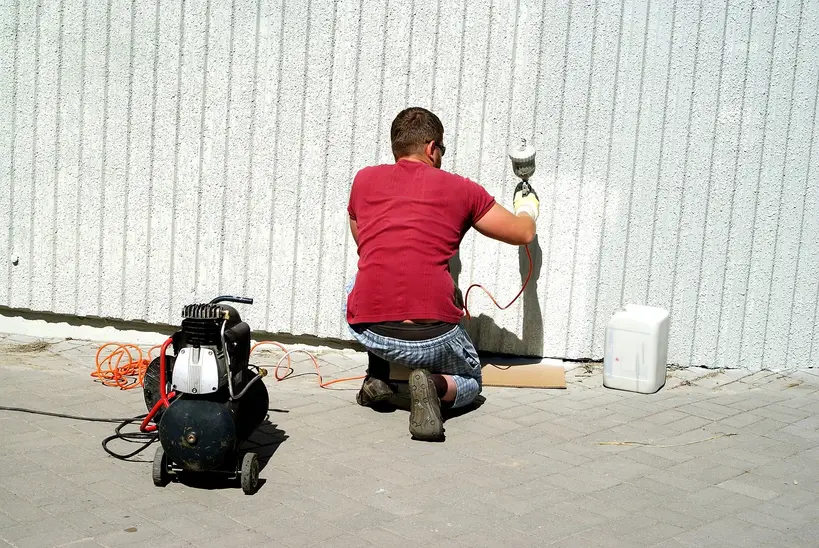
LVLP is usually the better fit for a small compressor because it runs at lower air volume and lower pressure than a typical HVLP gun. If your compressor cannot keep up with a higher-demand spray gun, LVLP reduces the chance of pressure drop, sputter, and uneven atomization.
AEROPRO TOOLS R500 LVLP is described as working at 3.0–3.9 cfm at 2.0–3.5 bar, which is the kind of operating range many small-shop users should examine first. That does not make it perfect for every job, but it makes the compressor match more forgiving.
Why LVLP often fits better
LVLP guns use less air, so they are less likely to outrun a small tank and force you into pauses between passes. That matters on home projects, where pressure sag can turn a smooth coat into a mottled one before the panel is finished.
When HVLP still works
HVLP still works if your compressor can maintain the required output, your hose is sized well enough, and your regulator keeps pressure stable at the gun. It can be a strong choice for base coat, clear coat, and primer because it gives high transfer efficiency and puts less paint into the air than older high-pressure setups.
How CFM and pressure limits change the result
If the gun asks for more air than the compressor can supply, the spray pattern narrows, the droplets get inconsistent, and the finish often dries rough before it levels. If pressure is too low, material can spit or fan unevenly. Either issue shows up fast on doors, fenders, and hood edges.
What size nozzle should you use?
For most home auto painting, 1.3 mm to 1.5 mm covers fine coatings, 1.7 mm to 1.8 mm suits primer and thicker material, and 2.0 mm to 2.5 mm is for heavier coatings or special-purpose flow. The right choice depends on viscosity, not just brand or gun type.
Touch-up and detail work
Use 1.0 mm or 1.3 mm when you want tighter control for small repairs, edges, and detail work. A smaller nozzle helps keep material output in check, which matters when the goal is a small blended area rather than a full panel.
Base coat and clear coat
Use 1.4 mm or 1.5 mm for many base coat and clear coat jobs. Those sizes are common because they balance atomization and flow without flooding the panel. Several kits in the market center on these sizes, including the ENDOZER set and the Zeinlenx set.
Primer and heavier materials
Use 1.7 mm, 1.8 mm, 2.0 mm, or 2.5 mm for primer and thicker coatings. If you force primer through a tip that is too small, the gun can starve the pattern, require excess pressure, or leave a rough coat that takes longer to sand.
Say your compressor is fine for 1.4 mm base coat work but you swap to 2.0 mm for primer without adjusting pressure and fluid. The gun may spit, the coat may look coarse, and sanding time goes up because the material did not atomize evenly.
Is HVLP or LVLP better for home auto painting?
Neither is universally better. HVLP is a strong choice when you have enough compressor capacity and want high transfer efficiency, while LVLP is often better when you need lower air demand and less overspray. The better gun is the one your compressor can support at the coating you plan to spray.
Air volume and overspray differences
HVLP guns use higher air volume than LVLP guns, and that can be a problem on small compressors. The upside is control and efficiency. The downside is the air supply requirement, which becomes visible as weak fan shape or pressure drop during longer passes.
Transfer efficiency and material waste
Transfer efficiency is where the choice matters in real use. AEROPRO TOOLS R500 LVLP is said to reach 65% paint transfer efficiency. On a home project, that means less paint ends up in the air or on masking paper, and more goes onto the panel where you want it.
That figure is not a promise of perfect results. It is a buying signal that the gun is built to send less material off-target, which helps when coating costs and cleanup time both matter.
What each type does to finish quality
HVLP can produce a cleaner finish when the compressor keeps up, because the spray pattern stays stable and the coating lands more evenly. LVLP can produce a better finish on a small compressor because a stable, lower-air spray is better than an unstable high-air one.
Choose the whole system, not just the gun. Nozzle size, gun type, compressor output, regulator placement, hose length, moisture control, and coating viscosity all affect the result. If one part is mismatched, the finish defect usually appears on the panel before the cause is obvious.
Match the gun to the coating
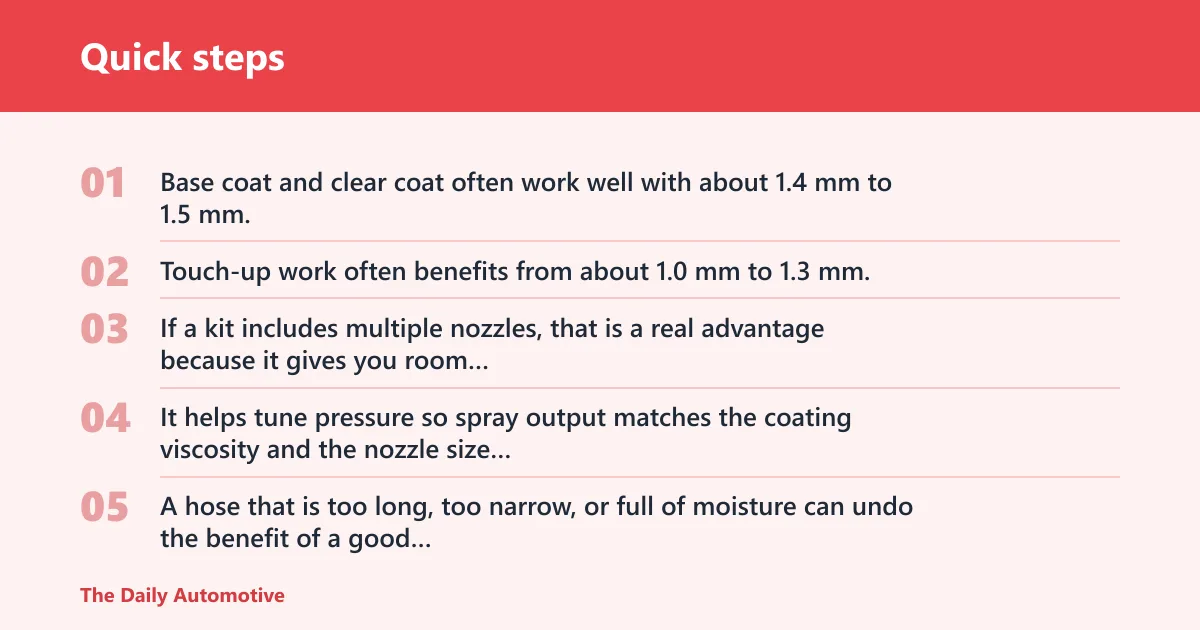
Base coat and clear coat often work well with about 1.4 mm to 1.5 mm. Primer often wants 1.7 mm or larger. Touch-up work often benefits from about 1.0 mm to 1.3 mm. If a kit includes multiple nozzles, that is a real advantage because it gives you room to match the coating instead of forcing one setup to do everything.
Check compressor, regulator, and hose setup
An air regulator is not optional trim. It helps tune pressure so spray output matches the coating viscosity and the nozzle size you chose. A hose that is too long, too narrow, or full of moisture can undo the benefit of a good gun.
An oil-water separator matters for the same reason. Moisture in the air line can lead to contamination, inconsistent atomization, and defects that look like poor paint quality even when the coating itself is fine.
Choose cup type, materials, and cleaning approach
Gravity-feed cups are commonly used in many listed models. They usually hold 600 ml / 20 oz in many listed models, provide steady material flow, improve visibility on the work, and make refills easier. That makes them a practical choice for home painting.
Look for stainless steel needles and nozzles, plus brass air caps or hoods. Brass is wear- and corrosion-resistant, and the ENDOZER hood’s 15-hole design is aimed at more uniform atomization. Those are practical durability features, not just spec-sheet clutter.
Disposable cup systems are useful when you want less cleanup. Some kits use about 600 ml or 650 ml liners, which can shorten teardown after primer, base coat, or clear coat work. The tradeoff is ongoing consumable cost, so they make the most sense if you spray often enough that cleanup time matters more than liner expense.
Picture a hobbyist spraying a full fender with clear coat using a 1.8 mm tip and an air regulator set too low. The finish may dry textured and rough because the droplets are too large and the pattern is unstable. Raise the system match first, and the same coating can lay down much more cleanly.
Paint gun decision matrix
| Job | Recommended nozzle size | Gun type | Compressor pressure / CFM tolerance | Likely failure mode if mismatched |
|---|---|---|---|---|
| Primer | 1.7 mm to 1.8 mm; 2.0 mm for thicker material | HVLP or LVLP with strong fluid control | Higher air demand; keep supply steady and avoid pressure sag | Dry spray, coarse texture, poor fill, or striping |
| Base coat | 1.3 mm to 1.5 mm | HVLP for compressor capacity; LVLP for smaller setups | Moderate air demand; stable pressure matters more than raw tank size | Orange peel, mottling, or uneven metallic laydown |
| Clear coat | 1.3 mm to 1.5 mm | HVLP or LVLP with smooth fan control | Stable pressure with clean, dry air | Runs, dry edge, or rough gloss from poor atomization |
| Touch-up | 1.0 mm to 1.3 mm | LVLP or detail-oriented HVLP | Lower air demand is often easier to manage | Overspray, heavy spot repair edges, or wasted material |
How to avoid overspray and orange peel when painting a car
Start with the right nozzle and the right gun for your compressor. Overspray usually comes from too much air, too much distance, or a spray pattern that is too wide for the task. Orange peel usually points to poor atomization, pressure mismatch, or coating that is landing too dry.
Practical setup habits
- Match nozzle size to coating thickness before opening the fluid control.
- Set the regulator at the gun, not just at the compressor.
- Use dry air through an oil-water separator.
- Keep the gun moving at a steady pace and overlap passes evenly.
- Test the fan pattern on masking paper before spraying the panel.
A common first-timer mistake is using a 1.4 mm tip for thick primer because it sprays fine on paper. The real problem shows up on the panel, where the coat looks dry and sandy because the material cannot flow correctly through the setup.
Frequently asked questions
What size nozzle should I use for car paint?
For many home jobs, 1.4 mm to 1.5 mm works for base coat and clear coat, while 1.7 mm to 1.8 mm fits primer. Use 1.0 mm to 1.3 mm for touch-up and detail work. The right nozzle depends on coating thickness and how much material you need to move.
Is HVLP or LVLP better for painting a car at home?
HVLP is better if your compressor can keep up and you want high transfer efficiency with lower overspray. LVLP is better if your compressor is smaller or you want a lower air-demand setup. The right choice depends on air supply first, not brand preference.
What CFM does a paint gun for cars need?
There is no single number that fits every gun, but the AEROPRO TOOLS R500 LVLP is listed at 3.0–3.9 cfm at 2.0–3.5 bar, which shows why CFM matters. Always compare the gun’s air need with what your compressor can sustain during a full pass.
Can I use one spray gun for primer, base coat, and clear coat?
Yes, if the gun supports multiple nozzle sizes and your compressor can handle the range of coatings. A multi-tip kit can work well, but primer, base coat, and clear coat do not all want the same fluid flow. You still need to change tips and settings.
Do disposable cup spray guns make cleanup easier?
Yes. Disposable cup systems with 600 ml or 650 ml liners reduce cleaning time because you throw away the liner instead of scrubbing a reusable cup after every job. The tradeoff is cost over time, so they make more sense for frequent painting or multi-stage projects.
What is the best paint gun for clear coat on cars?
A clear-coat gun should have good atomization, stable air delivery, and a nozzle around 1.3 mm to 1.5 mm. HVLP is often a strong choice if your compressor supports it. LVLP can be better when air supply is limited, as long as the spray pattern stays consistent.
Products related to this article
Sponsored / affiliate links. As an Amazon Associate I earn from qualifying purchases. I may earn additional commission from eligible campaigns.