Is Automotive Engineering Worth It? Career Check Guide
Yes, an automotive engineering degree pays off if you aim at EV powertrain, controls/software, manufacturing, or motorsport. Outside those lanes, mechanical engineering is usually the safer, broader choice. Pick the wrong major and you can pay more for fewer openings and less flexibility. This guide compares the degree with mechanical engineering and shows who should skip it.
What automotive engineering actually covers
Automotive engineering is a branch of vehicle engineering that brings together mechanical, electrical, electronic, software, and safety engineering. It applies to motorcycles, automobiles, and trucks, and it focuses on designing, developing, fabricating, and testing vehicles or components across production, development, and manufacturing. (en.wikipedia.org)
That definition matters because students often confuse the degree with automotive technology or mechanic training. Automotive technology generally prepares people for repair and service work. Automotive engineering is the degree path for design, validation, systems integration, and manufacturing decisions. Those are different jobs, different pay bands, and different coursework.
Where the work sits
The field touches the full vehicle cycle: concept design, component selection, prototype testing, compliance work, launch support, and plant-side production engineering. That is why one graduate may spend time in CAD and simulation, while another writes test plans, and another tracks line faults on a factory floor.
What sits inside the major
- Mechanical: structures, thermals, packaging, durability, and drivetrain hardware.
- Electrical: power distribution, battery systems, wiring, charging, and high-voltage safety.
- Electronic: ECUs, sensors, signal conditioning, and embedded hardware.
- Software: controls, diagnostics, autonomy, calibration, and validation tools.
- Safety: crashworthiness, functional safety, hazard analysis, and compliance.
Say your goal is to design a battery pack for a midsize EV SUV. The job is not just “car work.” It can involve thermal limits, crash packaging, voltage isolation, serviceability, and supplier sign-off, all before the vehicle reaches production.
Is automotive engineering worth it for your goals?
It is worth it when you want a targeted path into EV powertrain, controls, manufacturing, or motorsport and you can handle math, CAD, testing, and deadline pressure. It is a weaker fit if you want broad flexibility, dislike technical coursework, or want a job with fewer launch-cycle demands.
When the degree has strong return
The best return usually comes from roles tied to EVs, controls and software, manufacturing engineering, and motorsport or launch support. Those areas reward specialized technical skill. They also let employers judge candidates by proof of competence, not only by the degree title.
When the degree is a weak fit
If you want a wide range of office options without deeper technical work, the major can be a poor trade. The field asks for comfort with CAD, systems thinking, test data, production issues, and, in many roles, some coding or electrical knowledge. If that sounds tiring rather than interesting, a broader mechanical degree may fit better.
How to judge ROI before you apply
- Check whether the curriculum includes controls, embedded systems, EV systems, and manufacturing courses.
- Look for internships or co-ops with OEMs, suppliers, battery firms, or plants.
- Map likely jobs in your region, not just national averages.
- Compare tuition and living costs against the salary bands for your target role.
- Ask whether you want vehicle design, testing, production, or software work. If you do not know, the major may be too narrow.
Which four career bets pay off most?

In practice, the degree may be most useful in a few areas, such as EV powertrain and battery systems, controls and autonomous-driving systems, manufacturing and production engineering, and motorsport or launch-cycle program work. These paths show the clearest hiring need, the most specialized screening, and the closest link between what you study and what you do on the job.
EV powertrain and battery systems
Electric vehicles are driving demand for this work. That creates roles in battery pack design, thermal management, high-voltage safety, inverter integration, charging systems, and vehicle-level powertrain calibration. This is one of the clearest reasons the field is growing: the skill set is more specific than classic engine work.
Controls, sensors, and autonomous-driving systems
Autonomous driving changes the skill mix from purely mechanical to multidisciplinary. It creates demand for software, sensor fusion, validation, and controls work. Students who can handle Python, C/C++, data analysis, and system testing often have a better shot here than students who want only mechanical design.
Manufacturing and production engineering
Manufacturing is the most overlooked path. It covers tooling, process improvement, quality, line support, and launch readiness. It is not glamorous, but it is often where employers need people who can solve problems fast and keep production moving.
Motorsport and launch-cycle program work
Motorsport can be exciting, but it is a narrow niche with high pressure and limited seats. Launch-cycle work is broader, yet it shares the same traits: long hours, strict deadlines, and constant re-skilling. If that pace sounds appealing, the field can fit. If not, it can be draining.
Picture a supplier engineer assigned to a new EV platform six months before launch. The workweek may swing from simulation reviews to late-night build fixes to test-track issues. That pace is common near launch, and it is one reason the degree can pay well without always offering a calm schedule.
How much can automotive engineers make?
Automotive engineering pay varies because employers do not track the field as cleanly as some other professions. Mechanical engineering is often the closest official government labor category, and that makes it the best salary proxy when comparing public data. Specialization, region, and experience move pay faster than the title alone.
What the cited salary range means
The cited salary figures appear to span roughly the high-$80,000s to around $140,000 per year, with some other estimates landing in the mid-to-high $100,000 range. That spread is normal. Entry-level work, supplier roles, OEM design, EV programs, and software-heavy jobs do not pay the same, and the gap widens with experience and scarcity of skill.
| Pay reference | Cited figure | What it usually implies |
|---|---|---|
| Lower cited estimate | $89,496 | Often aligns with early-career or less specialized roles |
| Another cited estimate | $115,459 | Mid-range pay for established engineering roles |
| Another cited estimate | $127,528 | Often reflects stronger specialization or higher-cost markets |
| Higher cited estimate | $140,035 | More likely tied to specialized or advanced roles |
| Mechanical engineer median wage | $102,320 | Government proxy for comparison |
The Bureau of Labor Statistics reported a median annual wage of $102,320 for mechanical engineers. That does not equal automotive engineer pay, but it gives a grounded benchmark when broad salary claims get fuzzy. It also helps explain why ROI depends on the exact role, not the degree label alone.
Why specialization changes pay faster than the degree title
Two graduates can have the same degree and very different pay. A battery systems engineer, a calibration engineer, and a production engineer may all be “automotive engineers” in casual terms, yet their market value differs because their work solves different problems and uses different technical stacks.
What does the job market really look like?
The job market looks positive overall, though growth varies by role. Mechanical engineers were projected to grow by about 3% from 2019 to 2029, while automotive service technicians and mechanics were projected at about 2%. Specialized EV and ADAS roles may outpace general roles, but geography, OEM cycles, and supplier health still shape hiring.
What the Bureau of Labor Statistics tells you
The BLS proxy suggests steady but not explosive growth. That means this is not a guaranteed fast-track field. It is more accurate to say the market rewards targeted skills in EV, controls, manufacturing, and vehicle electronics than to say every automotive degree holder will have easy demand.
The limits you need to price in
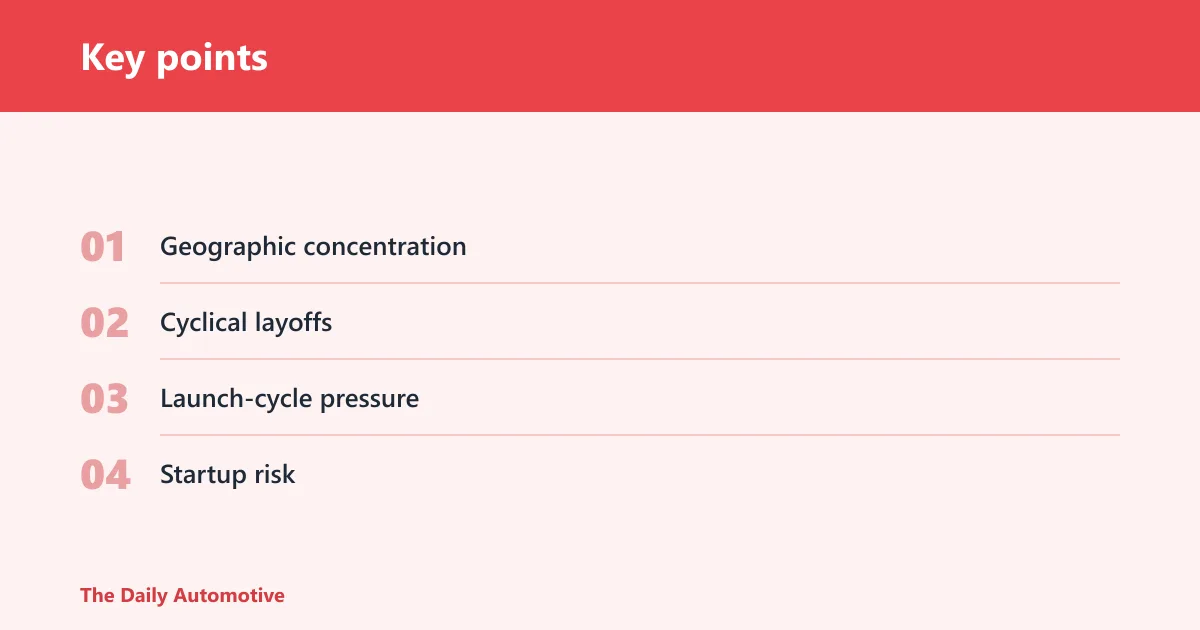
- Geographic concentration: many jobs cluster near OEMs, suppliers, test centers, and manufacturing hubs.
- Cyclical layoffs: platform delays, plant changes, and downturns can cut hiring fast.
- Launch-cycle pressure: hours often spike near SOP, or start of production.
- Startup risk: EV startups may offer upside, but also funding and churn risk.
Some recruiters talk about demand without naming the weak spots. That leaves students guessing. The better question is not whether the field is “in demand,” but whether your target region has the OEMs, suppliers, plants, or test labs that hire your specialty.
Use the decision matrix before you commit

This degree is easiest to judge by path, not by brand name. The matrix below scores the main career bets on salary ceiling, job stability, coursework difficulty, overtime risk, and fit for four common profiles. Higher scores are better for salary ceiling, stability, and profile fit, while lower scores are better for coursework difficulty and overtime risk.
| Path | Salary ceiling | Job stability | Coursework difficulty | Overtime risk | Design-oriented fit | Hands-on shop-oriented fit | Software-oriented fit | ROI-focused fit |
|---|---|---|---|---|---|---|---|---|
| EV powertrain and battery systems | 5/5 | 4/5 | 5/5 | 3/5 | 4/5 | 3/5 | 4/5 | 5/5 |
| Controls and autonomous-driving systems | 5/5 | 3/5 | 5/5 | 4/5 | 3/5 | 2/5 | 5/5 | 4/5 |
| Manufacturing and production engineering | 4/5 | 5/5 | 3/5 | 4/5 | 2/5 | 5/5 | 2/5 | 5/5 |
| Motorsport and launch-cycle program work | 3/5 | 2/5 | 4/5 | 5/5 | 5/5 | 3/5 | 2/5 | 2/5 |
Which path fits design-oriented students
If you want packaging, CAD, component tradeoffs, and system layout, EV powertrain and motorsport tend to fit best. They reward visual problem-solving and vehicle-level thinking. Just expect heavier pressure in launch work and a need to learn enough electronics to stay useful.
Which path fits hands-on shop-oriented students
If you like tools, builds, and line-side troubleshooting, manufacturing and production engineering usually fit best. This path can feel practical and visible. It is also one of the better options for job stability, especially near large plants or supplier parks.
Which path fits software-oriented students
If coding, data, and sensor logic appeal to you more than physical parts, controls and autonomous-driving systems are the strongest match. This area can pay well, but it also brings a steeper technical load and more competition from computer, electrical, and robotics graduates.
Which path fits ROI-focused students
If your main question is return on tuition, manufacturing and EV powertrain are usually the strongest bets. They pair clearer demand with broad usefulness. Motorsport is usually the weakest ROI choice because it is narrow, intense, and often harder to enter than its reputation suggests.
What education path makes the most sense?
The right education path depends on the job you want. An associate degree can support technician or applied manufacturing roles. A bachelor’s degree is the normal entry point for automotive engineering jobs. A master’s degree can be especially helpful if you want deeper specialization in controls, autonomy, battery systems, or design.
Associate degree vs bachelor’s vs master’s
- Associate: best for technician work, plant support, inspection, and applied testing roles.
- Bachelor’s: the standard route for engineering jobs in OEMs, suppliers, and design teams.
- Master’s: useful when you want advanced controls, autonomy, EV systems, or R&D roles.
When a mechanical engineering base is smarter
If you want to keep your options open, a mechanical engineering degree plus automotive projects can be a stronger route than a dedicated automotive program. That path usually keeps access to aerospace, industrial, energy, and general product design roles, while still allowing a move into vehicle work later.
What extra training helps most
For EV roles, high-voltage safety, battery systems, and thermal management matter. For autonomous and controls roles, coding, sensors, signal processing, and validation tools matter. For manufacturing, lean methods, quality systems, and production troubleshooting matter. Extra projects and internships often matter as much as the diploma.
Is automotive engineering in demand
Yes, but demand is concentrated rather than universal. EVs, autonomous driving, and vehicle electronics are pushing demand for specialized skills, while general mechanical demand remains steadier than explosive. The field is strongest where employers need people who can bridge hardware, software, and manufacturing.
A common first-timer mistake is choosing the major because cars are interesting, then discovering that the actual job is test plans, tolerance stacks, software debugging, or production escalations. Interest helps. It is not enough on its own.
Frequently asked questions
is it worth studying automotive engineering
Yes, if the program gives you real exposure to EV systems, controls, electronics, testing, and manufacturing. It is weaker if it is mostly branding with little technical depth. A mechanical degree plus automotive projects can be a better value when the school’s automotive curriculum is thin.
is automotive engineering a good career
It is a good career for students who want technical work tied to real products and who can live with deadlines, testing, and constant re-skilling. It is a poor fit for people who want a wide-open degree with minimal math, coding, or production pressure.
what jobs can you get with automotive engineering
Common jobs include EV powertrain engineer, battery systems engineer, controls engineer, validation engineer, manufacturing engineer, quality engineer, vehicle design engineer, and motorsport engineer. Some graduates also move into supplier support, test engineering, calibration, and production launch roles.
do you need extra specialization for automotive engineering
Usually, yes. The best-paying and most stable roles often require extra focus in EV systems, controls, software, manufacturing, or safety. A general degree can open the door, but specialization usually decides which jobs you can actually compete for after graduation.
is automotive engineering better than mechanical engineering
Not by default. Automotive engineering is better if you already know you want vehicle work and you are comfortable with a narrower track. Mechanical engineering is better if you want a broader job market, more fallback options, and less risk if automotive hiring cools in your region.
Products related to this article
Sponsored / affiliate links. As an Amazon Associate I earn from qualifying purchases. I may earn additional commission from eligible campaigns.