How Are Electric Car Batteries Made? Simple Breakdown
Electric car batteries are commonly described as being built in four factory stages: raw material processing, cell production, module or pack assembly, and final validation. Chemistry and quality control at each stage shape range, safety, and lifespan. Poor material handling, sloppy assembly, or weak testing can shorten range, speed up degradation, and raise replacement risk. This guide breaks down each step in plain English and shows what it means for ownership.
What makes up an EV battery?
Most EVs on the road today use lithium-ion battery packs with cells arranged for high energy density and long cycle life. The pack is the car’s main energy store, built from many small cells that are grouped into modules or integrated directly into the pack. A battery management system, or BMS, tracks charge, capacity, temperature, and cell balance. Thermal control heats and cools the pack.
Cells, modules, and the pack
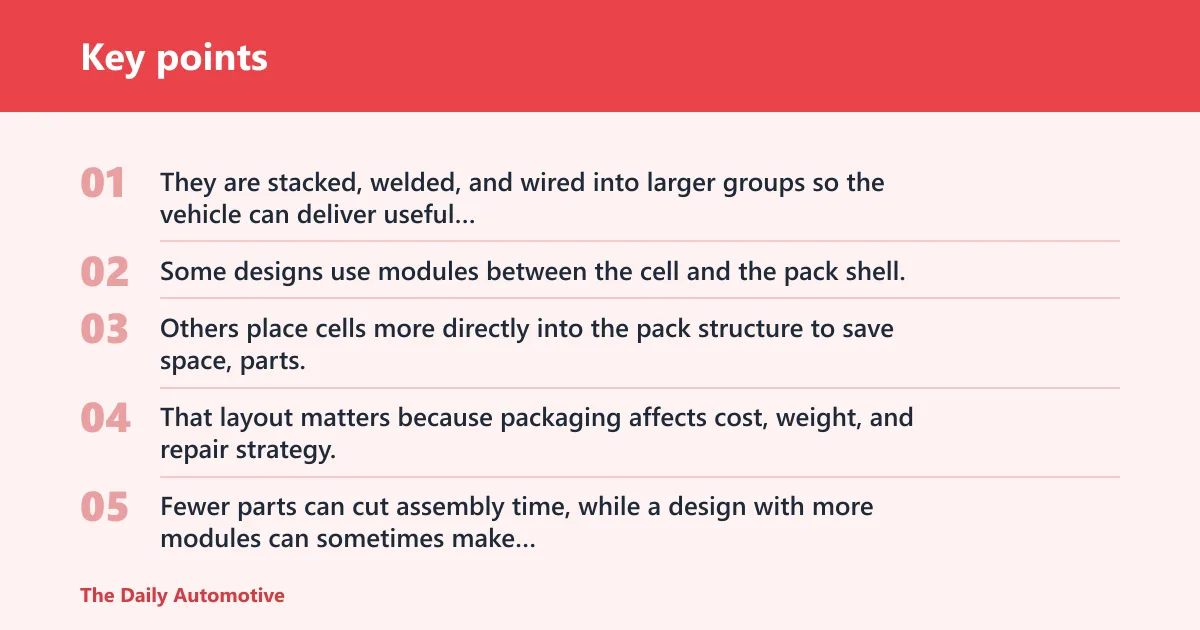
Battery cells are the basic units. They are stacked, welded, and wired into larger groups so the vehicle can deliver useful voltage and current. Some designs use modules between the cell and the pack shell. Others place cells more directly into the pack structure to save space, parts, and assembly time.
That layout matters because packaging affects cost, weight, and repair strategy. Fewer parts can cut assembly time, while a design with more modules can sometimes make service and isolation easier if one section fails. Audi says its Q6 e-tron pack is smaller, lighter, made up of fewer cells than earlier versions, and can be built in roughly half the time of previous packs.
Why the BMS matters
The BMS is the pack’s control layer. It tracks state of charge and capacity, blocks overcharge and overdischarge, controls charging and thermal behavior, and stores diagnostic data. Without that software layer, cells would drift apart in voltage and temperature, which would hurt range and shorten useful life.
Automakers use software-based battery management to improve efficiency in hot and cold climates. That is one reason EV range changes with weather. It is also why a battery can look healthy on a dashboard while the BMS quietly trims power to protect the pack.
How thermal control fits
The thermal management system heats and cools the pack. In cold weather, it helps the battery accept charge and deliver power. In hot weather, it limits heat soak, which supports longevity and charging performance. Heat is a major reason EV batteries lose capacity faster over time.
How are electric car batteries made?
Battery factory work typically starts with raw material processing, then electrode and cell production, then module or pack assembly, then testing and formation cycling. The core idea is simple: the factory turns mined and refined material into cells, then turns cells into a high-voltage pack that the car can monitor and use safely.
Raw materials and supply chains
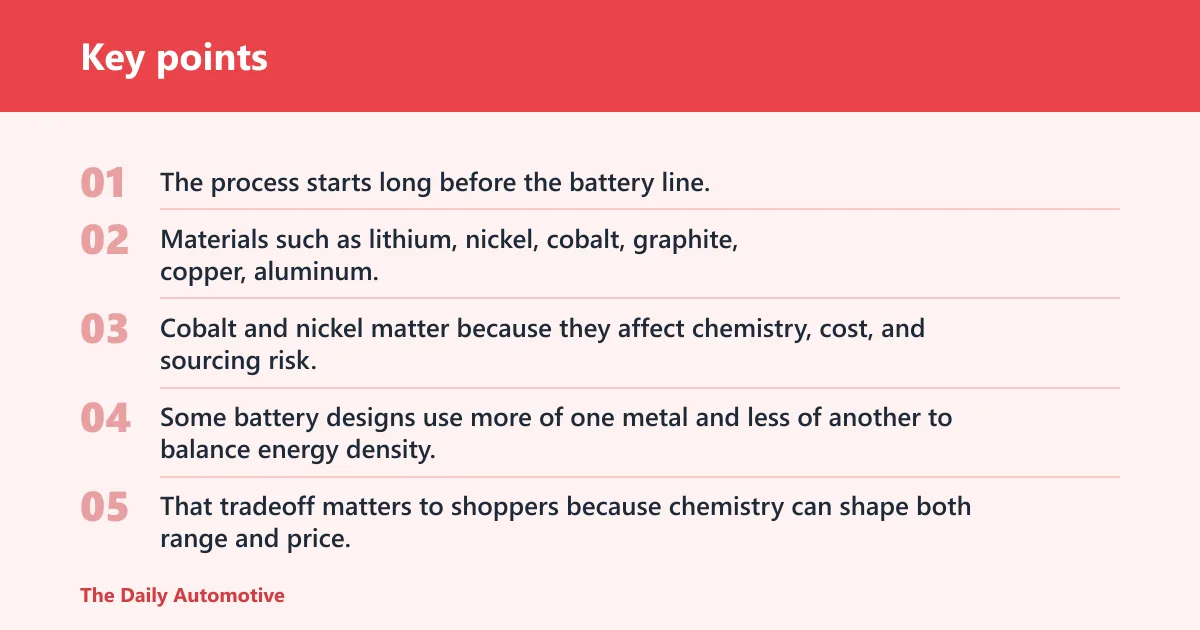
The process starts long before the battery line. Materials such as lithium, nickel, cobalt, graphite, copper, aluminum, and electrolyte ingredients generally need to be refined and delivered in tightly controlled form. Cobalt and nickel matter because they affect chemistry, cost, and sourcing risk. Some battery designs use more of one metal and less of another to balance energy density, durability, and supply constraints.
That tradeoff matters to shoppers because chemistry can shape both range and price. Lithium-ion batteries store more energy per pound and per gallon than lead-acid batteries and nickel-metal hydride batteries, which is why they dominate modern EVs. Higher energy density means more stored energy for a given size and mass, which helps range.
Electrode coating, cell assembly, and formation cycling
Inside the cell plant, manufacturers coat active material onto metal foil, dry it, cut it, stack or wind it, and seal it with electrolyte. Then comes formation cycling, a controlled first charge and discharge process that helps the cell settle into its usable behavior. This is where weak cells can be caught before shipping.
Formation cycling is also where quality control starts to separate good cells from bad ones. A cell that looks fine on paper can still show abnormal resistance, self-discharge, or capacity spread when charged and discharged under controlled conditions. Lithium-ion batteries self-discharge at only 1 to 2 percent per month in suitable conditions, so unusual loss during screening is a warning sign.
Module and pack assembly
After cell screening, the factory groups cells into modules or integrates them directly into the pack. Busbars, cooling plates, sensors, and protective housings get added. The pack must be mechanically secure and electrically stable, because a loose connection or damaged insulator can cause heat, imbalance, or shutdowns later.
A common first-timer mistake is assuming the pack is a single giant battery. It is really a managed system made of many cells, wiring, cooling paths, and software controls. That system-level design is why two EVs with similar range can age differently once heat, charging habits, and cell chemistry enter the picture.
Battery factory map
| Stage | What happens | Why it matters | Common failure point |
|---|---|---|---|
| Raw materials | Metals and electrolyte ingredients are mined, refined, purified, and shipped to the cell plant. | Impurities and supply constraints can change chemistry, cost, and the consistency of the final pack. | Contamination, uneven material quality, and supply interruptions. |
| Electrode and cell manufacturing | Active material is coated on foil, dried, cut, stacked or wound, filled with electrolyte, sealed, and formation-cycled. | This stage shapes energy density, range, and early-life durability. | Coating defects, moisture intrusion, separator damage, or weak cells found during formation cycling. |
| Pack assembly | Cells are grouped into modules or packed directly, then fitted with wiring, cooling hardware, sensors, and the BMS. | Good pack design improves safety, serviceability, and thermal control. | Loose interconnects, poor cooling contact, sensor faults, or imbalance between cell groups. |
| End-of-line testing | The finished pack is checked for leaks, electrical faults, software behavior, and overall performance before shipment. | Validation protects range, durability, and warranty outcomes. | Hidden defects that only appear under load, heat, or repeated charging. |
Range, cost, and durability all connect back to this map. Raw materials drive cost. Cell quality drives usable capacity. Pack assembly influences thermal control and serviceability. Final validation catches defects before the pack reaches a buyer.
Why do materials like nickel and cobalt matter?
Nickel and cobalt matter because they affect chemistry, energy density, cost, and sourcing pressure. Not every EV battery uses the same mix. Some designs lean toward higher energy density, while others prioritize lower material cost or less exposure to supply risk. That choice changes how the pack behaves in the real world.
Chemistry choices and cost
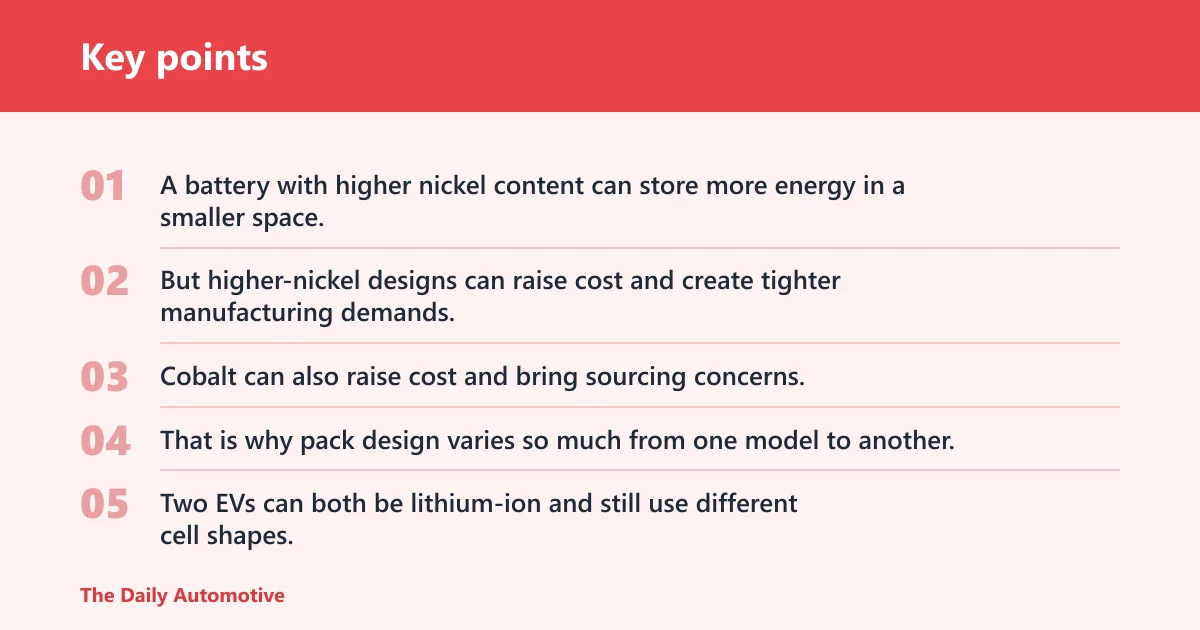
A battery with higher nickel content can store more energy in a smaller space, which can help range. But higher-nickel designs can raise cost and create tighter manufacturing demands. Cobalt can also raise cost and bring sourcing concerns, so automakers keep looking for chemistries that reduce dependence on it.
That is why pack design varies so much from one model to another. Two EVs can both be lithium-ion and still use different cell shapes, different cooling layouts, and different metal mixes. Those differences show up in price, charge speed, cold-weather behavior, and long-term fade.
How chemistry affects range and durability
Battery chemistry affects how much energy fits in the pack, how fast it can charge, and how it tolerates heat. Higher energy density helps range, but thermal control and BMS tuning matter just as much for daily use. Heat and extreme temperatures shorten battery life, so chemistry and cooling have to work together.
Suppose a sedan uses a chemistry tuned for dense packaging and fast charging, while a crossover uses a layout aimed at lower cost and simpler cooling. The sedan may offer more range from a smaller pack, but the crossover may be cheaper to build and easier to manage over repeated charge cycles. That is a tradeoff, not a defect.
Where does quality control happen?
Quality control starts during cell formation and continues through pack-level testing. The factory is looking for weak cells, bad seals, out-of-spec resistance, sensor problems, and software faults before shipment. That matters because a battery’s later life often starts with the checks that happen before it ever reaches the car.
Formation cycling and cell screening
Formation cycling is the first chance to see how a cell behaves under real electrical stress. Cells with uneven capacity, voltage drift, or abnormal self-discharge can be removed before they are built into a pack. This screening step helps protect both range and durability.
Common failure points here include moisture contamination, misaligned layers, poor sealing, and defects that do not show up until the cell is charged and discharged. A battery with one weak cell can trigger the BMS to limit output or charging, even if the rest of the pack is healthy.
Pack-level testing and validation
End-of-line testing checks the complete pack after assembly. Factories verify electrical isolation, coolant integrity, software communication, and basic performance under controlled conditions. This is the last chance to catch a problem before the pack is installed in the vehicle.
Validation also helps explain why some packs leave the plant with different service profiles. A smaller or lighter pack may be easier to build, but if the assembly process is rushed, the benefit can disappear. Good testing reduces the chance of an early failure that would otherwise show up as reduced range, warning lights, or charging issues.
How do battery design and heat affect lifespan?
Battery life declines over time because of age, charge cycles, and heat. Capacity degradation is the percentage of usable storage lost as the pack ages. The BMS can slow that loss, but it cannot stop it completely. That is why design, cooling, and charging behavior all matter.
Charge cycles and capacity degradation
Every charge cycle uses a small amount of the battery’s long-term life. Frequent fast charging, repeated deep discharges, and high heat can push degradation faster. The pack may still work well, but it will hold less energy than it did when new.
That is the point where warranty language matters. All automakers currently offer at least an eight-year, 100,000-mile battery warranty. Some go further: Tesla battery coverage can extend to 150,000 miles depending on the vehicle, and Tesla’s warranty requires the battery to retain at least 70 percent capacity. Hyundai and Kia offer 10-year, 100,000-mile battery warranty coverage. (Caranddriver)
Hot and cold weather effects
Cold weather can slow charging and reduce temporary range. Heat can speed up long-term wear. The thermal management system helps on both ends by warming the pack before charging and cooling it when conditions get too hot. That control supports charging speed, range consistency, and long-term durability.
Real-world data backs up the basic pattern. Tesla owners in the Netherlands saw average degradation of around 5 percent in 50,000 miles, and that same study showed 10 percent capacity loss or less after 150,000 or 200,000 miles. Those numbers do not mean every pack will age the same way, but they do show that many packs last a long time.
What happens during an EV battery replacement?
An EV battery replacement usually starts with diagnostics, not a wrench. Technicians check fault codes, state of health, and pack behavior before deciding whether the pack needs to come out. If replacement is needed, the pack is removed from under the chassis, a new or repaired unit is installed, and the vehicle gets post-swap testing and validation.
Diagnostics before the swap
Replacement work begins with owner outreach and diagnostics. The goal is to confirm whether the issue is a failing module, software problem, wiring fault, or a full pack issue. That matters because not every battery complaint needs a complete replacement.
High-voltage battery systems require basic safety awareness. Technicians use high-voltage safety equipment during replacement, and owners should not open or service the pack themselves. The pack stores enough energy to make improper work dangerous.
Removal, installation, and post-swap checks
Recurrent notes that the pack is dropped out from the bottom of the chassis during replacement. That underbody location is common because it saves cabin space and helps keep the center of gravity low. After the pack is installed, the car needs software checks, charging confirmation, and road validation.
Post-replacement testing matters because the new pack must talk correctly to the BMS, thermal system, and charging hardware. If those systems do not agree, the car may limit power or charging until the fault is cleared. A good replacement ends with validation, not just a bolted-in pack.
Frequently asked questions
How are batteries for electric cars made?
They are made in four main stages: raw material processing, electrode and cell production, pack assembly, and final validation. The factory first turns mined materials into battery-grade inputs, then builds cells, groups those cells into modules or packs, and runs formation cycling and end-of-line tests before shipment.
What happens to electric car batteries?
Over time, batteries age through charge cycles, heat exposure, and calendar wear. Capacity gradually falls, which can trim range and charging performance. The BMS keeps watch, and the thermal system helps slow wear, but the pack will still degrade. If it falls far enough, warranty rules may apply.
How do electric car batteries work?
Battery cells store energy chemically and release it as electricity when the car asks for power. The BMS monitors state of charge, capacity, temperature, and cell balance, while the thermal system keeps the pack in a safer operating range. Together they protect the pack and keep output predictable.
What are electric car batteries made of?
They are made from lithium-ion cells, plus materials such as nickel, cobalt in some designs, graphite, copper, aluminum, electrolyte, cooling hardware, wiring, sensors, and a protective case. The exact mix varies by chemistry, which is why cost, range, and longevity differ from one EV to another.
How long do electric car batteries last?
Most EV battery warranties run at least eight years and 100,000 miles, and some go longer. Tesla coverage can reach 150,000 miles depending on the vehicle, with a 70 percent capacity threshold. Real-world life often stretches beyond that, but heat, charging habits, and age still matter.
Products related to this article
Sponsored / affiliate links. As an Amazon Associate I earn from qualifying purchases. I may earn additional commission from eligible campaigns.