Is Automotive Service Technician a Good Career? Key Facts
Yes, automotive service technician can be a good career if you want hands-on work and can complete a 6–24 month training path; it fits poorly if you want clean work, fixed hours, or low physical strain. A bad fit can mean low pay early, injury risk, and costly retraining. This guide explains training, pay, day-to-day work, and which automotive career path fits you best.
What the Job Involves and Who Fits the Role


What this job really involves day to day
An automotive service technician and mechanic diagnoses, repairs, and maintains vehicles. Entry work often starts with oil changes, brakes, inspections, and routine maintenance, then moves toward electrical faults, drivability problems, and more advanced diagnostics as skill grows. (bls.gov)
The work is hands-on and often time-sensitive. A shop may need a car back the same day, while a fleet or dealer bay may be handling warranty work, scheduled maintenance, and customer complaints at once.
Who tends to do well in this career
This job fits people who like mechanical problem-solving, can work safely around heavy equipment, and do not mind learning new systems every few years. It also suits workers who want a faster route into paid work than a four-year degree usually requires.
It is a poorer fit if you dislike dirt, noise, tight deadlines, or repeated retraining. It can also frustrate people who want a predictable desk-style schedule or minimal customer interaction.
What does an automotive service technician do?
An automotive service technician finds faults, replaces worn parts, performs maintenance, and verifies that repairs solve the complaint. The role spans inspection, diagnosis, repair, and follow-up testing, so the work is broader than changing parts alone.
Diagnosis, repair, and routine maintenance
Routine jobs can include fluids, filters, brakes, tires, alignments, batteries, and inspections. More advanced work can involve scan tools, wiring diagrams, sensor testing, software-related faults, and intermittent no-start or warning-light problems.
Where the work happens: dealer, independent shop, fleet, specialty shop
Dealer technicians often see newer vehicles, brand-specific tools, and warranty procedures. Independent shops may handle a wider mix of makes and ages. Fleet work can mean repeat customers and scheduled maintenance. Specialty shops may focus on transmissions, electrical work, hybrids, diesel, glass, or collision-related repair.
How this role differs from body repair and diesel work
Auto service technicians work on how a vehicle runs. Auto body technicians repair panels, frames, paint, and collision damage. Diesel work is another branch with heavier engines, commercial vehicles, and different diagnostic demands.
That distinction matters because pay, training, and physical strain can vary a lot by segment. A body shop estimator, a diesel technician, and a hybrid diagnostics specialist are not interchangeable career paths.
How much do automotive technicians get paid?
The usual pay benchmark is the median annual wage cited at roughly $47,900, with an older figure of $42,090 from 2019 often still repeated online. That median helps set expectations, but actual earnings vary sharply by region, experience, specialization, and pay system.
BLS wage context and what median pay means
The U.S. Bureau of Labor Statistics is a common source for wage data and outlook information for automotive service technicians and mechanics. Median pay means half of workers earn less and half earn more, so it is a midpoint, not a starting salary or a top-end wage.
The occupation is described as an in-demand and good-paying job. That does not mean every bay pays well right away. Entry-level work can still feel tight if you are buying tools, paying for training, and earning beginner wages.
Why pay changes by region, experience, and employer type
Location matters because labor rates, cost of living, and customer demand vary. Experience matters because a tech who can diagnose electrical faults or complex drivability issues is usually more valuable than someone limited to quick service work.
Employer type matters too. Dealer technician and independent shop roles do not pay the same way, and specialty work often pays more than basic maintenance. Diagnostics and EV repair often bring stronger wages than oil changes and brake pads alone.
Flat-rate pay, hourly pay, overtime, and benefits
Flat-rate pay rewards billed labor time, but it can be risky when work is slow, comebacks happen, or repairs take longer than expected. Hourly pay can feel safer, especially for beginners, though the top end may be lower in some shops.
Benefits, overtime, tool allowances, and paid training can change the real value of a job. A shop with slightly lower hourly pay may still be the better offer if it provides steadier hours or better benefits.

What training do you need to become an automotive technician?
Many entry routes require only a high school diploma and focused training. Trade school or vocational training is a shorter path than a four-year degree, and many programs run from six months to two years. On-the-job learning then fills in the real-world details.
High school diploma or equivalent
A high school diploma or GED is often a common baseline. From there, employers may hire helpers or lube techs and train them upward, especially if the applicant shows reliability, basic math skills, and comfort with tools.
Trade school and vocational programs: what they cover
Trade school programs often cover engines, brakes, steering, electrical systems, diagnostics, and shop safety. That classroom time can shorten the learning curve, especially for someone starting with little technical experience.
Program length often falls between six months and two years. Longer programs may include internship-style shop time, which helps connect textbook knowledge to actual repair orders.
On-the-job learning, tools, and first certifications
New technicians still learn the most on the job. The first months usually involve basic maintenance, tool use, organization, and shop process. Tool purchases can become a major expense, so budget for that before jumping in.
One common path looks like this:
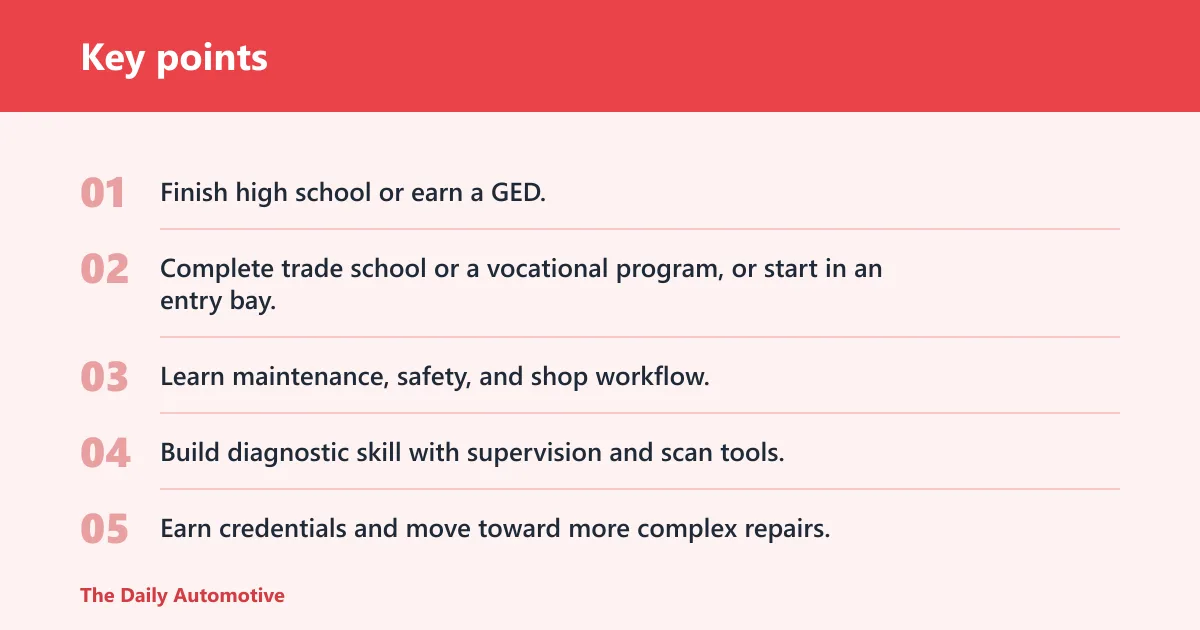
- Finish high school or earn a GED.
- Complete trade school or a vocational program, or start in an entry bay.
- Learn maintenance, safety, and shop workflow.
- Build diagnostic skill with supervision and scan tools.
- Earn credentials and move toward more complex repairs.
How does ASE certification affect your career?
ASE certification is an industry-recognized credential that can signal competence and employability. It does not guarantee skill by itself, but employers often use it as evidence that a technician has passed standardized testing and understands core systems.
What ASE certification signals to employers
ASE certification can matter most when a shop must trust you with customer vehicles, complex diagnostics, or warranty work. One service shop says its technicians are A.S.E. certified, which reflects how common the credential is in real hiring decisions.
How certification fits with master technician growth
ASE credentials can support progress toward master mechanic status. They also make it easier to move between employers, because they give a portable signal of training beyond one shop’s reputation.
When certification matters more than school brand
For many employers, skill and proof of competence matter more than school name. A strong certificate, solid references, and the ability to diagnose real faults can count for more than a longer program with weaker shop training.
Which technician path fits you best?
The best path depends on how much training you want, how much physical strain you can tolerate, and how fast you want pay growth. General service is the easiest entry, diagnostics has the strongest upside for problem-solvers, dealer work can be structured, and specialty repair can reward deep expertise.
Technician-career fit matrix by path and trade-off
| Path | Pay upside | Training time | Physical demands | Future demand |
|---|---|---|---|---|
| General service | Low to moderate | Short | Moderate | Steady |
| Diagnostics | High | Longer | Moderate | Strong |
| Dealership technician | Moderate to high | Moderate | Moderate | Strong |
| Specialty repair | High | Moderate to long | Varies | Strong in niches |
General service versus diagnostics
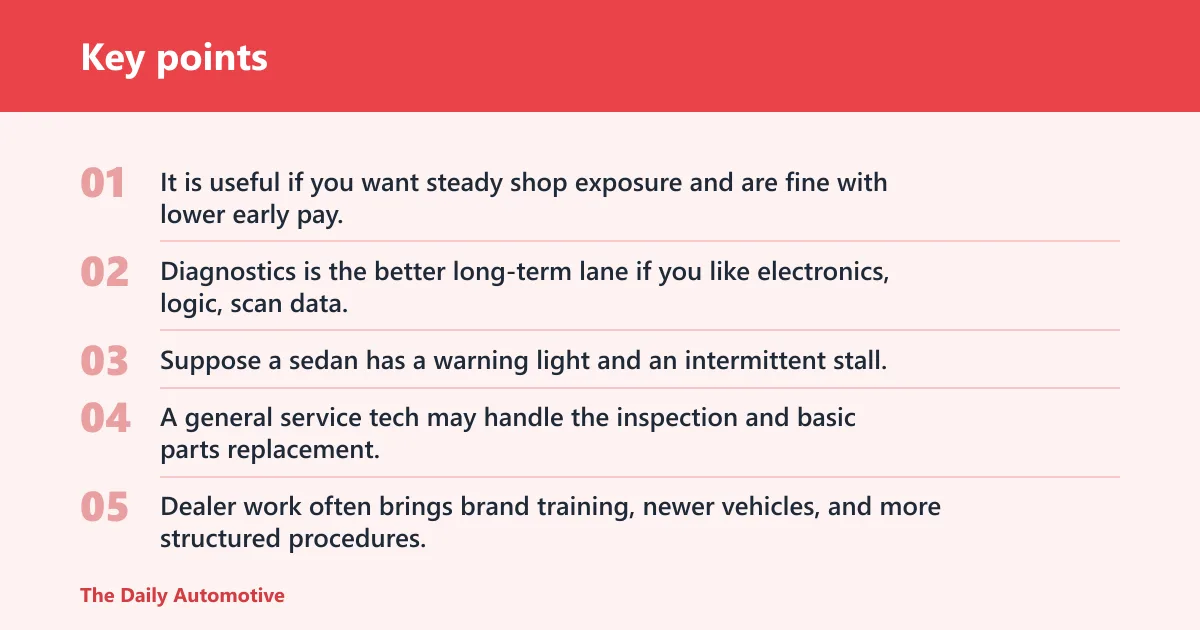
General service is the quickest way in. It is useful if you want steady shop exposure and are fine with lower early pay. Diagnostics is the better long-term lane if you like electronics, logic, scan data, and chasing faults that other techs could not pin down.
Suppose a sedan has a warning light and an intermittent stall. A general service tech may handle the inspection and basic parts replacement, while a diagnostics tech is more likely to trace the root cause through wiring, sensors, and software-related checks.
Dealer technician versus independent shop
Dealer work often brings brand training, newer vehicles, and more structured procedures. Independent shops may offer broader variety and closer customer contact. Pay and responsibilities vary by setting, and that variation matters more than the job title alone.
A dealer bay may be a better fit if you want a defined process and access to manufacturer systems. An independent shop may suit someone who likes variety and is comfortable switching between older and newer vehicles.
Specialty repair, including hybrid and EV work
Hybrid and electric vehicles are increasing technical complexity. Technicians need to understand both old and new technologies, especially high-voltage safety, software behavior, regenerative systems, and diagnostic workflows.
That creates an opening for people willing to learn. A shop that services hybrid and alternative fuel vehicles, or one that lists electrical services, transmission services, and computer diagnostics, is signaling where the market is heading.
A few concrete shop signals to watch
Baldwin Automotive lists electrical services, transmission services, and computer diagnostics. It also says some repairs can be completed in as little as one day, which is a reminder that productivity matters as much as technical skill.
One shop operates Monday through Friday during daytime business hours, while another lists weekday hours in a similar range. Hours like these show that schedule patterns are often fixed by the shop, not the technician’s preference.
What are the main downsides of the job?
The biggest downsides are physical strain, injury risk, tool costs, schedule pressure, and the need to keep retraining. It can be a solid career, but it is not low-stress work, and it is not well suited to people who want clean conditions or a desk-like pace.
Physical strain, injury risk, and uncomfortable conditions
This is a hands-on trade around heavy machinery, hot parts, sharp edges, chemicals, lifts, and moving vehicles. Work may happen on concrete floors, under hoods, in cramped spaces, and in hot or cold bays.
That is why injury prevention matters. Good shop habits, proper lifting, eye protection, and electrical safety are part of the job, not extras.
Schedule pressure, weekends, and customer deadlines
Some shops demand long or irregular hours, especially when customers want cars back fast or when the schedule fills with warranty work and same-day repairs. Flat-rate systems can increase pressure because time lost is often money lost.
Tool costs, retraining, and keeping up with new systems
Tools are expensive, and they do not stop evolving. New scan tools, software access, and brand-specific procedures can mean ongoing training costs. Technicians who ignore retraining can fall behind quickly.
A common first-timer mistake is thinking an auto tech career means only changing oil and never learning new diagnostic skills. It does not. The learning curve continues as engines, drivetrains, electronics, and software change.
Is automotive service technician a good career for the future?
Yes, it can be, because vehicle complexity keeps skilled work in demand and older workers retiring creates many new positions every year. The stronger future value is in technicians who can diagnose electronics, software faults, and hybrid or EV systems, not just change parts.
Why vehicle complexity keeps skilled work in demand
Modern vehicles have more sensors, modules, software logic, and networked systems than older models. That means repairs increasingly require diagnosis, not guesswork. Shops still need people who can think through problems and confirm the fix.
How hybrids, EVs, and software are changing the skill mix
Hybrid and electric vehicles are changing the work from traditional mechanical repair toward electrical systems, software-related complaints, and high-voltage awareness. That does not remove the need for technicians; it changes which technicians become most valuable.
Which skills matter most over the next 3 to 5 years
Over the next few years, likely useful areas include diagnostics, electrical testing, scan-tool use, software literacy, and comfort with newer drivetrains. Basic maintenance will remain needed, but the pay growth is more likely in deeper technical work.
Picture a shop with two openings: one for quick service and one for a diagnostic tech who can sort a charging-system fault on a hybrid crossover. The second job usually has more training demand, but it also has better long-term earning potential.
Frequently asked questions
is auto technician a good career
Yes, especially for someone who likes solving mechanical and electrical problems. The best returns usually go to techs who keep learning diagnostics, work toward certification, and move beyond basic service into more complex repairs.
is automotive mechanic a good career
It is a solid path for practical problem-solvers, but only if the physical side and learning curve are acceptable. Early earnings may be modest, yet specialization, certification, and experience can improve pay meaningfully over time.
is being an automotive technician worth it
It is worth it for people who value practical work, can handle tool costs and physical demands, and want a career that can grow without a four-year degree. It is less worth it if you dislike customer deadlines, uneven schedules, or ongoing retraining.
is auto mechanic a good job for the future
Yes, if you build skills in diagnostics, electronics, and hybrid or EV systems. Older workers retiring creates many new positions every year, and the need for technicians who can handle modern vehicle systems should remain strong.
Products related to this article
Sponsored / affiliate links. As an Amazon Associate I earn from qualifying purchases. I may earn additional commission from eligible campaigns.