What to Do If a Car Mechanic Rips You Off Legally
Get the invoice, the written estimate, and the old parts first. If the shop did work you did not authorize, or billed above the agreed estimate without notice, dispute it right away and pay only the uncontested amount. Waiting can erase evidence, weaken your case, and leave you stuck with repair debt or a car you cannot safely use. This guide shows how to separate a bad repair from a billing violation, collect proof, and choose the fastest recovery path.
What counts as a real repair dispute?
A real dispute often falls into one of three buckets: work done without consent, billing above the approved scope, or a repair that failed despite being authorized. A bad outcome alone is not proof of fraud. The key question is whether the shop stayed inside the repair order, the written estimate, and any later change-order approval.
Unauthorized work versus approved repairs
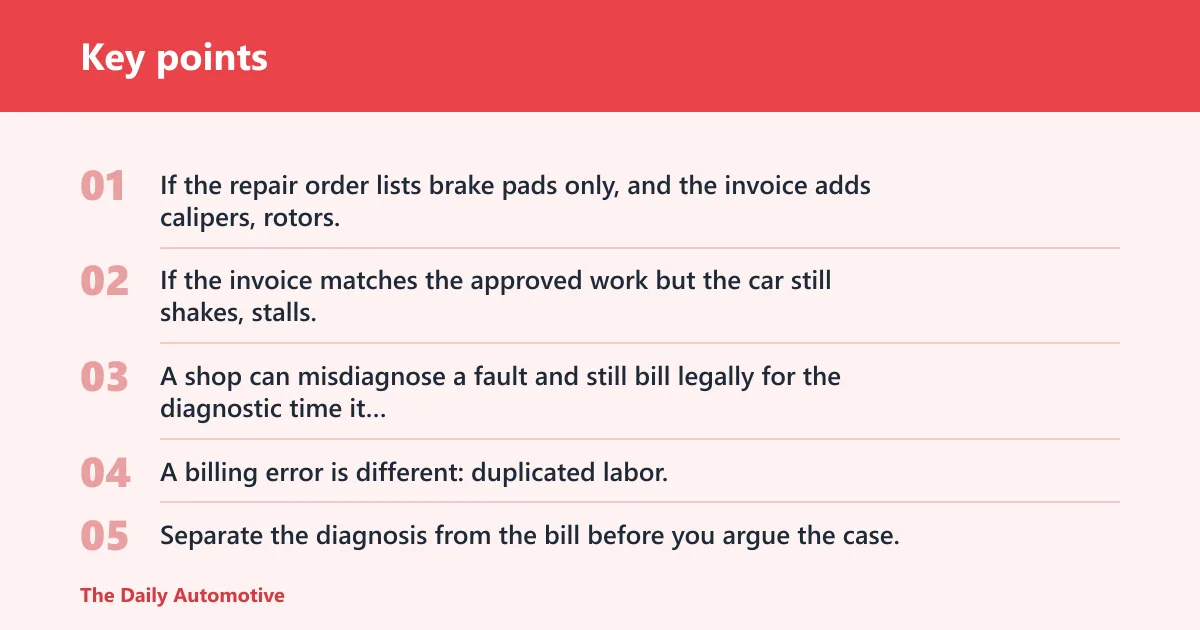
If the repair order lists brake pads only, and the invoice adds calipers, rotors, fluid flushes, and shop fees without a signed change order or clear phone approval, that is often a scope problem. If the invoice matches the approved work but the car still shakes, stalls, or leaks afterward, that may be a poor repair, not a billing violation.
Bad diagnosis versus billing error
A shop can misdiagnose a fault and still bill legally for the diagnostic time it disclosed. A billing error is different: duplicated labor, a parts charge that exceeds the estimate without notice, or a line item that does not match the repair order. Separate the diagnosis from the bill before you argue the case.
When a bad outcome still may not be fraud
Some repairs are authorized because the fault appeared likely, then the result disappoints. That is a warranty or workmanship dispute, not automatically a dishonest-shop case. Keep that distinction clear, because the fastest recovery path changes depending on whether you need a refund, a redo, or a licensing complaint.
Check the paperwork first
Start with the repair order, the written estimate, and the final itemized invoice. Compare the approval fields, labor hours, parts list, diagnosis notes, customer signature, labor rate, parts charge, taxes, fees, sublet work, and warranty terms. If any of those do not line up, that mismatch becomes the backbone of your dispute.
Repair order fields that matter
Look for the written estimate, authorization fields, labor hours, parts list, diagnosis notes, and your signature or initials. The estimate should also show whether the shop needed approval before going above a threshold amount, often stated as a dollar cap or percentage. If that trigger is missing, ask for the shop’s written policy.
Invoice lines to compare against approval
On the itemized invoice, compare the labor rate and labor hours to the original approval. Check parts charge, shop fees, taxes, and any sublet work sent out to another vendor. If the repair was under warranty, the invoice should say whether the later visit was covered, denied, or only partly covered.
What written estimates should include
A proper estimate should separate parts and labor, disclose any diagnostic fee, and explain when the shop must call for change-order approval. It should also say whether the estimate is binding or only a projection. If the estimate was vague, that weakens the shop’s defense against an unauthorized charge, but it does not erase every bill.
What checklist
Build the file now. Save timestamped photos, warning lights on the dash, the odometer reading, scan-tool codes if available, old parts, text messages, emails, and call notes. Ask for written explanations while the details are fresh, because memory fades and service writers change shifts.
Photos, codes, and timestamps
Take before-and-after photos of the affected area, the dashboard, and the odometer. If a warning light is on, photograph it with the engine running long enough for the message to show clearly. If another mechanic can read codes, save the exact trouble codes and the date the scan was done.
Ask for the old parts
Request the removed parts before you pay if your state and the shop’s policy allow it. Old parts help show that replacement happened at all and can be compared with the invoice line items. If the shop says it disposed of them, write down who said that, when, and under what policy.
Save texts, emails, and call notes
Keep every message thread and make call notes with date, time, name, and the exact promise or refusal. If someone approved extra work by phone, ask for that approval in writing before the vehicle leaves the lot. A clean record often matters more than a heated argument at the counter.
Best next move by situation
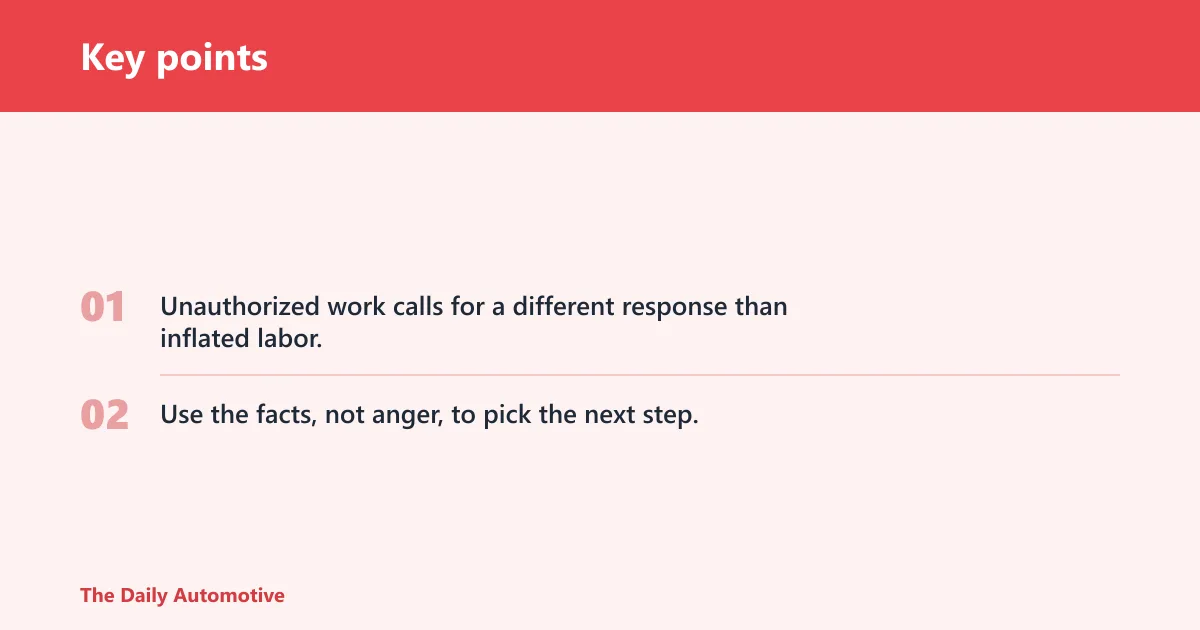
The best move depends on what went wrong. Unauthorized work calls for a different response than inflated labor, and a repeat failure needs different proof than a fake-parts claim. Use the facts, not anger, to pick the next step.
| Scenario | Evidence to collect | Pay under protest? | Best escalation path | Typical deadline |
|---|---|---|---|---|
| Unauthorized repair | Repair order, estimate, invoice, texts, call notes, photos of added work | Yes, if needed to release the car | Shop manager, card dispute, consumer agency | A credit card chargeback window often runs about 60 days from the statement date. |
| Inflated labor or fees | Labor rate, labor hours, estimate, invoice line items, shop policy | Usually yes for uncontested charges | Direct billing dispute, chargeback, attorney general complaint | Vary by state and card issuer |
| Repeated failure | Repair history, warning lights, scan codes, second opinion, warranty terms | Usually no for the repeat visit if warranty applies | Shop escalation, warranty claim, consumer agency | Warranty terms and state repair law vary |
| Fake parts claim | Old parts, part numbers, packaging, invoice, photos, independent inspection | Depends on whether release of the car is urgent | Shop manager, licensing board, card dispute | Report as soon as the mismatch appears |
| Diagnostics-only bill | Diagnostic fee disclosure, scan codes, notes on tests performed, estimate | Usually no if the fee was disclosed | Ask for the test results, then dispute any hidden charge | Before paying if the fee was never disclosed |
| Unsafe return-to-road refusal | Safety notes, photos, codes, written refusal, second opinion if possible | Yes for uncontested charges if it releases the car | Manager escalation, safety complaint, consumer agency | Immediately if the car is immobile |
Should you pay under protest?
Pay under protest when that is the fastest way to recover the car, stop storage fees, or avoid a lien while you preserve the right to dispute the bill. Refuse payment when the amount is clearly unauthorized and the car can stay safely where it is. The wrong choice can cost more than the bill itself.
When paying may help recover the car
If the car is undrivable, parked inside a storage yard, or held at a shop that charges daily storage, paying the uncontested portion may be the quickest way out. You can add a written reservation that you dispute the rest. That keeps the release moving while the paper trail stays intact.
When refusal may backfire
Refusing to pay can trigger a storage lien, block vehicle release, or push the dispute into towing and storage charges that exceed the original problem. If the shop has a colorable claim for work already authorized, holding out may reduce your position. Use refusal only when the billing error is clear and the vehicle’s release is not at risk.
How to write a payment reservation note
Write: “Payment made under written protest for release of vehicle only. I do not accept that these charges were authorized or correctly billed.” Keep a copy, photograph it, and send the same wording by email or text if possible.
Get a second opinion fast
A second opinion should answer whether the repair was actually needed, whether the failed work matches the symptoms, and whether the invoice matches what was installed. Ask for a written inspection, not a vague opinion. If the car is unsafe to drive, arrange same-day triage before you argue about the bill.
What an independent inspection should answer
The inspector should identify the current fault, check the obvious replacement parts, and confirm whether the previous repair was performed. Ask for the exact scan-tool codes, visible leaks, worn components, or broken fasteners found during inspection. A short written estimate helps show the cost to correct the issue.
How to use scan-tool codes and a written estimate
Scan codes alone do not prove a rip-off, but they can show whether the original fault returned or a new one appeared. Match the code list to the shop’s diagnosis notes and invoice. If the independent mechanic gives a different repair path at a much lower cost, that comparison strengthens your dispute file.
What to do if the car cannot be driven
Suppose a fuel pump repair fails and the car stalls at idle in a parking lot. Do not keep cycling the ignition if that could damage the system or strand you again. Request a towing plan, document the unsafe condition, and ask the shop to note in writing why they say the car cannot be released or driven.
Where to escalate the dispute

Use the fastest path that matches the problem. Card disputes help with billing errors. Consumer protection agencies help organize complaints and mediation or referral. Licensing boards can check a shop’s registration number and disciplinary records, then open a complaint process if the shop is licensed in your state.
Chargeback path and billing window
A credit card chargeback is usually the fastest route for “goods or services not as described” or unauthorized billing. Ask your card issuer about the billing dispute window and what evidence they want. Send the repair order, estimate, invoice, photos, and your written protest, because the merchant will also submit evidence.
Consumer protection complaint route
File with your state attorney general or local consumer affairs office if the dispute involves deceptive billing, repeated stonewalling, or refusal to correct obvious paperwork gaps. These offices often take complaints, mediate, or refer you elsewhere. They rarely guarantee money back, but they can pressure a response.
License board complaint and repair shop record checks
Look up the auto repair shop license or registration number if your state requires one. Check disciplinary records, complaint history, and the board’s submission rules before filing. A licensing complaint works best when the issue is a clear paperwork violation, unsafe conduct, or repeated noncompliance, not just a rough customer experience.
How to report a dishonest mechanic
If the case involves fake parts, repeated unauthorized work, or refusal to release the vehicle without a valid charge, report it through the consumer agency and the licensing board at the same time. Keep each complaint focused on dates, documents, and what was billed versus approved. That makes the record easier to verify.
Picture a brake job approved for pads only, then billed with rotors, brake fluid, and a wheel-alignment charge. The dispute turns on the repair order, not the frustration level. If the extra work lacks a change order, that line-item mismatch is the part to attack first.
Frequently asked questions
What to do when auto shop rips you off
Start with the paperwork, then move fast: repair order, written estimate, itemized invoice, photos, and old parts. If the charge was unauthorized or exceeded the agreed scope, dispute it in writing, pay only the uncontested amount if you need the car back, and file the right complaint route.
When a mechanic rips you off
Separate a real billing violation from a repair that simply failed. Unauthorized work, hidden fees, and charges beyond the approved estimate point toward a billing dispute. A repair that was approved but did not fix the car may call for a warranty claim or second opinion instead.
Do car mechanics rip you off?
Some do, but not every bad repair is a rip-off. A misdiagnosis, an honest mistake, or a part that failed again is different from charging for work never approved. Focus on proof: what you authorized, what was billed, and whether the shop can document the change.
Should I pay a mechanic if I dispute the bill?
Sometimes yes. Paying under protest can get your car released and reduce storage or lien risk while preserving your claim. If the charge is clearly unauthorized and the car can stay put safely, refusal may be better. The safest choice depends on the release risk and your evidence.
Can I get my money back from an auto repair shop?
Maybe, but the path matters. Card chargebacks can recover disputed card charges within the issuer’s window, while consumer agencies and licensing boards can pressure a shop or document a pattern. A refund is more likely when your file shows clear unauthorized work, duplicate billing, or a missed approval step.
How do I know if a mechanic is lying to me?
Look for mismatch, not just attitude. If the invoice shows work never approved, the story changes between phone calls, or the old parts cannot be produced when requested, those are red flags. Still, ask for written details before accusing anyone, because some disputes start with poor communication.
Products related to this article
Sponsored / affiliate links. As an Amazon Associate I earn from qualifying purchases. I may earn additional commission from eligible campaigns.