Is Nitrous Illegal In Cars? Proven Essential Facts
Nitrous oxide systems (NOS) are generally legal for street use in most US states if they are not engaged while driving on public roads. However, engaging a nitrous system while the vehicle is in motion on public streets is illegal in nearly all jurisdictions. Legality often depends on state and local laws regarding vehicle modification and safety equipment.
Have you ever seen a car suddenly rocket forward with an extra burst of speed? Chances are, you saw a nitrous oxide system, often called “NOS,” in action. Nitrous gives engines a powerful, temporary boost of horsepower. This makes many drivers wonder: Is this cool trick street-legal? It can be confusing because the rules change depending on where you live and how you use the system.
If you own a car and are curious about performance upgrades, you need clear, simple facts. Don’t worry! We are going to break down the complex laws surrounding nitrous oxide so you can understand what is safe and legal for your ride. Let’s explore the essential facts together.
Understanding What Nitrous Oxide Is (For Beginners)
Before we talk about laws, let’s make sure we know what nitrous oxide actually does to your car. Think of it like giving your engine a super-concentrated breath of air.
The Science Behind the Boost
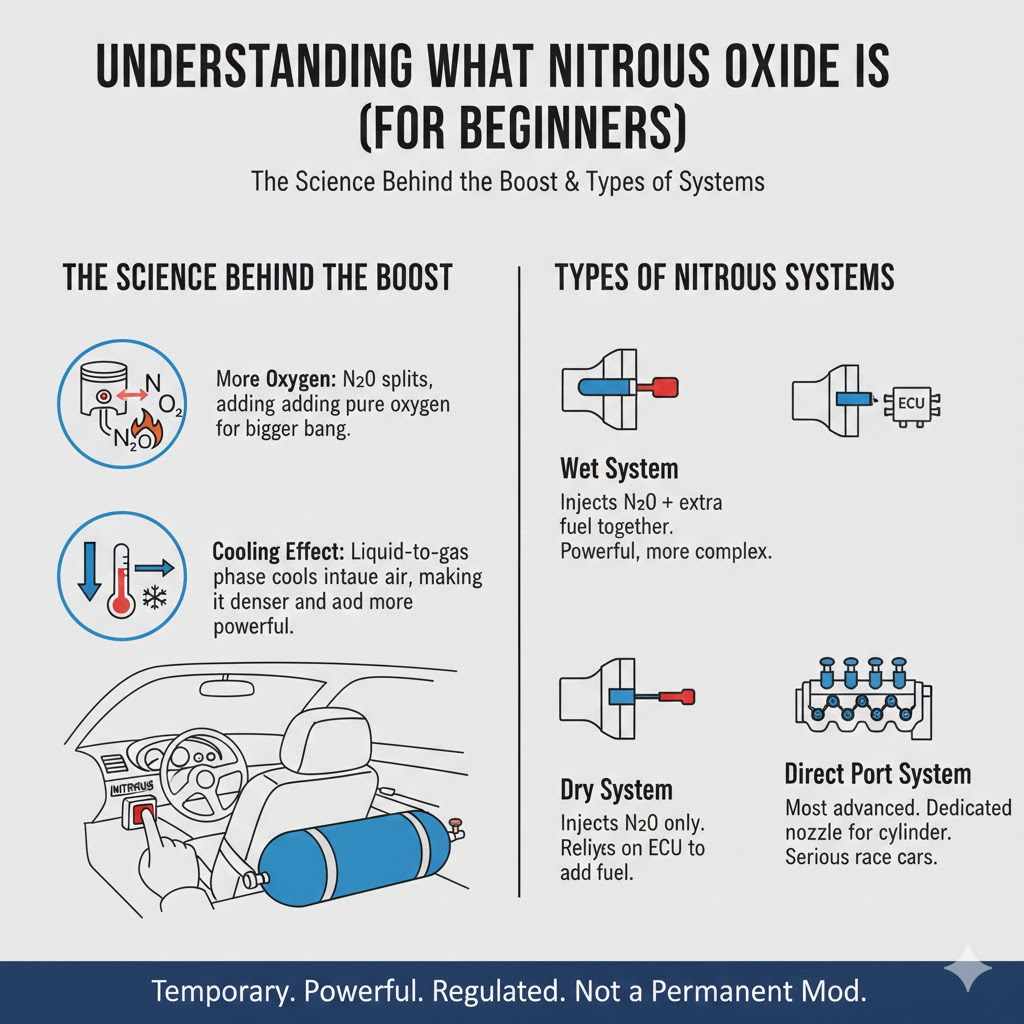
Nitrous oxide (N2O) is a gas that is stored as a liquid under high pressure in a tank inside your car. When the driver activates the system, this liquid turns into a gas and is injected into the engine’s intake manifold.
Why does this make the car faster? It does two main things:
- More Oxygen: When the nitrous gas enters the hot engine, it splits into nitrogen and pure oxygen. This extra oxygen allows the engine to burn much more fuel in the same amount of time.
- Cooling Effect: As the liquid nitrous turns into a gas, it dramatically cools down the air entering the engine. Cooler air is denser, meaning it packs more oxygen molecules into the cylinder, further boosting power.
This is a temporary, powerful addition to your car’s normal operation. It’s not a permanent modification like a turbocharger; it’s a switch you flip for instant speed.
Types of Nitrous Systems
Not all nitrous kits are the same. Understanding the basic types helps you understand why laws might target one type over another.
- Wet System: This system injects nitrous and extra fuel at the same time. It’s generally more complex and powerful.
- Dry System: This system only injects nitrous oxide. The engine relies on its computer (ECU) to add the necessary extra fuel.
- Direct Port System: This is the most advanced and powerful setup, where each cylinder gets its own dedicated nozzle for nitrous and fuel. This is usually found on serious race cars.
For street-driven cars, the simple wet or dry systems are more common, though still heavily regulated.
The Core Question: Is Nitrous Illegal in Cars?
This is the question everyone asks, and the answer is rarely a simple “yes” or “no.” The legality of nitrous oxide systems (NOS) depends heavily on two main factors: where you are driving and how you are using the system.
Street Use vs. Track Use
In the United States, the primary distinction for nitrous legality rests between public roads and private racetracks.
Public Roads and Highways
Generally, using a nitrous system while driving on any public road (city streets, state highways, interstates) is illegal in most places. Why? Because vehicle modifications that significantly alter horsepower, especially those that are engaged instantly, are often classified under state vehicle equipment standards or emissions laws.
- Insurance and Liability: If you get into an accident while using nitrous, your insurance company might deny coverage because the vehicle was operating outside its factory-approved specifications.
- Safety Equipment Standards: Many states have strict laws about vehicle safety equipment. Performance enhancements that drastically change speed capability without corresponding safety upgrades (like better brakes) are often prohibited.
Dedicated Racing Facilities (Drag Strips, Road Courses)
At dedicated, closed-circuit race tracks, using nitrous oxide is almost always perfectly legal. Race tracks operate under different regulations than public roads. They are designed for high-performance operation, and vehicle inspections are focused on safety for the race itself, not compliance with standard road laws.
State-by-State Differences: The Patchwork of Laws
There is no single federal law that outright bans the possession of nitrous in a passenger vehicle. Instead, the legality is governed by individual state laws concerning vehicle modifications, inspections, and reckless driving statutes.
For example, a state might not specifically list “Nitrous Oxide System” as illegal, but they might have a law stating that any device capable of releasing flammable or explosive materials that endanger the public is banned from street use. A nitrous kit could easily fall under that umbrella.
To give you a sense of how varied this can be, here is a brief overview based on common interpretations (always check your local Department of Motor Vehicles or Highway Patrol website for current statutes):
| Jurisdiction Type | Possession of System | Activation on Public Roads | Typical Classification |
|---|---|---|---|
| Most States (General Rule) | Often legal (as long as not installed incorrectly) | Illegal | Traffic Violation / Safety Hazard |
| States with Strict Emissions Laws | May be illegal to install | Definitely Illegal | Emissions Violation |
| Race Tracks/Private Property | Legal | Legal (Track Rules Apply) | Performance Operation |
It is crucial to remember that even if you own the bottle and the solenoids, if a police officer observes you activating the system on a public street, you can be pulled over and ticketed for illegal vehicle modification or even reckless driving, depending on the state.
The Legal Gray Area: Possession
Can you drive around with a full nitrous bottle in your trunk? This is where it gets tricky.
In many areas, simply possessing nitrous oxide in a vehicle is not, by itself, illegal—especially if the system is not installed or connected, or if the tank is completely empty. It is often treated the same way as carrying certain chemicals or pressurized containers. However, if the system is fully installed, plumbed, and ready to use, law enforcement can argue that the intent is clear, leading to confiscation or further charges under modification laws.
If you plan to use nitrous strictly for competition, you should consult resources like the SEMA organization (Specialty Equipment Market Association) or local automotive clubs, as they often track state-level legislative changes regarding performance parts.
Understanding Emissions and Vehicle Inspections
One of the biggest hurdles for street-legal performance parts, including nitrous, is environmental regulation.
The Role of the Clean Air Act
In the US, vehicle emissions are heavily regulated, largely stemming from the federal Clean Air Act. Any modification that intentionally increases the output of pollutants (like unburnt hydrocarbons or NOx) can run afoul of state Environmental Protection Agency (EPA) rules, which often enforce federal standards.
Nitrous oxide, while not directly causing long-term pollution when used temporarily, is often seen by regulators as an unapproved alteration to the designed fuel/air mixture. If your state requires regular emissions testing (smog checks), a visibly modified engine with an installed nitrous kit is highly likely to fail, regardless of whether you use it.
The Catalytic Converter Conundrum
Nitrous systems, by forcing more fuel and oxygen through the engine, drastically increase the load and temperature inside the exhaust system. This can quickly overheat and destroy your catalytic converter, which is an essential, expensive, and federally mandated emissions control device.
If your catalytic converter is damaged or removed to accommodate the system or the increased performance, your vehicle is automatically illegal for street use in almost every state, as tampering with emissions control equipment is a serious violation.
Safety and Installation Factors That Affect Legality
Legality isn’t just about the nitrous itself; it’s also about how safely it’s installed and used. Law enforcement looks at the overall safety of the vehicle modification.
Proper Installation is Key
If you are caught with a nitrous setup, an officer will likely examine how it was installed. A professionally installed system that uses high-quality components and safety features is less likely to be deemed an immediate road hazard than a poorly rigged setup.
Key safety considerations that police may look for include:
- The secure mounting of the high-pressure bottle.
- The use of proper, high-pressure rated lines and fittings.
- The presence of a safety blow-off valve (to release pressure if the bottle overheats).
However, even the best installation does not make street use legal if the state prohibits it.
The Role of Speed Limiting Devices
Many professional racing nitrous systems include electronic safeguards, often called “WOT” (Wide Open Throttle) switches, which ensure the system only activates when the throttle is fully depressed. More advanced systems may use speed controllers that prevent activation above a certain speed (e.g., 100 mph).
While these devices are great for protecting the engine on the track, they do not magically make the system legal on the street. If the device is intended to control illegal use on the street, it doesn’t change the primary violation if you are caught operating it improperly.
Legal Alternatives and Street-Legal Performance
If you are looking for a performance boost that won’t land you in trouble with the law or cause issues during inspection, there are much safer and clearer alternatives to nitrous.
Street-Legal Upgrades You Can Trust
These modifications are widely accepted for daily driving because they do not violate emissions or major vehicle safety standards:
- Performance Air Intake: Allows the engine to breathe easier, providing a modest, reliable power bump.
- ECU Tuning/Reflashing: A professional tuner can safely adjust the engine’s computer settings (fuel mapping and timing) for more power without installing physical, regulated parts.
- Exhaust System Upgrades: High-flow headers and cat-back exhaust systems can improve exhaust scavenging and sound without removing critical emissions equipment.
- Forced Induction (Turbo/Supercharger): While expensive, these kits are often engineered to meet certain emissions standards if they are CARB (California Air Resources Board) approved or equivalent for your region, making them a permanent, street-legal solution.
When Nitrous is the Only Option
The only time nitrous is unequivocally legal for use is when it is deployed in a sanctioned event where the vehicle is exempt from standard road regulations.
If you are building a dedicated drag car or track car that will never see public roads, you can install and tune a nitrous system for maximum performance without worrying about state vehicle codes. You will still need to adhere to the specific safety rules of the racetrack itself.
| Modification | Street Legality | Emissions Impact | Cost (Relative) |
|---|---|---|---|
| Nitrous Oxide System (NOS) | Illegal while engaged on roads | High Risk of Failure/Tampering | Low to Medium |
| Performance Tune (ECU Flash) | Generally Legal | Low, if done professionally | Medium |
| Aftermarket Intake/Exhaust | Varies by State/Part Approval | Medium Risk | Low |
| Approved Supercharger Kit | Usually Legal (if certified) | Low (if CARB approved) | High |
What Happens If You Get Caught?
Being pulled over while operating a nitrous system on a public road can lead to several unpleasant outcomes, ranging from a simple warning to significant fines and vehicle seizure, depending on the severity and local interpretation of the law.
Potential Penalties
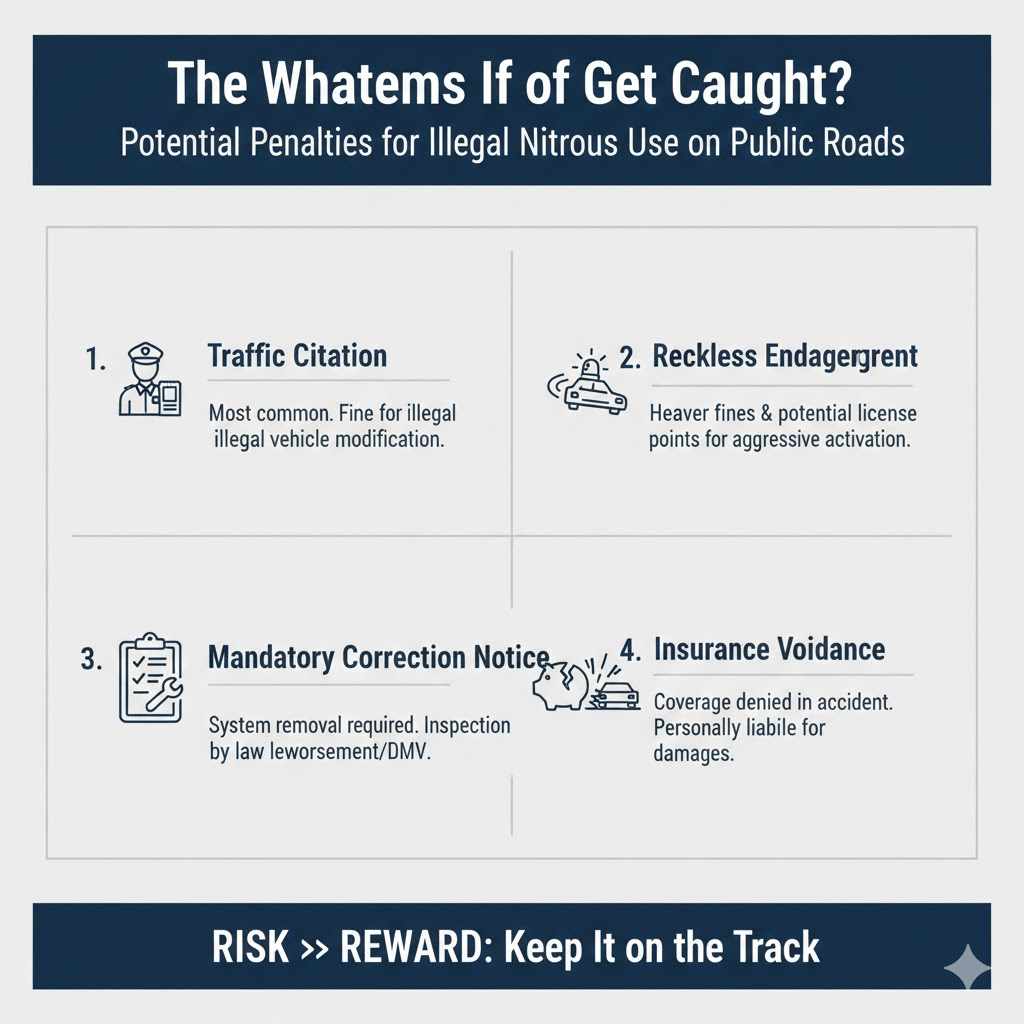
1. Traffic Citation: The most common outcome is being cited for an illegal vehicle modification. This usually involves a fine.
2. Reckless Endangerment: If the activation was sudden, aggressive, or caused another driver to react sharply, the officer might escalate the charge to reckless driving or endangerment, which carries much heavier fines and potential license points.
3. Mandatory Correction Notice (Fix-It Ticket): In some states, you might be required to have the system professionally removed and have the car inspected by law enforcement or the DMV to prove it has been restored to factory specifications before your registration is valid again.
4. Insurance Voidance: As mentioned before, if you are involved in an accident while using the system, your insurance coverage could be denied, leaving you personally liable for damages.
The key takeaway here is that the risk far outweighs the momentary benefit on a public road where speed limits and traffic conditions are already unpredictable.
FAQ: Frequently Asked Questions About Nitrous
Here are quick, straightforward answers to common beginner questions about nitrous legality.
Q1: Can I keep a nitrous bottle in my car if it is empty?
A: Generally, yes. An empty, disconnected bottle is usually treated as a piece of pressurized equipment, similar to an empty propane tank. However, if it is fully plumbed into the engine system, it could still be considered an illegal modification, even if the tank is empty.
Q2: Does the law distinguish between nitrous (N2O) and laughing gas (used medically)?
A: Yes. Medically administered nitrous oxide is regulated under health and safety laws. Automotive nitrous oxide is regulated under vehicle equipment, emissions, and traffic safety laws. They are treated very differently by law enforcement.
Q3: If my car is tuned for nitrous but the system is removed, is it legal?
A: If the tune itself has not altered other mandatory street-legal parameters (like timing or fueling beyond factory limits in a way that fails emissions), the car should be legal. However, aggressive tunes intended only for nitrous often cause issues like poor idle or high emissions when run without the gas, which could still result in a ticket.
Q4: Are there any states where nitrous is completely legal for street use?
A: No widely known state currently permits the active use of nitrous oxide systems on public roads for general driving due to safety and emissions concerns. Legality usually only applies to possession or use on private property/tracks.
Q5: Will my factory warranty be voided if I install nitrous?
A: Absolutely. Installing a nitrous system will almost certainly void any powertrain warranty coverage, as it is considered a major, unapproved modification that severely stresses engine components.
Q6: Is it illegal to buy nitrous refills for street cars?
A: It is generally not illegal to purchase refills, as the gas is sold for many legitimate purposes (welding, food service, track use). The illegality comes from installing and using the equipment on a street-driven vehicle.
Conclusion: Driving Smart with Performance Parts
Figuring out the rules for vehicle modifications can feel like navigating a maze, especially when dealing with powerful additions like nitrous oxide systems. To bring it all together simply: Possession in a street car is usually a gray area, but active use on public roads is illegal almost everywhere.**
Nitrous oxide offers incredible bursts of power, making it a favorite for drag racers and track enthusiasts. However, safety regulations, emissions standards, and insurance liabilities are stacked against its use outside of dedicated, controlled racing environments. For your everyday driving, keep your performance upgrades focused on modifications that enhance breathing, tuning, or efficiency—parts that are clearly designed to meet—not bypass—your state’s safety and environmental rules.
By understanding these proven facts, you can enjoy your vehicle confidently, knowing you are staying on the right side of the road regulations while keeping your car reliable and safe for the long haul. Drive smart, and save the huge power boosts for the track!