The Truly Nolen Mouse Car: A Complete Buyer’s Guide for 2026
A Truly Nolen mouse car is worth buying only when you can verify the donor chassis, title, and conversion history; without that paperwork, treat it as a novelty, not a blue-chip collectible. Skip those checks, and you can overpay for a difficult-to-insure fleet conversion with thin resale demand. This guide covers how to identify the car, how prices track the donor platform, what to inspect, and where the real risks sit before you buy.
Quick answer
A Truly Nolen mouse car is a promotional vehicle used by Truly Nolen of America, the family-owned pest control company founded in 1938. It is usually painted bright yellow and carries a roof-mounted mouse mascot, so the car reads like moving advertising first and a collector vehicle second.
Truly Nolen describes the mouse cars as moving billboards. The company says its legendary antique cars are used in parades and special events, and it says it has over 80 branch offices. Truly Nolen operates in Canada and over 60 countries through franchises, and Truly Nolen Canada includes a dedicated page for the mouse car.
Surviving examples draw collector interest because they are rare, easy to spot, and tied to a familiar brand. But the donor vehicle under the promotional bodywork sets most of the value. A well-kept Beetle-based car, a rust-free Astro, and a tired Express van do not belong in the same price conversation.
Mouse car history and donor platforms
These vehicles began as rolling ads and often returned to private hands after fleet duty ended. That history matters because fleet use can mean repeated starts, short trips, outdoor storage, and quick repairs instead of careful preservation. The result is a vehicle that may look playful while hiding practical wear.
Volkswagen Beetle examples
Older mouse cars built on Volkswagen Beetle underpinnings are often the early collector path, especially 1960s-1970s-era examples. They have stronger hobby appeal because the base car is already collectible, but stock horsepower is low, so even a clean example will not feel quick. Parts access is decent for common Beetle components, but the promotional conversion can complicate body and roof repairs.
Chevrolet Astro and chevy Express examples
Chevrolet Astro van examples are the practical middle ground. The V6 automatic layout can make them easier to live with than a Beetle, but rear wheel wells and rocker panels are often rust-prone, so body condition can affect ownership cost quickly. Chevy Express van examples are usually the easiest to maintain because the platform is newer and full-size, yet they are generally less collectible than older versions.
That difference changes resale too. A more modern Express may cost less to keep running, but a period Beetle often has a stronger exit market if it is documented, complete, and not badly modified. The mouse mascot alone does not carry the value.
Buying checklist table
| Donor platform | Red-flag inspection items | Estimated ownership difficulty |
|---|---|---|
| Volkswagen Beetle | Rust in heater channels and pan, poor roof-mount repairs, missing original trim, mismatched conversion parts, weak paperwork, evidence of prior collision work | High for project-grade cars; medium for clean driver-grade cars. Buy only with solid title, documented conversion, and minimal rust. Avoid if the body needs structural repair. |
| Chevrolet Astro | Rear wheel well rust, rocker-panel corrosion, tired V6 transmission behavior, cut or patched wiring, poorly mounted mascot hardware, cabin odor from storage or fleet use | Medium. Buy if the drivetrain is sound and rust is limited. Avoid if corrosion has reached the structure or if the conversion looks improvised. |
| Chevy Express | Fleet wear, commercial suspension fatigue, corrosion at lower seams, incomplete promotional pieces, old decals under repaint, maintenance records that show hard use | Low to medium for upkeep, but lower collectible upside. Buy if you want the easiest service path. Avoid if the goal is maximum collectability rather than usability. |
Use this simple rule: collector-grade means solid title, complete mouse hardware, and no major rust; driver-grade means presentable with repairable wear and known service needs; project-grade means you are buying missing parts, bodywork, and time. A project can make sense only when the purchase price leaves room for transport, repair, and paperwork.
Where can you buy one?
Bring a Trailer is the best place to study documented listings because the auction format tends to surface photos, comments, and maintenance details. That transparency helps you judge whether the conversion is complete and whether the donor platform is worth the premium. The bidding format can also push the price above a private-sale level when the car is desirable and well presented.
eBay Motors is broader, but the listing quality is mixed. It can include incomplete or rusted examples, so you need to assume more risk when photos are sparse or wording is vague. Retired fleet finds, local ads, and private sellers can be good sources, but the paperwork and inspection burden shifts onto you.
Suppose a yellow Astro appears with one clear exterior photo, no underbody shots, and a vague “runs great” note. That is not enough for a promotional vehicle with roof hardware and possible fleet wear. A detailed listing with body, underside, title, and engine photos is far easier to price.
What should you inspect before buying?
Start with the roof-mounted fiberglass mouse. It is a custom body piece often bolted to roof-rack mounting points, so it is worth checking for cracked fiberglass, water leaks, bent brackets, and repaired holes in the roof. It adds weight and wind drag, and old examples often need repair or replacement.
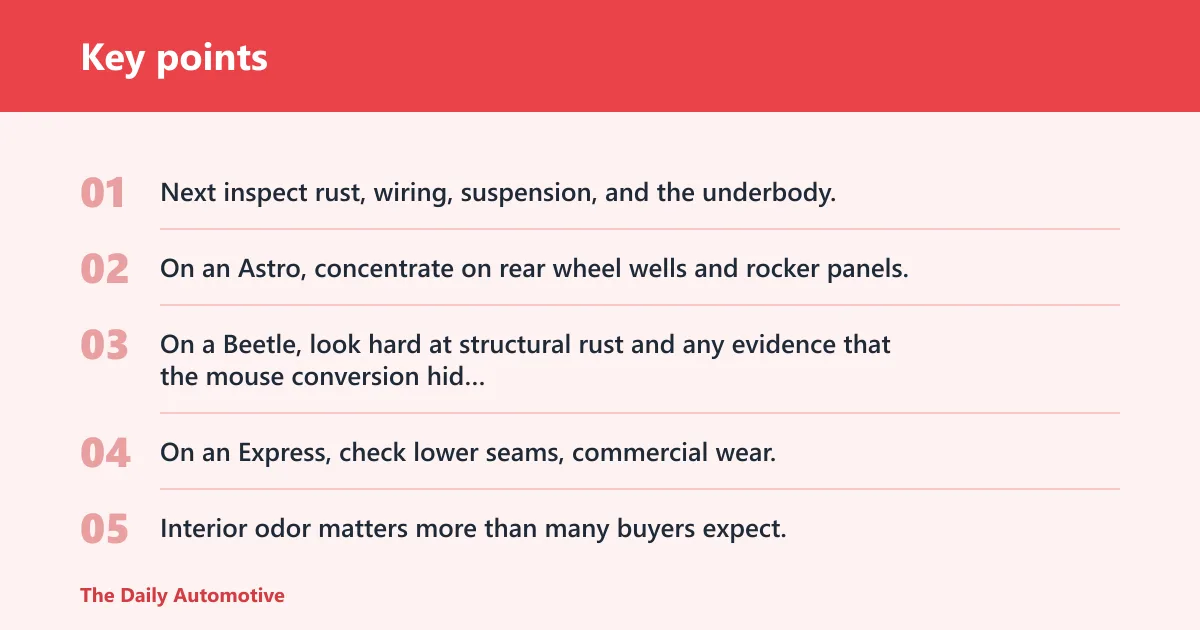
Next inspect rust, wiring, suspension, and the underbody. On an Astro, concentrate on rear wheel wells and rocker panels. On a Beetle, look hard at structural rust and any evidence that the mouse conversion hid prior metal damage. On an Express, check lower seams, commercial wear, and maintenance history that shows whether the van was kept on schedule or run hard.
Interior odor matters more than many buyers expect. A retired fleet vehicle can hold cleaning chemical smells, rodent contamination, or stale storage odor, and those issues can be hard to remove. Missing fleet pieces, non-original switches, and hacked wiring usually signal a faster path to extra spending.
A common first-timer mistake is to get distracted by the mouse-themed detailing and overlook whether the roof rack or side brackets are sturdy enough for daily use. A bright yellow car with a clean roof mouse can still hide rust around the rack hardware, and a small leak there can stain the headliner, corrode wiring, and spread trim damage over time.
What does ownership really cost?
The asking price is only the opening number. Real ownership cost usually includes transport, inspection, cosmetics, compliance work, and ongoing upkeep. For a distant purchase, enclosed or careful open transport can be a major line item, especially if the vehicle is non-running or the roof-mounted mouse cannot be removed safely.
Cosmetic repair can be modest or expensive depending on the donor platform and the mouse hardware. Paint correction, decal work, fiberglass repair, trim sourcing, and seat or carpet replacement add up fast. A Beetle with structural rust or an Astro with bad rear-body corrosion can move from driver-grade to project-grade very quickly.
Compliance work can also bite. If lights, mirrors, tires, or other equipment do not meet local requirements, registration delays may follow. A state inspection, title correction, or roadworthiness repair can be simple on one example and costly on the next, especially when fleet modifications were done long ago and poorly documented.
Picture a buyer who wins a mouse car on an auction site for a fair number, then discovers rust repair, missing trim, and nonworking lights after transport. The result is not a bargain. It is a delayed restoration budget with a mascot on top.
- Confirm the donor platform and year range from the title, tags, and visible chassis cues.
- Inspect the roof mouse, roof rack mounting, and all fiberglass seams.
- Check for rust, wiring faults, suspension wear, and underbody corrosion.
- Verify that the car can be registered in your state or province.
- Price transport, cosmetics, and compliance work before you bid.
Will insurance and registration be a problem?
They can be. Classic car insurance coverage varies, and modified fleet vehicles can be harder to place because insurers often care about originality, usage, storage, and replacement value. A heavily altered promotional vehicle may need a specialty underwriter rather than a standard collector policy.
Street legality is another separate question. Many mouse cars can be made road legal, but you still need to check lighting, mirrors, tires, emissions rules where applicable, and local inspection standards. A vehicle that once toured events can still fail on current equipment or documentation issues.
Restraints also matter. If an insurer limits annual mileage, show use, or storage conditions, that may fit a collector Beetle but frustrate someone hoping to commute in an Express. Always ask how the carrier values custom bodywork and whether the roof mouse is included in the agreed value.
Frequently asked questions
What is a Truly Nolen mouse car?
A Truly Nolen mouse car is a promotional vehicle from Truly Nolen of America, usually painted yellow and topped with a roof-mounted mouse mascot. It was built to advertise the company on the road, then often retired from service and passed into collector hands or private ownership.
How much does a Truly Nolen mouse car cost?
Price depends more on the donor platform and condition than on the mascot. A Beetle-based example with clean paperwork and solid bodywork usually sits in a different lane from a rusty Astro project or a later Express van. Transport, repair, and compliance work can easily add more than the headline price.
Where can I buy a Truly Nolen mouse car?
Bring a Trailer and eBay Motors are the most visible online channels, but they do not offer the same risk profile. Bring a Trailer listings are usually better documented. eBay Motors can include incomplete, rusty, or poorly described examples, so it demands far more caution and due diligence.
Are Truly Nolen mouse cars street legal?
Some are, but legality depends on title status, lighting, mirrors, tires, emissions rules where relevant, and state or province inspection standards. A converted fleet vehicle may also need paperwork correction before registration. Do not assume a car that still looks complete is automatically ready for the road.
What models were used as Truly Nolen mouse cars?
Common donor platforms include the Volkswagen Beetle, Chevrolet Astro van, and Chevy Express van. Older Beetle examples are the most collectible, Astro examples are a practical middle ground, and Express examples are usually the easiest to maintain. The platform underneath determines cost, parts access, and resale path.
Will classic car insurance cover a converted pest control vehicle?
Sometimes, but not always. Coverage depends on originality, declared use, storage, and how the underwriter views the conversion. A modified promotional vehicle may need a specialty policy, especially if the roof-mounted mouse or custom bodywork complicates valuation. Ask about agreed value before you buy, not after.
Products related to this article
Sponsored / affiliate links. As an Amazon Associate I earn from qualifying purchases. I may earn additional commission from eligible campaigns.