Lease vs Buy: How to Choose the Right Car Option Fast
Lease if you drive relatively little, keep cars for a few years, and care more about a lower monthly payment than owning the car. Buy if you drive more, keep a car longer, or want resale equity. Pick the wrong side and you can rack up overage fees, eat depreciation, or park cash in a car that no longer fits your life. This guide ranks lease vs buy by mileage, holding period, and resale risk, then breaks down the hidden costs most comparisons skip.
Lease vs buy car
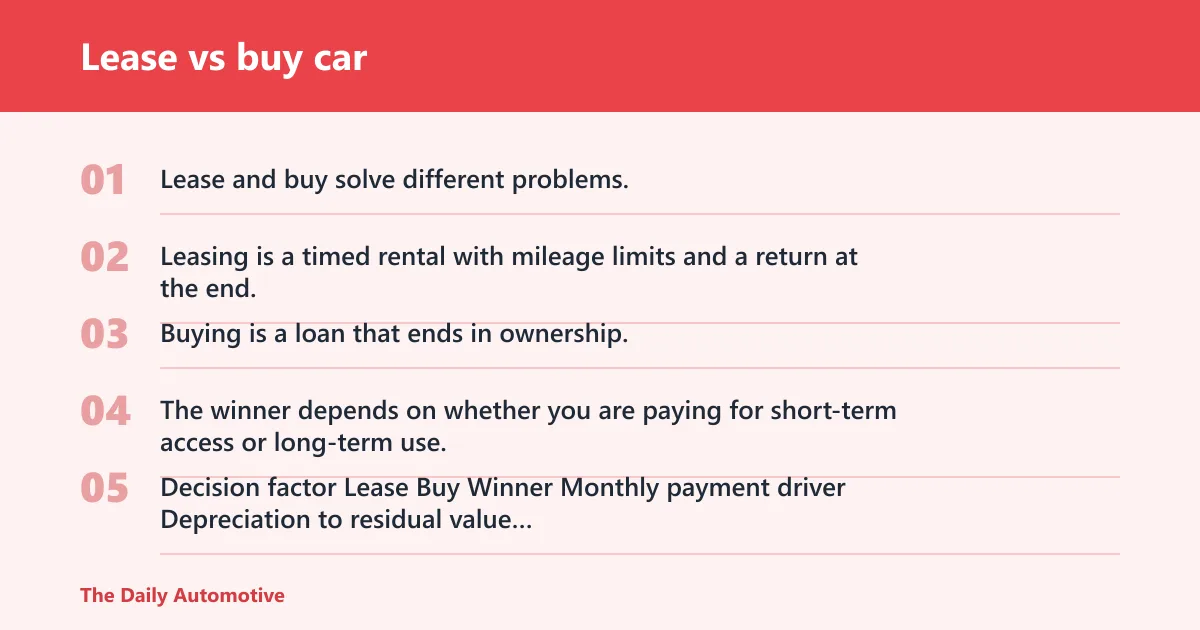
Lease and buy solve different problems. Leasing is a timed rental with mileage limits and a return at the end. Buying is a loan that ends in ownership. The winner depends on whether you are paying for short-term access or long-term use.
| Decision factor | Lease | Buy | Winner |
|---|---|---|---|
| Monthly payment driver | Depreciation to residual value plus finance charges | Principal, interest, taxes, and fees | Lease |
| Long-term cost if kept for years | New payment starts again at every term end | Payment ends, then only ownership costs remain | Buy |
| Mileage flexibility | Limited annual miles with overage penalties | No contract mileage cap | Buy |
| Warranty-period repair risk | Usually lines up well with early warranty coverage | Risk rises after warranty expires | Lease |
| End-of-term outcome | Return, buy out, or renew | Keep, sell, or trade | Buy |
Monthly payment drivers
Lease payments are built around depreciation from new value to residual value, then topped with finance charges. A high residual value can make a lease look cheap even when the sticker price stays the same.
Buying spreads the vehicle cost across the loan term and adds interest on the borrowed balance. The payment may be higher, but each payment builds equity instead of only paying for time behind the wheel.
Mileage, wear, and exit risk
Lease contracts specify a limited number of miles, and excess mileage penalties can range from 10 cents to 50 cents per mile. Unused miles do not create credit on a lease, so you do not get paid back for driving less than the allowance. (consumerreports.org)
Buying removes the mileage cap, but it shifts the risk to depreciation and resale timing. If the car’s value falls faster than expected, that loss sits with the owner rather than the lessor.
End-of-term outcome
A lease typically returns the car to the dealer at the end of the term. That keeps turnover simple, but it also means the driver has no asset unless the lease buyout is attractive.
Buying ends with ownership after the loan is paid off. At that point, the car can stay in service with no payment, which is where buying often pulls ahead over a longer horizon.
How leasing works
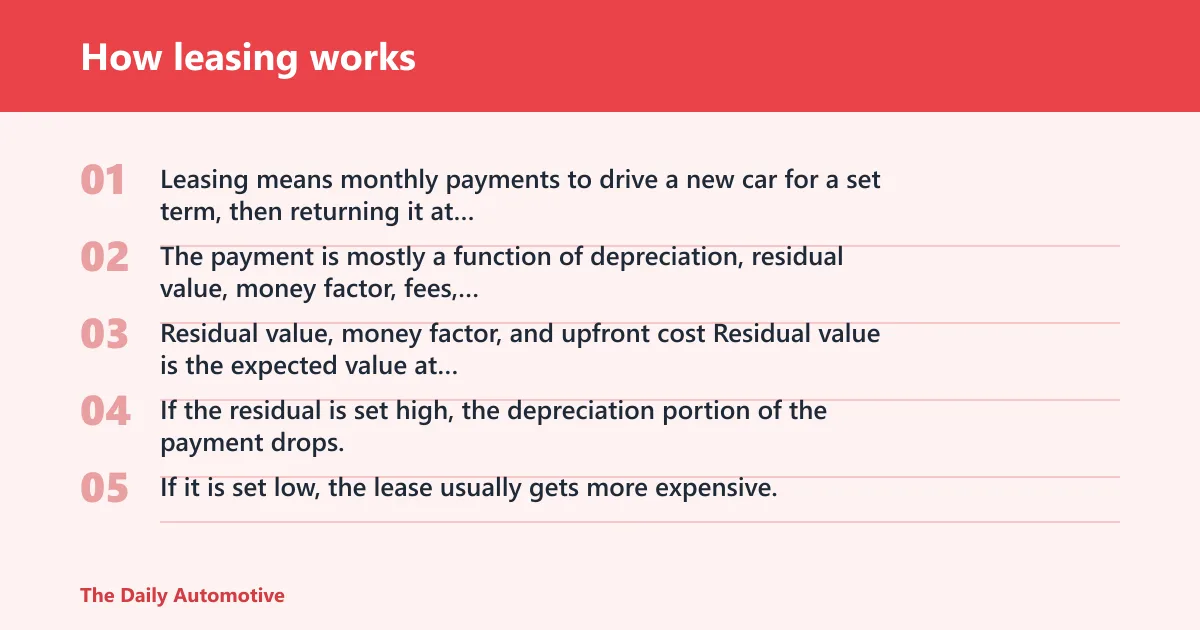
Leasing means monthly payments to drive a new car for a set term, then returning it at the end unless you buy it. The payment is mostly a function of depreciation, residual value, money factor, fees, and any cash due at signing.
Residual value, money factor, and upfront cost
Residual value is the expected value at lease end and one of the core pricing inputs. If the residual is set high, the depreciation portion of the payment drops. If it is set low, the lease usually gets more expensive.
Money factor is the lease finance charge metric. Think of it as the APR-equivalent concept in lease math, and note that it can be a dealer-negotiation variable in some transactions.
A down payment on a lease, often called a cap cost reduction, can lower the monthly bill, but it also puts more cash at risk if the car is stolen, totaled, or turned in early.
Mileage allowance and penalties
Lease contracts specify a contracted annual mileage allowance. Go over it and the overage charge lands at turn-in, while unused miles are simply wasted.
That is why a lease works best when driving is predictable. If commuting, road trips, or job changes are hard to forecast, the mileage math can get ugly fast.
End-of-lease return, wear charges, and buyout option
At turn-in, the car is inspected for excess wear, mileage overages, and other contract issues. Small damage can become real money when the lease is closed out.
Some leases may allow a buyout. That can be a good move when the buyout is below market value, but it can also become a surprise if the residual is higher than the car is actually worth.

How buying with a loan works
Buying with a conventional car loan means monthly principal and interest payments until the balance is paid off. After that, the vehicle belongs to the owner, who keeps the equity and decides when to sell or trade.
Loan payment, equity, and payoff timing
Each payment reduces the loan balance and builds equity. That equity can offset the next car purchase or soften the hit of selling early.
Buying can be the cheapest way to drive if the vehicle is kept long enough. The break-even point usually arrives after the loan is gone and the car still has usable life left.
Resale value risk and depreciation
Ownership also means resale risk. If the market softens, the owner absorbs that loss, especially in the first few years when depreciation is usually steepest.
That risk can work in your favor if the market holds up. A strong resale value can narrow the gap between buying and leasing, sometimes enough to flip the decision.
Which costs more over time?
Leasing usually looks cheaper month to month, but that does not make it cheaper overall. Over time, the cost answer depends on how many payments you make, how much the car depreciates, and whether you keep the vehicle long enough for ownership to pay off.
When leases look cheap early
Leases can look easy on the budget because the driver is paying for depreciation, not the full vehicle price. That can help if the car is only needed for a short stretch and the mileage stays inside the contract.
The catch is the reset. A new lease starts a new payment cycle, and fees keep showing up every time the term rolls over.
When buying wins later
Buying tends to win when the same car stays in service past the loan payoff date. Once the payment stops, the owner still has transportation without a monthly note, and the remaining cost is usually insurance, maintenance, and repairs.
That is why time horizon matters. A driver who keeps cars seven years or more usually gives ownership a much better chance to come out ahead.
What mileage and time horizon change
Mileage and holding period are the two biggest filters in the lease vs buy decision. Low miles and short ownership favor leases. High miles and long ownership favor buying because the contract limits, fee structure, and depreciation risk line up better for owners.
Low-mileage commuter
A commuter who stays well under the lease mileage allowance can use a lease efficiently, especially if the car will be replaced in two to three years. The lower monthly payment can help when the priority is predictable short-term transportation.
This is also the easiest profile for warranty-period coverage, which helps limit early repair surprises. The lease still needs careful attention to fees, wear, and turn-in rules.
High-mileage driver
High-mileage drivers usually lose on a lease because every extra mile is priced into the contract or charged at turn-in. Even a low monthly payment can be erased by overage penalties.
Buying usually wins here because there is no mileage cap and the driver is not paying to avoid a limit that will be broken anyway. The owner still takes depreciation risk, but it is a cleaner risk than a mileage penalty that arrives later.
Keeping the car 7+ years
Keeping a car past the loan payoff almost always improves the case for buying. The monthly obligation ends, but the vehicle keeps serving the driver, which lowers the average cost per month over time.
Leasing for that long usually means several renewals, repeated fees, and no equity. That is why long-horizon drivers usually belong in the buy column.
Choose lease if… / Choose buy if…
Lease can make sense if you stay under the mileage allowance, expect to change cars every couple of years, and want newer vehicles with warranty coverage. Choose buy if you drive more, keep cars long enough to outlast the loan, or want the option to keep or sell the vehicle later.
Choose lease if…
- Your annual miles are low and predictable.
- You want a shorter commitment with easier turnover.
- You prefer lower monthly payments and accept mileage rules.
- Your use fits inside the warranty window and you can avoid wear charges.
Choose buy if…
- You drive a lot or your mileage is hard to predict.
- You plan to keep the car beyond the loan term.
- You want equity, resale value, or no mileage cap.
- You are comfortable owning repair and depreciation risk after the warranty ends.
Business use and tax treatment
Business owners may see significant tax advantages from leasing, but the rules depend on use documentation and how the vehicle is claimed. Keep clear records of business versus personal miles, because the tax result follows the actual use pattern, not the monthly payment alone.
Buying can also offer deductions, but the mechanics differ and the paperwork matters. For either path, the decision should be made with mileage logs and tax treatment in mind, not just the headline payment.
Decision worksheet: three real-world scenarios

This worksheet puts the decision into practice. The key question is not which option has the lower sticker payment, but which one has the lower expected cost after mileage, ownership horizon, and exit risk are counted.
| Scenario | Monthly payment drivers | Expected end cost pattern | Mileage risk | Recommendation |
|---|---|---|---|---|
| Low-mileage commuter | Lease benefits from lower depreciation exposure and warranty fit | Lease can stay contained if turn-in is clean | Low if miles stay under allowance | Lease |
| High-mileage driver | Buy payment may be higher, but no overage charges | Buying wins if the car is kept past payoff | High on a lease, none on a loan contract | Buy |
| Business-use vehicle | Lease may benefit from business tax treatment and predictable turnover | Depends on documentation, deduction method, and usage share | Medium; records matter either way | Lease or buy, based on tax rules and miles |
Low-mileage commuter scenario
A driver covering far fewer miles than the lease allowance can often keep the end cost controlled. If the vehicle is returned clean and on time, the lease may deliver the lowest hassle-adjusted cost for a two- or three-year cycle.
Verdict: lease, if the commute is short and the car will be replaced on schedule.
High-mileage driver scenario
A driver with long commutes, client visits, or frequent road trips may pay too much for a lease because excess mileage penalties can add up quickly. Buying avoids that contract risk and leaves the owner free to drive without watching the odometer.
Verdict: buy, unless the driver can guarantee very low annual miles.
Business-use vehicle scenario
A business vehicle can tilt either way. Lease treatment can be appealing because business owners may see significant tax advantages from leasing, but those advantages depend on records, usage mix, and how the vehicle is accounted for.
Verdict: compare the tax outcome with mileage logs in hand before choosing.
lease vs buy car calculator
A lease vs buy car calculator should compare the full cost of each path, not just the monthly payment. The right version includes mileage allowance, fees, taxes, expected resale value, and the time you plan to keep the car.
What to plug in
- Annual mileage and how predictable it is.
- How long you expect to keep the car.
- Lease residual value, money factor, acquisition fee, and disposition fee.
- Loan rate, term length, expected trade-in or resale value, and maintenance costs.
- Any business-use percentage and recordkeeping method if taxes matter.
How to read the result
If the lease total stays lower only when mileage is under a tight cap, the lease is fragile. If the buy total falls below the lease after the loan ends, ownership is probably the better long-run choice.
The calculator should also flag exit risk. Early termination, negative equity rollovers, and buyout surprises can turn a good-looking payment into a bad deal.
lease vs buy car pros and cons
The useful way to compare lease vs buy is not by slogans. Leasing offers shorter commitments, easier vehicle turnover, and possible tax advantages for business use. Buying offers ownership, equity, and no mileage ceiling.
Lease pros and cons
Leasing can reduce monthly payments and keep the car inside the warranty period, which lowers early repair exposure. The downside is hard limits: mileage caps, wear charges, acquisition and disposition fees, and the risk of paying to exit early.
Buy pros and cons
Buying creates equity and ends with ownership after payoff, which can make it the cheapest path when the car stays in service long enough. The downside is that the owner carries depreciation risk and may face higher repair costs after the warranty ends.
lease vs buy car used car
Lease vs buy for a used car is often more of a buying question, because many lease programs focus on new vehicles. If a used car fits the budget and is expected to stay in service for years, buying often makes more sense than trying to structure a lease around a vehicle that already absorbed much of its depreciation.
Why used-car buying often wins
Used cars typically have less depreciation left to pay for, which can improve the value of a purchase. The trade-off is higher maintenance uncertainty, so inspection history and remaining life matter more than a glossy monthly payment.
When a used vehicle is already well past its steepest depreciation, buying usually lines up better with the goal of long-term cheap transportation.
lease vs buy for business vehicle
Business vehicles can favor leasing when the owner wants predictable turnover and possible tax advantages, but the decision depends on documentation and how the vehicle is used. Mileage logs, usage percentages, and accounting treatment matter more here than a simple payment comparison.
What business owners should watch
Lease payments can be attractive if the vehicle is used mainly for work and replaced on a schedule. But if business mileage is high, excess mileage penalties and wear charges can eat into the benefit.
Buying may fit better when the business intends to keep the vehicle after payoff and reduce long-run cost. Either way, keep clean records from day one.
lease vs buy for tax purposes
For tax purposes, the better choice is the one that matches your usage records and filing method. Leasing can create easier deductions in some cases, but tax treatment is not automatic, and the rules change depending on business versus personal use.
Records that matter
Track business miles, personal miles, fuel, repairs, and dates of use. Without those records, a good tax position can disappear fast during filing or an audit review.
Tax savings should be treated as a tie-breaker, not the whole decision. The vehicle still has to fit the mileage, time horizon, and resale-risk profile.
lease vs buy vs finance car
Lease vs buy vs finance car is really lease versus ownership with a loan. Financing is the path to ownership; leasing is payment for temporary use with mileage rules and a return at the end.
Where financing fits
Financing makes sense when the buyer wants long-term control and the option to keep the car after payoff. It is often the better move for people who dislike contract limits or who expect to run the vehicle well beyond three years.
Leasing can still win on short-term cost, but financing usually wins when equity and flexibility matter more than a lower monthly note.
best to lease or buy a car
The best choice is lease for short, low-mileage use with stable income and a desire for newer cars. Buy for higher mileage, longer ownership, and stronger long-run value. The closer your real driving pattern is to the lease contract, the more leasing can work.
Quick rule of thumb
If the car will be gone before the loan would be paid off, leasing deserves a close look. If the car will stay well past payoff, buying usually has the better math.
lease vs buy for ev
EVs can make lease math look attractive because depreciation and incentives can shift quickly. That same speed can also make a lease risky if residual values are set too high or if the market moves against the car before the term ends.
What changes with EVs
EV incentives, battery perceptions, and resale swings can all change the payment story. Leasing can protect against some resale risk, but it can also leave money on the table if the car holds value better than expected.
Buying an EV works best when the owner plans to keep it long enough to dilute depreciation and benefit from lower running costs. Short-term EV shoppers often prefer the certainty of a lease, but only after reading the mileage and buyout terms carefully.
lease vs buy car reddit
Lease vs buy car reddit debates usually turn on anecdotes about low payments or regret after turn-in, but the real answer is still mileage, horizon, and residual risk. A lease can look brilliant for one driver and disastrous for another who simply drives too much or exits too early.
How to filter online advice
Ignore opinions that leave out fees, mileage caps, or turn-in charges. If a post compares only monthly payment, it is missing most of the cost picture.
Use the same checklist every time: miles, term, fees, resale risk, and exit plan.
lease vs buy tesla
Lease vs buy Tesla follows the same framework, but EV depreciation, incentives, and buyout assumptions matter even more. A Tesla lease can appeal to drivers who want lower commitment and lower early repair exposure, while buying can pay off if the car is kept long enough and resale stays strong.
Tesla-specific caution points
Watch the residual value and the buyout price closely. If the market value ends up below the contract buyout, the lease can be painful to exit.
Buying makes more sense when the plan is to keep the car past payoff and avoid repeated lease fees. Leasing makes more sense when the owner wants quick turnover and can stay inside the mileage cap without stress.
Frequently asked questions
lease vs buy car
Lease if you want a temporary car with lower monthly payments and you drive within a contract mileage cap. Buy if you want ownership, no mileage limit, and the chance to keep driving after the loan is paid off. The correct choice depends on how long you will keep the car.
lease vs buy car calculator
A useful calculator should compare total cost, not just the payment. Include taxes, acquisition and disposition fees, mileage penalties, maintenance, insurance differences, and expected resale value. Without those inputs, the result can be badly misleading.
lease vs buy for business vehicle
Business vehicles can lean toward leasing when predictable turnover and tax treatment matter, but documentation is nonnegotiable. Keep mileage logs and separate business from personal use, because the tax result depends on the records as much as the contract structure.
lease vs buy for tax purposes
Tax treatment can tilt the choice, but it should not be the only reason to lease or buy. Lease deductions and purchase deductions follow different rules, and those rules depend on how the vehicle is used, titled, and recorded.
best to lease or buy a car
Lease is usually better for low-mileage, short-horizon drivers who want newer vehicles and can accept contract limits. Buy is usually better for high-mileage drivers and anyone planning to keep the car past the loan term, where equity and no mileage cap start to matter more.
lease vs buy for ev
EV leasing can help limit resale risk when technology and incentives are moving quickly. Buying can still win if the plan is long-term ownership and the vehicle’s value holds up better than expected. The residual value and buyout price deserve extra scrutiny here.
Products related to this article
Sponsored / affiliate links. As an Amazon Associate I earn from qualifying purchases. I may earn additional commission from eligible campaigns.