Best Car Drivetrain for Daily Driving: FWD vs AWD Guide
For many commuters, FWD is often the most practical daily drivetrain. Pick AWD mainly if you regularly deal with snow, steep hills, or unplowed roads, since it can add cost, weight, and tire wear without much benefit in many other cases. Pick the wrong setup and you can pay more for fuel, tires, and repairs over years of stop-and-go driving. This guide compares FWD, RWD, AWD, and 4WD using weather, tire choice, mileage, and maintenance costs.
This guide is part of our Transmission problems and fixes series.
The common mistake is treating drivetrain as the main traction choice. In daily use, tires and weather usually matter more. I have driven FWD cars on proper winter tires that stopped and climbed better than AWD cars on worn all-seasons, especially at commuter speeds where the electronic aids are already working hard.
Best car drivetrain for daily driving: the real trade-off

What daily driving actually asks of a drivetrain
Most commuters ask a car to leave a driveway, merge into traffic, brake in wet weather, and survive years of short trips. That favors simple packaging, low running cost, and predictable behavior more than extra driven wheels.
Daily driving is not off-road driving. Most miles happen on dry pavement, then wet pavement, then snow or slush now and then. The best drivetrain for that pattern is not always the one with the most hardware.
Why weather and tires matter more than badge-level assumptions
Tire compound and tread shape do more for grip than drivetrain alone. All-season tires are built for broad use; winter tires use softer rubber and tread patterns that bite into cold pavement and packed snow. That matters in braking, turning, and acceleration.
Traction control and stability control help, but they cannot create grip the tire does not have. They can trim wheelspin and correct some yaw, yet they still depend on available tire-road friction.
What do FWD, RWD, AWD, and 4WD do?
Front-wheel drive sends engine power to the front wheels, rear-wheel drive sends it to the rear, all-wheel drive can send power to all four automatically, and four-wheel drive usually lets the driver choose higher- and lower-range modes for tougher conditions. For commuting, that basic layout matters more than the badge on the tailgate.
Front-wheel drive for compact packaging and simple commuting
FWD is common in economy cars, compact crossovers, and many family sedans because it is simple to package and usually cheaper to build. The engine’s weight sits over the driven tires, which helps in rain and light snow.
FWD’s downside shows up when power rises or roads get slick. Hard acceleration can pull the front tires in two directions at once, steering and driving. That can mean understeer and some wheelspin on steep, wet streets.
Rear-wheel drive for balance and road feel
RWD sends driving force to the rear axle, which frees the front tires to focus on steering. That is why many trucks and performance cars use it. The steering often feels cleaner, and the car can feel more balanced in dry conditions.
On slippery roads, RWD can ask more of the driver. A light rear end on ice or slush has less natural bite than a front axle carrying engine weight. Good winter tires help a lot, but throttle inputs still need more care.
All-wheel drive for automatic traction help
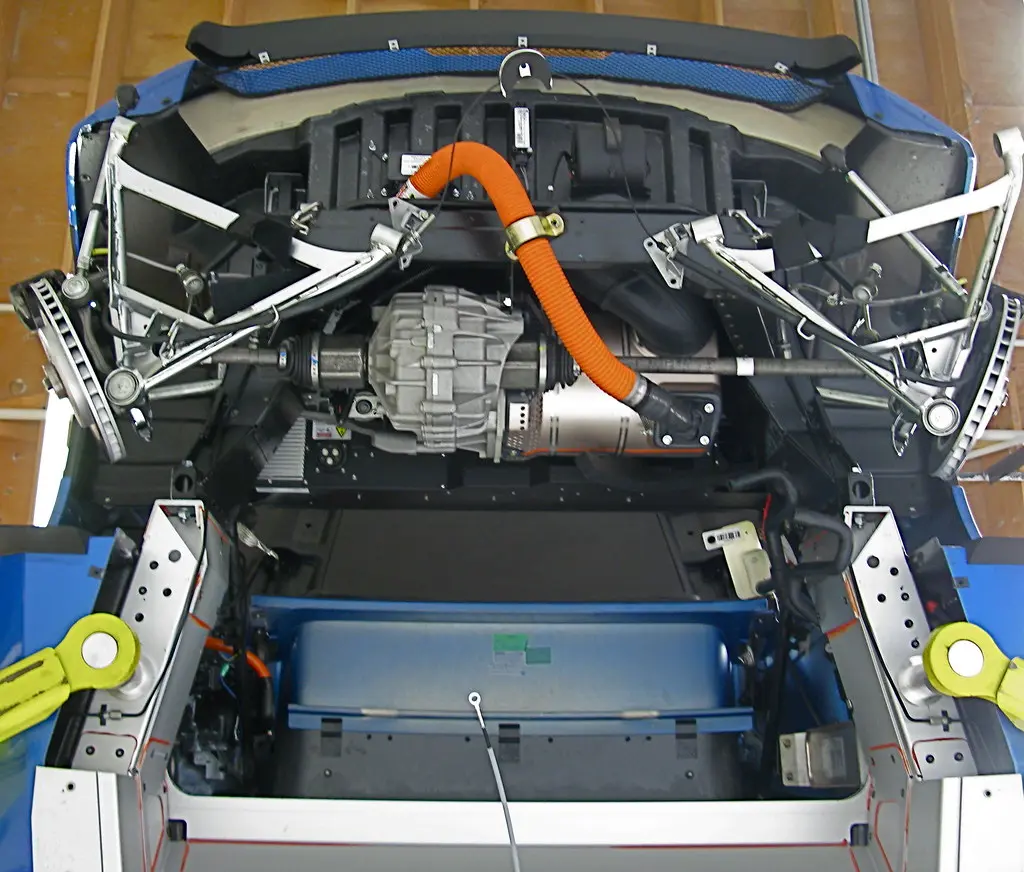
AWD uses sensors and clutches or differentials to send torque where it is needed. In mixed weather, that can reduce wheelspin and make a car easier to launch from a wet stop or climb a snowy hill. It is common in sedans, crossovers, and some wagons.
The tradeoff is added weight, more mechanical parts, and usually a higher purchase price. Some AWD systems are nearly invisible in normal use; others are reactive and only help after slip starts. Either way, the extra hardware is still along for every mile.
Four-wheel drive for trucks, SUVs, and low-range use
4WD is usually built for truck and SUV duty. Many systems are driver-selectable, with modes such as 2H, 4H, and 4L. Low range is useful for slow crawling, steep grades, and loose terrain, not grocery runs.
For normal commuting, 4WD is usually too much system for too little gain. It adds complexity and often rides in vehicles that are heavier and thirstier to begin with. If the commute is paved, 4WD is rarely the clean answer.
Is AWD worth it for everyday driving?

AWD can be worth it when your daily route regularly includes snow, steep grades, or roads that stay wet and slippery for long stretches. It is less useful in dry or mild climates, because the added traction mostly helps at launch, not in braking or cornering.
When AWD helps in rain, snow, and mixed roads
AWD shines when one drive wheel set starts to lose grip while pulling away from a stop. That can help in slush, on an icy incline, or when a driveway piles snow at the apron. It also helps a loaded crossover feel calmer when the road surface changes mile by mile.
What AWD does not do is shorten stopping distance on a wet highway by magic. Braking is still tire-limited. That is why an AWD car on poor tires can still be a bad winter commuter.
Where AWD adds cost, weight, and service needs
AWD often adds drivetrain mass and some mechanical drag. The exact fuel penalty varies by vehicle, but the direction is consistent: more parts moving means more energy lost. The extra hardware also gives you more fluid services and more failure points over time.
That cost is easy to miss in a showroom and easy to feel later, especially if the system needs differential service, transfer-case-like fluid changes, or expensive repairs outside warranty.
Why AWD still needs good tires
AWD can help a car move, but tires help it move, turn, and stop. A worn all-season tire can blunt the advantage of AWD fast. In snowy regions, winter tires often bring a bigger improvement than stepping from FWD to AWD on marginal rubber.
If the budget is tight, money may be better spent on tires first. That purchase often pays back in every season, not only in the one with snow.
Is FWD better than RWD for commuting?
For most commuters, yes. FWD usually wins on price, efficiency, and foul-weather predictability, especially in compact and midsize cars. RWD can still be a smart commuter choice in warm, dry regions where handling feel matters more than low-speed traction.
Why FWD usually wins on price and efficiency
FWD cars are often lighter and simpler, which can help with purchase price and running costs. There are fewer drivetrain parts between the engine and the driven wheels, so there is less complexity to buy, service, and eventually repair.
That matters most for stop-and-go commuting, where fuel use and brake wear are already part of the bill. A simpler drivetrain keeps the ownership math cleaner.
When RWD makes sense in warm, dry climates
RWD is a sensible daily-driver choice when winters are mild and roads stay dry most of the year. In those conditions, the steering can feel more natural and the car can feel more settled at speed. A well-tuned RWD sedan can be a better highway companion than many small AWD crossovers.
RWD also makes sense for drivers who care about balance and response more than all-weather bite. The key is matching the car to the climate, not to a badge preference.
How traction behavior changes at low speeds and in stop-and-go traffic
At low speeds, especially in rain, FWD tends to be forgiving because the engine weight presses down on the driven axle. RWD can spin easier when pulling away from wet intersections or climbing slick ramps, though modern traction control reduces the drama.
That said, traction control only trims excess slip. It does not give the rear axle the same load advantage that a front-driven layout already has.
How much do tires and weather change the answer?
They change it a lot. Tire choice can outweigh drivetrain choice in rain and light snow, and local weather often decides whether traction hardware matters every day or only a few mornings a year. Hills make the gap larger.
All-season tires versus winter tires
All-season tires are fine for many dry and wet commutes, but they are a compromise. Winter tires use rubber that stays more compliant in cold weather, which helps braking, turning, and climbing when temperatures fall and the road turns slushy or icy.
For a snowbelt driver, winter tires on FWD can be a smarter buy than AWD on weak all-seasons. That is especially true if the commute includes city speeds, where stopping and turning matter as much as getting moving.
Rain, snow, and hills: where grip actually comes from
Rain exposes tread depth and rubber quality. Snow exposes tread bite and compound flexibility. Hills expose torque control, weight distribution, and tire pressure more than the number of driven axles. The steepness of the route matters as much as the drivetrain.
A short, flat city commute in a wet climate may be fine with FWD. A long, hilly, unplowed commute is where AWD starts to earn its keep.
What traction control and stability control can and cannot fix
These systems reduce wheelspin and can correct skids, which is useful on wet pavement. They are worth having on any drivetrain. But they cannot replace real tire grip, and they cannot make a poor winter setup behave like a better one.
Electronic aids are support tools. They are not traction in themselves.
Do AWD and 4WD hurt fuel economy and add maintenance?
Yes. AWD and 4WD usually carry a fuel-economy penalty because of extra weight and moving parts, and they also add service points. The more complex the drivetrain, the more you should expect to budget for fluids, wear items, and possible repairs.
Parasitic loss and extra weight in daily use
Every extra gearset, shaft, clutch pack, and differential adds drag. That drag is small on its own, but it shows up over thousands of miles. The weight penalty also hurts city driving more than highway cruising because stop-and-go amplifies it.
That is why the same AWD system can feel more costly in an urban commute than on an open road trip.
Transfer case and differential service points
AWD and 4WD vehicles may need extra fluid changes in rear differentials, front differentials, and transfer case or coupling assemblies, depending on design. Some systems are straightforward; others need exact service intervals to stay healthy.
Missed service can become expensive because the parts that help with traction are also the parts most likely to suffer when fluid breaks down or tire sizes are mismatched.
Why long-term ownership costs usually rise with complexity
More parts mean more chances for seals, bearings, and clutches to age out. Even when nothing fails, the service bill is often higher than it is on a simpler FWD car. That difference matters more to high-mileage drivers than to low-mileage weekend users.
If a buyer keeps cars a long time, the cheapest drivetrain is often the one with the least hardware.
Side-by-side daily-driving decision table
This table scores the main commuter drivetrains on the factors that matter most in real use. Higher scores mean better daily-driving value for that row, not absolute superiority in every condition.
| Factor | FWD | RWD | AWD | 4WD |
|---|---|---|---|---|
| Dry-road efficiency | 5 | 4 | 3 | 2 |
| Wet traction | 4 | 3 | 5 | 4 |
| Snow traction | 3 | 2 | 5 | 4 |
| Maintenance burden | 5 | 4 | 3 | 2 |
| Purchase price | 5 | 4 | 3 | 2 |
| Tire dependence | 4 | 3 | 4 | 3 |
| Ride feel | 3 | 5 | 4 | 2 |
| Long-term ownership cost | 5 | 4 | 3 | 2 |
Read the table through the lens of your commute. If your roads are dry and your mileage is high, FWD or RWD can be the better economic choice. If your mornings start on packed snow or steep streets, AWD gains ground fast. If you do not need low-range gearing, 4WD is usually more truck than commuter.
Choose FWD if… / Choose RWD if… / Choose AWD if… / Choose 4WD if…
Choose FWD if your commute is mostly city or suburban, your climate is mild to moderate, and low running cost matters more than steering feel. It is also a strong pick for drivers who want the simplest ownership path over many years.
Choose RWD if you live in a warm, dry region, prefer balanced handling, and do not need extra traction help for winter mornings. It also works well for shoppers who value a traditional sedan feel and can accept more care in slippery weather.
Choose AWD if you deal with frequent rain, snowbelt winters, steep hills, or roads that are not cleaned quickly after storms. It is best when the added cost is justified by regular use, not by a vague sense that more driven wheels must be better.
Choose 4WD only if your daily driving overlaps with truck or SUV needs, rough access roads, or situations where selectable modes and low range actually matter. For a normal commuter, it is usually extra mass and extra cost without enough return.
- List your worst 10 commute days, not your average day.
- Check whether those days are wet, icy, snowy, or just cold.
- Decide whether winter tires would solve most of the problem.
- Compare purchase price, fuel use, and service cost over several years.
- Only then decide whether FWD, RWD, AWD, or 4WD fits best.
Frequently asked questions
What is the best drivetrain for daily driving?
For most drivers, FWD is the best daily drivetrain because it keeps purchase price, fuel use, and maintenance simpler than AWD or 4WD. It is especially sensible for city and suburban commuting. If winter weather is frequent and severe, AWD can be the better fit.
Does AWD hurt fuel economy on a daily driver?
Usually it does. AWD adds weight and drivetrain drag, and both work against fuel economy in city traffic and stop-and-go use. Highway impact can be smaller, but the penalty is still there. The exact gap depends on the vehicle and the AWD design.
Which drivetrain is most reliable for a daily driver?
Reliability often tracks with simplicity. A well-maintained FWD setup is usually the easiest bet for long-term dependability, while RWD can also be durable because the layout is straightforward. AWD and 4WD add service points and more parts that can age or fail.
Do I need 4WD for daily driving?
Most commuters do not. 4WD is aimed more at trucks, SUVs, rough access roads, and low-speed traction use than normal pavement commuting. If the daily route is mostly paved, 4WD is usually more capability than the driver will ever use.
Products related to this article
Sponsored / affiliate links. As an Amazon Associate I earn from qualifying purchases. I may earn additional commission from eligible campaigns.