P0121 Chevy Silverado: How to Diagnose and Fix the Throttle Position Sensor Code
What Does the P0121 Code Mean on a Chevy Silverado?
Your Silverado’s check engine light pops on, and the scanner reads P0121. The truck feels sluggish, maybe it won’t shift right, and you’re left wondering if this is a quick fix or a trip to the dealer. This code points to the throttle position sensor (TPS) circuit reporting a range or performance problem. The engine control module (PCM) sees a voltage signal from the TPS that doesn’t match expected values based on engine load and speed.
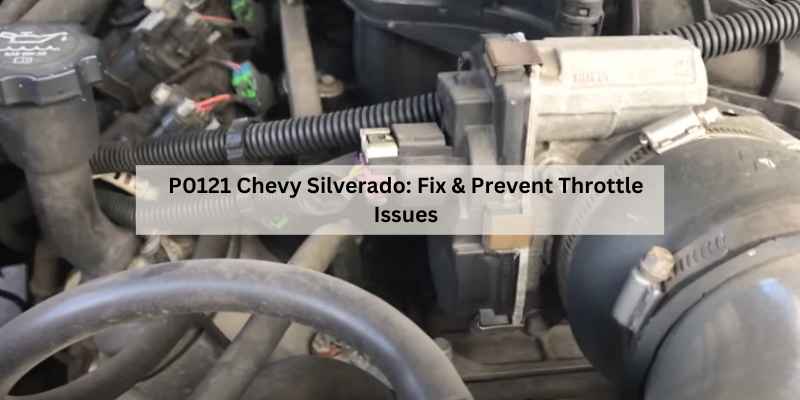
On modern Silverados with drive-by-wire, the TPS lives inside the throttle body assembly on top of the engine. It tells the computer how far the throttle plate is open. When that signal goes out of bounds, the PCM doesn’t trust it, so it defaults to a reduced power mode. You’ll walk away from this article knowing exactly how to test the sensor, what parts to check, and what a fair repair should cost.

Dorman
Dorman 977-519 Throttle Position Sensor
- Direct replacement - this throttle position sensor is designed to match the fit and function of the original sensor on specified v…
- Ideal solution - this sensor is a reliable replacement for an original part that has failed due to fatigue or electrical malfuncti…
- Durable construction - this sensor is made from quality components to ensure reliable performance and a long service life
This isn’t a code you should ignore, but it’s also not usually a catastrophic failure. Most of the time, it’s a sensor, a wire, or a dirty throttle body. We’ll cover all three.
If you need a replacement part, the Dorman 977-519 Throttle Position Sensor is a solid direct-fit option. It matches the original sensor’s fit and function, and it’s built to handle the same conditions as the factory unit. It’s a reliable choice when you’ve confirmed the sensor itself is the culprit.
P0121 Symptoms: What You’ll Notice in the Driver’s Seat
The symptoms of P0121 can range from barely noticeable to undrivable. Here’s what owners typically report:
- Check engine light – The most obvious sign. Sometimes it flashes, sometimes it stays steady.
- Limp mode – The truck limits power and tops out at low RPM. You’ll press the gas and get almost nothing.
- Poor acceleration – Hesitation or stumbling when you step on the pedal, especially from a stop.
- Transmission shifting issues – The transmission may shift hard, late, or refuse to shift at all because it relies on throttle position data to decide shift points.
- Rough idle – The engine might hunt for idle speed or stall when you come to a stop.
- Surge at highway speed – The truck might buck or surge as the TPS signal fluctuates.
Some drivers get the code without any noticeable symptoms. That’s the tricky part. The PCM can detect an out-of-range voltage even when the truck still feels normal. But if you ignore it, the problem usually gets worse.
Long-term, a bad TPS wreaks havoc on your transmission. The PCM uses throttle position to calculate line pressure and shift timing. A faulty sensor makes the transmission act confused, which leads to harsh shifts and premature wear on clutches and bands.
Top Causes of P0121 on Chevy Silverado (Ranked by Likelihood)
Faulty Throttle Position Sensor
The TPS itself is the most common failure. Inside the sensor, a resistive track wears out over time. This creates dead spots in the voltage sweep, so the signal jumps instead of moving smoothly. On 2026-2026 Silverados, the TPS is a separate unit that bolts to the throttle body. On 2026-2026 models, it’s integrated into the throttle body assembly, which means you replace the whole unit when the sensor fails.
Wiring and Connector Issues
Corroded pins, broken wires, or a loose connector cause intermittent P0121 codes. The TPS connector sits near the top of the engine, exposed to heat and moisture. Over time, the plastic degrades and the terminals lose tension. A simple fix is to unplug the connector, spray both sides with electrical contact cleaner, and apply dielectric grease before plugging it back in. But check the wiring harness for chafing too, especially where it rubs against the intake manifold.
Carbon Buildup on Throttle Body
Carbon deposits on the throttle plate and bore restrict airflow. The PCM tries to maintain idle by adjusting the throttle plate position, but the TPS reading doesn’t match what the computer expects. This throws a P0121. This is common on high-mileage Silverados that have never had the throttle body cleaned. A thorough cleaning with throttle body cleaner and a soft brush often clears the code if carbon is the root cause.
How to Diagnose P0121: A Step-by-Step Guide
Before you throw parts at the problem, do the diagnostic work. It takes about 30 minutes and a basic multimeter.
Using an OBD-II Scanner to Check Live Data
Plug in your scanner and look at the live data stream. Find the throttle position reading. With the key on and engine off, slowly press the accelerator pedal from rest to wide open. The TPS voltage should rise smoothly from about 0.5 volts at idle to around 4.5 volts at wide open throttle (WOT). Watch for any jumps, drops, or flat spots in the reading. A smooth sweep means the sensor is likely fine. A jerky or erratic reading points to a worn sensor.
Also check the accelerator pedal position sensor data. On drive-by-wire trucks, the pedal has its own sensor that sends the driver’s input to the PCM. If the pedal sensor is faulty, the PCM gets conflicting signals between pedal position and throttle position, which can trigger P0121. Compare the two readings side by side. They should move in sync as you press the pedal.
Testing TPS Voltage with a Multimeter
If you want to verify the sensor directly, use a multimeter. Disconnect the TPS connector and identify the three wires: reference voltage (usually 5V), ground, and signal. On most Silverados, the signal wire is the middle pin, but check the wiring diagram for your specific year to be sure.
- Turn the ignition to the ON position without starting the engine.
- Probe the reference wire and ground wire. You should see about 5 volts.
- Probe the signal wire and ground. With the throttle closed, you should read around 0.5 volts.
- Slowly open the throttle plate by hand (or have someone press the pedal). The voltage should increase smoothly to about 4.5 volts at full throttle.
- If the voltage jumps around or doesn’t reach the expected range, the sensor is bad.
One thing to watch: some Silverados have a 0-5V sweep that’s reversed, where idle reads high and WOT reads low. Check your service manual for the correct polarity. The key is smooth movement, not the exact direction.
How to Fix P0121: DIY Repairs vs. Professional Service
If the sensor is bad, replacement is straightforward. On 2026-2026 models, the sensor bolts to the throttle body with two small screws. Unplug the connector, remove the screws, and swap in a new unit. On 2026-2026 models, you replace the entire throttle body assembly since the sensor isn’t serviceable separately.
Before you replace anything, try the cheap fixes first. Clean the throttle body with a dedicated cleaner and a soft cloth. Inspect the wiring harness for damage. Clean the connector terminals and apply dielectric grease. These steps cost under $20 and solve a surprising number of P0121 cases.
For DIYers, the job is a 30-minute task on older trucks and maybe an hour on newer ones. You’ll need basic hand tools, a socket set, and possibly a new gasket for the throttle body if you’re replacing the whole assembly.
Professional service makes sense if you’re not comfortable working on the engine or if the diagnostic points to a deeper electrical issue. A shop will charge you for diagnosis (usually one hour of labor) plus the repair. They’ll also have access to factory scan tools that can test the sensor sweep more precisely than a generic OBD-II scanner.
If you’re replacing the throttle body on a 2026-2026 Silverado, you’ll need to perform a throttle body relearn procedure after installation. Some trucks do this automatically after a few key cycles. Others require a scan tool to command the relearn. If you don’t do it, the idle might be high or unstable for a while.
P0121 Repair Cost: What to Expect
The cost varies wildly depending on the root cause and where you get the work done. Here’s a realistic breakdown:
| Repair Option | Parts Cost | Labor Cost | Total Estimate |
|---|---|---|---|
| DIY – TPS sensor replacement (2026-2026) | $30 – $60 | $0 | $30 – $60 |
| DIY – Throttle body replacement (2026-2026) | $150 – $300 | $0 | $150 – $300 |
| Independent shop – TPS sensor | $30 – $60 | $80 – $120 | $110 – $180 |
| Independent shop – Throttle body | $150 – $300 | $100 – $150 | $250 – $450 |
| Dealership – TPS sensor | $40 – $80 | $120 – $180 | $160 – $260 |
| Dealership – Throttle body | $200 – $400 | $150 – $200 | $350 – $600 |
These are ballpark figures. Prices vary by region and whether you buy OEM or aftermarket parts. Check the current price on Amazon for the Dorman sensor to get a concrete number for your budget.
The good news is that most P0121 repairs land on the lower end of that range. Wiring fixes are even cheaper, often just the cost of a connector pigtail and some solder. The expensive scenario is a failing PCM, which is rare but possible. If you’ve tested everything else and the code persists, have a shop check the PCM with a scope before replacing it.
Is It Safe to Drive with a P0121 Code?
Short answer: it’s safe to drive short distances, but you shouldn’t ignore it for long. The truck will likely go into limp mode, which caps your speed and acceleration. That’s annoying on the highway and dangerous when merging into traffic. More importantly, the erratic TPS signal can cause the transmission to shift erratically, which damages internal components over time.
If the check engine light is flashing, pull over and shut the engine off. A flashing light indicates a severe misfire that can damage the catalytic converter. That’s a different problem than P0121, but the two can happen together if the TPS causes the engine to run rough enough to misfire.
For steady, non-flashing P0121, you can drive to a shop or parts store. But don’t put it off. The longer you drive, the more stress you put on the transmission and the higher the chance of getting stranded.
If you’re stuck on the side of the road and need to get moving, you can try disconnecting the battery for a few minutes to clear the code. That might get you out of limp mode temporarily, but the code will come back if the underlying issue isn’t fixed. It’s a band-aid, not a solution.
Year-Specific Notes: Silverado 1500 vs. 2500/3500
The P0121 code behaves differently depending on your truck’s generation.
2026-2026 Silverado 1500 and 2500/3500: These trucks use a separate TPS mounted on the throttle body. The sensor is cheap and easy to replace. Common failure points include the sensor itself and the wiring harness that runs along the intake manifold. The connector is prone to corrosion, especially in northern states where road salt gets everywhere. If you’re chasing an intermittent code, check the connector first.
2026-2026 Silverado 1500: These use an integrated throttle body with the TPS built in. You can’t replace just the sensor. The throttle body is more expensive, but the failure rate is lower. Most issues on these trucks come from carbon buildup or wiring issues rather than the sensor itself. The 2026-2026 2500/3500 trucks with the 6.0L gas engine share the same throttle body design, so the same guidance applies.
2026 and newer: The newer trucks use a different throttle body design with improved durability. P0121 is less common here, but when it does appear, it’s usually a wiring issue or a failed throttle body actuator. The diagnostic process is the same, but the parts are pricier.
One more distinction: the Silverado 2500 and 3500 with the Duramax diesel don’t have a traditional throttle plate. They use an intake throttle valve that behaves differently. If you have a diesel and get P0121, the diagnostic steps are similar, but the parts and labor costs are higher because the throttle body is larger and harder to reach.
Frequently Asked Questions
Can I clear the P0121 code and keep driving?
You can clear it, but it will come back if the problem isn’t fixed. Clearing the code resets the PCM’s memory and might get you out of limp mode temporarily. If the underlying issue is a worn TPS, the code will return within a few drive cycles. Use the cleared code as a diagnostic tool: if it takes a long time to come back, the issue might be intermittent, like a loose connector.
Will a bad TPS cause transmission problems?
Yes. The PCM uses throttle position to determine shift points, line pressure, and torque converter lockup. A faulty TPS sends incorrect data, so the transmission shifts erratically. You might feel hard shifts, delayed engagement, or no shift at all. In severe cases, the transmission goes into failsafe mode and locks in a single gear. Fixing the TPS usually resolves the transmission symptoms.
How do I know if it’s the TPS or the accelerator pedal position sensor?
Use a scan tool to compare both readings. Press the pedal slowly and watch the data. The pedal sensor should read 0% at rest and 100% at full depression. The TPS should follow in sync. If the pedal reads correctly but the TPS doesn’t, the TPS is bad. If the pedal reading is erratic, the pedal sensor is the problem. On most Silverados, the pedal sensor is part of the pedal assembly and isn’t serviceable separately.
Is throttle body cleaning actually necessary?
On high-mileage trucks, yes. Carbon buildup on the throttle plate restricts airflow and messes with the idle control. This can cause P0121 even with a healthy TPS. Cleaning the throttle body takes 15 minutes and costs about $10 in cleaner. It’s a cheap preventative step that also improves idle quality and throttle response. Do it every 50,000 miles or so.
What happens if I ignore P0121 for months?
The truck will likely spend most of its time in limp mode, which limits speed and acceleration. The transmission will shift harshly, accelerating wear on clutches. Eventually, the TPS might fail completely, leaving the throttle stuck in one position. That’s a safety hazard. You might also fail an emissions test because the check engine light stays on. Fix it sooner rather than later.
Final Verdict
P0121 on a Chevy Silverado is a manageable repair that most owners can handle at home. The diagnostic path is clear: check the live data, test the sensor voltage, inspect the wiring, and clean the throttle body. Replace the sensor or throttle body only if those steps don’t resolve the issue.
- Start with the cheap fixes: clean the throttle body and check the connector for corrosion.
- Use a multimeter to verify the TPS voltage sweeps smoothly from 0.5V to 4.5V.
- Compare TPS and pedal sensor readings on a scan tool to isolate the failing component.
- On 2026-2026 trucks, replace just the sensor. On 2026-2026 trucks, replace the whole throttle body.
- Expect to pay $30-$60 for a DIY sensor swap or $250-$450 for a shop-installed throttle body.
- Apply dielectric grease to the TPS connector to prevent future corrosion issues.
- Don’t drive long-term with this code — the transmission damage isn’t worth the delay.
If your Silverado is also throwing other codes related to the throttle or pedal, check our guide on P0101 Chevy Silverado for related airflow issues. And if you’re dealing with limp mode right now, our limp mode bypass guide might get you home safely.
Products related to this article
Sponsored / affiliate links. As an Amazon Associate I earn from qualifying purchases. I may earn additional commission from eligible campaigns.