Best PSI Gauge for Your Car: 3 Digital and Pencil Picks
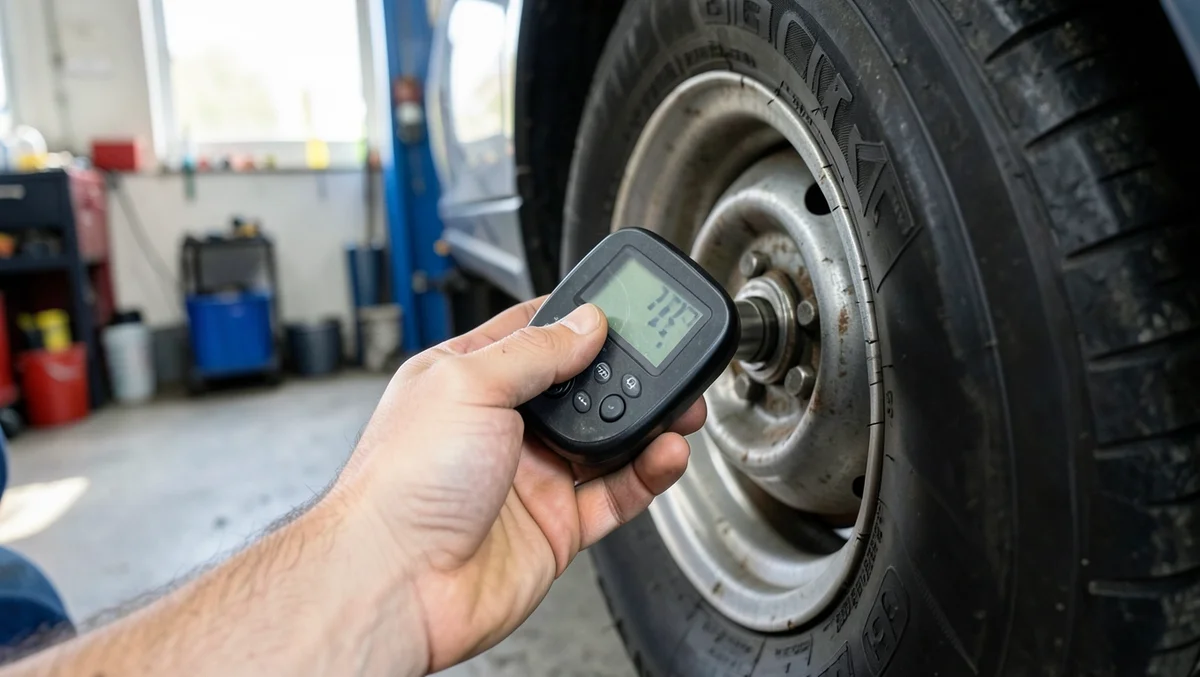
Most car tires need 30–35 PSI cold, but the correct number is not on the tire sidewall — it’s on the sticker inside your driver’s door jamb or in your owner’s manual. A dedicated PSI gauge for your car gives you an accurate reading in seconds, which matters because gas-station gauges are frequently off by 2–5 PSI. Below we cover what pressure your tires actually need, then compare three affordable digital and pencil gauges so you can pick the right one.
Our Top Pick
MOST ACCURATE DIGITAL PICK
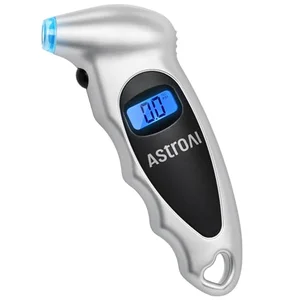 |
AstroAI Digital Tire Pressure Gauge, 0–150 PSI – $7.49 Reads in 0.1 PSI increments with a backlit display, so it stays readable in a dark garage or at night on the roadside.
|
What PSI Should My Car Tires Be At?
Most passenger cars call for somewhere between 30 and 35 PSI cold (meaning the tires haven’t been driven on for at least three hours). The exact figure is different for every vehicle, and it’s printed on a sticker on the driver’s door jamb or listed in the owner’s manual — not on the tire itself. The number molded into the tire’s sidewall is the tire’s maximum pressure rating, not the pressure your car actually needs, and inflating to that number will overinflate most vehicles.
Check your pressure at least once a month and before any long trip, since tires naturally lose roughly 1 PSI per month and pressure drops further as temperatures fall. If you’re diagnosing a tire that keeps going soft between checks, a gauge alone won’t tell you why — a slow leak needs its own troubleshooting steps, and a leaking valve stem is one of the more common culprits.
Digital vs. Pencil vs. Analog Gauges: Which Should You Buy?
Digital gauges give you a precise numeric readout, often to a tenth of a PSI, and most add a backlight for checking tires in the dark. They run on a small battery, so eventually you’ll need to replace it — a minor inconvenience for the extra readability. Pencil gauges are the old-school standby: no battery, nothing to break, and a slide-out stem you read against printed markings. They’re less precise and harder to read in low light, but they’ll outlast almost anything else in your glovebox. Analog dial gauges split the difference — no battery, a large easy-to-read face — but they can drift out of calibration over years of use and are bulkier to store than a pencil gauge.
For most drivers, a digital gauge is worth the extra dollar or two for the precision and backlight. If you want a true no-battery backup to keep in the glovebox alongside it, a pencil gauge is the simplest option.
AstroAI Tire Pressure Gauge Digital 0-150PSI
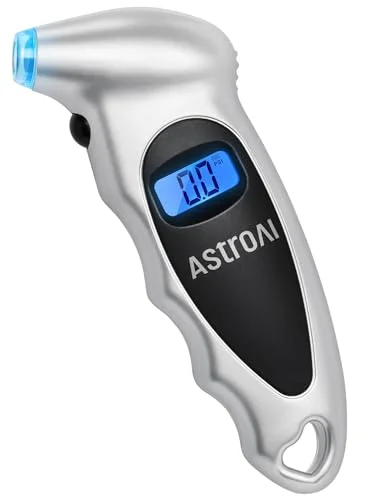
This is the gauge we’d recommend to most car owners first. It’s a straightforward digital tool that reads tire pressure in 0.1 PSI increments — precise enough to catch a slow leak before it becomes a flat — and its backlit LCD makes it usable in a dark garage or on the shoulder of a road at night. The included Presta valve adaptor means the same gauge works on a bike tire too, which is a nice bonus if there’s a bike in the household.
Pros
- Accurate to 0.1 PSI increments
- Backlit LCD readable in low light
- Presta valve adaptor included for bicycle tires
- Compact enough for a glovebox
Cons
- Maxes out at 150 PSI, so it isn’t suited to heavy-duty commercial tires
- Runs on a small battery, which will eventually need replacing
Buy the AstroAI Digital Tire Pressure Gauge on Amazon here.
AstroAI Pencil Tire Pressure Gauge 2 Pack
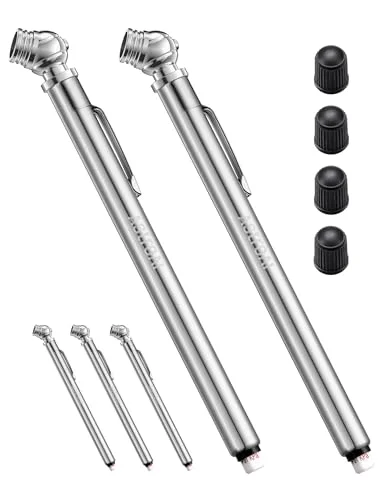
If you’d rather have something that never needs a battery, this pencil gauge is a solid backup — or a primary gauge for anyone who prefers the simplicity. Its stainless steel body and metal nozzle hold up well to years of being tossed in a glovebox or toolbox, and the slide-out stem gives you a reading you can trust without waiting on a digital display to initialize. It covers 10–75 PSI, which is plenty for passenger car and bicycle tires, though it won’t cover a truck tire that needs 80+ PSI.
Pros
- Stainless steel body built to last
- Metal nozzle for a consistent seal on the valve
- No battery required
- Two gauges included, so you can keep a spare in a second vehicle
Cons
- Manual slide-out reading only, no digital display
- 10–75 PSI range won’t cover higher-pressure truck tires
Buy the AstroAI Pencil Tire Pressure Gauge on Amazon here.
ETENWOLF T300 Digital Tire Pressure Gauge
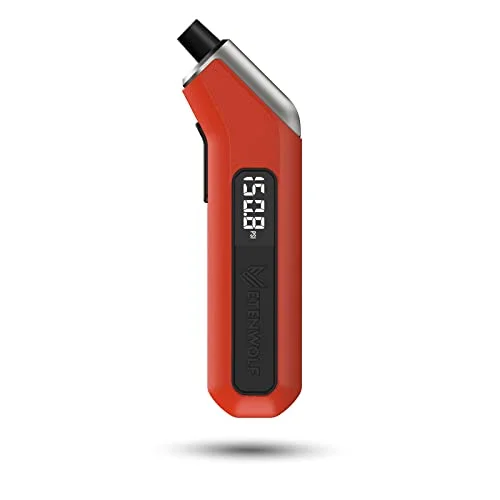
This is the gauge to reach for if your vehicle needs more than 150 PSI — think trailer tires, some truck tires, or anyone who just wants extra headroom. It’s calibrated to the ANSI B40.7 Grade 2A standard, so its readings hold up to the kind of scrutiny a mechanic would expect, and it reads all the way up to 200 PSI. Checking the valve stem itself for a leak is worth doing with a gauge this accurate, since a slow valve leak can otherwise look like normal pressure loss over time.
Pros
- Calibrated to ANSI B40.7 Grade 2A accuracy standards
- 3–200 PSI range covers cars, trucks, and RVs
- Uses replaceable AAA batteries instead of a proprietary cell
- Bright orange housing is easy to spot in a toolbox
Cons
- Larger footprint than a pencil gauge, so it takes up more glovebox space
- Digital display can be harder to read in direct sunlight
Buy the ETENWOLF T300 Digital Tire Pressure Gauge on Amazon here.
Frequently Asked Questions
How accurate is the AstroAI digital tire pressure gauge?
The AstroAI digital gauge reads in 0.1 PSI increments and supports four pressure units, so it works whether you think in PSI, BAR, KPA, or KGF/CM². That resolution is precise enough to catch a small leak well before it becomes a flat.
Can the AstroAI pencil gauge measure bike tire pressure?
Yes. It covers a 10–75 PSI range, which comfortably includes most bicycle tires as well as car and motorcycle tires. The stainless steel body holds up to being carried in a bike bag or car glovebox without losing accuracy.
What makes the ETENWOLF T300 gauge different from the others?
Its 3–200 PSI range is the widest of the three, and it’s the only one of the group calibrated to the ANSI B40.7 Grade 2A standard. That combination makes it the better pick for truck or trailer tires that run higher pressures than a typical passenger car.
Does the AstroAI gauge work with Presta valves?
Yes, it ships with a Presta valve adaptor, which most car-focused gauges don’t include. That’s what lets the same gauge double as a bike tire gauge for Presta-valve bicycle tubes.
Are these gauges suitable for car tires?
Yes, all three gauges are built for standard car tire pressures. The AstroAI digital and pencil gauges suit most passenger cars and light trucks, while the ETENWOLF T300’s higher 200 PSI ceiling gives it extra room for larger trucks or trailers.
Why is my gas station tire gauge reading different from my own gauge?
Gas station air pump gauges see heavy daily use and get dropped, kicked, and left out in the weather, so their readings frequently drift 2–5 PSI from the true pressure. A gauge you keep in your own car and don’t leave exposed to the elements will generally stay more consistent over time.
The Bottom Line
A dedicated PSI gauge pays for itself the first time it catches a slow leak before it turns into a roadside flat. For most drivers, the AstroAI digital gauge is the best all-around pick thanks to its 0.1 PSI accuracy and backlit display. Want a battery-free backup for the glovebox? The AstroAI pencil gauge covers that. And if your vehicle runs higher pressures than a typical car, the ETENWOLF T300’s 200 PSI range and ANSI-certified accuracy make it the one to reach for. Whichever gauge you choose, check your tires monthly against the pressure listed on your door jamb sticker — not the number molded into the tire sidewall — and you’ll get longer tire life, better fuel economy, and a safer ride.
Products related to this article
Sponsored / affiliate links. As an Amazon Associate I earn from qualifying purchases. I may earn additional commission from eligible campaigns.