Service Auto Stop-Start: What It Means and How to Fix It
Service Auto Stop-Start usually means the system has shut itself off because of a battery, sensor, charging, or fault-code problem; if the light stays on after a restart or battery charge, treat it as a real fault, not normal behavior. Ignore it, and you can end up with a no-start battery or a stop-start system that never comes back. This guide separates normal shutoff conditions from battery, sensor, and charging faults, then gives the first repair step for each.
Temporary Disablement Versus System Faults


It means the vehicle has detected a problem in the stop-start system or one of its input conditions and has turned the feature off. Sometimes that is temporary and expected; sometimes it points to a battery, charging, switch, or stored-code fault that needs diagnosis.
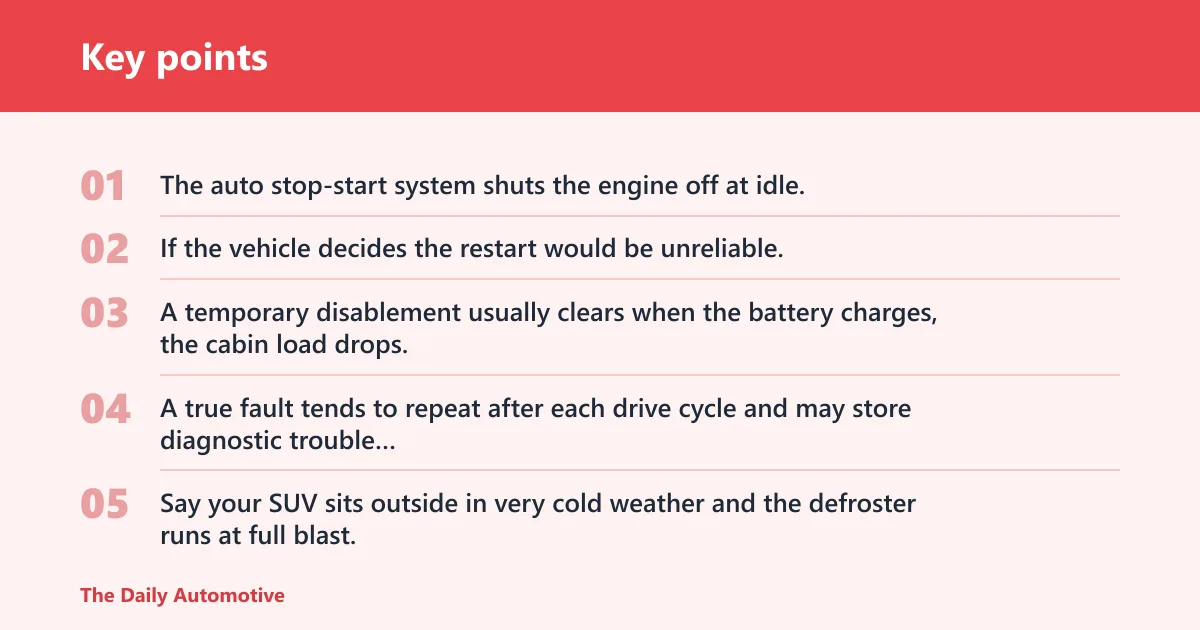
The auto stop-start system shuts the engine off at idle, then restarts it when conditions are right. If the vehicle decides the restart would be unreliable, it disables the feature and may display a service message instead of a simple “not available” notice.
Temporary disablement vs. a true fault
A temporary disablement usually clears when the battery charges, the cabin load drops, or the engine warms up. A true fault tends to repeat after each drive cycle and may store diagnostic trouble codes in the battery or body-control systems.
Say your SUV sits outside in very cold weather and the defroster runs at full blast. Stop-start may stay off all morning without anything being broken. If the message remains after a long highway drive and a full battery charge, scan for codes next.
What the warning is telling you right now
The message is telling you the system cannot meet its own operating rules. Those rules usually include battery state of charge, engine temperature, brake-pedal input, and several safety switches on the hood, doors, and seats.
That is why the same message can appear for very different reasons. A weak battery, a misadjusted brake switch, or a faulty hood latch can all block stop-start operation.
Is it safe to keep driving?
Usually yes, if the car starts normally and there are no other warning lights, but the system is not being protected by stop-start. If the battery is weak or the charging system is failing, continued driving can turn a convenience issue into a no-start problem.
If the warning appears with slow cranking, dim lights, or a battery icon, treat it as a charging concern rather than a nuisance message.
How auto stop-start works and what can block it
The auto stop-start system is designed to shut the engine off at idle to save fuel, then restart it when the brake or another input tells the car you want to move again. It depends on battery state, charging output, temperature, and several safety interlocks, so it is designed to refuse operation when any of those signals look wrong.
Role of battery state of charge and the battery management system
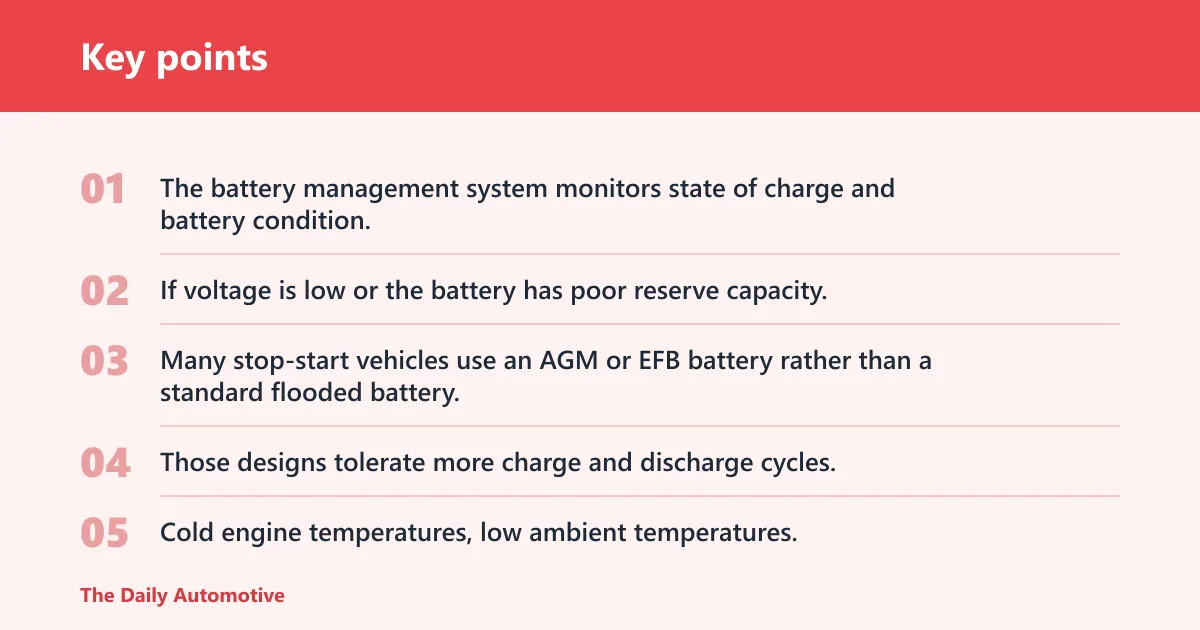
The battery management system monitors state of charge and battery condition, then decides whether stop-start can run. If voltage is low or the battery has poor reserve capacity, the system may disable stop-start to preserve starting power.
Many stop-start vehicles use an AGM or EFB battery rather than a standard flooded battery. Those designs tolerate more charge and discharge cycles, which matters because stop-start can restart the engine many times in a trip.
Why cold weather and cabin load can stop operation
Cold engine temperatures, low ambient temperatures, and heavy HVAC demand can all keep stop-start inactive. That includes front and rear defrost, high fan speed, and compressor demand that would strain the electrical system or reduce cabin comfort.
These are normal inhibit conditions, not failures by themselves. The system is protecting battery reserve and drivability.

Why is my stop-start system not working?
Stop-start may not work because the battery is weak, the charging system is underperforming, a brake switch signal is missing, or one of the hood, door, or seatbelt inputs is telling the car a safe restart is not confirmed. Those are the most common branches to check first.
Battery and charging-system faults
A weak stop-start battery is a common cause, especially if the battery is older, undersized, or not the correct AGM or EFB type. Alternator, belt-drive, or voltage-regulation problems can also keep the battery management system from approving stop-start.
Low charging voltage often produces more than one symptom. You may see the service message, slower cranking, or a battery warning at the same time.
Brake switch and pedal-input problems
The brake switch tells the system when the pedal is pressed and released. If that switch is misadjusted, intermittent, or faulty, the car may not know when it is safe to shut down or restart the engine.
This is a common diagnostic item because the system relies on an exact pedal signal. A small switch fault can look like a larger stop-start failure.
Hood latch, door, and seatbelt input faults
Hood latch, door, and seatbelt switches are safety interlocks. If any of them report an open hood, an unlatched door, or an unbuckled belt, stop-start may stay disabled even though the car seems otherwise normal.
These inputs can fail, stick, or drift out of adjustment. A faulty switch can mimic a stop-start system fault without affecting basic drivability.
Decision tree: symptom, likely cause, first step
Use the symptom pattern to sort the problem before replacing parts. The goal is to separate a normal inhibit condition from a battery, switch, or charging fault, then choose the first check that gives the most information.
| Symptom | Likely branch | First diagnostic step |
|---|---|---|
| No warning, but stop-start never activates | Normal inhibit condition, battery state, temperature, or cabin load | Check battery age, recent short trips, HVAC demand, and ambient temperature |
| Warning message plus weak cranking or low voltage | Battery or charging-system fault | Test battery state of charge and charging voltage before buying parts |
| Warning after battery replacement or software update | Battery registration/coding issue, wrong battery type, or stored code | Verify correct AGM/EFB fitment and scan for codes after replacement |
| Warning with brake-light oddities or pedal input issues | Brake switch or pedal signal fault | Check brake-light operation and scan live data for pedal input changes |
| Warning after hood, door, or seatbelt issues | Safety interlock switch fault | Inspect latch and switch status in live data, then check the suspect switch |
Two common examples
Suppose a compact crossover shows the message only during a January cold snap, with the blower on high and the rear defroster active. That points first to normal inhibit behavior, not immediate failure.
A common first-timer mistake is replacing the battery immediately after a warning appears on a two-year-old stop-start car. If the replacement battery is the wrong type, or it is not registered where required, the warning can return.
Battery type, registration, and replacement basics
Stop-start cars usually need an AGM or EFB battery, not a standard flooded battery. AGM batteries handle deep cycling well; EFB batteries are also designed for higher cycling than conventional batteries, but the vehicle must be matched to the type specified by the manufacturer.
AGM vs. EFB and why the type matters
AGM batteries are common in vehicles with heavier electrical loads and frequent stop-start use. EFB batteries are also built for stop-start duty, but they are not interchangeable with every system. Using a standard battery can shorten life and cause repeat stop-start problems.
The battery’s chemistry affects charge acceptance, recovery, and the battery management system’s decision to allow engine shutoff. If the wrong battery is installed, the system may see poor reserve capacity even when the battery is new.
Battery coding or registration where applicable
Some vehicles may need battery registration or coding after replacement so the control module can recognize the new battery’s type and age. Without that step, the car may keep using the old charging strategy and may continue to inhibit stop-start.
That is especially relevant after a battery swap on vehicles that track battery history closely. If the warning starts after replacement, check this before assuming the new battery is defective.
How do you fix auto stop-start system fault?

Start with an OBD-II scan, confirm battery health, and inspect the input switches before replacing expensive parts. The fix depends on the branch: some cars need a battery or charging repair, while others need a switch, latch, or coding correction.
Read OBD-II diagnostic trouble codes
Persistent warnings call for diagnostic trouble codes, because the stored codes help separate battery, charging, brake, and sensor circuits. Live data can also show whether the brake switch, hood latch, or battery management system is reporting an abnormal state.
Codes matter here because a stop-start message is not specific. The same dashboard text can come from very different failures.
Check battery health before buying parts
Check state of charge, cold-cranking ability, and battery reserve before ordering modules or sensors. A battery can look fine at rest and still fail under stop-start cycling, especially if it is the wrong type or has been repeatedly discharged.
If the vehicle uses AGM or EFB, confirm that the replacement matches the original specification. A correct battery type with poor registration data can still cause repeat complaints.
Inspect switches, wiring, and charging output
Inspect the brake switch, hood latch, door switches, and seatbelt inputs, then verify alternator output and charging control. Loose connectors, corrosion, or a misadjusted switch can be enough to block stop-start operation.
If charging output is low or unstable, the battery management system may keep the feature disabled until the underlying issue is fixed.
How much does it cost to repair stop-start system problems?
Costs vary by branch. Battery-only repairs are often the lowest-cost fix, sensor and switch problems usually sit in the middle, and charging-system or dealer-level diagnosis can cost more because the fault may need code reading, live-data checks, and programming-related steps.
Battery-only repair range
A stop-start battery replacement is usually the cheapest major repair if the battery is truly the problem, but the exact price varies with battery type, size, and vehicle access. AGM batteries generally cost more than standard batteries, and that difference matters on stop-start vehicles.
Sensor or switch diagnosis and replacement range
Brake switches, hood latches, and similar inputs usually cost less than batteries or alternators, but diagnosis time can add up if the fault is intermittent. The repair bill depends on whether the issue is a simple switch replacement or wiring repair.
Charging-system or dealer-level diagnosis range
If the alternator, voltage regulation, or battery management system needs diagnosis, expect a higher labor bill because the fault may require targeted testing. Dealer-level programming or battery registration can add cost when the vehicle requires coding after replacement.
Can I drive with the auto stop-start service light on?
Usually yes, if the car starts normally and no charging or brake warnings are present, but you should not ignore the message. It often means the feature is disabled, and if the root cause is battery or charging related, the vehicle can eventually become hard to start or stall under load.
If the warning appears with dim lights, slow cranking, or multiple electrical faults, treat it as a repair issue rather than a simple convenience problem.
Can cold weather affect stop-start?
Yes. Cold weather can reduce battery output, slow engine warm-up, and increase cabin heating demand, so stop-start may stay off until conditions improve. That is normal behavior on many vehicles, especially during short trips or repeated cold starts.
If the system works again after a longer drive in milder weather, that points more toward an inhibit condition than a failed part.
Frequently asked questions
What does service auto stop-start mean?
It means the vehicle has detected a fault or an operating condition that prevents the stop-start system from working. The message can reflect a temporary inhibit state, such as cold temperature or high electrical demand, or a true problem in the battery, charging, brake, or sensor circuits.
Does a bad battery cause stop-start problems?
Yes. A weak battery is one of the most common causes because the system needs reliable voltage and reserve capacity to restart the engine repeatedly. A stop-start vehicle also often needs AGM or EFB battery specifications, so a standard battery can create repeat problems.
What sensors can disable stop-start?
Brake switches, hood latch inputs, door switches, and seatbelt switches are common disabling inputs. If any of those signals look unsafe or inconsistent, the control module can block engine shutoff and restart logic even though the car otherwise drives normally.
Products related to this article
Sponsored / affiliate links. As an Amazon Associate I earn from qualifying purchases. I may earn additional commission from eligible campaigns.