Service StabiliTrak Chevy Equinox: What It Means and How to Fix It
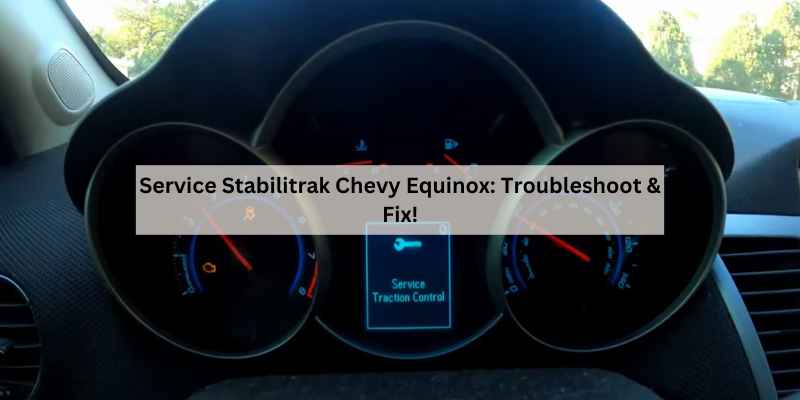
You’re driving down the highway, and the message Service StabiliTrak pops up on the dash. The traction control light might blink, or the car suddenly feels like it lost half its power. It’s annoying, and it makes you wonder if something expensive is about to break.
This message is the Equinox’s stability control system telling you it has detected a fault. It could be a minor glitch from a weak battery, or it could be a failed sensor. The good news is that most causes are straightforward to diagnose, and many you can fix yourself in an afternoon. This guide walks you through the real causes, the exact diagnostic steps, and the honest repair costs so you don’t get taken for a ride at the dealership.

VeloCore
VeloCore 12631186 Electronic Throttle Body with 6-Pin…
- 【VEHICLE FITMENT - CHEVY】 Compatible with Chevrolet Malibu 2008, 2009, 2010, 2011. Compatible with Chevrolet Equinox 2010, 2011. C…
- 【VEHICLE FITMENT - GM FAMILY】 Compatible with GMC Terrain 2010, 2011. Compatible with Buick LaCrosse 2010-2011, Regal 2011, Allure…
- 【REPLACES OE NUMBER】 Direct Plug-and-Play Replacement. Compatible with GM / ACDelco part numbers: 977-779, 977779, 67-3014, 673014…
You’ll leave this page knowing exactly what to check first, how to tell a false alarm from a real failure, and when you can keep driving safely.
If your diagnostic points to a failing throttle body, a direct replacement like the VeloCore 12631186 Electronic Throttle Body is a solid option. It’s a plug-and-play unit for the 2.4L LE5/LE9 Ecotec engines found in the 2026-2026 Equinox, and it comes with the integrated throttle position sensor and idle air control valve already installed.
What Does “Service StabiliTrak” Mean on a Chevy Equinox?
StabiliTrak is GM’s name for its electronic stability control system. It uses sensors to detect when your car is losing traction or starting to skid. When it works, it applies the brakes to individual wheels or cuts engine power to keep you on your intended path.
When the system detects a problem with any of its components, it disables itself and shows the service stabilitrak chevy equinox warning. This is a safety feature, not a breakdown. The system refuses to operate until the fault is cleared. Your brakes and steering still work normally, but the safety net is gone.
Think of it like a check engine light for the stability system. It doesn’t tell you which part failed; it just says something is wrong. Your job is to find out what.
The 5 Most Common Causes (Ranked by Likelihood)
After years of working on these crossovers, the same five culprits cause about 90% of StabiliTrak warnings. Here they are in order of how often they show up.
Wheel Speed Sensor Failure
This is the number one cause. Each wheel has a sensor that reads how fast it’s spinning. If one sensor fails, the system can’t compare wheel speeds, so it shuts down. The sensor itself often gets dirty, or the wire leading to it chafes and breaks.
You’ll usually see a code like C0035, C0040, C0045, or C0050, depending on which wheel is affected. These codes point directly to a specific wheel speed sensor circuit.
Throttle Body and Reduced Engine Power
This one is common on the 2.4L Ecotec engine. The throttle body controls how much air enters the engine. The sensor inside it wears out over time, sending erratic signals to the computer. When the computer can’t trust the throttle position, it triggers reduced engine power mode to protect the engine.
You’ll see the StabiliTrak warning alongside the message Reduced Engine Power on the driver information center. The car will feel sluggish, and the gas pedal might not respond well. Codes P2135, P0121, or P0223 are classic indicators of this issue.
This is where the VeloCore throttle body comes in. It replaces the factory unit with upgraded sensor technology and high-temperature internal gears, which addresses the wear problem that plagues the original design.
Steering Angle Sensor Calibration
The steering angle sensor tells the system which way you’re pointing the wheels. If it loses calibration, the system thinks the steering wheel is centered when it’s not. This causes false activations or immediate shutdowns.
This often happens after an alignment or a battery disconnect. The fix is usually a simple recalibration using a scan tool, not a replacement part.
Battery and Grounding Issues
Modern cars are sensitive to voltage drops. A weak battery or a corroded ground cable can cause all sorts of electrical gremlins, including false StabiliTrak warnings. The system needs a steady supply of voltage to operate correctly.
If you recently jumped the car or left the lights on, a low battery is a prime suspect. Check the battery voltage first. It should read around 12.6 volts with the engine off and 13.5 to 14.5 volts with the engine running.
ABS Module and Wiring Harness Corrosion
The ABS module controls the brakes and communicates with the StabiliTrak system. If the module fails or the wiring harness corrodes, you’ll get the warning. This is more common in northern states where road salt eats at connectors.
The X411 connector, located near the battery tray, is a known trouble spot on 2026-2026 models. Corrosion here can cause random, intermittent StabiliTrak warnings that are hard to pin down.
How to Diagnose the Problem Yourself (Step-by-Step)
You don’t need to be a master mechanic to narrow this down. Follow this flow and you’ll find the problem in most cases.
- Check the battery. Use a multimeter to test the voltage. If it’s below 12.4 volts, charge it and clear the code. Drive it for a day and see if the warning returns.
- Scan for codes. You need a scan tool that reads ABS and StabiliTrak codes, not just engine codes. A basic OBD-II scanner won’t cut it. Pick up a mid-range tool like an Autel or BlueDriver that reads all modules.
- Look up the code. Write down every code you find. A C0035 code means the left front wheel speed sensor circuit is bad. A P2135 code points to the throttle body. Match the code to the part.
- Inspect the wheel speed sensors. Remove the wheel and check the sensor for dirt, metal shavings, or damage. Inspect the wiring harness for breaks or chafing. Clean the sensor with brake cleaner and re-test.
- Check the throttle body connector. Unplug it and look for corrosion or bent pins. If the connector looks clean, the throttle body itself is likely the issue.
- Inspect the ground straps. Look for the ground cable from the battery to the engine block and from the engine to the chassis. Make sure they’re tight and free of corrosion.
- Test the steering angle sensor. This requires a scan tool with bidirectional controls. You can usually recalibrate it through the tool by following the on-screen prompts.
Pro tip: Don’t buy parts randomly. The diagnostic code is your map. Replacing a wheel speed sensor when your problem is the throttle body wastes time and money.
How to Reset the Service StabiliTrak Message (When It’s Safe)
You can clear the message in two ways. The first is using a scan tool to clear the codes. The second is disconnecting the battery for about 15 minutes. Both methods work, but they only clear the message if the underlying fault is gone.
If the problem was a low battery or a loose connection, the message will clear and stay off. If the message comes back immediately after clearing, the fault is still present. Don’t keep resetting it and hope it goes away. That’s how you end up stranded.
One thing to note: after a battery disconnect, the StabiliTrak light might stay on until you drive the car for a few minutes. The system needs to relearn the steering angle sensor position. Turn the steering wheel fully to the left and right once, then drive straight. The light should turn off.
Repair Costs: DIY vs. Mechanic vs. Dealership
Here’s the honest breakdown of what you’ll pay for each common fix. These are real-world estimates, not sticker prices.
| Repair | DIY Parts Cost | Independent Mechanic | Dealership |
|---|---|---|---|
| Wheel Speed Sensor | $40 – $80 | $150 – $250 | $250 – $400 |
| Throttle Body Replacement | $80 – $150 | $250 – $400 | $400 – $600 |
| Steering Angle Sensor Recalibration | $0 (if you own a scan tool) | $80 – $120 | $100 – $150 |
| Battery Replacement | $120 – $180 | $200 – $300 | $250 – $350 |
| ABS Module Replacement | $200 – $400 | $600 – $900 | $1,000 – $1,400 |
The dealership charges a premium for diagnostics alone, often $150 to $200 just to look at the car. An independent mechanic will charge $50 to $100. If you DIY, you can buy a decent scan tool for the price of one dealership diagnostic visit.
Is It Safe to Drive? A Simple Decision Tree
This is the question everyone asks. Here’s how to decide based on what you’re experiencing.
- Just the light is on, no other symptoms: Safe to drive. The stability system is off, but your brakes and steering work normally. Get it diagnosed soon.
- Light is on with reduced engine power: Drive cautiously to a safe location. The computer has limited engine output to protect itself. You can drive short distances, but don’t push the car hard.
- Light is on and the car pulls to one side: Not safe to drive far. This could be a stuck brake caliper or a failed ABS module. Get it towed.
- Light is on after a jump start: Likely a false positive from low voltage. Drive it for a few minutes and the light should clear. If it doesn’t, check the battery.
Use your judgment. If the car feels normal, you’re probably fine to get to work or a shop. If anything feels off, don’t risk it.
Recalls and TSBs for Chevy Equinox StabiliTrak Issues
GM has issued several Technical Service Bulletins (TSBs) for these problems. A TSB is not a recall; it’s a known issue with a documented fix that dealerships use for diagnosis.
The most relevant one is TSB #PIT-5480, which covers the X411 connector corrosion on 2026-2026 models. The fix involves cleaning the connector and applying dielectric grease. If you’re getting random StabiliTrak warnings, this is worth mentioning to your mechanic.
There’s also TSB #09-05-93-005 which addresses intermittent StabiliTrak warnings caused by low battery voltage. It’s a simple software update that adjusts the voltage threshold for the system.
Recalls are different. Check the NHTSA website using your VIN to see if your Equinox has any open safety recalls. Most of these don’t relate directly to StabiliTrak, but it’s always worth checking.
Frequently Asked Questions
Will a bad wheel bearing cause the Service StabiliTrak light to come on?
Yes. A worn wheel bearing can cause the wheel speed sensor to read inconsistently. The sensor sits near the bearing, and excess play in the bearing creates an erratic signal. If you hear a humming noise that gets louder when turning, check the bearing first.
Can low tire pressure trigger the StabiliTrak warning?
It can, but it’s rare. The system uses wheel speed sensors, not tire pressure sensors. If one tire is significantly underinflated, it spins faster than the others, which the system might interpret as a slip. Check your tire pressures and make sure they’re all within a few PSI of each other.
How much does a dealership charge to diagnose a StabiliTrak problem?
Most dealerships charge a flat diagnostic fee between $150 and $200. This fee covers the time to scan the modules and perform basic tests. If you approve the repair, some dealerships waive the fee. Independent shops usually charge less, around $80 to $120.
Will the Service StabiliTrak message clear itself?
Sometimes. If the fault was temporary, like a voltage drop, the light might turn off after a few drive cycles. But if the underlying problem is a failed sensor, the light will stay on or keep coming back. Don’t count on it fixing itself.
Can I replace the throttle body myself?
Yes, it’s a manageable job for a DIYer. It sits on top of the engine and is held on by four bolts. You’ll need to disconnect the coolant lines and the electrical connector. The whole job takes about an hour. Just make sure you use a quality replacement part and torque the bolts to spec.
The Bottom Line
The service stabilitrak chevy equinox warning is rarely a catastrophic failure. It’s usually a sensor, a battery issue, or a throttle body problem. Start with the cheapest and easiest checks first: battery voltage and a full code scan. Work your way up from there.
Here’s what to remember:
- Scan codes with a tool that reads ABS modules, not just engine codes.
- Check the battery voltage before anything else, especially after a jump start.
- Wheel speed sensors are the most common failure point and the cheapest to fix.
- Reduced engine power points to the throttle body, not the brakes.
- Corrosion at the X411 connector is a known issue on 2026-2026 models.
- Dealership diagnostics cost a premium; independent shops do the same work for less.
- It’s safe to drive with the light on if the car feels normal, but don’t ignore it.
For more context on this specific problem, check out our guide on the 2026 Equinox StabiliTrak fix or learn how to turn off StabiliTrak when you’re in a slippery situation. And if you’re dealing with other electrical gremlins, our piece on the 2026 Equinox clock losing time covers a similar diagnostic approach.
Products related to this article
Sponsored / affiliate links. As an Amazon Associate I earn from qualifying purchases. I may earn additional commission from eligible campaigns.