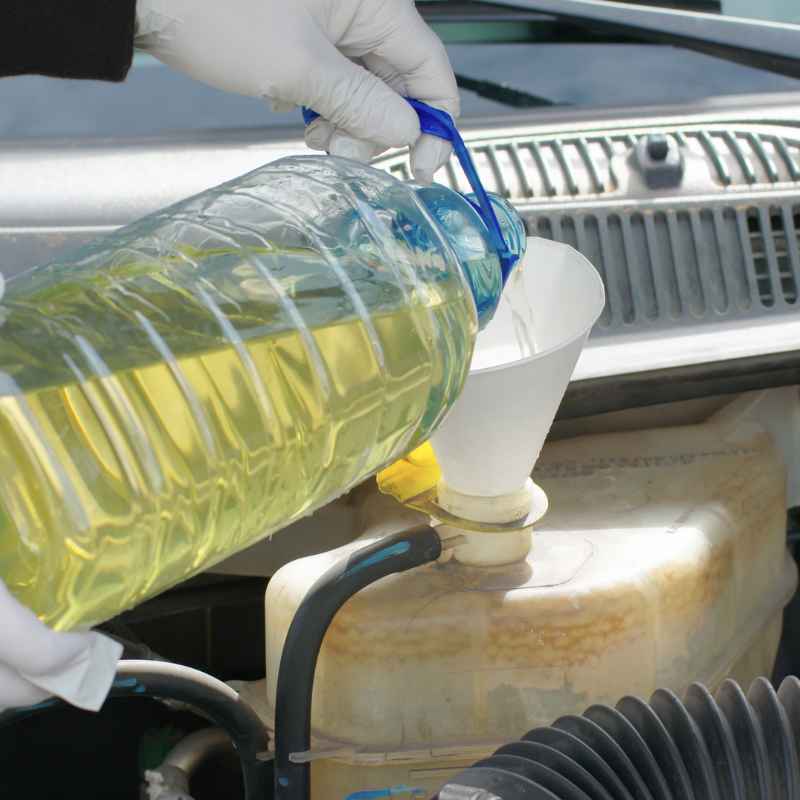
Should the Car Be Running When Adding Coolant? Find Out
No, the engine should be off and cooled down before you add coolant. Only let it idle if you need to diagnose a leak or fan issue; do not use idling as a way to pour into a hot system. Opening a pressurized cooling system at the wrong time can spray scalding coolant and turn a simple top-up into an overheated engine or damaged hoses. This guide tells you when the engine must be off, when idle is acceptable for diagnosis, and when coolant loss means you should stop driving.
Safety first when handling hot coolant


Running or off? decision tree
This is the quickest way to separate a safe top-up from a cooling-system fault.
| Condition | What to do | Why |
|---|---|---|
| Engine cold and coolant level is low | Shut the engine off, let it cool, then top up at the correct fill point. | A cold system is not pressurized, so the cap can usually be handled safely. |
| Engine warm or hot | Shut it down and wait for it to cool before opening anything. | Cooling system pressure is higher at operating temperature, and hot coolant can spray. |
| Overheating continues after refill | Stop driving, inspect for leaks, and recheck the level after cooldown. | Low coolant may be only one part of the problem. |
Engine cold and safe to top up
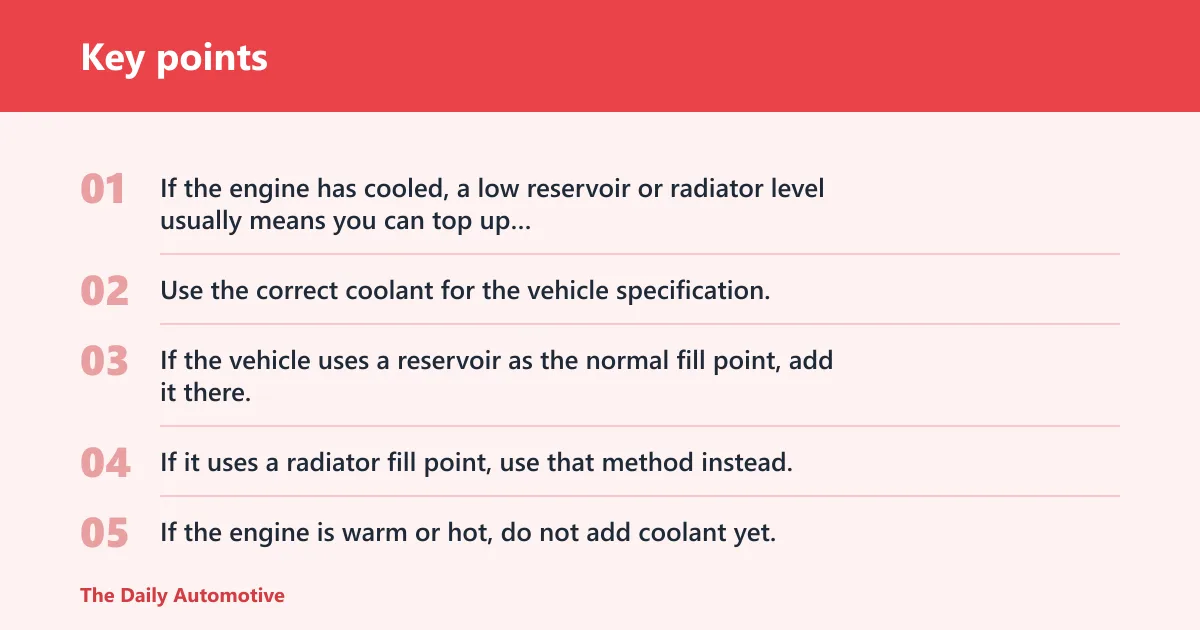
If the engine has cooled, a low reservoir or radiator level usually means you can top up the system. Use the correct coolant for the vehicle specification, then secure the cap fully before starting the engine again. If the vehicle uses a reservoir as the normal fill point, add it there. If it uses a radiator fill point, use that method instead.
Engine warm or hot, shut it down
If the engine is warm or hot, do not add coolant yet. Most engines cool down within the first hour after shutdown, and an engine still hot after 2 hours can signal a cooling-system problem. Wait until the system is safe to touch, then check the level at the proper fill point.
Overheating after refill, stop and inspect
If the temperature gauge stays high or climbs again after you refill, stop driving. Look for an external leak, check the fan operation, and recheck the reservoir after the engine fully cools. Persistent overheating can point to a thermostat, radiator, water pump, trapped air, or head gasket issue.
Engine off before topping up
The direct answer is simple: the engine should be off before adding coolant. A hot cooling system is pressurized, and that pressure raises the boiling point while also making the cap dangerous to open. If you open the radiator cap or reservoir cap at the wrong time, scalding coolant can escape fast enough to cause burns.
Coolant moves heat away from the engine, but it can only do that properly when the system can circulate and release heat as designed. Low coolant is one main reason an engine stays hot after shutdown, but heat alone is not proof that the level is the only problem.
Check the owner’s manual and the coolant label before you pour anything in. The coolant type must match the vehicle specification, and some systems use a premixed product while others require concentrate and distilled water. Use the stated fill point and the stated mix ratio, no guesswork.
What happens if you open the coolant cap when the engine is hot?
Hot coolant can flash out of the opening under pressure. That spray can reach hands, face, and forearms before you have time to react. The cap itself may also release pressure in stages, which is why the safest move is to wait until the engine is fully cool before removing it.
A radiator cap holds system pressure. Reinstall it correctly after topping off. On many modern vehicles, the reservoir is the normal service point, so you may never need to open the radiator itself unless the manual says so.
Reservoir vs. radiator fill points
Do not assume every car is filled in the same place. Many modern vehicles use a coolant reservoir as the expansion tank and normal top-up point. Others still call for direct radiator filling. The correct method depends on the vehicle design, not on a universal rule.
| Fill point | What to look for | What matters |
|---|---|---|
| Coolant reservoir | Cold fill line and, on some tanks, a hot fill line | Fill to the cold mark when the engine is cool. |
| Radiator | Radiator cap and filler neck on vehicles designed for it | Use the specified cap-removal procedure only when the engine is cool. |
How to identify the correct fill point
Start with the owner’s manual. If the manual shows a reservoir with MIN or COLD marks, that is often the normal check point when the engine is cool. If the manual instructs you to remove a radiator cap, use the specified sequence and never improvise with a hot engine.
Say your sedan has a translucent reservoir on the left inner fender with a COLD line. With the engine off and cool, a low level there is a simple top-up job. If the same car is still running hot after that refill, the next step is diagnosis, not another pour.
Cold fill line and hot fill line
On reservoirs that show both marks, use the cold line for a cool engine. The hot line is not a target for a cold fill and should not be treated as the normal level after shutdown. If the tank has only one mark, follow that mark and the manual together.
Radiator cap steps on vehicles that use one
Some vehicles are checked by filling the radiator directly, then topping the reservoir to its mark. On those vehicles, the radiator cap must be removed only after the engine has cooled. Reinstall the cap firmly after topping up, because the cap helps the system hold pressure once the engine is running again.
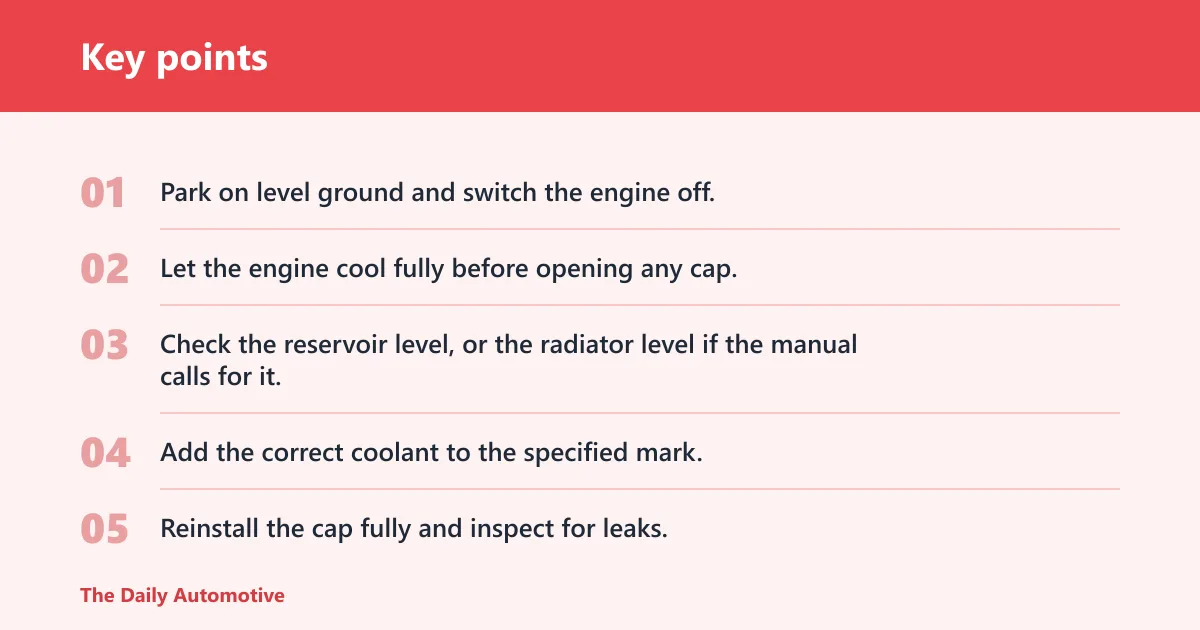
- Park on level ground and switch the engine off.
- Let the engine cool fully before opening any cap.
- Check the reservoir level, or the radiator level if the manual calls for it.
- Add the correct coolant to the specified mark.
- Reinstall the cap fully and inspect for leaks.
- Start the engine and watch the gauge, heater output, and reservoir level after cooldown.
How do I know whether low coolant is causing overheating?
Low coolant is one common cause of overheating, but it is not the only one. If the temperature gauge climbs, the heater blows cool air when it should be hot, or the level drops again after a refill, the cooling system needs more than a top-up. Trapped air can also cause poor heater performance or inaccurate temperature readings.
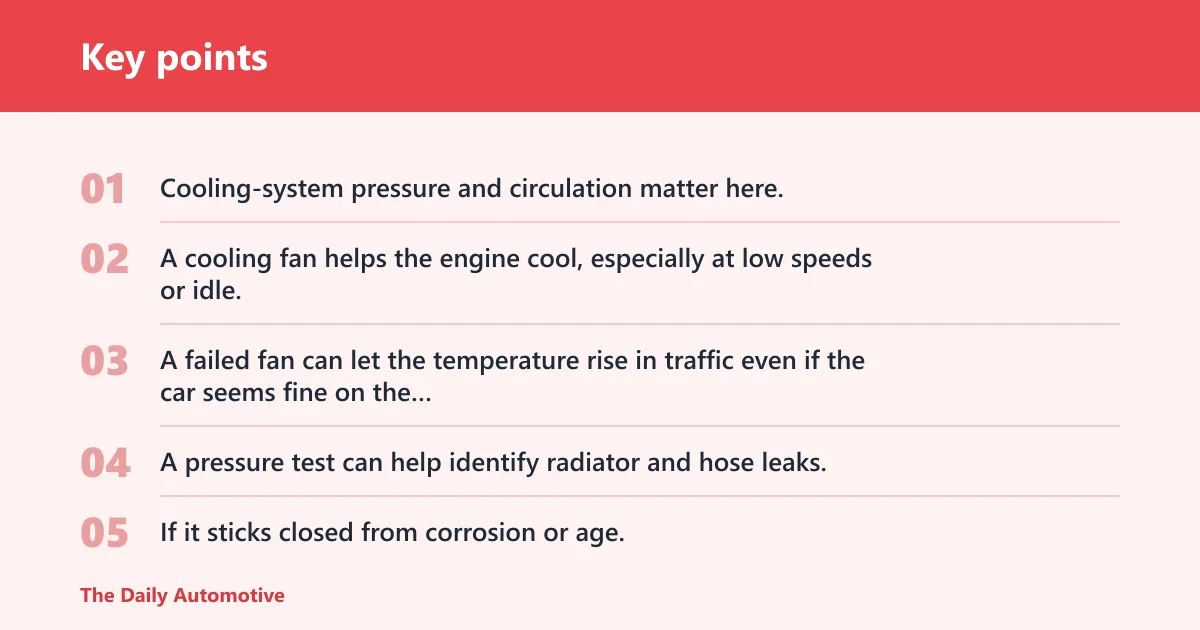
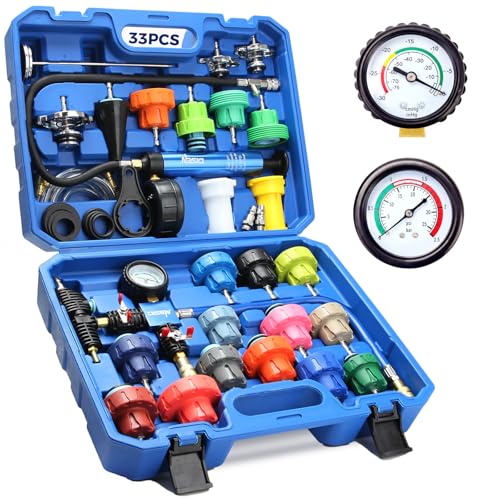
Cooling-system pressure and circulation matter here. A cooling fan helps the engine cool, especially at low speeds or idle. A failed fan can let the temperature rise in traffic even if the car seems fine on the highway. A pressure test can help identify radiator and hose leaks.
Thermostat, fan, radiator, and water pump checks
A thermostat opens at operating temperature. If it sticks closed from corrosion or age, the engine may overheat and may set code P0128 or P0125. A radiator can also clog with rust, mineral deposits, or debris. A water pump moves coolant through the engine, and if it fails, leaks and overheating can follow.
A common first-timer mistake is pouring coolant into the overflow tank and assuming the engine is fully serviced. Picture a compact car that idles in a driveway with the gauge near hot and the heater barely warm. If the coolant level is fine after cooldown, the fault may be airflow, thermostat control, or circulation rather than low fluid alone.
When a leak or head gasket issue is likely
If the coolant level keeps falling, look for leaks at hoses, the radiator, the water pump, the thermostat housing, or the expansion tank. A blown head gasket can also cause overheating. If the engine is still hot after about 2 hours or the level drops again quickly, further diagnosis is usually needed before more driving.
Coolant decision tree
Use this sequence after topping off coolant so you do not confuse a refill with a repair. If the engine was cold and the level was low, fill to the correct mark, secure the cap, and recheck after a short drive and another full cooldown. If the engine was hot or the gauge was already high, stop first and diagnose.
What to check after topping off
Look for drips around the radiator, hoses, reservoir, and cap. Confirm the cap is seated correctly. Watch the temperature gauge on the next drive. Verify that the heater output becomes warm once the engine reaches temperature. If the level drops again, there may still be a leak or trapped air in the system.
Air purge and recheck sequence
Bleeding air out of the cooling system is vehicle-specific and should follow the manual. Some systems purge air through a reservoir automatically, while others use a bleed screw or a special fill sequence. Do not use a universal bleed method unless the manual specifically calls for it.
- Allow the engine to cool completely.
- Recheck the reservoir or radiator level at the specified mark.
- Inspect hoses, the radiator, and the water pump area for fresh leaks.
- Start the engine and watch for stable gauge behavior.
- After the engine cools again, verify the level one more time.
When to stop driving and get help
Stop driving if the gauge rises toward hot, coolant is disappearing quickly, or the engine overheats again after refill. Do not keep adding fluid to a system that is pushing coolant out or running hotter each time. That pattern needs inspection, not repeated top-offs.
Frequently asked questions
Should the car be running when adding coolant?
No. The engine should be off and cool before you add coolant. Letting it idle is only useful for diagnosis, such as checking a fan that should come on or spotting a leak. Do not open a hot cooling system just to pour coolant into it.
Do you add coolant with the engine hot or cold?
Add coolant with the engine cold whenever possible. Most engines cool down within the first hour after shutdown, and a hot system can still be under pressure. Waiting protects you from scalding spray and gives you a more accurate level reading at the reservoir or radiator.
Can I add coolant directly to the radiator or reservoir?
It depends on the vehicle. Many modern cars use the reservoir as the normal fill point, while some require direct radiator access. Follow the owner’s manual and use the cold fill line or the specified radiator procedure. Do not assume every cooling system is filled the same way.
What should I check if my car overheats even after adding coolant?
Check for leaks at hoses, the radiator, the water pump, the thermostat housing, and the expansion tank. Confirm the fan runs when needed, and consider a thermostat fault if the engine stays hot or sets P0128 or P0125. Persistent overheating needs a proper inspection, not another top-up.
How do I bleed air out of the cooling system after topping up coolant?
Use the vehicle’s prescribed method only. Some systems self-bleed through the reservoir, while others require a bleed screw or a specific warm-up sequence. Trapped air can cause poor heater performance or inaccurate temperature readings, so recheck the level after cooldown and follow the manual closely.
Products related to this article
Sponsored / affiliate links. As an Amazon Associate I earn from qualifying purchases. I may earn additional commission from eligible campaigns.