How Much Is a Car AC Diagnostic?
A basic car AC diagnostic is often reported at about $100 to $200. Leak detection or electrical troubleshooting can push the bill into the $200 to $400 range or higher. Skip the right test and you can pay for refrigerant, parts, or labor you did not need. This guide explains which symptoms call for a basic check, a leak test, or deeper electrical diagnosis.
What the base fee covers and extra costs
Most drivers should expect a starter fee that covers a technician’s time, a visual inspection, and basic testing, with the total rising when the shop has to chase a leak, test control circuits, or verify pressure under load. Pricing changes with location, vehicle layout, and whether the shop or a mobile unit is doing the inspection.
What the base fee usually includes
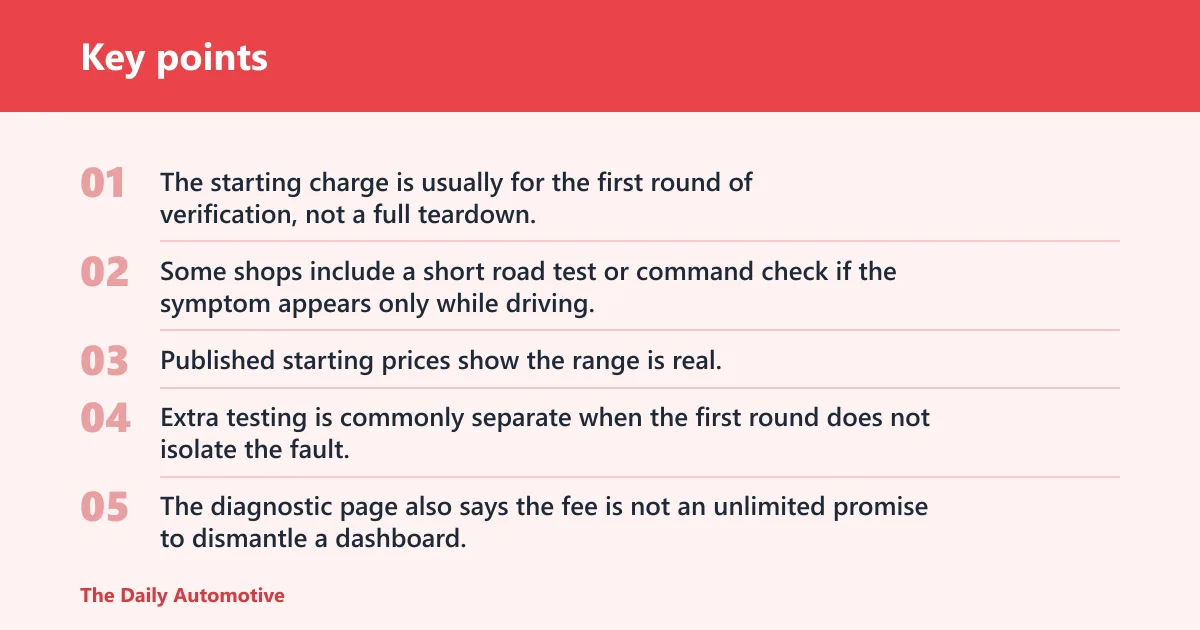
The starting charge is usually for the first round of verification, not a full teardown. At minimum, that often means a visual check, a fault-code scan, a quick look at vent output, and pressure readings with the system operating. Some shops include a short road test or command check if the symptom appears only while driving.
Published starting prices show the range is real. One diagnostic page lists basic fault-code reading from CZK 400, and the same page says the diagnostic starting price is CZK 400. Another service page budgets a car AC workshop diagnosis in Dubai at AED 100–350, while a mobile AC inspection is AED 199 including VAT.
What is often billed separately?
Extra testing is commonly separate when the first round does not isolate the fault. Refrigerant recovery, dye injection, nitrogen pressure testing, extended electrical tracing, dashboard access, and parts replacement are usually outside the initial fee. The diagnostic page also says the fee is not an unlimited promise to dismantle a dashboard.
That matters because two cars with the same symptom can take very different paths. A clogged cabin filter may be quick to confirm. An intermittent compressor command fault can take longer because the problem may appear only at certain temperatures or engine speeds.
What a car AC check really covers
A car AC check is usually a basic inspection, not a complete fault isolation process. It can confirm obvious issues like low airflow, a blown fuse, empty refrigerant, or a nonworking fan, but it may stop short of proving the root cause. If the symptom is intermittent or hidden, expect more time and more test steps.
-
Confirm the complaint. The technician should verify whether the problem is weak airflow, warm air, idle-only failure, or a compressor that will not engage. That first split determines whether the next branch is airflow, refrigerant, heat rejection, or electrical.
-
Inspect the obvious items. A quick check should include cabin filter condition, blower output, fuse status, visible hose damage, condenser debris, and fan operation. These are fast to inspect and can explain a large share of simple complaints.
-
Measure system behavior. The shop should note vent temperature, static and running pressure, ambient temperature, and whether pressure changes make sense for the weather. Pressure that looks low on a hot day may not mean the same thing as low pressure on a mild day.
-
Decide whether deeper testing is justified. If the first checks do not match the symptom, the quoted fee should expand only as needed for leak tests, electrical tracing, or control-module checks. That keeps a basic inspection from turning into a guess-and-replace visit.
Shop timing and labor drivers
Shop pricing tracks time. A simple inspection may be quick, but hidden leaks, poor compressor control, or weak heat rejection can require multiple test cycles and waiting for the system to stabilize. Intermittent faults often cost more because the technician has to catch the failure in the act.
Mobile inspection pricing
Mobile AC inspection pricing can look lower or more convenient, but it often covers a narrower test set than a fully equipped workshop. The distinction matters when the symptom needs recovery equipment, pressure testing, or component access that a mobile visit cannot complete. The diagnostic page separates workshop diagnosis from mobile inspection for that reason.
Fault-code scan vs real diagnosis
A fault-code scan is useful, but it is not the same as diagnosis. It only reports stored codes or live data the module already sees, and a clean scan does not prove the system is healthy. The wrong code can also point at a symptom rather than the actual failed part.
Why a scan can point the wrong way
Many AC faults do not set a useful code until the problem gets worse. Low refrigerant can cause compressor shutoff without a direct leak code. A weak condenser fan can trigger pressure problems that look like compressor trouble. A bad blend-door actuator can make the cabin feel warm even when refrigerant pressure is normal.
Say your scan shows a compressor-related code on a car with cold lines but weak cabin cooling. That does not automatically mean the compressor is bad. The next branch should be airflow and blend-door behavior, because the system may be making cold refrigerant but failing to move that cooling through the cabin.
When a scan is still useful
A scan can still save time by pointing to a sensor, actuator, or control-module problem. It is especially useful on vehicles with automatic climate control, because the module may store command or feedback codes that a basic visual check will miss. Even then, the code should lead to testing, not end it.
AC diagnostic decision table
This table shows the usual branch, the first test, the likely add-on test, and the warning signs that justify a deeper diagnostic. Time bands are shop time bands, not repair times.
| Symptom | Likely branch | First test | Likely add-on test | Red-flag signs that justify deeper diagnosis |
|---|---|---|---|---|
| Weak air from vents | Airflow | Cabin filter, blower speed, vent output check | Blend-door movement and duct inspection | Air changes with fan speed but not temperature setting; multi-zone cabin only cools on one side |
| Cold at idle, warm at stoplights | Heat rejection | Condenser inspection and cooling fan check | Pressure test under idle load and at higher rpm | Debris packed in condenser fins; fan runs weakly or not at all; cooling improves at speed |
| Compressor cycles off quickly | Refrigerant | Static and running pressure check | Electronic sniffer or dye inspection | Low-side pressure stays low; visible oily residue; recent recharge with repeat loss |
| No compressor engagement | Electrical | Fuse, relay, ground, and command check | Sensor and control-module testing | Power and ground are present but the compressor still does not respond |
| Cold line, warm cabin | Airflow or climate control | Vent temperature and airflow pattern check | Blend-door actuator test | One side of a dual-zone system is warm; temperature changes do not match the dial |
| Musty smell and slow recovery after recharge | Refrigerant leak | Visual leak inspection and pressure check | UV dye, soapy-water check, or nitrogen pressure test | Leak is near the evaporator or hidden behind trim |
Why refrigerant leak testing costs more
Leak testing costs more because it usually takes special equipment and extra time to prove where refrigerant is escaping. A basic visual inspection can spot oily residue or damaged fittings, but hidden leaks often need an electronic sniffer, UV dye, soapy-water checks, or nitrogen pressure testing. A car AC leak diagnostic and repair can cost $100 to over $300.
Electronic sniffer and UV dye
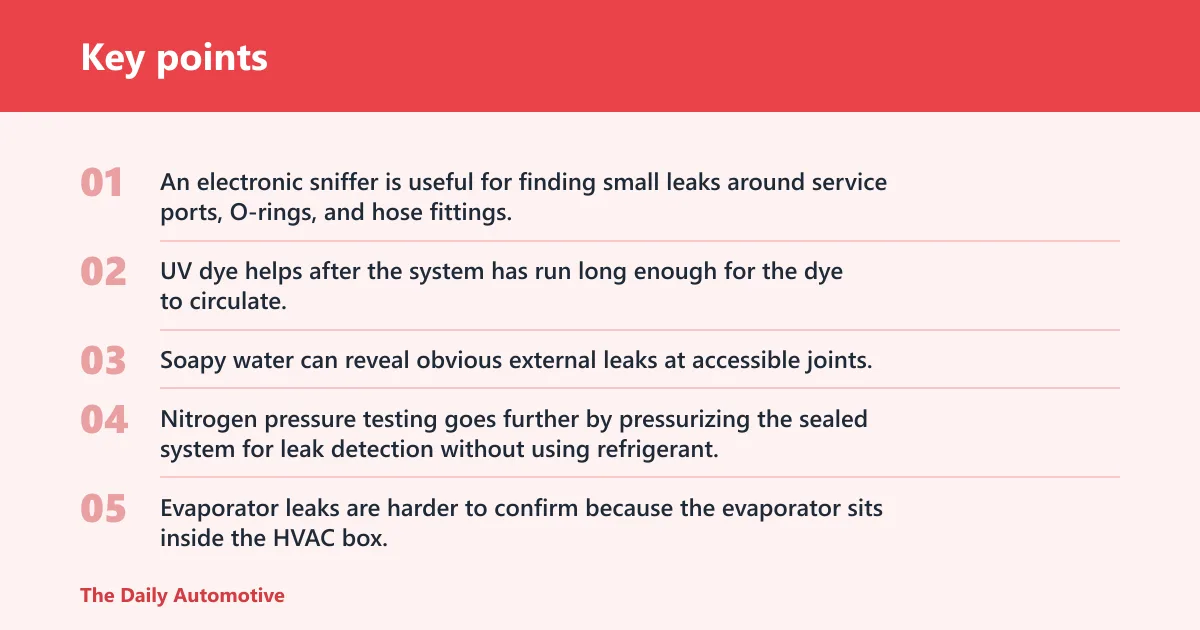
An electronic sniffer is useful for finding small leaks around service ports, O-rings, and hose fittings. UV dye helps after the system has run long enough for the dye to circulate. Those tools help confirm suspicion, but the repair decision should still depend on where the leak is and whether the part is serviceable.
Soapy-water checks and nitrogen pressure testing
Soapy water can reveal obvious external leaks at accessible joints. Nitrogen pressure testing goes further by pressurizing the sealed system for leak detection without using refrigerant. The leak article says professional tools include electronic sniffers and nitrogen pressure tests, and it notes that EPA-certified technicians are required for refrigerant handling.
Evaporator leaks are harder to confirm because the evaporator sits inside the HVAC box. The leak article notes that evaporator leaks are rarer but more complex to repair, which is why a cheap top-off can turn into a much larger diagnostic job if the cabin side is the source.
When airflow or heat rejection is the issue
Cold refrigerant does not help if the air cannot move through the cabin or the condenser cannot shed heat. Airflow problems and heat-rejection problems often feel like low refrigerant because the vents blow warm or only mildly cool air. The fix is different, though, so the branch matters.
Blower output and cabin filter checks
A restricted cabin filter can cut airflow enough to make the system feel weak even when refrigerant pressure is normal. A bad blower motor, resistor, or control module can do the same. If vent air improves at higher fan settings but stays warm, the issue may be airflow delivery rather than refrigerant charge.
Picture a compact sedan with full fan speed but only a light stream at the center vents. If the cabin filter is packed and the vent temperature is only slightly cool, the first branch is airflow, not recharge. Replacing the right part there is cheaper than opening the refrigerant circuit.
Condenser condition and cooling fans
Condenser fins packed with debris can reduce heat rejection, especially in traffic. Weak cooling fans can make the problem show up first at idle and clear up once the car is moving. Stacked-cooler layouts put the condenser close to other heat exchangers, so airflow blockage can snowball quickly.
When electrical diagnosis adds time
Electrical diagnosis adds time because the problem may sit in a fuse, relay, ground, sensor, wiring, or control module rather than the compressor itself. The technician has to compare command versus response: if the module asks for cooling but the compressor does not act, the fault is somewhere in the chain.
Compressor control circuit checks
Common checks include fuses, relays, power supply, grounds, pressure switches, and clutch or control-valve operation. If the electrical side is weak, the compressor can be fine mechanically and still never engage. That is one reason a code scan alone can miss the real issue.
Manual versus automatic climate control
Manual climate control is usually simpler. Automatic systems add sensors, actuators, and software logic that can move the wrong door or misread cabin temperature. Multi-zone cabins add more actuators and more possible failure points, so a simple hot-air complaint can turn into a longer diagnostic session.
A common first-timer mistake is assuming cold refrigerant lines mean the whole system is working. In practice, the cabin can still stay warm if a blend door is stuck, a fan is weak, or the condenser cannot dump heat at idle.
What a car AC diagnostic includes
A fair diagnostic quote should say what the first fee covers and what will trigger more billing. Ask whether the price includes a scan, pressure readings, visual inspection, leak checking, and a follow-up estimate if the first branch does not solve the issue. The cost usually covers diagnosis only, not the repair itself.
-
Ask for the first branch. The shop should say whether it will start with airflow, refrigerant, heat rejection, or electrical testing. That keeps the work focused and makes the quote easier to compare.
-
Confirm what is included. Ask whether the fee covers pressure readings, scan data, leak detection, and basic visual inspection. If not, the extra charge should be named before testing begins.
-
Clarify the next step. If the first test is inconclusive, find out what the next billed check will be and roughly what it adds. That is especially important on vehicles with hidden leaks or automatic climate systems.
Frequently asked questions
How much is a car AC diagnosis?
A basic car AC diagnosis often starts around $100 to $200, but the final bill can climb when the problem needs leak detection or electrical tracing. Local labor rates, vehicle design, and whether the shop or a mobile service is doing the work all affect the number you see.
How much is a car AC check?
A car AC check is often the cheaper end of the process because it may cover only a visual inspection, a scan, and a quick pressure or airflow check. If the shop has to move into leak testing or module troubleshooting, the price is no longer just a simple check fee.
How much does a car AC diagnostic cost near me?
Nearby pricing depends on shop labor rates, the local market, and whether the vehicle needs simple verification or deeper testing.
How much does it cost to get your car AC diagnosed?
Getting a car AC diagnosed usually means paying for technician time and test equipment rather than a fixed repair price. Expect a lower fee for a basic inspection and a higher one if the shop must confirm a refrigerant leak, test the compressor circuit, or check automatic climate-control actuators.
What does a car AC diagnostic include?
A proper diagnostic usually includes a scan, a visual inspection, pressure readings, airflow checks, and then targeted testing based on the symptom. It should not stop at a code scan alone, because stored codes may only show a symptom and not the root cause.
Is a free AC check the same as a diagnostic?
No. A free AC check is often a limited inspection, usually meant to spot obvious problems or decide whether paid testing is needed. A true diagnostic goes farther, especially when the fault is hidden, intermittent, or tied to refrigerant loss, fan performance, or control-module behavior.
Why can a car AC diagnostic cost more than a code scan?
A code scan only reads stored faults or live data. A diagnosis may need pressure testing, leak detection, electrical checks, and time to reproduce the problem, which is why the price is higher. A scan can point the shop in the right direction, but it rarely proves the failure on its own.
Products related to this article
Sponsored / affiliate links. As an Amazon Associate I earn from qualifying purchases. I may earn additional commission from eligible campaigns.