How Much Does It Cost to Replace a Blend Door Actuator in a Car?
Replacing a blend door actuator is often reported to cost about $50 to $150 for the part, about $150 to $400 for DIY with calibration tools or scan help, about $300 to $700 at an independent shop, and about $500 to $1,000+ at a dealer. Ignore it, and you can end up with the wrong cabin temperature, stuck airflow, or a dashboard job that needs extra labor to finish. This guide breaks down each repair path and explains which vehicle layouts push the bill higher.
Repair scenario cost ranges and diagnostic factors

This is the quickest way to compare repair routes. The part price is only one piece of the bill, because diagnosis, calibration, and access time can change the total more than the actuator itself.
| Repair scenario | Estimated part cost | Labor hours | Likely add-on diagnosis | Cost drivers to watch |
|---|---|---|---|---|
| DIY part-only | $50 to $150 | 1 to 3 | $0 to $100 if a scan is needed after install | Easy access, single-zone HVAC, manual reset possible |
| DIY plus scan-tool calibration | $50 to $150 | 1.5 to 4 | $50 to $150 for scan-tool time or tool access | Electronic recalibration, dual-zone HVAC, manual reset fails |
| Independent shop replacement | $50 to $150 | 2 to 4.5 | $100 to $200 if diagnosis is separate from repair | Dashboard removal, rear actuator access, stuck door checks |
| Dealer replacement | $80 to $250 | 2.5 to 5+ | $150 to $250 or more, depending on fault tracing | Factory scan procedure, complex HVAC programming, higher labor rate |
These ranges assume the actuator is the problem. If diagnosis shows a broken gear, a seized blend door, or shaft damage, the repair can move beyond a simple swap and the final bill rises fast.
What a blend door actuator does
A blend door actuator is a small motor in the HVAC climate control system. It moves blend doors through linkages so the system can mix hot and cold air for cabin temperature control, and it can also manage defrost, floor, vent, and bi-level airflow.
That matters because a bad actuator can change where air goes and how warm or cool it feels. Some vehicles use one blend door, while others use two, and driver-side and passenger-side temperature control can be separate.
How it moves blend doors
The actuator turns a shaft or gear set that shifts the blend door to a new position. If the gear strips, the motor loses position, or the door binds, the HVAC system may stop responding to temperature changes or may click while trying to move.
Why temperature control changes
When the actuator cannot move the door correctly, the system may stay on heat, stay on cold, or split the difference badly. A modern vehicle may recalibrate electronically during startup, but that only works if the door and actuator can move through their full range.
What raises the replacement price?
Access is the biggest cost driver. A simple actuator behind an open panel costs far less than one buried behind the dashboard, especially on vehicles with dual-zone HVAC or rear HVAC that add more parts and more time.
Dashboard access and labor time
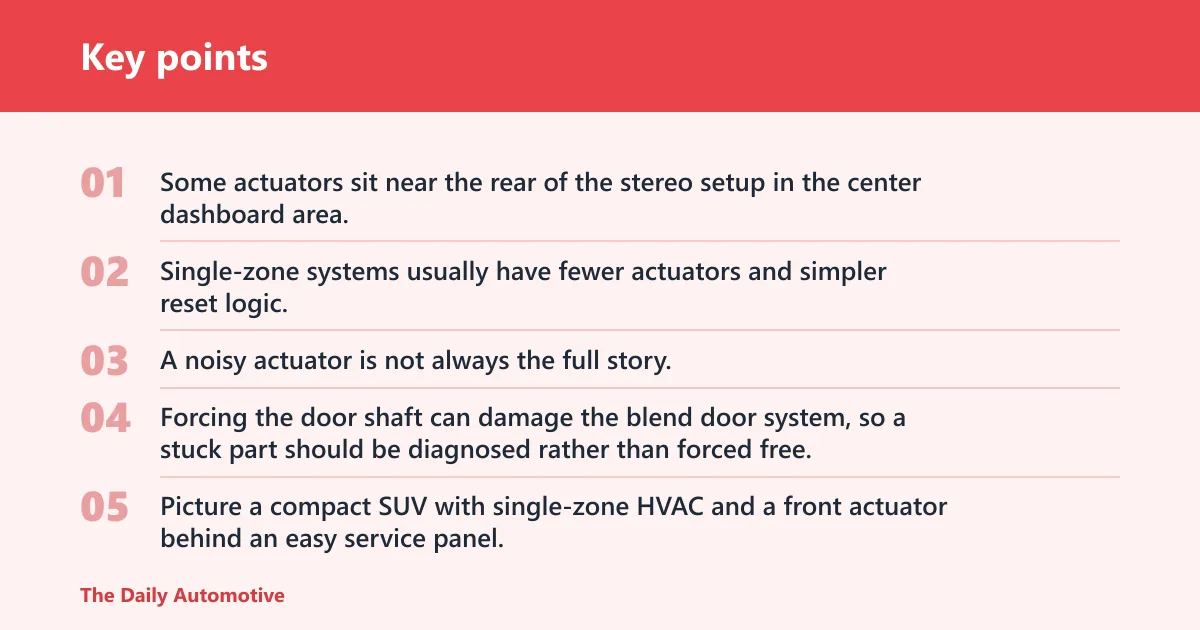
Some actuators sit near the rear of the stereo setup in the center dashboard area. Others are tucked deeper in the dash, where trim removal and cramped hand access add time, and that time is what pushes the labor bill up.
Single-zone versus dual-zone HVAC
Single-zone systems usually have fewer actuators and simpler reset logic. Dual-zone systems may have separate left and right blend doors, so a fault on one side can still leave the other side working, but it also means more diagnosis and a longer repair path.
Rear HVAC and hard-to-reach actuators
Rear climate systems add another layer. If the bad actuator is part of rear HVAC, access can involve trim in the cargo area or rear quarter panel, and that usually means more labor hours than a front-only repair.
Broken gears, stuck doors, and shaft damage
A noisy actuator is not always the full story. If the blend door is stuck, the gear teeth are broken, or the shaft is damaged, replacing the motor alone may not fix the problem. Forcing the door shaft can damage the blend door system, so a stuck part should be diagnosed rather than forced free.
Picture a compact SUV with single-zone HVAC and a front actuator behind an easy service panel. That repair can stay near the low end of the range. Now suppose the same symptom appears on a full-size crossover with dual-zone front heat and rear vents; labor and diagnosis can climb even if the actuator part itself is ordinary.
Can you replace it yourself?
Yes, if the actuator is reachable, the service manual gives a clear procedure, and the system can be reset without special programming. DIY makes less sense when the job needs dashboard removal, electronic calibration, or a fault trace that goes beyond the actuator itself.
When DIY makes sense
DIY works best when the actuator is visible behind a panel, the symptom points strongly to one unit, and the vehicle uses a manual reset or a simple ignition sequence. In that case, the main savings come from labor, not from the part.
When calibration adds hidden cost
Some vehicles need a diagnostic scan tool for electronic reset on some modern vehicles, while others can use a specific ignition sequence instead of manual adjustment. If calibration fails, the repair may need another scan session, which can erase some of the money saved by doing the swap yourself.
When the service manual matters most
The service manual is the right source because reset and recalibration steps change by make and model. It tells you whether the actuator must be removed for reset, whether maximum heat is part of the procedure, and whether the system expects a scan-tool relearn after installation.
- Disconnect power safely. Turn the ignition off and follow the vehicle’s battery or key-off procedure before removing trim. That helps avoid accidental movement during the repair.
- Remove the access panel. Open the trim or lower dash cover that exposes the actuator. If the service manual calls for glove box or stereo-area removal, do that in the listed order so clips and brackets do not break.
- Mark the actuator position. Note how the shaft and connector sit before removal. That makes it easier to confirm the new unit is installed in the same orientation.
- Install the replacement unit. Seat the actuator on the shaft, tighten the fasteners evenly, and reconnect the electrical plug. Do not force the shaft if it resists, because that can damage the HVAC system.
- Run the reset procedure. Use the manual sequence or scan-tool routine listed for the vehicle. Some procedures involve setting maximum heat, then cycling the ignition or commanding recalibration through the scan tool.
- Test the airflow. Move the temperature controls from cold to hot and check vent, floor, and defrost modes. If the temperature does not sweep correctly, stop and recheck the installation before assuming the new actuator is bad.
Do you need a scan tool to reset it?
Sometimes yes, sometimes no. Reset procedures change by vehicle and may require a scan tool, but some vehicles can use a specific ignition sequence instead of manual adjustment. The deciding factor is the service manual, not a universal rule.
Manual reset versus electronic recalibration
A manual reset usually means moving the HVAC controls through a prescribed sequence, often after the actuator is reinstalled. Electronic recalibration is different: the control module learns the new position through a scan tool or an automatic startup routine on some vehicles.
What the service manual usually specifies
The manual may tell you to set maximum heat, then wait, cycle the ignition, or let the system complete a relearn on startup. Those steps matter because the actuator and blend door need to agree on end stops, or the system can drive itself out of range.
Why some vehicles need a diagnostic scan tool
Newer HVAC systems often store actuator position data and fault codes. If the module sees a mismatch after replacement, a scan tool can command recalibration and clear learned faults faster than repeated manual attempts.
Say the driver side blows cold after a new actuator goes in, while the passenger side still changes normally. That points to a calibration or blend-door issue, not just a failed part, and a scan-tool reset may be the next step before more hardware gets replaced.
Blend door actuator cost by repair path
Cost changes by route because each path bundles different work. Part-only DIY is cheapest when access is easy. Independent shops usually sit in the middle. Dealers charge more, but they also tend to have the factory procedure and scan equipment for complex HVAC systems.
Part and labor ranges
The part itself usually sits in the $50 to $150 range, though some dealer parts may cost more. Labor at an independent shop commonly makes up the biggest share of the bill, and dealer labor rates plus factory programming can push the total into the $500 to $1,000+ band.
Likely diagnosis add-ons
Diagnosis is not always bundled with replacement. If the shop has to verify whether the clicking comes from the actuator, a stuck blend door, or a failed shaft, that first check can add about $100 to $200 or more before the repair starts.
Cost drivers to watch
- Dashboard removal for hidden actuators.
- Dual-zone HVAC with separate left and right controls.
- Rear actuator access on vehicles with rear climate control.
- Electronic recalibration after installation.
- Broken gears, damaged shafts, or a seized blend door.
Frequently asked questions
How much does it cost to replace a blend door actuator?
Most repairs land somewhere between $50 and $1,000+, depending on whether you buy the part only, do the labor yourself, or pay a shop or dealer. The total rises quickly when the actuator sits behind the dashboard, the vehicle has dual-zone or rear HVAC, or calibration requires scan-tool time.
Is it cheaper to replace a blend door actuator yourself?
Usually yes, if the part is easy to reach and the vehicle allows a manual reset. DIY savings shrink when the job needs a scan tool, hidden dashboard access, or more diagnosis to confirm the actuator is actually the fault. Labor and calibration are the main costs you avoid.
Can a blend door actuator be reset after replacement?
Yes. Many vehicles need a reset or recalibration after the new actuator is installed, and some can do that with an ignition sequence or startup routine. Others require a scan tool. The service manual is the best source because the steps change by make and model.
What happens if a blend door actuator is not calibrated?
The HVAC system may misread door position and leave the cabin stuck on hot, cold, defrost, or the wrong mix of vents. It can also click, stop partway through movement, or keep chasing the correct position every time the ignition turns on. That can mean repeated repair time.
How do you know if the blend door actuator is stuck or bad?
Common signs include clicking behind the dash, temperature stuck hot or cold, no response when you change settings, or uneven driver and passenger airflow. If the actuator moves but the temperature does not change, the blend door itself may be stuck or the shaft may be damaged.
Will forcing the blend door shaft damage the HVAC system?
Yes. Forcing the shaft can damage the blend door system, which can turn a simple actuator replacement into a larger HVAC repair. If the door does not move freely during diagnosis, stop and inspect the linkage, gear, or shaft instead of applying more force.
Products related to this article
Sponsored / affiliate links. As an Amazon Associate I earn from qualifying purchases. I may earn additional commission from eligible campaigns.