Can You Fix Your Own Car? DIY vs. Mechanic Repair Guide
Do it yourself only if the job is low-voltage, low-lift, and seems easy to reverse within a short time. Otherwise, consider a mechanic, especially for brakes, steering, airbags, fuel, or hybrid/high-voltage systems. A wrong call can turn a cheap fix into a tow, a larger repair, or a safety failure. This guide sorts common jobs by risk, cost, and complexity, and shows how to price the cost of being wrong.
| Decision factor | Can You Fix Your Own Car? DIY | Mechanic Guide | Winner |
|---|---|---|---|
| Upfront cash outlay | Low for parts-only jobs, but tools add cost fast | Higher labor bill, but no tool purchase | DIY for simple maintenance; mechanic for one-off complex repairs |
| Safety margin | Good on reversible, low-risk jobs | Better on brakes, suspension, transmission, and high-voltage systems | Mechanic |
| Time and diagnosis burden | Fast when the fault is obvious; slow when the symptom is vague | Better when diagnosis matters more than parts replacement | Mechanic |
| Cost of a mistake | Can turn a small repair into a larger bill or a tow | Usually lower risk of rework and repeat labor | Mechanic |
Can you fix your own car, or should you pay a mechanic?
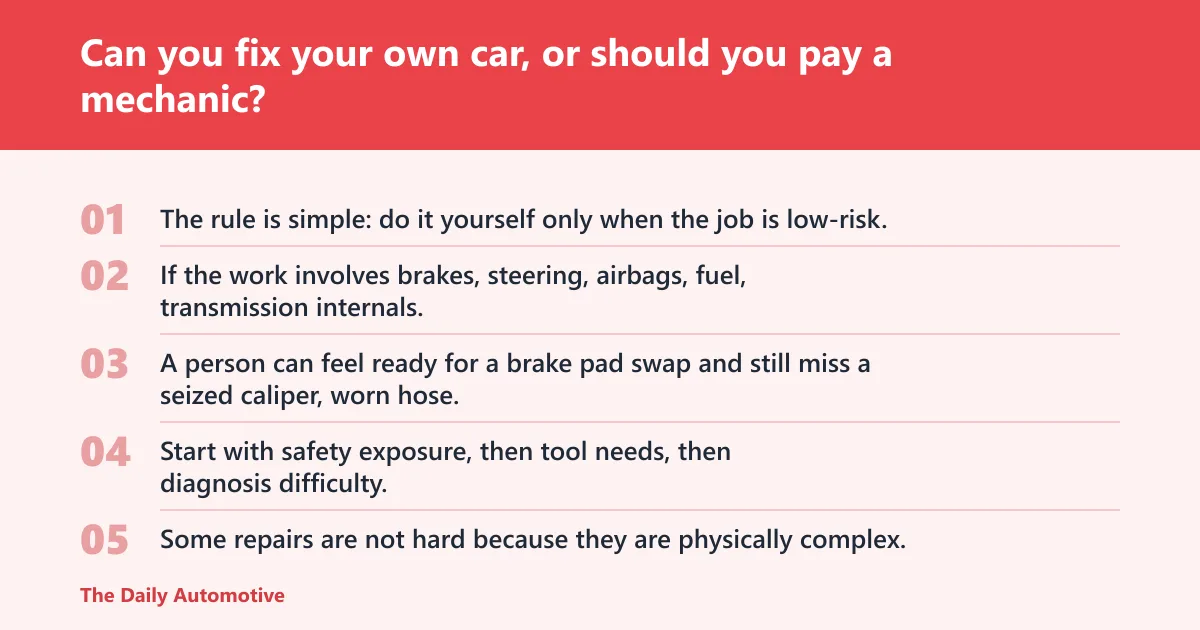


The rule is simple: do it yourself only when the job is low-risk, the part is easy to identify, the car can stay safely supported, and the repair can be reversed without much damage. If the work involves brakes, steering, airbags, fuel, transmission internals, or hybrid/high-voltage systems, a shop is the safer call.
Use risk, not confidence, as the first filter
Confidence is a weak test. A person can feel ready for a brake pad swap and still miss a seized caliper, worn hose, or worn rotor that changes the job. Start with safety exposure, then tool needs, then diagnosis difficulty, then the rework bill if the job goes wrong.
When diagnosis is the real barrier
Some repairs are not hard because they are physically complex. They are hard because the symptom can come from several causes. A code, noise, or warning light is a clue, not a fix; that is why an OBD II scanner helps narrow the problem before you decide DIY versus mechanic.
Time and inconvenience matter too
A repair that saves money but strands the car for a weekend may still be the wrong choice if it is your only transport. Add your own time, the parts run, and the chance of ordering the wrong component. If the total starts to approach shop pricing, the mechanic can win even before safety enters the picture.
📊 A professional mechanic may charge $500 for a brake job. Source: Can You Fix Your Own Car? DIY vs. Mechanic Guide.
What car repairs are safe to do yourself?
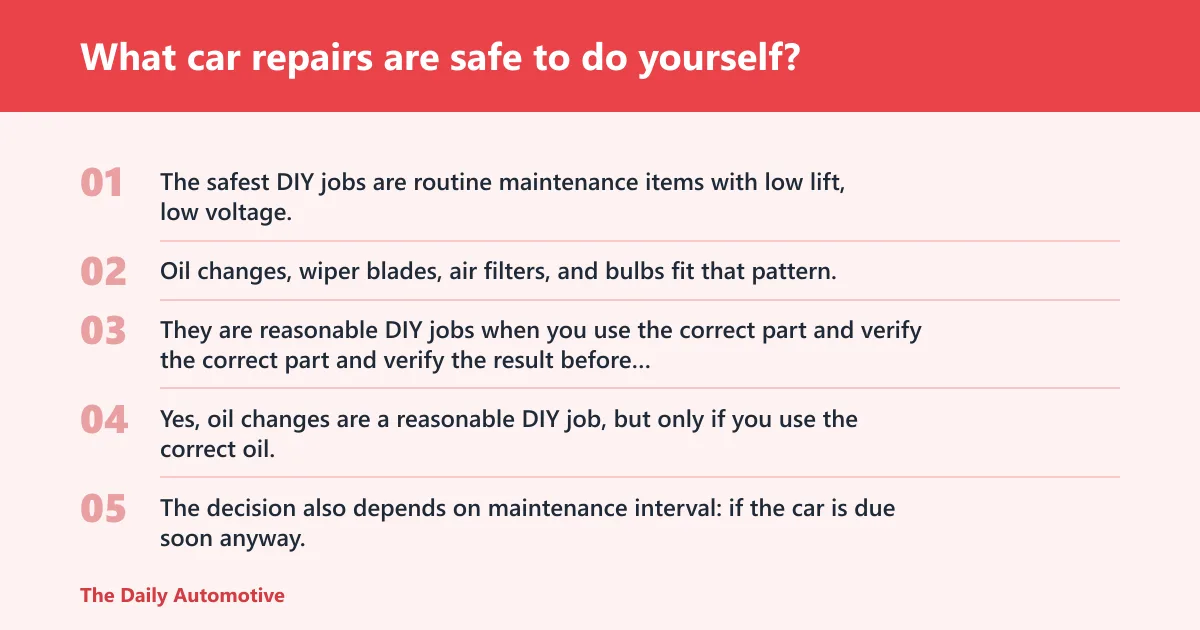
The safest DIY jobs are routine maintenance items with low lift, low voltage, and an easy path back to stock if something is wrong. Oil changes, wiper blades, air filters, and bulbs fit that pattern. They are reasonable DIY jobs when you use the correct part and verify the result before driving.
Can I do my own oil change at home?
Yes, oil changes are a reasonable DIY job, but only if you use the correct oil, have an oil funnel, and handle used oil responsibly. The decision also depends on maintenance interval: if the car is due soon anyway, the DIY case is stronger; if the schedule is unclear, check the owner’s manual first.
Used oil and the filter need proper disposal. A stripped drain plug, wrong gasket, or overfilled crankcase can turn a cheap service into a repair bill. The job is still beginner-friendly, but only if the car is lifted securely and the final oil level is checked carefully.
Wiper blades, air filters, and bulbs are the easiest wins
Wiper blades, air filters, and bulbs are common starter jobs. They are low-cost, reversible, and listed as reasonable DIY repairs. If a bulb is installed incorrectly, the fix is usually quick once you notice it, which keeps the rework cost low.
The main trap is part selection. Bulbs must match the correct type, and many cars use different fitments left and right or for low beam versus high beam. Air filters are simple, but a badly seated filter can still let unfiltered air through; that is why a final inspection matters.
When a simple swap still needs the exact part
Even easy jobs fail when the part number is wrong. A bulb that physically fits may still draw the wrong load or aim poorly. A filter with the wrong shape may not seal. DIY is safe here only when you verify the part against the vehicle’s exact application, not just a generic description.

What car repairs are too risky to DIY?
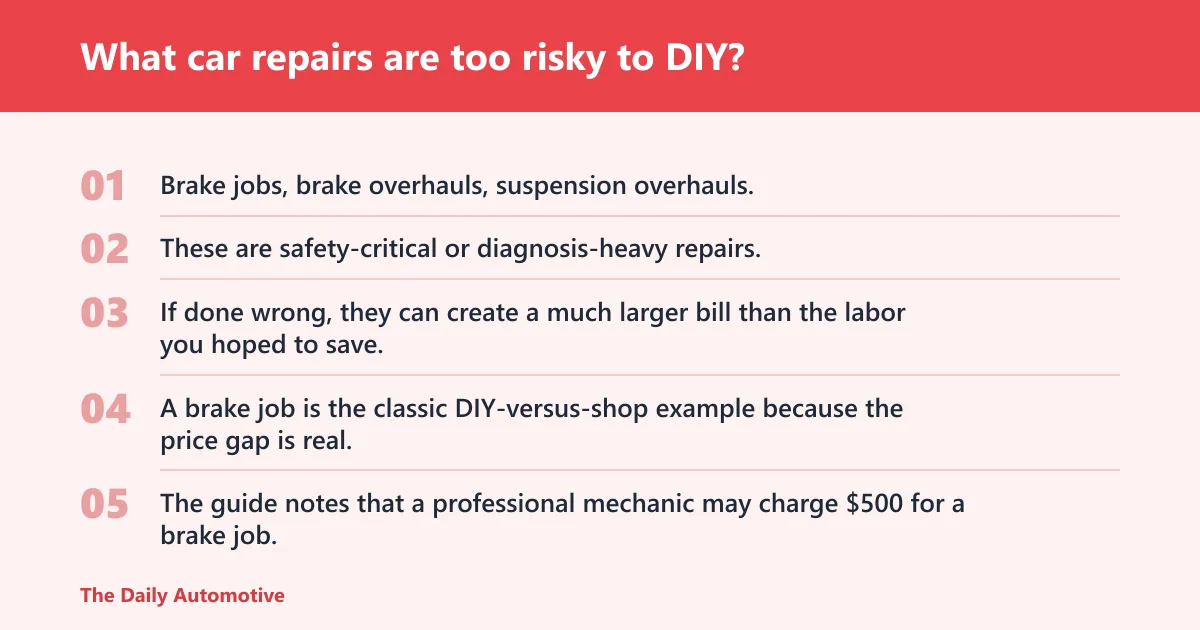
Brake jobs, brake overhauls, suspension overhauls, and transmission work are often the point where the downside starts to outweigh the DIY savings. These are safety-critical or diagnosis-heavy repairs. If done wrong, they can create a much larger bill than the labor you hoped to save.
Brake jobs: where savings can disappear fast
A brake job is the classic DIY-versus-shop example because the price gap is real. The guide notes that a professional mechanic may charge $500 for a brake job, while the same brake job can be done for $200 with DIY auto repair. That gap shrinks fast if the wrong parts are ordered, hardware is reused when it should not be, or a fault is missed.
Brake work is also safety-critical. A soft pedal, uneven stopping, or a dragging caliper is not a cosmetic issue. If the problem is diagnosis rather than pad replacement, the mechanic often wins on total cost because the car avoids repeat labor and avoidable wear.
Brake and suspension overhauls belong with a shop
Brake overhauls are described as best left to a certified mechanic, and suspension overhauls are in the same category. These jobs often require proper diagnosis, special tools, and precise installation. They also affect vehicle control directly, which makes a small mistake much more serious than a failed trim-piece repair.
Transmission work is usually mechanic territory
Transmission work is described as best left to a certified mechanic. The diagnosis is harder than the parts swap, and the mistakes are expensive. If the symptom is slipping, harsh shifting, or a code tied to the transmission, the bill from a missed diagnosis can be far higher than the shop estimate you were trying to avoid.
Picture a car that hesitates in second gear and throws a warning light. A basic code reader may show a fault, but that does not prove the internal cause. On a transmission, guessing is costly.
How much money can you save by doing the work yourself?
DIY saves labor charges, but the true comparison includes parts, tools, time, and the cost of a mistake. A simple job can save real money. A complex one can cost more at home once you buy specialty tools, spend a Saturday diagnosing it, and pay again to correct it.
Parts cost versus labor cost versus tool cost
For routine maintenance, the parts bill is often the main cost. Wiper blades, an air filter, and many bulbs are cheap enough that DIY makes obvious sense. Oil changes are similar, but the savings depend on how often the car needs service and whether you already own the basics like a socket wrench set and an oil drain pan.
For brake work, the math changes. If the shop quote is $500 and the DIY parts bill is $200, the apparent savings are $300 before tools. Add a jack and jack stands, a torque wrench, and any specialty tools, and the gap narrows. If you will not reuse the tools, the real savings can be much smaller.
The hidden cost of a wrong repair
A wrong repair can cost more than the original quote. Misdiagnosed noise can lead to replacing good parts. A bad brake install can eat rotors or damage calipers. A poor suspension repair can create alignment wear and handling problems that require another shop visit.
When paying a mechanic is actually cheaper
If the job needs diagnosis, the vehicle is safety-critical, or the repair is likely to be repeated if the first attempt fails, the mechanic may be cheaper in total. That is especially true when the car has advanced driver assistance systems, complex electronics, or a fault that needs calibration after the part is installed.
Use this repair decision matrix before you start
Score each job on four factors: safety risk, tool cost, time, and rework cost. Low scores favor DIY. High scores favor a mechanic. The point is not to ban home repair; it is to keep you from taking on a job where one mistake wipes out the savings.
| Job | Safety risk | Tool cost | Time / diagnosis | Rework cost | Recommended call |
|---|---|---|---|---|---|
| Wiper blades | Low | Low | Low | Low | DIY |
| Air filter | Low | Low | Low | Low | DIY |
| Bulbs | Low to moderate | Low | Low | Low | DIY if the bulb type is confirmed |
| Oil change | Low | Low to moderate | Low to moderate | Moderate if drained or filled wrong | DIY for routine maintenance |
| Brake job | High | Moderate | Moderate | High | Mechanic unless diagnosis is simple and confidence is high |
| Brake overhaul | High | High | High | High | Mechanic |
| Suspension overhaul | High | High | High | High | Mechanic |
| Transmission work | High | High | High | Very high | Mechanic |
How the matrix changes for beginners, renters, and older vehicles
Beginners should lean more toward a shop if the work requires lifting the car, disconnecting the battery, or a code they do not fully understand. Renters usually have less space, less time, and fewer tools, so simple maintenance jobs matter most. Older vehicles can be more forgiving mechanically, but rust, brittle connectors, and seized fasteners raise the rework cost.
Cars with advanced driver assistance systems deserve extra caution. Camera and sensor calibrations, steering angle issues, and brake-related warnings can turn a plain parts swap into a systems job. If the repair affects sensors, steering, or braking logic, stop and call a shop.
What tools do you need for home repair?
Start with safe lifting and correct tightening, then add diagnosis tools. The essential items from the guide are a socket wrench set, jack and jack stands, a multimeter, and an OBD II scanner. That combination covers many basic repairs without pretending every problem is simple.
Jack and jack stands: safe lifting comes first
A jack and jack stands are important because the car needs to be supported securely before you work underneath it. A jack lifts; the stands hold. Never rely on the jack alone. If the job requires you to be under the car, secure support is not optional.
Torque wrench: why fastener tightness matters
A torque wrench matters because too little clamping force can loosen a wheel, brake component, or suspension fastener, while too much can damage threads or crush parts. On safety-critical repairs, “tight enough” is not a useful method. Use the right tool and the correct specification for that vehicle.
Should I buy an OBD2 scanner for DIY car repair?
Yes, if you plan to do more than the simplest maintenance. The guide recommends an OBD II scanner for checking codes before deciding DIY versus mechanic. A basic scanner may read engine codes only, which is useful, but it does not prove the fix. It narrows the problem; it does not solve it.
Use the code to separate a likely sensor issue from a deeper mechanical problem. If the same code returns after clearing and rechecking, or if the car has multiple systems involved, that is a sign to stop guessing and hand it to a shop.
How do you avoid the biggest DIY mistakes?
The biggest mistakes are ordering parts before confirming the symptom, skipping the safety check before lifting, and assuming a code or warning light tells the whole story. Verify the fault, match the part, and inspect the repair before driving. If the system involves brakes or electronics, be conservative.
Confirm the symptom before ordering parts
A common first-timer mistake is buying a part for the loudest problem instead of the real one. A squeak can come from a belt, pulley, or brake hardware. A warning light can reflect a failed sensor, a wiring issue, or a component further down the chain. Diagnosis first, parts second.
Verify the repair before you drive
After the job, check for leaks, missing clips, loose fasteners, and warning lights. If the repair touched brakes, do a slow test in a safe area before normal traffic. If the repair involved battery disconnects or electronics, confirm that the system powers up normally and no new faults appear.
When to stop and call a shop
If the car has an unresolved warning light, a repeated code, an airbag fault, a brake warning, or an ADAS-related issue, stop. Those systems can affect the vehicle even when the parts look fine. A shop has the diagnostic equipment and calibration tools that many home garages do not.
Frequently asked questions
Can I fix my own car or should I take it to a mechanic?
Take the car to a mechanic when the repair affects safety, needs special diagnosis, or requires the vehicle to be lifted and supported for more than a simple task. DIY makes sense for reversible maintenance like wiper blades, air filters, bulbs, and many oil changes.
What car repairs can I safely do myself?
Begin with wiper blades, air filters, bulbs, and oil changes. Those are listed as reasonable DIY jobs and have low rework cost if you verify the part and the final result. Once the job affects brakes, suspension, steering, or transmission function, the risk rises sharply.
What car repairs are too dangerous to DIY?
Brake overhauls, suspension overhauls, and transmission work are among the clearest “shop only” jobs. Brake jobs can also cross into that zone if the diagnosis is unclear. Anything involving airbags, fuel, or hybrid/high-voltage systems should be treated with the same caution.
How much money can I save doing car repairs myself?
You can save the labor bill, but only if the job stays simple and the parts are right. The brake example is useful: $500 for a mechanic versus $200 for DIY auto repair. That savings can shrink once you add tools, time, and the cost of a wrong diagnosis.
What tools do I need to fix my own car?
At minimum, have a socket wrench set, jack and jack stands, a multimeter, and an OBD II scanner. Add a torque wrench for any fastener that matters to safety. If you cannot support the car securely or tighten fasteners correctly, the job is not ready for DIY.
What are the biggest mistakes people make when repairing cars themselves?
The biggest mistakes are guessing at diagnosis, buying the wrong part, skipping secure lifting, and driving before verifying the repair. Another common error is treating a code reader as a final answer. It is only a starting point, especially when the fault may involve brakes, suspension, or electronics.
Verdict: choose DIY for maintenance, choose a mechanic for safety-critical repairs
Choose DIY if the job is low-voltage, low-lift, reversible, and clearly identified: oil changes, wiper blades, air filters, and many bulbs. Choose a mechanic if the job affects braking, steering, suspension, transmission, airbags, fuel, hybrid/high-voltage systems, or anything where diagnosis is uncertain and the cost of a mistake is high.
The best rule is not “Can this be done at home?” It is “What happens if the repair is wrong?” If the answer is a tow, a second repair, or a safety problem, let the shop take it from there.
Products related to this article
Sponsored / affiliate links. As an Amazon Associate I earn from qualifying purchases. I may earn additional commission from eligible campaigns.