Smog Check vs Emissions Test
Smog check and emissions test often mean the same compliance screen, but state rules decide the label, the method, and the vehicle you bring. Your DMV may require a tailpipe test, an OBD scan, or a visual inspection. Missing the correct one can delay registration, trigger fines, or block tag renewal. This guide explains the legal split, common test methods, and how to tell what your DMV requires.
| Decision factor | Smog Check | Emissions Test | Winner |
|---|---|---|---|
| Name used by the state | Often the term in California-style programs and a few other state systems. | More common as the broader umbrella term in many states and countries. | Emissions Test |
| Typical methods | Can include OBD-II, tailpipe, visual, and evaporative checks. | Can be OBD-II-only for newer vehicles, or include tailpipe and other checks. | Tie |
| Vehicle-specific rules | Often tied to California registration and biennial renewal rules. | Usually shaped by model year, fuel type, and local exemption rules. | Emissions Test |
| Best clue for drivers | If your renewal notice or state DMV says “smog check,” use that wording. | If your agency says “emissions test,” follow the testing method it lists. | Tie |
| Common failure points | Missing equipment, bad readiness monitors, or a check engine light. | OBD faults, tailpipe readings, evaporative leaks, or visual defects. | Tie |
Smog check vs emissions test at a glance
These terms overlap, but they are not always the same legal instruction. A smog check is usually a state program name, while emissions test is the broader label for any inspection meant to screen pollution-related vehicle output.
The practical difference is the rule set. One state may require an OBD-II scan only. Another may still require a tailpipe measurement or a visual check for tampering or missing parts.
Name versus process
A label tells you what the state calls the inspection. The process tells you how the car is checked. That is why two drivers can both be told to “get emissions done” and still face different steps at the station.
Most emissions tests take 20-30 minutes. The site claims coverage across all 50 states, lists more than 8,000 testing stations, more than 3,200 cities, and says requirements were updated for 2026.
Are a smog check and emissions test the same thing?
Usually, yes in purpose and sometimes in casual speech, but no in legal wording and not always in method. Both are meant to screen a vehicle for pollution-related compliance. States decide whether the inspection is called a smog check, an emissions test, or something else entirely.
That distinction matters when you renew registration or move to a new address. The same car can face a different inspection label, a different test method, or a different exemption rule after the move.
Same goal, different rulebook
Both programs target smog-forming pollutants. The difference is the local process. One state may rely on an OBD-II scan, another on tailpipe analysis, and another on a combined inspection with visual and evaporative checks.
California is the clearest example of a state where the term smog check is standard. The California Smog Check Program may be required every two years and can include enhanced inspection in some counties.
What does each test check?
Both inspections can look at the same pollution problem, but they catch failures in different places. A modern OBD-based test checks the car’s computer, while a tailpipe test measures exhaust directly and a visual check looks for tampering or missing equipment.
OBD-II scan and readiness monitors
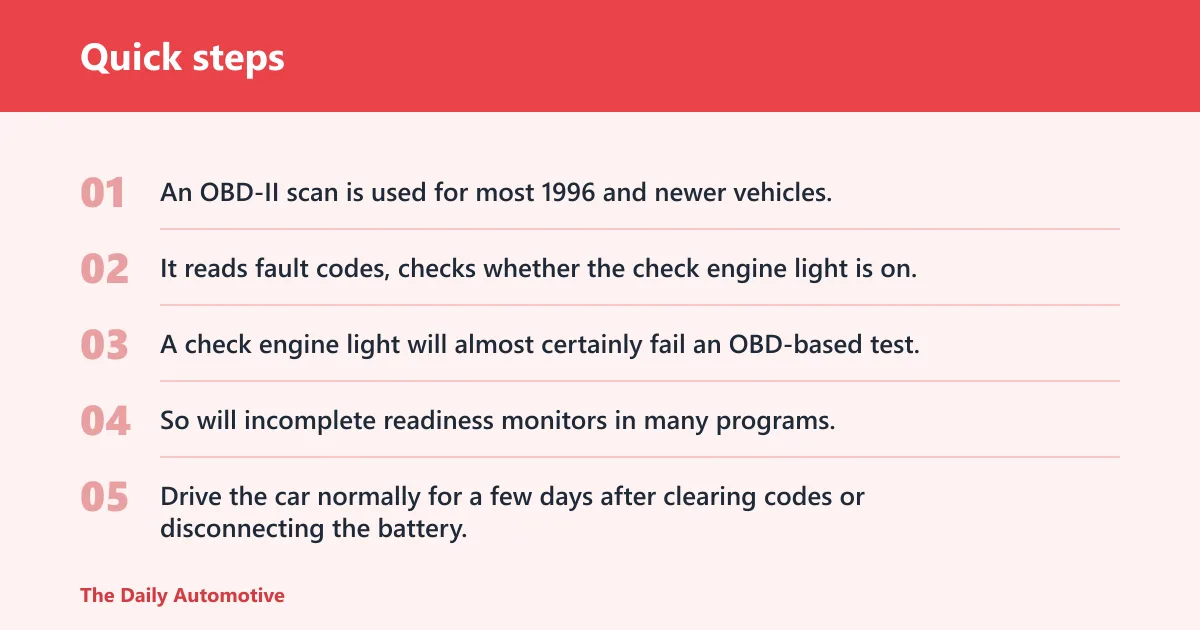
An OBD-II scan is used for most 1996 and newer vehicles. It reads fault codes, checks whether the check engine light is on, and looks at readiness monitors that show whether self-checks have finished.
A check engine light will almost certainly fail an OBD-based test. So will incomplete readiness monitors in many programs, especially after a battery disconnect or a code clear.
Drive the car normally for a few days after clearing codes or disconnecting the battery. That gives the monitors time to set again before the inspection.
Tailpipe measurement
Some jurisdictions still use a tailpipe test, which measures exhaust directly. The vehicle may be checked while idling or on a dynamometer, and some programs use a two-speed idle method instead.
This method looks at actual exhaust output, so it can fail a car that has no computer-code problem but still runs dirty under load or at idle. It can also pass a vehicle that has no stored fault code, even if another inspection step later finds a problem.
Visual and evaporative checks
A visual emissions inspection checks whether required parts are present and unaltered. That includes looking for tampering, missing equipment, or components that do not match the car’s emissions setup.
Many inspections also include an evaporative emissions system check. That may involve the gas cap or other leak-related checks tied to the fuel system rather than the tailpipe.
A 2001 gas sedan may pass the OBD screen and still fail the visual inspection if the catalytic converter appears non-original and the air pump is missing. It may pass an OBD screen and still fail the visual inspection.
Which vehicles are usually tested?
Model year and fuel type matter more than the wording on the notice. Most 1996 and newer gasoline vehicles are checked through an OBD-II-based process, while diesel, hybrid, and electric vehicles may follow different rules or be exempt in some states.
1996 and newer gasoline vehicles
These are the most common candidates for OBD-II scanning. The computer check is fast, but it still depends on readiness monitors, fault codes, and check engine light status.
That means a vehicle can look mechanically fine and still fail because the inspection computer sees incomplete self-tests. The reverse can happen too: the scan may look clean, while a visual or tailpipe step catches the problem.
Diesel, hybrid, and EV rules
Diesels often face separate standards. Hybrids may be treated like gasoline vehicles in some programs and differently in others. Electric vehicles are generally exempt from smog checks.
That exemption is about the absence of tailpipe emissions, not a universal exemption from every state inspection rule. If you moved, your new state may still care about registration timing, VIN checks, or other non-emissions paperwork.
Why the fuel type matters
A state can use one label for all of this and still apply different inspection paths. A 1998 gas sedan may get an OBD-II check, a diesel pickup may need a different method, and an EV may skip the emissions portion entirely.
That is why the notice and the vehicle description matter more than the generic phrase “get a smog check.”
Which test do I actually need?
This table is the fastest way to sort out the name, the method, and the paper you should bring. Read the state naming convention first, then match your vehicle type and expected method before you head to the station.
| State naming convention | Vehicle type | Likely test method | Common failure trigger | What document to bring |
|---|---|---|---|---|
| Smog check | 1996+ gas | OBD-II | Check engine light or incomplete readiness monitors | Registration renewal notice |
| Smog check | Diesel | Tailpipe or state-specific diesel inspection | Visible smoke, excess soot, or equipment issue | Registration paperwork and VIN details |
| Smog check | Hybrid | OBD-II or exemption review | Incomplete monitors after battery disconnect | Renewal notice and prior repair records |
| Smog check | EV | Usually exempt from smog portion | State may still require other registration steps | Title or registration documents |
| Emissions test | 1996+ gas | OBD-II | Stored codes or readiness not set | Registration renewal notice |
| Emissions test | Older gas or some specialty vehicles | Tailpipe, idle, two-speed idle, or dynamometer | High HC, CO, or NOx at the pipe | Vehicle registration and any repair receipts |
| Emissions test | Diesel, hybrid, or EV | Depends on state rule | Wrong station type or missing exemption proof | Agency notice showing required test type |
How to read the table
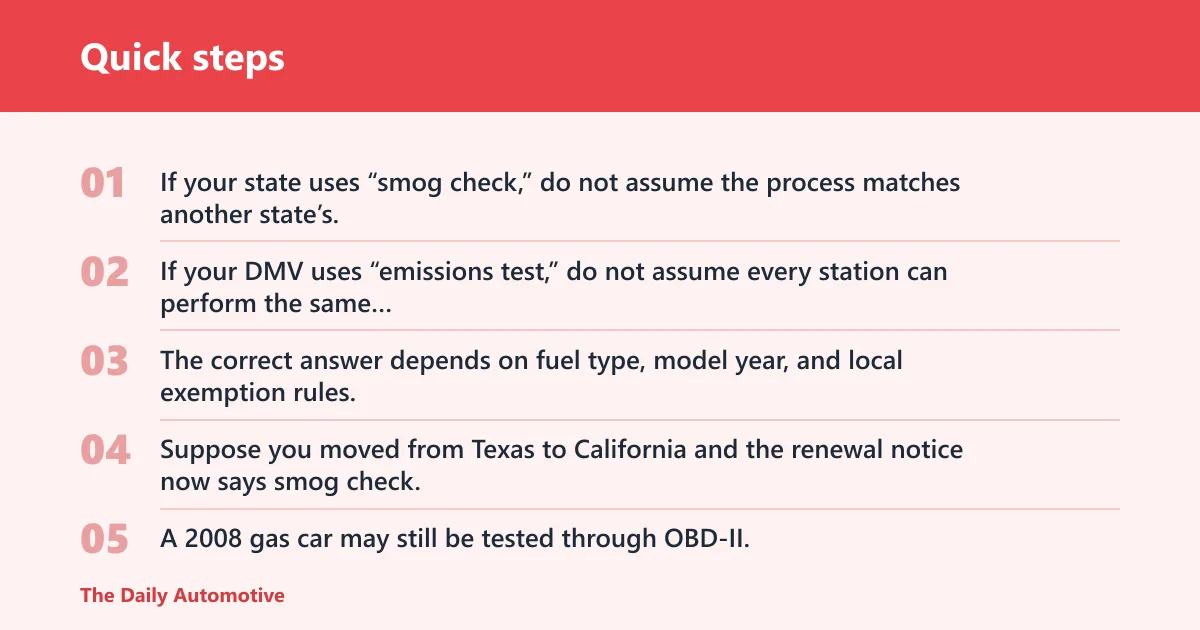
If your state uses “smog check,” do not assume the process matches another state’s. If your DMV uses “emissions test,” do not assume every station can perform the same inspection. The correct answer depends on fuel type, model year, and local exemption rules.
Suppose you moved from Texas to California and the renewal notice now says smog check. A 2008 gas car may still be tested through OBD-II, but the station may also check items that were not part of your old state’s process.
Can a car pass one and fail the other?
Yes. A car can pass an OBD-based emissions test and still fail a visual inspection, and it can also pass a tailpipe check while failing readiness or evaporative criteria. The failure point depends on which part of the inspection the state requires.
Pass the computer check, fail the visual
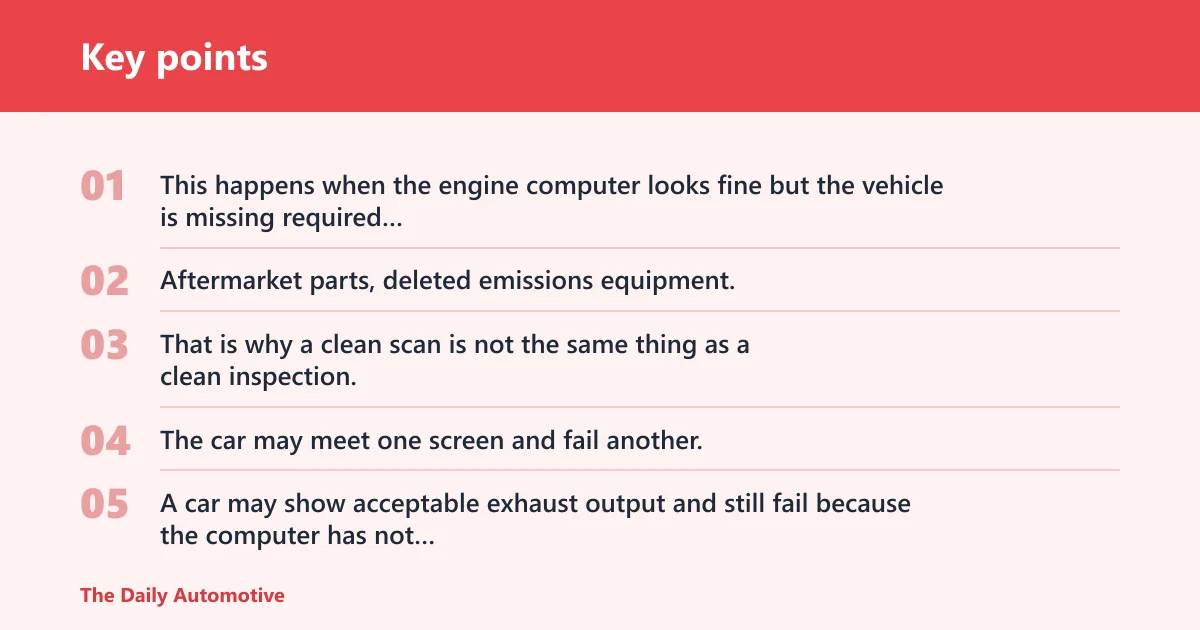
This happens when the engine computer looks fine but the vehicle is missing required parts or shows signs of tampering. Aftermarket parts, deleted emissions equipment, or a missing canister can trigger that result even when no fault code is stored.
That is why a clean scan is not the same thing as a clean inspection. The car may meet one screen and fail another.
Pass the tailpipe, fail the OBD or evaporative screen
A car may show acceptable exhaust output and still fail because the computer has not completed readiness checks or because the evaporative system leaks. A gas cap or leak-related issue can matter even if the exhaust numbers look normal at the pipe.
This is one of the most common surprises for drivers after repairs or battery replacement. The car can feel normal, yet the inspection computer still sees an incomplete or faulted system.
What each failure usually means
OBD failures usually point to stored codes, pending codes, or incomplete monitors. Tailpipe failures point to measured exhaust that is too dirty for the program. Visual failures point to missing or altered equipment.
That split matters because the repair path changes. A code-clear issue may only need drive time. A tailpipe failure may need a mechanical repair. A visual failure often needs the original emissions hardware restored.
Choose Smog Check if… / Choose Emissions Test if…
Pick the label your state agency uses, then match the inspection method to the car. The right choice is driven by local law, but the vehicle itself decides whether the station is likely to use OBD-II, tailpipe, visual, or evaporative checks.
- Choose Smog Check if your renewal notice uses that exact term, you are in California or a California-style program, or your station instructions mention biennial testing for a gas vehicle.
- Choose Smog Check if your car is a 1996+ gasoline model and the state program is built around an OBD-II scan with possible visual or evaporative checks.
- Choose Emissions Test if your DMV uses the broader term, your new state names the inspection that way, or the agency directs you to a specific emissions station type.
- Choose Emissions Test if your vehicle is older, diesel, hybrid, or subject to a state method that still uses tailpipe analysis or a special exemption review.
The safest move after a change of address is simple: follow the renewal notice, not the old state habit. A car that passed under one rule can still fail under another because the inspection path changed.
Frequently asked questions
Is smog check and emissions test the same thing?
Usually, they serve the same compliance purpose, but the legal label and inspection method can differ by state. One state may say smog check and another may say emissions test, even when both are aimed at the same pollution screen and both can involve OBD-II, tailpipe, or visual checks.
What is the difference between a smog check and an emissions test?
The difference is mostly procedural. Smog check is often the state program name, especially in California, while emissions test is the broader term. The real differences show up in method, vehicle coverage, and exemption rules, not in the shared goal of limiting pollution.
What is a smog check vs smog test?
In everyday speech, people often use both phrases to mean the same inspection. In state paperwork, though, “smog check” is more likely the official term. “Smog test” is usually informal shorthand, so the renewal notice and DMV instructions matter more than the casual phrase.
What is the difference between smog check and emissions test in California?
California is the state most closely tied to the term smog check. The California Smog Check Program often applies biennially and may include enhanced inspection in some counties. In practice, the station can use OBD-II, visual, tailpipe, or evaporative checks depending on the vehicle.
Do I need a smog check or emissions test for registration renewal?
Use whichever term appears on your renewal notice or state DMV page. The main issue is not the label itself but whether your vehicle is due for inspection, exempt, or subject to a specific testing method. If you moved, follow your new state’s rules, not the old ones.
Can a car pass one test and fail the other?
Yes. A car can pass an OBD-based check and fail a visual inspection, or pass a tailpipe test and still fail because readiness monitors are incomplete. A battery disconnect or code clear can create that mismatch, so drive normally for a few days before retesting.
Products related to this article
Sponsored / affiliate links. As an Amazon Associate I earn from qualifying purchases. I may earn additional commission from eligible campaigns.