Emissions Test Cost: How Much It Really Costs
An emissions test often costs roughly $15 to $50. Many drivers pay roughly $40 to $100 once fees and bundled checks are added. A failed test can turn a visit into a repair bill and another trip. This guide separates the base price, common add-ons, retest costs, and the state rules that change the total.
Typical cost range
A standard passenger-vehicle emissions test typically costs between $15 and $40, but that is often only the station’s base fee. The total can rise if your state adds a certificate charge, if the shop bundles the inspection with other required checks, or if your vehicle needs a more complex test type.
What the quoted fee usually includes
Some stations quote only the inspection price. Others include paperwork or administrative charges, and some do not include the state certificate fee at all. That is why two quotes that look similar can leave you with different totals at checkout.
Why the final bill can be higher
The final bill can be higher because the inspection fee is only one line item. In states with separate certificate charges, or in places that bundle safety and emissions checks, the amount you hand over can be noticeably above the advertised test price.
Emissions test cost calculator
Use the table below to estimate the total out-of-pocket cost, not just the sticker price. The point is to separate the base inspection from certificate fees, retest charges, and program rules that can change what you pay at the counter.
| Scenario | Base fee | Possible certificate fee | Retest fee | Estimated total out-of-pocket | What changes the total |
|---|---|---|---|---|---|
| Emissions-only pass | $20 to $40 | $0 to separate state fee | $0 | $20 to $40, plus any certificate charge | Typical OBD-II inspection at a station that charges only for the test. |
| Bundled safety + emissions pass | $30 to $50 combined | Often included or added separately | $0 | $30 to $50, sometimes more with a certificate fee | One visit covers both checks, but the bundle is not priced like emissions-only service. |
| Fail then retest | $15 to $40 first test | May still apply | $0 to discounted or free | $15 to $40, plus any certificate fee already owed | Some programs offer a free or discounted return visit if you come back within the allowed window. |
| Fail then repair plus retest | $15 to $40 first test | May still apply | $0 to discounted or free | Test fee + diagnostics + repairs + retest | The repair bill is separate from the test price and is usually the largest part of the total. |
| Free or discounted program eligible | $0 to reduced fee | Varies by program | $0 to discounted or free | Can be near $0 for the test itself | Low-income assistance, county programs, or state E-Check rules can reduce the station charge. |
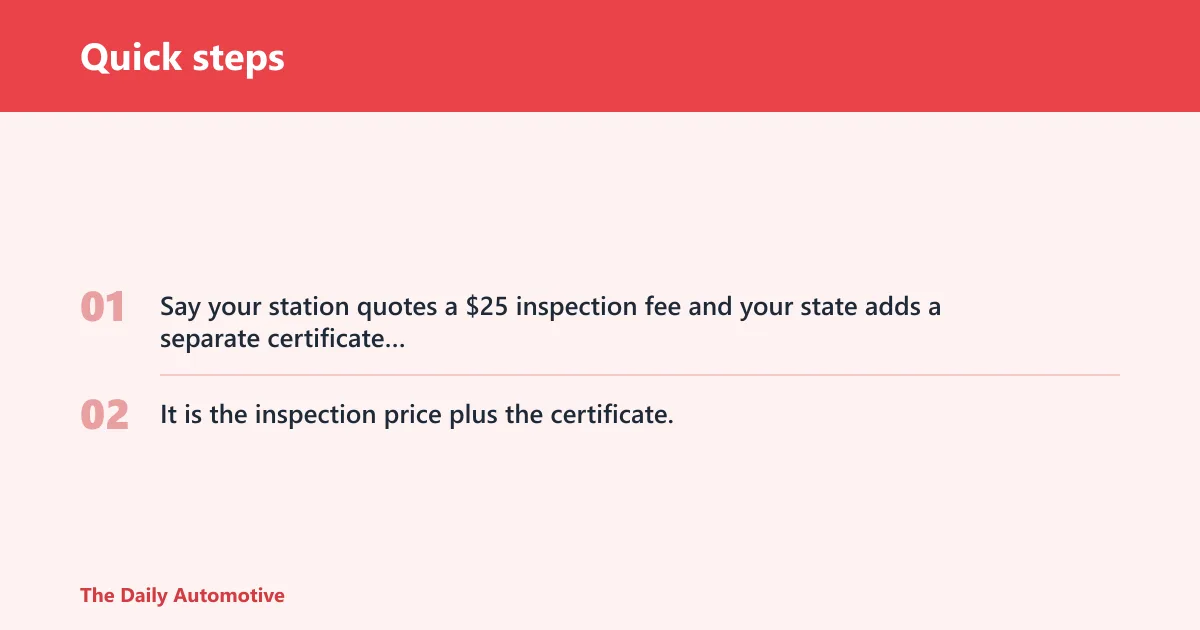
Say your station quotes a $25 inspection fee and your state adds a separate certificate charge. Your total is no longer $25. It is the inspection price plus the certificate, and any failed-test follow-up starts a new cost category entirely.
Why prices vary by state
Emissions test pricing is not universal. Some states cap what stations can charge, while others let private stations set their own rates. Local program rules, certificate charges, and whether the state uses a separate paperwork fee can all change the total for the same vehicle.
State-capped fees versus market-priced stations
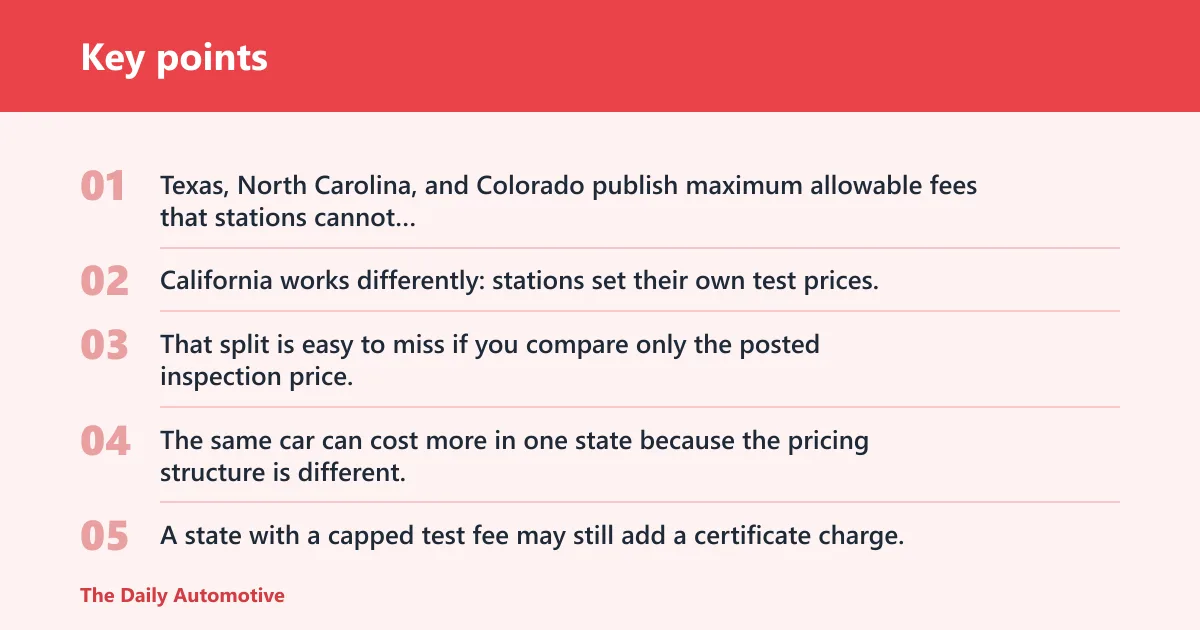
Texas, North Carolina, and Colorado publish maximum allowable fees that stations cannot exceed. California works differently: stations set their own test prices, but each vehicle also pays a state certificate fee. That split is easy to miss if you compare only the posted inspection price.
Why the same vehicle can cost more in one state
The same car can cost more in one state because the pricing structure is different, not because the vehicle changed. A state with a capped test fee may still add a certificate charge, while another state may bundle inspection costs or require a more involved test method.
What changes the price by vehicle?
Vehicle type matters. Most late-model gasoline vehicles from 1996 and newer qualify for OBD-II testing, which is generally cheaper because it uses a scan tool and diagnostic data. Older vehicles, diesel vehicles, and special cases can cost more because they need more equipment or more time.
OBD-II inspections for 1996-and-newer gasoline vehicles
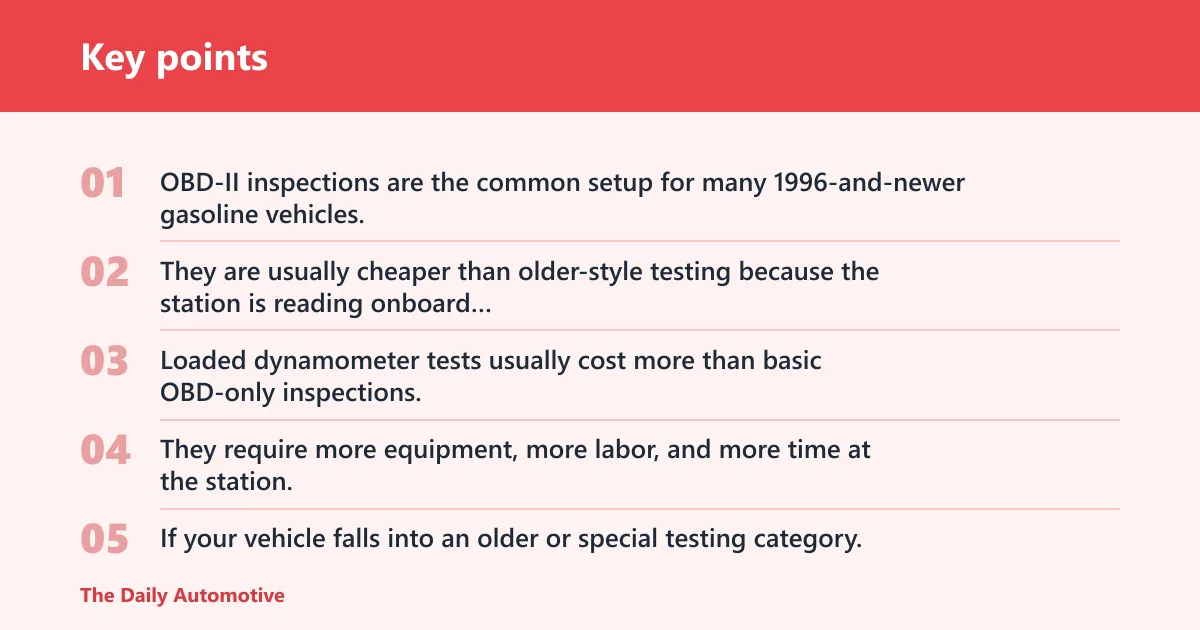
OBD-II inspections are the common setup for many 1996-and-newer gasoline vehicles. They are usually cheaper than older-style testing because the station is reading onboard diagnostic data rather than running a more complex mechanical test procedure.
Older vehicles and loaded dynamometer tests
Loaded dynamometer tests usually cost more than basic OBD-only inspections. They require more equipment, more labor, and more time at the station. If your vehicle falls into an older or special testing category, expect the price to move above the simplest gasoline test.
Diesel opacity tests and special-case pricing
Diesel opacity tests apply to some diesel vehicles and are often priced differently from standard gasoline OBD tests. In many programs, they can carry higher fees than a routine passenger-vehicle inspection because the test setup is not the same.
Picture a 2001 gasoline sedan that qualifies for OBD-II testing. The station scan is quick, and the base charge may be near the low end of the local range. Now picture an older diesel pickup that needs a different test method. The price usually climbs because the inspection itself is more involved.
Do emissions tests cost money?
Usually, yes. But some drivers can qualify for free or discounted testing, and some programs reduce the price if you return after a failure within the allowed window. Whether you pay the full charge depends on your state, your vehicle, and your program eligibility.
When the test is free or discounted
Ohio’s E-Check program allows up to three free tests within a 365-day period, and the fourth and subsequent Ohio E-Check tests cost around $18 each. That is a clear example of how program rules can change the bill even when the vehicle and station stay the same.
Low-income assistance and repair programs
Arizona and Ohio are mentioned as states with repair assistance programs. Those programs matter because the failed-test cost is not only the retest fee. If repairs are needed, help with the repair side can change the total much more than a small discount on the inspection itself.
Retest and waiver rules to check before you go
Some states offer free or discounted retests if you fail and complete repairs quickly. Others have waiver or assistance rules with specific deadlines and paperwork. Check those rules before you pay for diagnostics, because a return visit may be cheaper than you expect or may not be covered at all.
Smog check vs emissions test pricing
In some states, “smog check” and “emissions test” mean the same thing. In others, a smog check is the local term for a specific program, and the price changes by station, by vehicle type, or by whether the inspection is bundled with another required check.
When the terms mean the same thing
Many drivers use the terms interchangeably, and many stations do too. The label does not always tell you the price structure, though. A “smog check” quote may still leave out certificate fees, retest charges, or a separate administrative fee.
When a smog check is bundled with other inspections
Some states bundle emissions with safety inspection, and combined fees often land around $30 to $50. That is not the same as an emissions-only quote. If you need both checks, compare the bundle total, not just the emissions portion.
How to compare station quotes correctly
Ask whether the quote includes the state certificate fee, whether it covers both inspections if the station bundles them, and whether there are any administrative charges. A low base price can look better than it really is if those extras are hidden until checkout.
How to avoid surprise charges
Ask about the full price before you arrive. Confirm whether the station charges separately for the certificate, whether a retest is free, and what payment types they accept. If your vehicle may need a diesel, dyno, or special-case inspection, ask that before you line up.
- Ask for the base inspection fee and whether it includes the certificate.
- Confirm whether the station performs your exact test type.
- Ask how retests work after a failure and how soon you must return.
- Check whether your state offers free, discounted, or assisted testing.
- Confirm payment methods and required documents before you leave home.
A common first-timer mistake is hearing a low quote and assuming it is the full amount. Then the certificate fee appears at the counter, and the bill is no longer the number the driver expected.
Frequently asked questions
How much does an emissions test cost?
A standard passenger-vehicle emissions test typically costs between $15 and $40. The total can run higher if your state adds a certificate fee, if the station bundles other required inspections, or if your vehicle needs a more complex test than a basic OBD-II check.
How much is a vehicle emissions test?
For many drivers, the base price is in the same $15 to $40 range. The answer depends on state rules, whether the station is privately priced or state-capped, and whether the quoted number includes a certificate fee or only the inspection itself.
How much for an emissions test near me?
Near-you pricing depends on your state, your county program, and the station itself. Call ahead and ask for the inspection fee, the certificate fee, and any retest charge. That is the best way to compare nearby stations without getting surprised at checkout.
Why do emissions test prices vary by state?
States use different pricing models. Some cap the fee, some allow station pricing, and some add separate state certificate charges. The same vehicle can therefore cost more or less depending on local rules, even before you factor in repair or retest costs.
What can make an emissions test more expensive?
Older vehicles, diesel opacity tests, loaded dynamometer tests, bundled safety inspections, and separate certificate fees can all raise the total. A failure can also add diagnostic time, repair costs, and a retest charge, which is why the first quoted price is not always the final bill.
Does the price include a certificate fee?
Not always. California is the clearest example of a state where stations set their own test prices but each vehicle also pays a state certificate fee. That is why two quotes that look similar can leave you with different totals after the inspection.
Products related to this article
Sponsored / affiliate links. As an Amazon Associate I earn from qualifying purchases. I may earn additional commission from eligible campaigns.