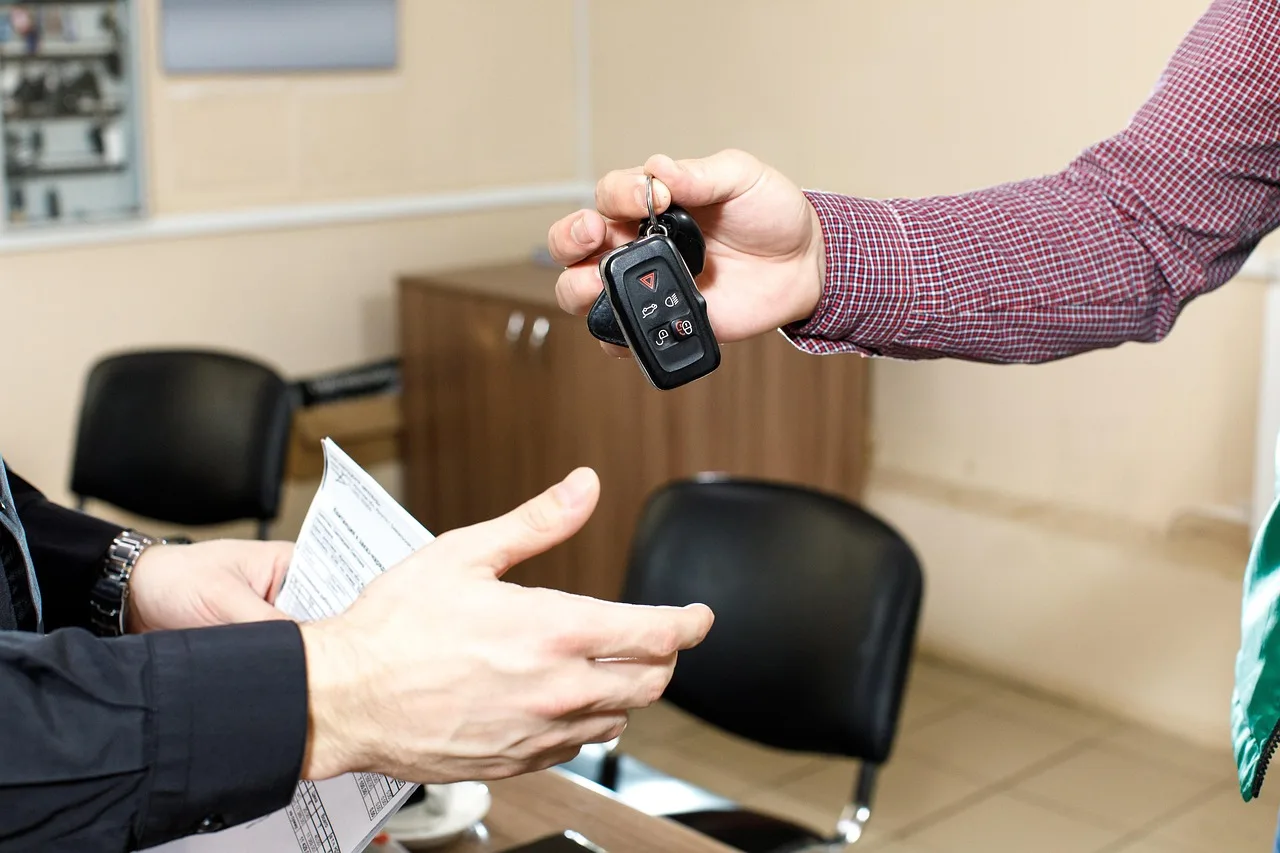
Car Ownership Essentials
Start with a few tiers of car ownership essentials: legal papers first, emergency gear second, maintenance basics third, and a monthly budget buffer sized around one tank of fuel plus a bit extra. Skip that order, and a flat tire, dead battery, or missed registration can turn a cheap car into a tow bill, fine, or missed workday. I’ve seen all three happen. This guide sorts what to buy, keep in the car, store at home, and review during your first year.
The three first purchases or setup tasks are simple: carry the legal documents you may need at the roadside, build a breakdown kit you can actually use in the dark and rain, and bookmark the owner’s manual at the maintenance schedule. Everything else comes after those three.
Car ownership essentials: start with these 3 first
Legal documents you may actually need at the roadside
Keep proof of insurance, the registration certificate, and emergency contact details in the glove box or a slim document organizer that keeps out water. Put your insurer card, registration certificate, roadside-assistance membership details, and two written emergency numbers there. The article recommends keeping documents in the glove box, and essential documents include license, registration, and insurance documents. Carry the driving license on the driver, not loose in the car.
Do not keep the original title in the vehicle. If the car is stolen, that paperwork creates a second problem. A photocopy of insurance details at home and a printed roadside-assistance number in the car are the safer move.
A breakdown kit you can use in the dark and rain
A useful kit starts with basics that solve common failures fast. The emergency kit list includes jump leads, a warning triangle, a high visibility vest, a flashlight, and a tire pressure gauge. Add a first aid kit, work gloves, and a small toolkit, then check where each item sits so nothing rolls loose in the cabin.
The failure mode that catches new owners is false preparedness. A dead jump pack, expired tire sealant, or missing wheel-lock key turns a minor stop into a recovery call.
The owner’s manual and maintenance schedule as your baseline
The owner’s manual matters because it answers the questions that show up when time is short: warning-light meanings, correct tire pressures, fluid specs, fuse locations, and reset instructions after service. Bookmark the maintenance schedule section first.
That one step prevents a lot of expensive guessing. It also tells you what the car actually needs, rather than what a generic checklist assumes.
According to Just Bought a Car? The Ultimate Checklist for New Car Owners – Auto … — The new car owner article has 15 tips.
Oil change costs: What to expect and how to avoid overpaying
An oil change is one of the most critical—and often overlooked—maintenance tasks for preserving engine life. Prices typically range from **$35 to $100** for conventional oil in a standard vehicle, but full-synthetic service, larger engines, or dealership labor can push costs to **$120–$180**. Overpaying or delaying changes risks oil starvation, accelerated wear, and costly repairs down the line.
Understanding what drives the final bill—oil type, engine size, provider, and add-ons like tire rotations—helps you budget and spot fair quotes. For a breakdown of typical pricing and red flags, see how much an oil change costs by service type.
Air Filter Replacement Costs: DIY vs. Shop Pricing
A new engine air filter typically runs $15 to $60 when professionally installed, while a cabin air filter replacement usually costs $25 to $80 after labor. Prices shift depending on whether you choose a parts store, dealership, or independent shop, and waiting too long to replace these filters reduces airflow, lowers fuel efficiency, and forces your HVAC blower to work harder. Air filter replacement costs guide breaks down realistic pricing across common scenarios and highlights the trade-offs between DIY swaps and shop visits.
Understanding these cost ranges helps you budget accurately and decide when a simple filter change is a straightforward maintenance task versus when professional service may be warranted.
How to Budget for a Car Alignment Without Overpaying
A car alignment keeps your vehicle running straight, extends tire life, and prevents uneven wear—but costs vary widely. A standard alignment typically ranges from **$80 to $250**, though quotes can spike if shops bundle diagnostics, tire balancing, or suspension repairs. Knowing what’s included (and what’s upsold) helps avoid unnecessary expenses. This guide breaks down alignment pricing by type—front-end, four-wheel, or specialty setups—and flags red flags in quotes, so you can prioritize what matters most for your car’s handling.
For a deeper look at alignment pricing, including how to spot hidden fees and what affects costs (like EV or lifted vehicles), check out the breakdown of car alignment costs.
Managing Windshield Replacement Costs and Calibration
Windshield replacements typically range from $250 to $600, though advanced driver assistance systems can significantly increase the final bill due to required recalibration. Skipping this step risks safety hazards or additional repair costs. windshield replacement cost factors explains how insurance deductibles, glass type, and calibration requirements influence your total expenses.
This guide breaks down what should be included in an all-in quote to prevent unexpected surprises. Understanding the difference between OEM and aftermarket glass helps you make informed decisions that protect both your vehicle’s functionality and your budget.
Understanding diagnostic test costs before you commit to repairs
Diagnostic fees typically range from $100 to $200, varying significantly based on whether you need a basic code scan or a comprehensive dealer-level analysis. Knowing the difference prevents you from overpaying for unnecessary parts or underdiagnosing a small fault that could escalate into major engine damage. Our guide breaks down exactly what you are paying for, helps you decide when a free scan is sufficient versus when a deeper investigation is required, and provides a decision framework to evaluate repair estimates before signing off. This clarity is essential for maintaining your vehicle’s reliability without incurring avoidable expenses.
Choosing Between Front-Wheel and All-Wheel Drive
Front-wheel drive paired with quality winter tires handles daily commuting better than all-wheel drive for most drivers. AWD only justifies its higher purchase price, fuel consumption, and maintenance costs if you regularly navigate steep hills, heavy snowfall, or poorly cleared roads. Choosing the wrong drivetrain means paying more without gaining any advantage in braking or cornering grip.
The supporting guide breaks down how each system delivers power to the pavement, compares real-world ownership expenses, and provides a decision table based on your typical driving conditions. Evaluating these FWD versus AWD tradeoffs before you buy prevents overspending on capability you will never actually use.
How to Pick the Best Car Air Freshener for Long‑Lasting Odor Control
The guide walks you through a step‑by‑step process: clean spills or mildew first, then select a freshener format—charcoal for heavy odors, gel for moderate, or a mild clip for small cabins. It matches each solution to odor type, cabin size, and climate, so you know exactly which product will last the longest.
Following this method saves money, eliminates lingering smells, and keeps passengers comfortable, while also flagging safety considerations for new‑car interiors. For a quick reference, see the decision table that pairs odor problems with the optimal car air fresheners.
When to Use Meguiar’s Ultimate Interior Detailer
Meguiar’s Ultimate Interior Detailer excels as a daily maintenance spray for light dust, fingerprints, and UV protection on dashboards and trim, but it cannot replace dedicated leather cleaners or heavy-duty degreasers for soiled cabins. Using it on heavily dirty surfaces leaves grime trapped in seams and accelerates leather aging, making proper product selection critical for interior longevity.
This interior detailer review breaks down exact use cases, surface compatibility, and finish expectations to prevent misuse. It includes a decision table distinguishing where this spray fits versus when stronger cleaners are necessary, ensuring you maintain your vehicle’s interior without damaging sensitive materials through incorrect product application.
Car Wash vs Hand Wash: Matching the Method to Your Paint
The safest wash method depends entirely on your car’s current paint condition and finish. Vehicles with swirl marks, soft clear coats, or dark paint benefit from careful hand washing with clean tools to prevent further marring. For daily drivers with already-worn finishes, a brushless automatic wash saves time without adding significant risk.
Choosing incorrectly can lead to expensive machine-polish corrections, faded trim, and scratches visible in direct sunlight. This comparison breaks down how factors like ceramic coatings, paint protection film, and overall finish type influence the decision. Use this car wash method guide to match your specific vehicle to the lowest-risk cleaning approach before you spend money on unnecessary detailing repairs.
Armor All Glass Cleaner: Spray vs. Wipes for Daily Drivers
Armor All glass cleaner handles daily-driver windshield and window cleanup effectively, but choosing between the spray bottle and pre-moistened wipes determines whether you get a streak-free finish or waste time chasing haze. The spray formula is the better buy if you clean your glass more than once a month, while wipes belong in the glovebox for quick touch-ups on the go.
Using the wrong format or applying it improperly can smear tint-safe film and leave visible residue on interior windows. For commuters and families who need a straightforward, affordable solution without specialty detailing steps, this cleaner does the job reliably when matched to your routine. Our full breakdown of Armor All glass cleaner compares the spray, wipe, and ceramic options so you can pick the right one.
What essentials should i have in my car right now?
Right now, the answer is a risk-first stack: legal paperwork, a breakdown kit, tire service tools, and the owner’s manual. Comfort gear can wait. Space and budget change the exact kit, but every car should cover the failures that stop the trip, trigger a fine, or risk a tow.
The risk-first order: legal, emergency, maintenance, comfort
Most lists flatten everything into one pile. That is how a phone mount gets treated like a warning triangle. A better system ranks items by consequence first, then by storage space, then by ongoing cost.
- Legal: proof of insurance, registration certificate, emergency contacts, roadside policy details.
- Emergency: jump solution, warning triangle, high-visibility vest, flashlight, first aid kit, tire plan.
- Maintenance: owner’s manual, tire-pressure routine, fluid-check routine, wiper and battery checks.
- Comfort: chargers, tissues, sunshade, spare layer, snacks for long trips.
How space and budget change the answer
A city hatchback without a spare-tire well needs a different trunk plan than a wagon or pickup. If the car came with run-flats or only a sealant kit, the trunk should carry an inflation plan, a pressure gauge, and printed instructions for when sealant should not be used.
Budget matters too. Buy one reliable jump solution before buying five low-value accessories. A glove-box organizer and a decent flashlight beat decorative clutter every time.
What can stay at home and what belongs in the car
Keep ownership records, service receipts, and the original title at home. In the car, keep only the documents needed during a stop or breakdown, plus the gear required to stay visible and mobile until help arrives.
Heavy tools should stay secured in the trunk or cargo floor, never in the footwell or on a rear shelf. In a sudden stop, loose metal becomes a hazard.
Must-have
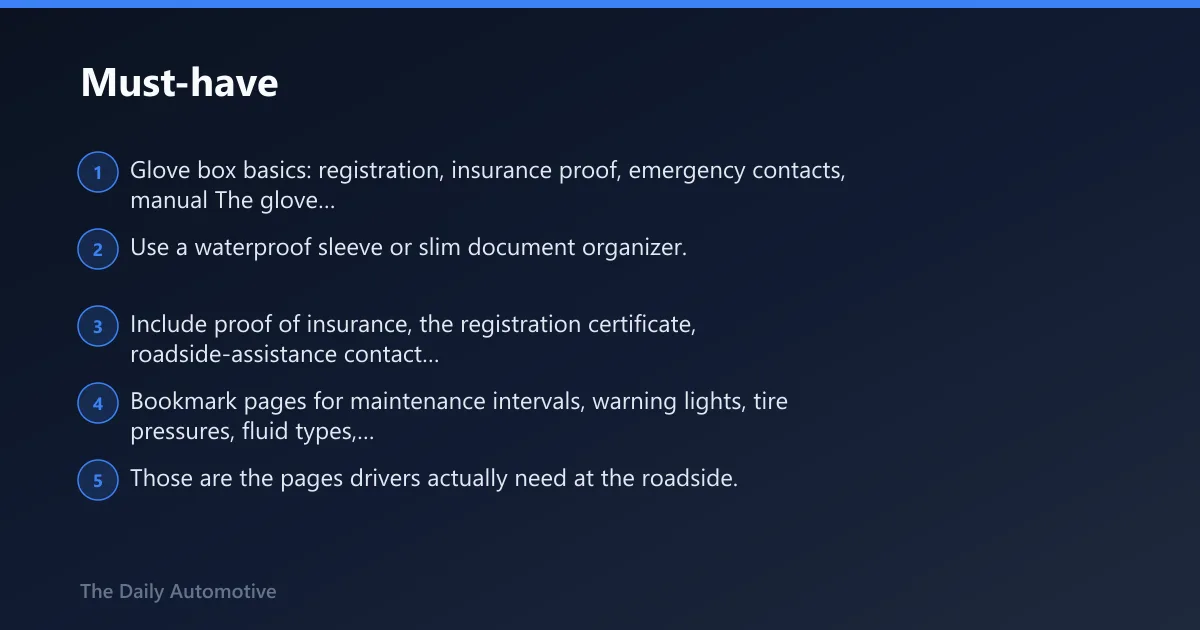
Glove box basics: registration, insurance proof, emergency contacts, manual
The glove box is the right home for legal paperwork and fast-reference material. Use a waterproof sleeve or slim document organizer. Include proof of insurance, the registration certificate, roadside-assistance contact details, emergency contact numbers, and the owner’s manual if the car still has it in paper form.
Bookmark pages for maintenance intervals, warning lights, tire pressures, fluid types, fuse layout, and wheel-change instructions. Those are the pages drivers actually need at the roadside.
Trunk basics: jump solution, triangle, vest, flashlight, first aid kit
The trunk kit should solve the failures that strand most drivers: weak battery, puncture, night breakdown, minor injury, and no safe way to warn traffic. Pack the kit low and secure it so the heavy items do not move under braking.
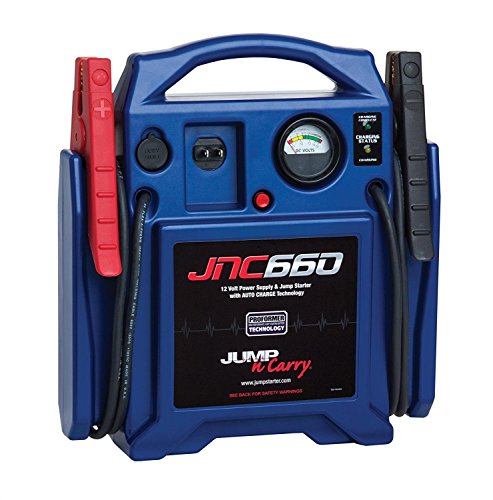
Clore Automotive Jump-N-Carry JNC660
Based on specs and reviews, this is the serious end of the jump-start category. The 1700 Peak Amps figure and 22Ah battery suggest enough reserve for drivers who do not want to rely on another car being nearby. The built-in voltmeter is useful because dead jump packs are common.
The drawback is obvious: it is bulky and costs $126.02. For a very small trunk or a low-mileage city car, that size may feel like overkill. It also needs periodic charging, or it becomes cargo instead of backup.

LIANXIN 142 PCS Emergency Roadside Kit
For a first-time owner on a tight budget, this type of bundled kit covers a lot of gaps fast. Based on specs and reviews, the value is breadth: jumper cables, lights, small tools, and a compact pack that stays in one place.
The tradeoff is that combo kits usually mix genuinely useful pieces with lighter-grade ones. At $39.99, it makes sense as a starter set, but the flashlight, gloves, and jumper-cable quality should still be checked before depending on it in bad weather.
Tire basics: spare or inflation plan, jack, lug tools, pressure gauge
The checklist recommends an inflated spare tire and a car jack. Add the lug wrench, the locking wheel-nut key if the car uses one, and a tire pressure gauge. Before assuming the car is covered, lift the trunk floor and confirm the tools are actually present.
Many newer cars do not include a real spare. Some have a sealant bottle and compressor. Some have run-flats. Some have nothing more than a tow hook. That changes the whole trunk plan. If there is no spare, carry the inflation kit, understand sealant limits, and know when to stop and call recovery instead of driving on a damaged tire.
Check the spare itself. A flat spare is a common failure mode. So is a missing lock key, especially after used-car purchases or wheel changes.
Roadside cover details: card, phone number, coverage limits, backup access
Roadside breakdown cover should sit in the must-have tier because it closes the gaps your own kit cannot fix. Keep the provider card, a printed phone number, membership number, and a short note on what the policy covers: local tow only, home start, onward travel, or tire assistance.
If the phone dies, the printed number still works from a borrowed phone or a service-station line. That one piece of paper is cheap insurance against a dead battery on the person as well as in the car.
What should every car owner keep in the glove box?
Every car owner should keep current registration and insurance proof, roadside-assistance details, emergency contacts, and the owner’s manual or key reference pages in the glove box. Store them in a dry sleeve, leave the original title at home, and make sure anything printed is still readable after a wet winter.
Document organizer setup that stays readable and dry
A slim zip wallet or plastic envelope works better than folding loose sheets into the glove box. Moisture, heater airflow, and receipts destroy readability over time. Label one pocket for legal paperwork and one for reference pages.
What paperwork to carry and what to leave at home
Carry proof of insurance, registration certificate, roadside-assistance details, and emergency contacts. Keep service invoices, finance papers, spare-key records, and title paperwork at home. The goal is access without overexposure.
Quick-reference pages worth bookmarking in the manual
Mark the maintenance schedule, dashboard warning light meanings, tire pressure chart, fuse map, wheel-changing procedure, and fluid specification pages. Those sections answer the majority of first-year ownership questions quickly.
Consumables and spares
Fluids and small refill items that solve common annoyances fast
Keep washer fluid, paper towels, nitrile or work gloves, and spare tire valve caps in the garage or trunk depending on climate and space. Where legal and applicable, a few correct fuses and bulbs can be worth carrying. Confirm fitment in the manual before buying them.
These are low-cost items, but they have an expiry pattern of their own. Washer fluid gets used. Batteries die. Sealant bottles age out. Small items need a review date, or they become forgotten clutter.

VIAIR 400P EF portable air compressor
Based on specs and reviews, this is a step above the tiny compressors bundled with many cars. The 150 PSI rating, longer hose, and faster-fill claim suit heavier vehicles, repeated top-ups, or drivers who travel far from easy help.
The drawback is cost and bulk. At $240.20, it is hard to justify before the legal kit and jump solution are sorted. It also takes more trunk room than a basic emergency inflator, so small-car owners need to decide if the performance is worth the space.
Wear items to inspect or replace on a schedule
Track wiper blades, battery age, tire sealant expiry, flashlight batteries if the light is not rechargeable, and any bulbs the car still uses in serviceable housings. On the maintenance side, oil level, coolant and other owner-checkable fluids, tire pressure, tread depth, rotation, balancing, and battery health belong on a repeat routine.
Cold-weather and long-trip consumables that earn their trunk space
For winter regions, add gloves, a hat, a compact scraper, and a small absorbent mat or towel. For long trips, water, shelf-stable snacks, and a paper map of the region still have value when coverage drops or the phone is flat.

BLACK+DECKER 20V MAX drill kit
This sits at the edge of “consumables and spares” because it can earn its place for owners who do basic garage jobs, seasonal plate swaps where legal, or battery-clamp work at home. Based on specs and reviews, the built-in light and clutch control are the useful parts.
The drawback is simple: it is not a roadside essential. At $59.99, money usually belongs elsewhere first. It also adds charger management and battery upkeep, which makes it a home-garage tool more than an in-car purchase.
Nice-to-have
Comfort and convenience gear after the core kit is sorted
Once the legal, emergency, tire, and maintenance basics are covered, add comfort items with a clear purpose. A phone charger, small cash reserve, tissues, and a compact umbrella are reasonable. Decorative organizers, duplicate cables in every pocket, and novelty gadgets usually crowd out higher-value gear.

VIOFO A129 Plus Duo dash cam
Based on specs and reviews, a front-and-rear dash cam can make sense for commuters, urban parkers, and anyone who wants evidence after a minor collision or parking incident. The GPS and parking modes are the practical features here, not the gadget appeal.
The drawback is that it does nothing to get a broken car moving again. At $170.99, it belongs after roadside basics and budget planning. It also adds install time, memory-card upkeep, and another device to troubleshoot.
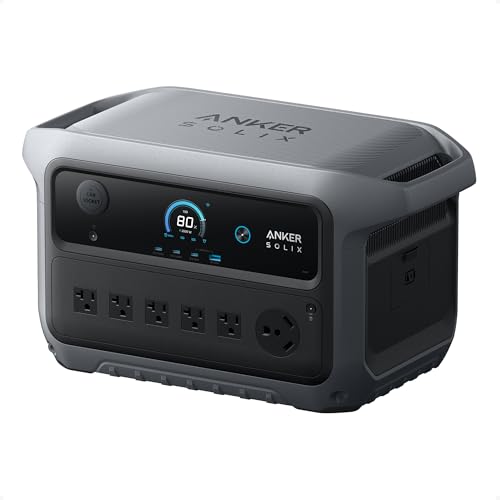
Anker SOLIX C2000 Gen 2 portable power station
This is a niche item for road-trippers, field work, extended outages, or family travel where refrigeration or device charging matters. Based on specs and reviews, the 2,048Wh and 2,400W figures put it in serious portable-power territory.
The drawback is severe for most new owners: $999.99 is far beyond the first-year essentials budget, and the unit is large. For ordinary commuting and emergency preparedness, that money covers many higher-priority ownership costs first.
Driver-segment add-ons that make sense
- New owners: document organizer, pressure gauge, flashlight, printed roadside details.
- Commuters: jump starter, dash cam, backup charging cable, spare work gloves.
- Parents: first aid kit with child-specific basics, wipes, water, seasonal spare layers.
- Road-trippers: better compressor, paper map, extra water, deeper first aid kit.
- Cold-weather drivers: scraper, warm gloves, traction aid where local conditions justify it.
What to skip for now if money or cargo space is tight
Skip premium detailing sprays, seat-back organizers, novelty multi-tools, decorative cabin accessories, and oversized power gear unless the car’s use case clearly supports them. The first-year goal is resilience, not a packed trunk.
The prioritized checklist and storage map
Four tiers: must have, should have, nice to have, skip for now
| Tier | Items | Why this tier | Ongoing cost or review |
|---|---|---|---|
| Must have | Insurance proof, registration certificate, emergency contacts, owner’s manual, roadside cover details, jump solution, warning triangle, high-visibility vest, flashlight, first aid kit, inflated spare tire or inflation plan, car jack, lug tools, tire pressure gauge | Directly reduces fines, stranding risk, and unsafe roadside stops | Review monthly; recharge packs; confirm paperwork dates; check spare pressure |
| Should have | Washer fluid, gloves, paper towels, fuses, bulbs where applicable, tire sealant if compatible, phone charger, small cash reserve | Solves common minor failures and delays | Check seasonally; replace used or expired items |
| Nice to have | Dash cam, better compressor, umbrella, water, snacks, winter scraper, family travel extras | Useful in specific driving patterns, but not first-priority spend | Review before trips and at season changes |
| Skip for now | Decorative accessories, duplicate gadgets, premium detailing kits, oversized power gear without a clear need | Takes money and cargo space from higher-risk needs | Buy later only if an actual use appears |
Storage map: glove box, trunk, door pocket, center console
| Location | Keep here | Avoid here |
|---|---|---|
| Glove box | Insurance proof, registration certificate, roadside card, emergency contacts, owner’s manual, pen, small document sleeve | Original title, loose coins mixed with paperwork, leaking liquids |
| Trunk or cargo floor | Jump starter or leads, warning triangle, high-visibility vest, first aid kit, flashlight, spare or inflator, jack, lug wrench, lock key, gloves, washer fluid refill | Unsecured heavy tools, loose bottles, anything that can slide into a spare well latch |
| Door pocket | Thin tissues, parking receipts, maybe a compact vest if local rules require fast access | Metal tools, aerosol cans, hard objects that rattle or become projectiles |
| Center console | Phone cable, small cash reserve, pen, charging adapter, flashlight only if it fits securely | Sharp tools, bulky kits, spare parts that get buried |
Failure-mode check: flat spare, dead jump pack, missing lock key, dead phone
Run this check before assuming the kit is complete. Is the spare inflated. Is the jump pack charged. Is the wheel-lock key in the car. Is the tire sealant expired. Does the roadside card include a phone number. Can help be reached if the mobile battery dies.
That five-minute review catches the gaps most people miss.
What do I need for car ownership beyond the purchase price?
Beyond the purchase price, car ownership means paying for the full total cost of ownership. TCO is a financial estimate for direct and indirect ownership costs, and TCO includes costs beyond the purchase price of a product. For a car, that means insurance, fuel, servicing, registration, tires, repairs, depreciation, and replacement items.
Total cost of ownership in plain terms
A TCO analysis includes acquisition and operating costs. TCO also includes replacement or upgrade costs at end of life. For car owners, that breaks down into acquisition cost, operating costs, maintenance and repair, and later replacement or upgrade spending.
- Acquisition cost: purchase price, taxes, initial registration, immediate catch-up maintenance after buying used.
- Operating costs: fuel, insurance, parking, tolls, routine washes if corrosion control matters locally.
- Maintenance and repair: servicing, tires, brakes, batteries, fluids, wipers, fault diagnosis, recovery gaps.
- Replacement or upgrade costs: end-of-life tires, battery packs for accessories, eventual replacement vehicle decisions, feature upgrades only if justified.
- Depreciation: the value the car loses while owned, even if no money changes hands that month.
The budget categories that catch new owners first
Insurance and fuel are the obvious ones. The less obvious traps are registration renewals, tire replacement, battery failure, and deferred maintenance on a used car bought cheaply. That is why the monthly buffer belongs in the essentials system, not as an afterthought.
One tip is to set up insurance before driving. The new car owner article has 15 tips, but this one belongs near the top because driving uninsured turns a normal ownership mistake into a legal and financial problem quickly.
How to turn irregular car bills into a monthly sinking fund
Split costs into monthly and irregular buckets. Pay the monthly bucket first: fuel, insurance, parking, loan if any. Then feed the irregular bucket every month for servicing, registration, tires, repairs, and accessory replacement.
For budget-conscious owners, the simplest rule is to keep the first buffer small but real. The opening recommendation still holds: one tank of fuel plus 20% as a starting reserve.
Budget setups
Bare-minimum setup for a new owner on a tight budget
Cover legal paperwork, a basic roadside kit, a tire-pressure routine, and a small repair buffer first. If money is tight, buy the starter emergency kit and document organizer before stepping up to better inflators or convenience tech.
Balanced setup for daily commuters
Commuters benefit from a better jump solution and clearer evidence after incidents. More mileage means more exposure to battery trouble, punctures, and parking knocks, so the budget should account for earlier wear-item replacement too.
Higher-mileage or family-car setup with more roadside risk
Higher-mileage drivers should expect faster consumption of tires, wipers, and battery life. Families also carry more people and more schedule risk, so breakdown cover and a stronger tire-inflation plan move up the priority order.
Review schedule: monthly, seasonal, and before long trips
| Setup | Recommended product mix | Known product prices | Who it suits |
|---|---|---|---|
| Starter | LIANXIN roadside kit | $39.99 | First-time owners and very tight budgets |
| Mid | Clore jump starter + LIANXIN roadside kit | $126.02 + $39.99 | Daily drivers who want stronger self-recovery options |
| Serious | Clore jump starter + VIAIR compressor + VIOFO dash cam | $126.02 + $240.20 + $170.99 | Higher-mileage commuters, road-trippers, multi-driver households |
Review paperwork and jump-pack charge monthly. Check spare pressure, tire tread, and fluid levels seasonally. Before long trips, repeat the whole failure-mode check and confirm roadside cover terms.
When a Basic OBD2 Scanner Hits Its Limits
While a standard OBD2 code reader catches generic check-engine lights, serious DIY maintenance often requires deeper diagnostic data. If you drive late-model vehicles and want actionable live-streams rather than just passive error codes, the BlueDriver OBD2 scanner verdict highlights where entry-level tools stop being enough.
For owners managing one or two modern cars, understanding the difference between a $100 specialized tool and cheap universal readers prevents costly shop visits. The supporting analysis details specific performance gaps, helping you determine if your car actually needs advanced compatibility or if a basic unit suffices.
Frequently asked questions
what documents should a car owner carry
A car owner should carry current registration and proof of insurance in the car, ideally in the glove box, plus roadside-assistance details and emergency contacts. The driver should keep their license on them. Leave the original title and most financial paperwork at home to reduce theft risk.
what car emergency items are worth keeping in the trunk
The trunk should hold the gear that solves real roadside failures: jump leads or a jump starter, a warning triangle, a high-visibility vest, a flashlight, a first aid kit, and tire tools. Add an inflated spare tire and car jack if the vehicle has them, or an inflator and compatible sealant plan if it does not.
how do i budget for ongoing car ownership costs
Budget by separating monthly costs from irregular ones. Monthly costs usually include insurance and fuel. Irregular costs include servicing, registration, tires, repairs, and replacement items. Feed a sinking fund every month so annual renewals and surprise repairs do not land all at once.
what basic maintenance does a new car owner need to track
A new owner should track oil level, coolant and other owner-checkable fluids, tire pressure, tread depth, rotation, balancing, battery health, wiper condition, and seasonal checks. The owner’s manual should drive the schedule, because service intervals, warning lights, and fluid specs vary by vehicle.
what essentials do you need in your car
The essentials are the items that cover legal compliance, breakdown risk, and basic maintenance reference. That means registration and insurance proof, roadside contact details, the owner’s manual, a jump solution, warning triangle, high-visibility vest, flashlight, first aid kit, and a workable tire plan.
Products related to this article
Sponsored / affiliate links. As an Amazon Associate I earn from qualifying purchases. I may earn additional commission from eligible campaigns.