The Intersection of Adventure and Automotive Lifestyle
A vehicle is adventure-ready if its range, clearance, payload, tires, and recovery plan fit the route with a meaningful buffer left. Miss that, and you risk getting stranded, damaging parts, or paying for gear that looks capable but fails off-road. This guide shows how to judge real trail, road-trip, EV, hybrid, and overland readiness before you buy or pack.
What makes a vehicle adventure-ready?



Adventure-ready vehicles need off-road capability, real cargo space, and mechanical reliability. That means the right traction, enough ground clearance, useful drivetrain modes, and a body that can carry gear without turning every trip into a packaging problem.
Traction, ground clearance, and drivetrain modes
Traction starts with tires and drivetrain logic, not badging. Ground clearance matters for rocks, ruts, snow, and washouts, but F2 is the hard boundary here: ground clearance and aggressive styling alone are not enough for adventure use. A vehicle also needs useful drive modes, stable low-speed control, and approach and departure angles that fit the terrain.
For dirt roads and mild trails, all-wheel drive with proper tires may be enough. For steeper climbs, loose rock, mud, or sand, you want a system with good torque transfer, low range if the route calls for it, and enough underbody protection to handle a mistake.
Cargo space, seat folding, and gear access
Cargo space is not a brochure number. Usable volume depends on interior shape, seat-folding flexibility, wheel-well intrusion, and how easily long or awkward items can be loaded. Roof and hitch storage matter too, but only if the vehicle accepts them without hurting access, balance, or visibility.
Say your weekend kit includes two sleeping pads, a cooler, a stove, wet boots, and a dog crate. A tall cargo area with flat-folding seats may work better than a larger but oddly shaped trunk that forces you to stack everything above the window line.
Range, reliability, and repairability
Long-trip readiness also means the vehicle can go far enough, be serviced easily enough, and fail rarely enough to matter. Parts availability, known weak points, and the ability to inspect or repair common issues are part of the purchase decision, especially once the route leaves dense metro areas.
Range is more than tank size or battery capacity. In practice, it can vary with weather, payload, elevation, road speed, and detours. A route plan that ignores those factors can turn a capable vehicle into a roadside problem.
Is an SUV always the right choice for adventure travel?
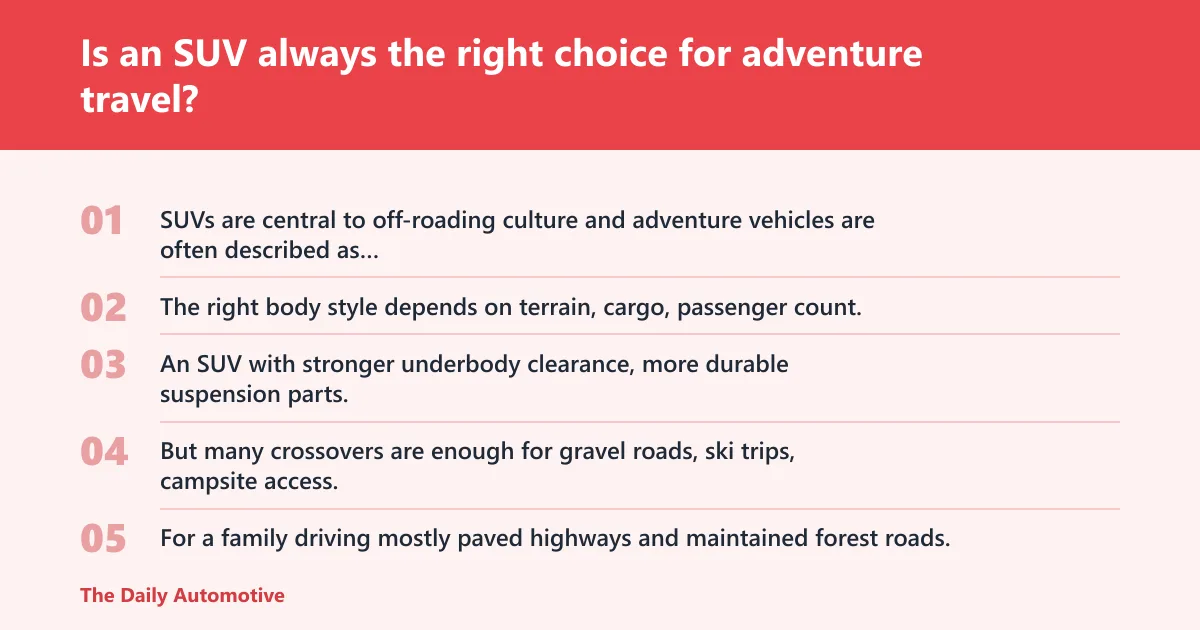
No. SUVs are central to off-roading culture and adventure vehicles are often described as having all-terrain capabilities and rugged design, but an SUV is not automatically better than a crossover. The right body style depends on terrain, cargo, passenger count, and how far help sits from the route.
SUVs versus crossovers for dirt roads and family trips
An SUV with stronger underbody clearance, more durable suspension parts, and better drivetrain options can make sense on tougher routes. But many crossovers are enough for gravel roads, ski trips, campsite access, and family travel where comfort and fuel economy matter more than trail hardware.
For a family driving mostly paved highways and maintained forest roads, a crossover with good tires and sensible packing may be the better ownership choice. It usually asks less from fuel budgets and tires, and often returns easier road manners on long runs.
When a truck makes more sense
A truck fits when gear is bulky, dirty, or heavy. Bikes, firewood, tools, coolers, recovery boards, and rooftop tent systems often make more sense in a bed than in a closed cabin. Trucks also help when you need recovery gear, accessory mounting, or dedicated cargo separation.
The tradeoff is obvious: ride quality, fuel use, and parking can worsen. If the route is mostly highway with a few trailheads, a truck may be more than you need. If the route includes repeated hauling or rough access roads, the bed can be the deciding factor.
When a wagon or crossover is enough
A wagon or crossover can be enough when the trip is road-biased, gear volumes stay moderate, and the route never asks for serious clearance or recovery hardware. These vehicles often provide easier loading, lower costs, and better efficiency than heavier off-road oriented choices.
That is the point of a capability-first decision. Choose the least aggressive vehicle that still clears the route with room to spare.

What makes a car good for adventure and lifestyle use?
A good adventure vehicle matches the trip, not the image. The right one balances traction, cargo flexibility, range, repairability, and mounting options so the trip stays safe and practical. F1 is the baseline: off-road capability, real cargo space, and mechanical reliability are the core requirements.
What counts as real capability
Real capability includes usable tires, underbody protection, tow points, spare tire access, and recovery provisions. Styling cues can suggest intent, but F2 and F3 draw the line clearly: clearance and aggressive styling alone are not enough, and a vehicle without recovery gear can turn an adventure trip into a rescue call.
What counts as lifestyle fit
Lifestyle fit means the vehicle also works on Monday. That includes seating comfort, noise control, easy loading, child-seat access, and enough range or fuel economy to avoid making every commute expensive. A vehicle can be trail-capable and still be a poor daily driver if it is too loud, too cramped, or too thirsty.
What features matter most for road trips and off-road camping?
Road trips and camping reward range, comfort, cargo layout, and weather tolerance. Off-road camping adds clearance, traction, recovery points, and underbody protection. The best setup is the one that reaches camp, carries sleeping and cooking gear, and still has a margin for detours or bad weather.
Road trip planning
Road trip planning starts with fuel stops, charging access, passenger comfort, and route flexibility. If the route crosses sparse stations or limited chargers, you need more range buffer. If passengers are spending long hours inside, seat support, climate control, and cabin noise matter nearly as much as storage.
Early motoring expanded leisure and travel for family vacations and outdoor access, and that pattern still shows up in modern trip planning. The vehicle should make the destination easier to reach, not create a second project along the way.
Recovery gear and trail safety
Recovery gear is not for looks. Basic trail extraction tools can keep a stuck vehicle from becoming a rescue call. Depending on terrain, that may include a jack, traction aids, tow points, and a way to handle soft ground or limited traction without damaging the vehicle.
A common first-timer mistake is buying an SUV with off-road styling, then assuming the badging equals trail safety. It does not. The route decides the equipment, and the equipment decides whether a detour becomes a tow.
How do I separate adventure styling from real capability?
Start with hardware, not trim names. Real capability comes from tires, clearance, protection, recovery points, and mounting options. Adventure styling can help resale or personal taste, but it does nothing if the vehicle bottoms out, lacks tow points, or cannot carry the gear securely.
Tires, clearance, and underbody protection
All-terrain tires often matter more than cosmetic trim. They can improve grip on dirt, gravel, mud, and snow, while also changing ride, noise, and tread wear. Underbody protection matters if the route includes rocks, ruts, or hidden debris that can strike the oil pan, fuel system, or battery pack.
Tow points, spare tires, and recovery gear
Tow points should be real attachment points, not styling hooks. Spare tire access also matters, especially if the route includes sharp rock or debris. A vehicle that hides the spare, limits jack access, or lacks a clear recovery plan is less ready than it looks.
Roof rails, hitch mounts, and accessory fit
Roof rails and hitch mounts expand carrying options, but only if the vehicle can support the load and the accessory fits without blocking lights, cameras, or tailgate access. This matters for roof boxes, bike racks, cargo trays, and spare tire carriers. Accessory mounting is part of the buying decision, not an afterthought.
Use this capability checklist before you buy

Score each vehicle against the trip you actually plan to take. Pass or fail should be based on whether the vehicle has enough margin for cargo, clearance, traction, range, recovery, and mounting options. A route with dirt access and one overnight stop has different needs from a weeklong remote trip.
| Capability | Trail day | Weekend camping | Overlanding | Daily driving |
|---|---|---|---|---|
| Cargo volume | Pass if day gear fits inside with seats up | Pass if sleeping and cooking gear fits with a usable rear load floor | Pass if water, food, recovery, and sleep systems fit without blocking access | Pass if commuter gear does not force constant roof use |
| Clearance | Pass if road ruts and trailheads are manageable | Pass if campsite access does not require careful spotting | Pass if the route’s roughest sections clear with margin | Pass if clearance does not ruin step-in height or parking ease |
| Drivetrain | Pass if traction controls and tires handle loose surfaces | Pass if wet grass, gravel, and steep entrances are covered | Pass if terrain and weather include traction loss with recovery options | Pass if efficiency and traction are balanced for regular use |
| Range | Pass if a day loop leaves buffer for detours | Pass if fuel or charging stops match the route map | Pass if remote segments still leave at least 20% margin | Pass if commute cost and refill timing stay practical |
| Reliability | Pass if failure risk is low enough for one-day use | Pass if service gaps will not affect a short trip | Pass if parts and known service points are available along the route | Pass if maintenance burden stays acceptable year-round |
| Recovery provisions | Pass if basic tow and extraction points exist | Pass if you can self-extract from soft ground | Pass if the plan includes real recovery gear | Pass if added gear does not make daily use cumbersome |
| Accessory mounting | Pass if racks or hitch carriers fit light gear | Pass if roof or hitch storage can hold overflow | Pass if tents, spare tire carriers, or storage systems mount securely | Pass if mounts do not block access or visibility |
Scoring by trip type
Trail day: prioritize traction, clearance, and recovery. Weekend camping: prioritize cargo shape, roof or hitch storage, and moderate range. Overlanding: prioritize serviceability, fuel or charging access, strong mounting options, and a bigger safety margin. Daily use: prioritize comfort, cost, and maintenance burden.
- List the trip type, terrain, and distance.
- Check cargo shape before checking raw volume.
- Confirm clearance, tires, and drivetrain fit the roughest section.
- Map fuel stops or chargers and add buffer.
- Verify recovery gear, tow points, and spare tire access.
- Estimate tire, fuel, maintenance, and accessory costs before buying.
How much cargo space do you need for outdoor trips?
You need enough space for the trip without stacking loose gear to the roofline or blocking access to essentials. The right answer depends on whether you are packing for one person, a couple, or a family, and whether you need room for sleeping systems, coolers, or wet recovery gear.
Day trips versus weekend camping
Day trips can fit in a smaller cargo area if the vehicle has sensible access and folding seats. Weekend camping usually needs more room for sleeping gear, food, water, chairs, and weather layers. The shape of the opening matters because bulky items are harder to load through a narrow hatch.
Solo packing versus family packing
Solo travelers can usually trade volume for organization. Families need separate bags, child gear, snacks, and often more climate and comfort equipment. That pushes the choice toward vehicles with better interior packaging, not merely a larger number on a spec sheet.
Roof boxes, hitch carriers, and cargo organization
Roof boxes help with light, bulky items. Hitch carriers help with dirty or oversized gear. Both reduce interior crowding, but they add drag, weight, and complexity. The vehicle should support these accessories without making the rear hatch unusable or putting too much weight too high.
Can an electric vehicle work for adventure travel?
Yes, but only when the trip matches the charging map and range buffer. F9 is the key idea: eco-friendly adventure travel can include road trips in electric or hybrid cars. EVs work best when routes have predictable charging access, moderate distances, and conditions that do not wreck range planning.
Range planning and charging access
EV adventure use depends on charger availability, time at the charger, and how much range the route consumes after speed, weather, and load are factored in. Remote routes with sparse infrastructure can become poor fits quickly. Charging access is part of the terrain.
Cold weather, elevation, and load effects
Cold weather, higher elevations, and heavier payloads all reduce usable range. That matters on mountain passes and in winter travel. A route that works in summer may fail in January unless you build in much more charging margin.
Where EVs fit best and where they do not
EVs fit best on regional road trips, campsite runs near charging, and adventure travel where the path is predictable. They fit poorly when the route is remote, the day is long, and backup charging is uncertain. In those cases, a hybrid or efficient gas vehicle is often the simpler choice.
Hybrids as a middle ground
Hybrids reduce fuel stops and range anxiety without giving up long-distance flexibility. They suit mixed-use ownership well, especially when adventure travel is occasional and commuting is frequent. That balance can matter more than peak trail image.
What reliability factors matter on long trips?
Long-trip reliability comes down to service access, wear management, and failure risk. A vehicle with known weak points, hard-to-find parts, or awkward maintenance needs can turn into a problem before the route ends. Remote travel punishes uncertainty.
Maintenance burden and service network access
Look at how often the vehicle needs service, how specialized the parts are, and whether basic work can be done away from a dealer network. If service points are sparse along the route, a simpler drivetrain and common consumables may be the safer choice.
Tire wear, brakes, and suspension load
Adventure travel loads tires, brakes, and suspension harder than commuting does. Heavier accessories raise wear and can expose weak components sooner. If the route includes gravel, washboard roads, or repeated mountain descents, maintenance costs climb along with stress on the chassis.
Reducing failure risk before remote travel
Check tire age, spare condition, fluid service, battery health, and suspension wear before you leave. Carry the recovery gear the route actually requires. F3 is blunt for a reason: a vehicle without recovery gear can turn an adventure trip into a rescue call.
Cost matters too. Off-road tires wear differently from street tires. Roof racks, hitch carriers, recovery boards, and extra storage systems all add expense. Fuel, charging, and maintenance should be part of the ownership math before you chase a trim package that only looks ready.
Frequently asked questions
What makes a car good for adventure and lifestyle use?
A good adventure vehicle combines traction, cargo flexibility, range, reliability, and recovery capability. F1 captures the core: off-road capability, real cargo space, and mechanical reliability. If one of those is missing, the vehicle may look ready while failing on the route or becoming too hard to live with every day.
Is an SUV always better for adventure travel than a crossover?
No. An SUV can be better when the route is rough, heavy cargo is involved, or recovery hardware matters. But many crossovers are enough for dirt roads, family road trips, and moderate camping. The better choice is the one that matches clearance, drivetrain, and packing needs without extra cost or weight.
What features matter most for road trips and off-road camping?
For road trips, focus on range, passenger comfort, and cargo access. For off-road camping, focus on clearance, tires, drivetrain modes, and recovery gear. Road trips punish fatigue and bad planning; camping punishes poor access, weak cargo packaging, and lack of trail safety hardware.
How do I choose a vehicle for overlanding and daily driving?
Start with the route and the commute. Overlanding asks for serviceability, fuel or charging access, recovery gear, and useful mounting points. Daily driving asks for comfort, manageable costs, and easy parking. If one vehicle has to do both, choose the mildest platform that still clears the hardest planned route.
What is the difference between adventure styling and real capability?
Adventure styling is visual: cladding, badges, roof trim, and dark accents. Real capability is mechanical: tires, clearance, underbody protection, recovery points, and drivetrain behavior. F2 is the cleanest test here. If the styling is there but the hardware is not, the vehicle is dressed for the role, not built for it.
Can an electric vehicle work for adventure travel?
Yes, if the route has enough charging access and the distance leaves a healthy buffer. EVs work best for predictable trips near infrastructure. They are a poor fit for remote travel when weather, elevation, or loading can shrink range below safe limits. Hybrids often fit more routes with less planning stress.
Products related to this article
Sponsored / affiliate links. As an Amazon Associate I earn from qualifying purchases. I may earn additional commission from eligible campaigns.