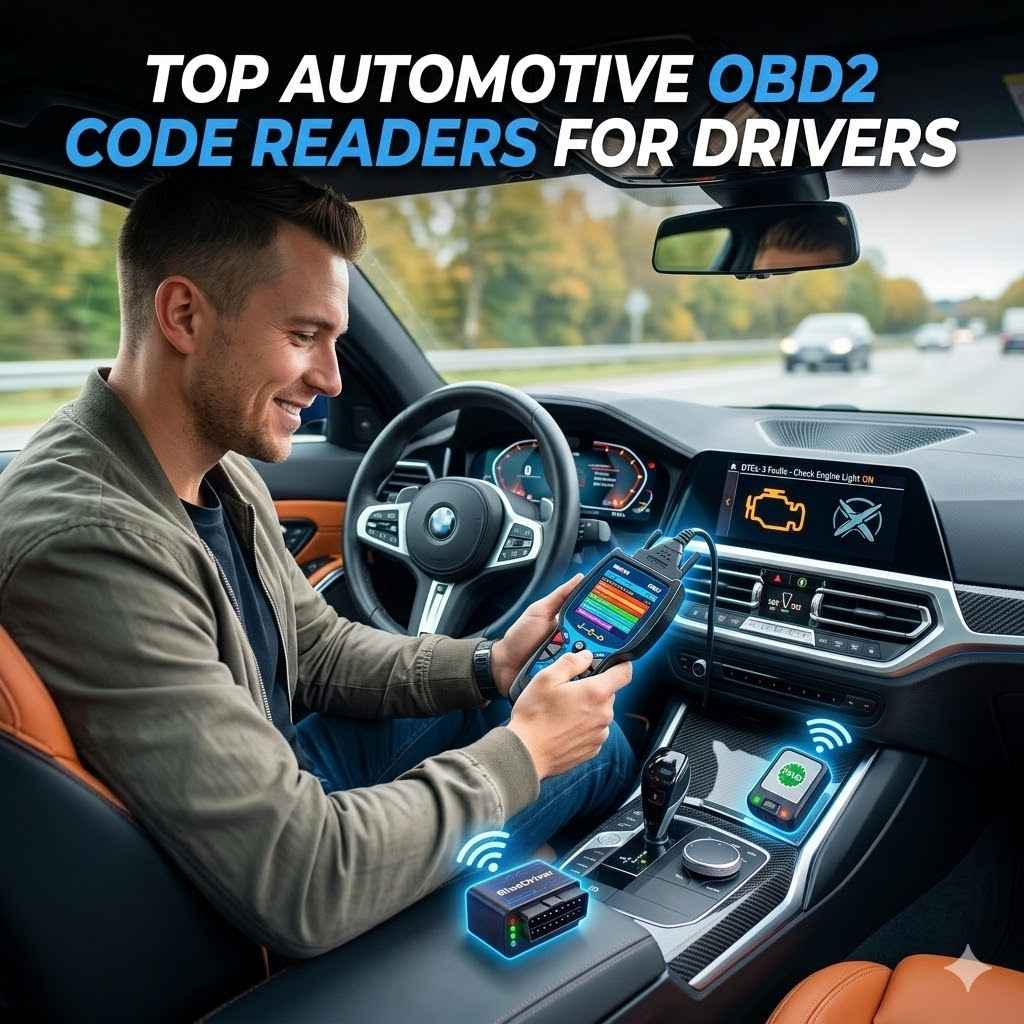
Top Automotive OBD2 Code Readers For Drivers
Figuring out why your car’s check engine light is on can seem tricky. Many drivers wonder about the Best Automotive OBD2 Code Readers for Drivers because the choices feel overwhelming. What do all those codes mean?
Don’t worry, this guide will make it simple. We’ll walk through everything you need to know step-by-step. Get ready to understand your car better!
What Are OBD2 Code Readers
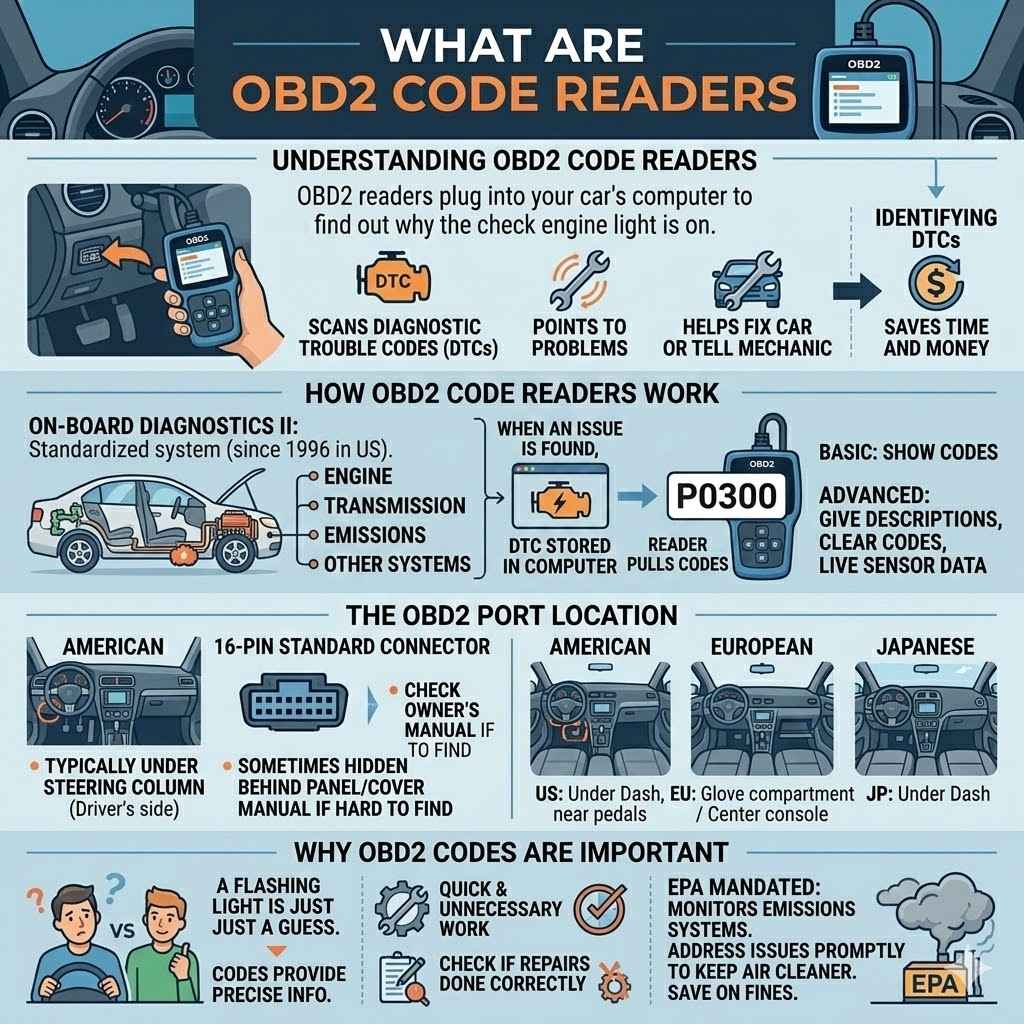
OBD2 code readers are handy tools that plug into your car’s computer. They help you find out why the check engine light is on. Think of it as a way to talk to your car and get its messages.
These readers scan for diagnostic trouble codes (DTCs). These codes point to specific problems. Knowing these codes helps you fix your car or tell a mechanic exactly what’s wrong.
This saves you time and money.
How OBD2 Code Readers Work
OBD2 stands for On-Board Diagnostics II. It’s a system built into cars and light trucks sold in the United States since 1996. The system monitors many parts of your vehicle.
It checks the engine, transmission, and other systems. When it finds an issue, it stores a DTC. The OBD2 port is usually found under the dashboard on the driver’s side.
The reader plugs into this port. It then pulls the codes from the car’s computer. Some readers just show the code, while others give a description.
More advanced ones can also clear codes or show live data from your car’s sensors.
The OBD2 Port Location
Finding the OBD2 port is usually straightforward. It’s typically located under the steering column on the driver’s side. You might need to bend down a bit to see it.
Sometimes it’s hidden behind a small panel or cover. If you can’t find it, your car’s owner’s manual will show you exactly where it is. It’s a standard 16-pin connector.
This makes it easy for different readers to plug in.
For example, in many American cars, you’ll look under the dashboard, near the pedals. European cars might have it in the glove compartment or center console. Japanese cars often place it in a similar spot to American cars.
Knowing its location is the first step to using your code reader effectively.
Why Are OBD2 Codes Important
These codes are vital for car maintenance and repair. Without them, diagnosing a problem would be like guessing in the dark. A simple flashing check engine light could mean anything from a loose gas cap to a serious engine issue.
An OBD2 code reader gives you precise information. This allows for quick and accurate repairs. It also helps you avoid unnecessary work.
You can even use it to check if repairs were done correctly. It empowers you as a car owner.
The Environmental Protection Agency (EPA) mandated OBD2. It helps monitor emissions systems. This means that when your check engine light comes on, it often relates to emissions control.
Addressing these issues promptly not only saves you from potential fines but also helps keep the air cleaner. It’s a win-win situation for your wallet and the environment.
Choosing the Best Automotive OBD2 Code Readers for Drivers
Picking the right OBD2 code reader can seem tough with so many options. You want something easy to use and informative. The best ones help you understand what’s happening with your car without needing to be a mechanic.
We’ll explore the top choices that drivers like you find most helpful. We’ll look at features that matter most for everyday use.
Features to Look For
When searching for the Best Automotive OBD2 Code Readers for Drivers, certain features stand out. Ease of use is key. Many basic readers just display the code.
More advanced ones offer definitions of the codes right on the screen. This saves you from having to look them up online. Auto-scan functionality is also great.
It means the reader automatically detects your car’s make and model.
Some readers connect wirelessly to your smartphone via Bluetooth or Wi-Fi. This allows you to use an app for a more detailed analysis. These apps can often provide a wealth of information, including repair guides and estimated costs.
Live data streaming is another valuable feature. It lets you see real-time sensor readings, which is helpful for diagnosing intermittent problems. The ability to clear codes is also a must-have for many drivers.
Code Definitions
This feature is super helpful for beginners. Instead of just getting a cryptic code like P0300, the reader will tell you “Random/Multiple Cylinder Misfire Detected.” This immediate clarity makes troubleshooting much easier. It helps you understand the severity of the issue right away. Many readers provide these definitions directly on their screens. Others send them to a connected smartphone app. This saves you from searching through manuals or websites.
Live Data Stream
This lets you see what your car’s sensors are doing in real-time. For example, you can watch the engine’s RPMs, coolant temperature, and oxygen sensor readings. Mechanics use this to diagnose tricky problems. It can show if a sensor is giving faulty readings or if a system isn’t performing as expected. This feature is more common on higher-end scanners. It’s a powerful tool for anyone wanting to understand their car’s performance in detail.
ABS and Airbag Scan Capability
While most OBD2 readers focus on the engine, some can also scan other systems like the Anti-lock Braking System (ABS) and airbags. These systems have their own set of codes. If your ABS or airbag light is on, a reader with this capability can tell you why. This is a significant advantage over basic readers. It offers a more comprehensive diagnostic solution for your vehicle.
Freeze Frame Data
When a code is triggered, the car’s computer captures a “snapshot” of sensor data at that exact moment. This is called freeze frame data. It shows the engine conditions when the fault occurred. This information is invaluable for pinpointing the root cause of a problem, especially if it’s intermittent. It’s like getting a glimpse into the car’s memory right when something went wrong.
Popular OBD2 Code Reader Types
There are a few main types of OBD2 code readers available. The simplest are the basic code readers. They are inexpensive and easy to use.
They plug into the port and display DTCs and their definitions. Then there are handheld scan tools. These are more advanced and often have color screens, more powerful diagnostic functions, and sometimes even a built-in library of repair information.
They are typically more expensive than basic readers.
Wireless OBD2 adapters are also very popular. These small devices plug into the OBD2 port and connect to your smartphone or tablet via Bluetooth or Wi-Fi. You then use a mobile app to read codes, view live data, and perform other diagnostics.
This offers great flexibility and a more modern user experience. Many of these apps provide extensive databases of vehicle information and repair tips.
Basic Code Readers
These are the entry-level devices. They are perfect for drivers who just want to know what the check engine light means. They are usually very affordable. You plug them in, read the code, and often get a simple definition. They can also usually clear codes. For simple, common issues like a loose gas cap, they are all you need. They are compact and easy to store in your glove box.
Handheld Scan Tools
These are more substantial devices, often with their own screen and buttons. They offer more diagnostic power than basic readers. They can typically access more modules in your car, not just the engine. Some can perform active tests, which means they can command certain parts of your car to operate. This helps in diagnosing specific components. They are a good middle ground for enthusiasts or those who want more in-depth diagnostics.
Wireless OBD2 Adapters (Bluetooth/Wi-Fi)
These are tiny dongles that connect to your car’s OBD2 port. They then communicate wirelessly with your smartphone or tablet. You need to download a companion app. Apps like Torque Pro, OBD Fusion, or Car Scanner ELM OBD2 are popular choices. These apps turn your phone into a powerful diagnostic tool. They offer live data, graphing, code reading, and clearing, and sometimes even performance metrics. They are very versatile and often offer the best value for features.
Real-Life Examples of OBD2 Reader Use
Sarah’s car started sputtering one morning. The check engine light came on. She used her basic code reader and found code P0301, which meant a cylinder 1 misfire.
She knew this was a common issue and, after a quick online search, decided to try replacing the spark plug for cylinder 1. It was a simple fix, and the car ran smoothly again. She saved a trip to the mechanic.
Mark’s car had an intermittent stalling problem. It would happen randomly. His handheld scan tool showed live data.
He noticed that the engine temperature sensor reading would suddenly drop to a very low number just before the car stalled. This gave him a strong clue that the sensor itself was faulty. He
Another driver, David, had his ABS light come on. His basic reader couldn’t access ABS codes. He borrowed a friend’s more advanced scanner that could read ABS.
It showed a code indicating a faulty wheel speed sensor on the rear left wheel. Knowing this, David was able to tell his mechanic exactly what needed fixing. The repair was done quickly and efficiently.
Top Rated OBD2 Code Readers for Everyday Drivers
When you’re looking for the Best Automotive OBD2 Code Readers for Drivers, it helps to know which ones are consistently praised for their performance and ease of use. These readers balance advanced features with a user-friendly experience. They are perfect for car owners who want to take charge of their vehicle’s diagnostics.
We’ve picked out some top contenders that make understanding car problems much simpler.
Top Picks for Ease of Use
For drivers who prioritize simplicity, certain models excel. These readers often have intuitive interfaces and straightforward instructions. They might offer one-button scan functionality or a clear, easy-to-read display.
The goal is to get you the information you need quickly, without a steep learning curve.
Ancel AD310 Classic Enhanced Universal OBD II Scanner
This is a popular choice for its straightforward operation. It offers a clear LCD screen that displays DTCs and their definitions. It can read and clear engine codes. It also supports all OBDII protocols and works with most vehicles made after 1996. Its compact design makes it easy to store. It’s ideal for basic troubleshooting and for drivers who don’t need advanced features.
Autel AutoLink AL319 OBD2 Scanner
The Autel AL319 is another excellent option for beginners. It features a color display and provides clear code definitions. It also has a handy “I/M readiness” function. This checks if your car’s emission systems are ready for a smog test. It’s very easy to use with its hotkeys for entering and erasing DTCs. This tool offers a good balance of functionality and simplicity.
Best Value OBD2 Code Readers
Getting the most for your money is important. Some readers offer a great range of features at a very reasonable price. These are ideal for drivers who want more than just basic code reading but don’t want to break the bank.
Veepeak OBD II WiFi Adapter for iOS and Android Devices
This small adapter plugs into your OBD2 port and connects wirelessly to your smartphone. You’ll need a compatible app like OBD Fusion or Car Scanner. It’s incredibly versatile, offering live data, graph displays, and sensor monitoring. The initial cost is low, and you can choose from various app options to suit your needs. It’s a cost-effective way to get powerful diagnostic capabilities.
KingNeed NT200 OBD2 Code Reader
The KingNeed NT200 is a solid option for its price. It provides comprehensive OBDII functions, including reading and clearing codes, viewing freeze frame data, and I/M readiness status. It has a clear screen and simple button controls. It’s a reliable choice for everyday car owners who want dependable diagnostics without a high cost.
Advanced OBD2 Scanners for Enthusiasts
For those who love working on their cars or want deeper insights, advanced scanners are the way to go. These tools offer more capabilities, including the ability to access and diagnose other vehicle systems.
Autel MaxiCOM MK808BT Pro
This is a professional-grade diagnostic tool. It can perform extensive diagnostics on all available modules of your car, not just the engine. It supports a vast range of functions, including oil reset, EPB service, SAS calibration, and BMS reset. It has a user-friendly touchscreen interface and comes with software updates. While more expensive, it offers professional-level diagnostics for serious enthusiasts and DIY mechanics.
Launch X431 V+ Heavy Duty
While often marketed for heavy-duty vehicles, some versions of the Launch X431 series offer incredible capabilities for passenger cars as well. These scanners can perform advanced coding, programming, and bidirectional controls. They provide access to nearly every system in a modern vehicle. They are complex and have a higher price point, but offer unparalleled diagnostic depth for those who need it.
Comparison of Top Reader Types
To help you decide, here’s a quick comparison of the different types of readers:
| Reader Type | Pros | Cons | Best For |
|---|---|---|---|
| Basic Code Readers | Inexpensive, easy to use, portable | Limited features, only engine codes | Beginners, occasional use |
| Handheld Scan Tools | More features, often color screen, good balance | More expensive than basic, can be complex | DIY mechanics, enthusiasts |
| Wireless Adapters (Bluetooth/Wi-Fi) | Versatile, smartphone integration, good value | Requires smartphone/app, potential app costs | Tech-savvy users, those wanting app integration |
| Professional Scanners | Extensive features, all systems access, advanced functions | Expensive, complex, may require training | Professional mechanics, serious hobbyists |
Understanding and Using Your OBD2 Codes
Once you’ve used an OBD2 code reader, you’ll have a code or several codes. The next step is to understand what they mean and what to do next. This section will guide you through interpreting these codes and using them to your advantage.
Decoding Common OBD2 Trouble Codes
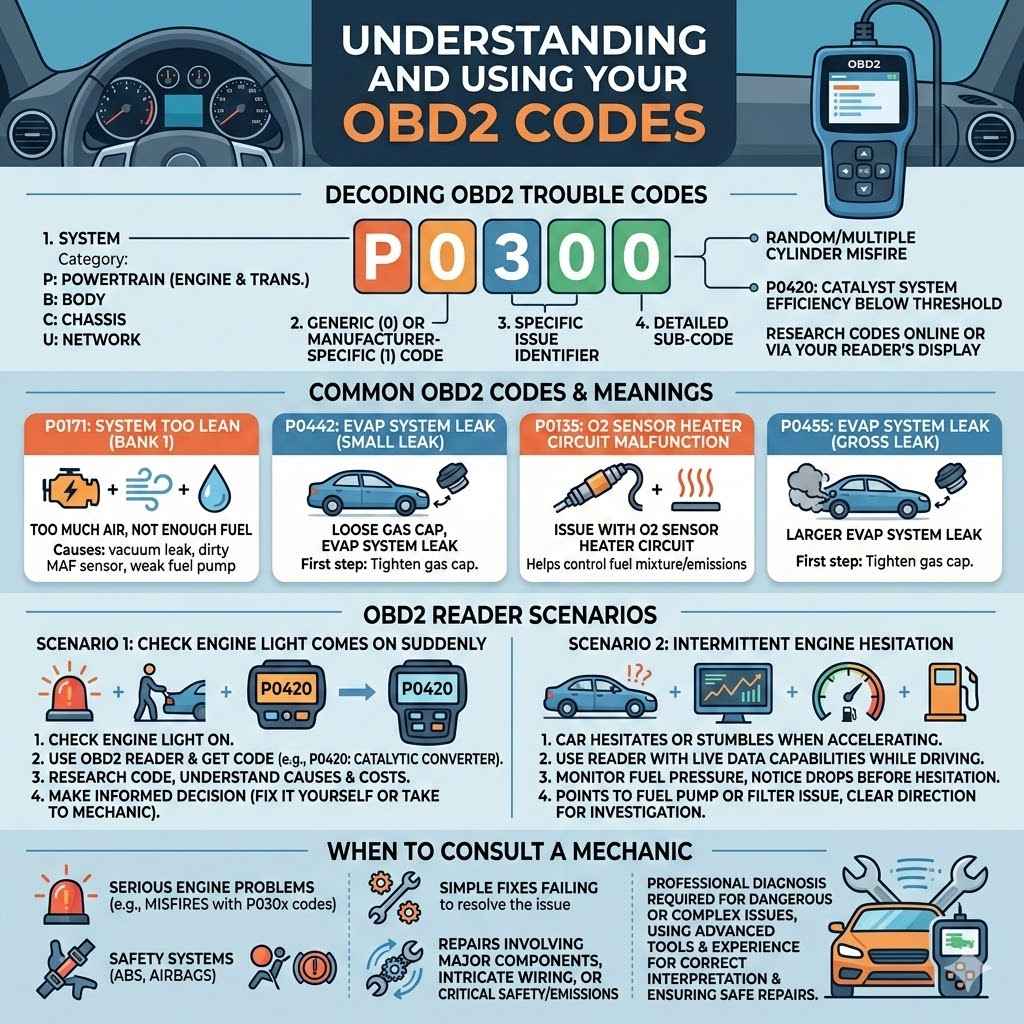
OBD2 codes follow a standard format. They begin with a letter, followed by four numbers. The first letter indicates the system.
‘P’ is for powertrain (engine and transmission), ‘B’ for body, ‘C’ for chassis, and ‘U’ for network communication. The first number after the letter tells you if it’s a generic (0) or manufacturer-specific (1) code.
The last two numbers are the specific issue. For example, P0300 means a random/multiple cylinder misfire. P0420 means Catalyst System Efficiency Below Threshold (Bank 1).
Understanding this basic structure helps you categorize the problem. Many online resources and the reader’s own display can provide detailed explanations for each code. Don’t be afraid to look them up.
Here are some common codes and their general meanings:
P0171 System Too Lean (Bank 1)
This code means there’s too much air or not enough fuel getting to the engine. It could be caused by a vacuum leak, a dirty mass airflow sensor, or a weak fuel pump.
P0442 Evaporative Emission System (EVAP) Leak Detected (Small Leak)
This often points to a loose gas cap, but could also mean a leak in the EVAP system. Checking and tightening your gas cap is the first step.
P0135 O2 Sensor Heater Circuit Malfunction (Bank 1 Sensor 1)
This code indicates an issue with the heater circuit for one of your oxygen sensors. Oxygen sensors help control the fuel mixture and emissions.
P0455 Evaporative Emission System (EVAP) Leak Detected (Gross Leak)
This is similar to P0442 but indicates a larger leak in the EVAP system. Again, a loose gas cap is a common culprit.
OBD2 Code Reader Scenarios
Let’s look at a couple of common scenarios to see how an OBD2 reader helps.
Scenario 1: Check Engine Light Comes On Suddenly
You’re driving, and the check engine light illuminates. You pull over, plug in your OBD2 reader, and it shows code P0420. This code means your catalytic converter might be failing. You can then research this code to understand the potential causes and costs. You’re now informed and can decide whether to fix it yourself or take it to a mechanic with specific knowledge of the issue.
Scenario 2: Intermittent Engine Hesitation
Your car sometimes hesitates or stumbles when accelerating, but the check engine light doesn’t stay on. You use a reader with live data capabilities. While driving, you watch the fuel pressure readings. You notice that the fuel pressure drops significantly just before the hesitation occurs. This points towards a potential issue with the fuel pump or fuel filter, giving you a clear direction for further investigation.
When to Consult a Mechanic
While OBD2 code readers are powerful tools, they aren’t always the final answer. Some issues are complex and require specialized tools or expertise. If you get a code that indicates a serious engine problem, like a misfire with a P030x code, or if the code suggests a problem with safety systems like ABS or airbags, it’s usually best to let a professional handle it.
Also, if you’ve tried a simple fix based on a code and the problem persists, it’s time to call in the experts.
Many mechanics also use more advanced diagnostic software that can perform bidirectional controls and deeper system tests. They have the experience to interpret codes correctly and understand how different systems in your car interact. If the repair involves major components, intricate wiring, or systems critical to safety or emissions, professional diagnosis is highly recommended.
It ensures the job is done right and safely.
Frequently Asked Questions
Question: How often should I use an OBD2 code reader?
Answer: You don’t need to use an OBD2 code reader regularly. It’s most useful when your car’s check engine light comes on or if you notice unusual performance issues. Keeping it handy in your glove box is a good idea for these situations.
Question: Can an OBD2 reader damage my car?
Answer: No, using a standard OBD2 code reader correctly will not damage your car. They are designed to communicate with your vehicle’s computer safely. Just ensure you’re using it according to the manufacturer’s instructions.
Question: Do all cars have an OBD2 port?
Answer: Cars and light trucks sold in the United States since 1996 are equipped with OBD2 systems. Most vehicles in other regions also follow similar standards, though there might be slight variations.
Question: Can I clear codes without fixing the problem?
Answer: Yes, you can clear codes without fixing the underlying issue. However, the check engine light will likely come back on after a short period as the problem still exists. It’s always best to address the cause of the code before clearing it.
Question: Are expensive OBD2 scanners always better?
Answer: Not necessarily. For most drivers, a moderately priced handheld scanner or a good wireless adapter with a capable app provides all the necessary features. Expensive scanners are typically for professional mechanics or serious car enthusiasts needing advanced functions like programming.
Summary
Choosing the Best Automotive OBD2 Code Readers for Drivers means finding a tool that fits your needs and skill level. From basic readers for simple checks to advanced scanners offering deep diagnostics, there’s an option for everyone. Understanding your car’s codes empowers you to make informed decisions about maintenance and repairs, saving you time and money.