
3 Best Jacks for Car (2026): We Compared
The best jack for most DIY car owners is a low-profile floor jack: it fits more sedans and lowered cars, lifts fast, and gives enough range for wheel service without fighting clearance. Pick the wrong style and you can miss the pinch weld, run out of travel, or buy a jack that will not fit under the car.
Quick comparison
| Product | Badge | Best for | Price | ||
|---|---|---|---|---|---|
 |
Yaciente 3 Ton Floor Jack, Heavy Duty Steel Car Jack withYaciente | Our pick | 3 ton · 5.3"–18" range · floor jack | $109.99
Price as of 25 Oct 2026
|
View |
 |
STANDTALL Electric Car Jack 3 Ton 12V Scissor Floor JackSTANDTALL | Also great | 3 ton · 5.5"–16.5" range · electric scissor | $50.34
Price as of 25 Oct 2026
|
View |
 |
1.5 Ton Car Scissor Jack,3.93"-13.18" Adjustable LowStacool | Budget pick | 1.5 ton · 3.93"–13.18" range · manual scissor | $19.49
Price as of 25 Oct 2026
|
View |
Fit comes first, not capacity. A jack that clears the lift point, reaches the needed height, and stores where you can keep it will beat a bigger number on the box.
For garage work on cars, a low-profile floor jack is the strongest default. For trucks, SUVs, and roadside storage, a bottle jack or scissor jack makes more sense depending on how much lift and speed you need.
📊 Vevor Pneumatic Jack has a stated weight rating of 6,000 lbs. Source: Caranddriver.
How we chose
Clearance came first: minimum saddle height has to fit under the vehicle’s lowest approved jacking point. If the jack starts too tall, you are done before the handle moves.
Lift range came next. Maximum lift height matters for tire clearance, for getting a stand under the vehicle, and for taller trucks and SUVs that need more travel than a compact car.
Capacity was treated as a margin question, not a winning score. A 2-ton, 2.5-ton, 3-ton, 3.5-ton, 4-ton, 6,000 lb, 7,000 lb, or 8,000 lb rating only helps if it fits the vehicle and the job.
Storage and use case also mattered. Roadside emergency gear belongs in the trunk; garage tools can be larger, slower, and heavier if they earn the space.
Comparison table
| Jack type | Typical fit | Clearance strength | Lift strength | Storage strength | Main limitation |
|---|---|---|---|---|---|
| Low-profile hydraulic floor jack | Sedans, coupes, lowered cars | Best for low saddle height | Strong for garage work | Bulky for trunk storage | Too large to keep in most cars |
| Bottle jack / all-in-one bottle jack | Trucks, SUVs, taller vehicles | Higher starting height | Strong vertical lift | Compact footprint | Less stable on some narrow contact points |
| Scissor jack | Emergency roadside use | Fits trunk storage well | Slow and limited | Best for compact carry | Poor for frequent maintenance |
Which jack fits your vehicle and use case?
This is the sizing shortcut most buyers need. Match the vehicle, the clearance, and the job first; then choose capacity, speed, and storage only after that.
Decision table
| Vehicle type | Minimum clearance needed | Ideal jack type | Recommended capacity range | Whether stands are required | Storage fit | Common failure mode to avoid |
|---|---|---|---|---|---|---|
| Lowered sedan or coupe | About 3 to 4 inches at the jacking point | Low-profile hydraulic floor jack | 2.5-ton to 3-ton | Yes, for any under-vehicle work | Garage storage, not trunk-first | Too-tall saddle height or pinchweld damage |
| Standard sedan | About 4 to 5 inches | Low-profile floor jack | 2-ton to 3-ton | Yes, if you will work under the car | Garage storage or small shop space | Buying for capacity alone and ignoring height |
| Crossover or light SUV | About 5 to 6 inches | Floor jack or bottle jack | 3-ton to 3.5-ton | Yes, for maintenance under the vehicle | Garage storage | Running out of lift before tire clearance |
| Truck or body-on-frame SUV | Higher starting point, often closer to 6 inches | Bottle jack or all-in-one bottle jack | 3-ton, 4-ton, 6,000 lb, 7,000 lb, or 8,000 lb | Yes, always for support work | Compact enough for cargo-area carry | Using a jack with too little lift or too narrow a base |
| Roadside spare-tire use only | Whatever fits the factory jacking point | Scissor jack | Match the vehicle’s manual requirement | Usually not needed if only changing a tire, but stand support is safer when possible | Best trunk fit | Slow cranking, unstable ground, or overreaching the lift |
Say your sedan sits low enough that the front lip is just over 4 inches off the ground. A 3-inch minimum saddle height matters more than an extra ton of capacity, because a jack that cannot get under the car solves nothing.
Suppose your pickup needs a tire rotation in a driveway and the axle sits high enough that a compact floor jack never gets close to the contact point. A bottle jack with a higher starting height makes the first lift easier, but jack stands still need to support the vehicle before anyone works underneath.
What size car jack do you need?
Use three measurements: the lowest jacking point, the lift height you need, and the vehicle’s weight margin. The jack must fit under the car first, then it must rise high enough to remove the wheel and place stands, and only then should capacity decide the final model.
Minimum saddle height determines whether the jack can slide under the car. Common ranges are about 3 to 6 inches, which is why lowered cars often need a low-profile floor jack.
Maximum lift height decides how much room is available for tire removal and stand placement. Common ranges are about 12 to 22 inches, which tends to matter more for trucks and SUVs than for sedans.
Capacity should leave margin over the vehicle mass, but not in a way that forces you into a jack that is too tall or too heavy to use. A 2-ton jack can suit lighter cars, while 3-ton and 3.5-ton models fit more home-garage use. Larger trucks can justify 4-ton, 6,000 lb, 7,000 lb, or 8,000 lb ratings.
Low-profile floor jack: best for sedans and lowered cars
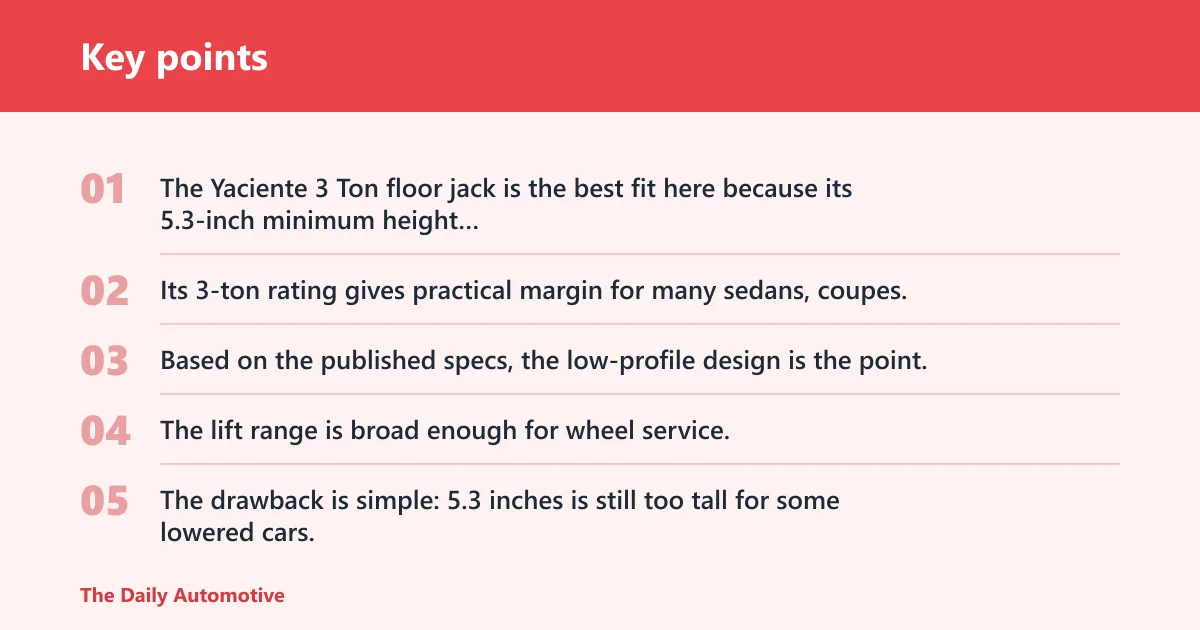
The Yaciente 3 Ton floor jack is the best fit here because its 5.3-inch minimum height and 18-inch lift range target garage work for cars that still have moderate clearance. Its 3-ton rating gives practical margin for many sedans, coupes, and compact performance cars without forcing a truck-sized tool into a small garage.
Based on the published specs, the low-profile design is the point. The lift range is broad enough for wheel service, and the single-piston rapid-lift setup is aimed at faster rises than a basic economy jack.
The drawback is simple: 5.3 inches is still too tall for some lowered cars. If the front jacking point sits closer to the pavement than that, this jack is the wrong first buy.
Minimum saddle height for low cars
Low cars are the hardest fit case because front lips, side skirts, and lowered suspension can leave little room for the saddle to enter cleanly. A low-profile floor jack is the right tool when the jack point sits close to the ground and the buyer wants a garage-ready tool instead of an emergency-only one.
Lift height and speed
An 18-inch max lift is useful because it gives enough room to remove a wheel and place stands without chasing the last inch of travel. A fast-lift pump design matters here, since it reduces the number of strokes needed compared with a slow, small-volume jack.
Why it is the garage pick
This type is best when speed, stability, and repeat use matter more than trunk storage. It is the one to buy when the car lives at home, the work happens on a hard level surface, and the jack will spend more time in the garage than in the cargo area.
Bottle jack: best for trucks and SUVs
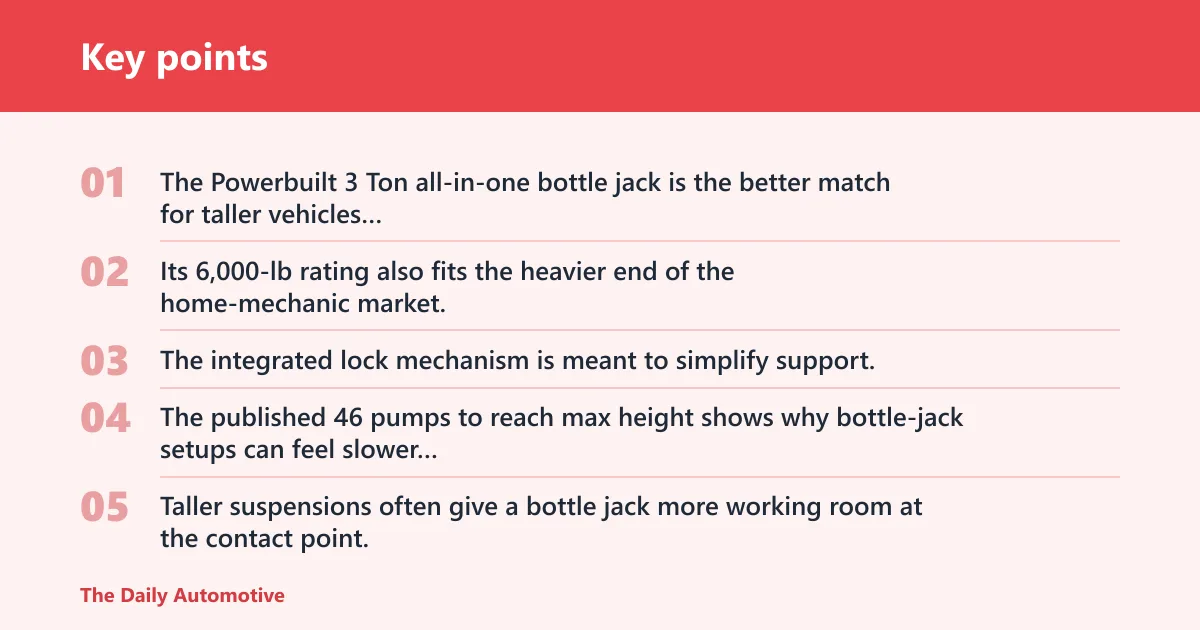
The Powerbuilt 3 Ton all-in-one bottle jack is the better match for taller vehicles because its compact footprint and 21-inch maximum lift suit trucks and SUVs better than a low floor jack that may run out of height. Its 6,000-lb rating also fits the heavier end of the home-mechanic market.
What stands out is the all-in-one approach. The integrated lock mechanism is meant to simplify support, but it does not replace the need to confirm the vehicle is stable and properly supported before work begins.
The drawback is speed and effort. The published 46 pumps to reach max height shows why bottle-jack setups can feel slower than a fast floor jack when the job involves repeated lifting.
Why trucks and SUVs suit a bottle jack
Taller suspensions often give a bottle jack more working room at the contact point. That higher starting height can be an advantage when a floor jack would need too much initial clearance to fit under the frame or axle point.
What the all-in-one feature does and does not do
An integrated lock or similar built-in support feature can help with convenience, but it does not change the need for safe setup. Jack stands remain the standard choice for under-vehicle work, especially when the job involves shaking the vehicle, removing suspension parts, or spending time underneath.
Capacity that makes sense here
More capacity is not automatically better if the jack becomes too tall, too slow, or too awkward to store.
Scissor jack: best for emergency trunk storage
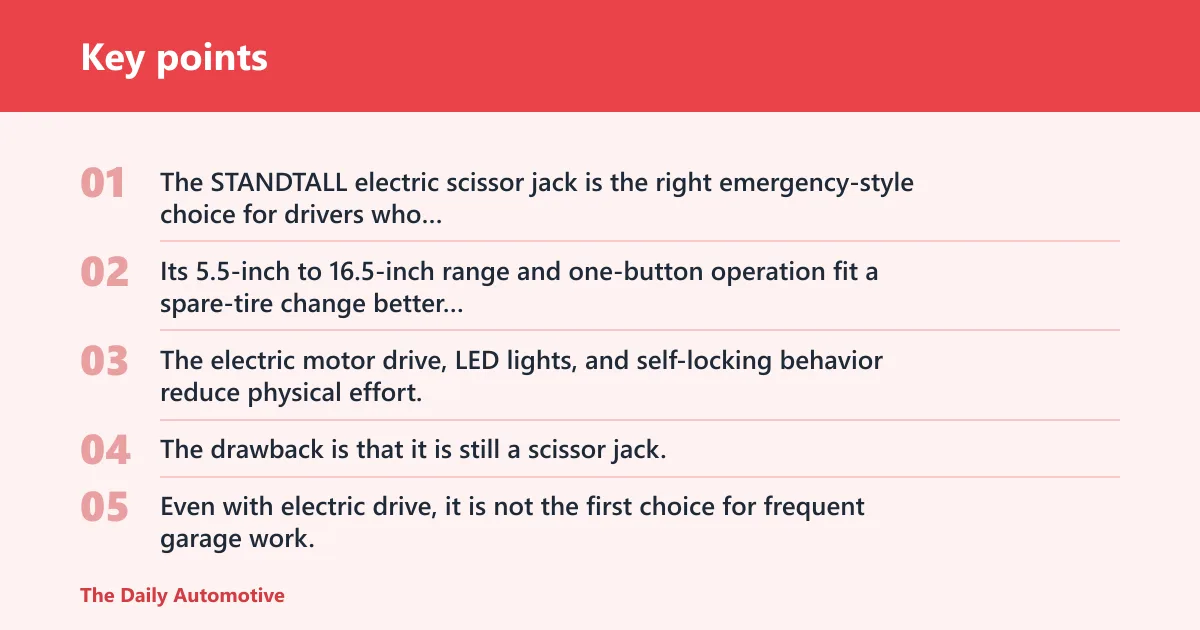
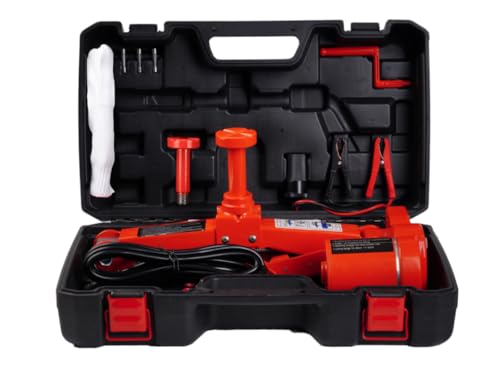
The STANDTALL electric scissor jack is the right emergency-style choice for drivers who want compact carry and low effort in a roadside kit. Its 5.5-inch to 16.5-inch range and one-button operation fit a spare-tire change better than regular shop maintenance.
What stands out is convenience. The electric motor drive, LED lights, and self-locking behavior reduce physical effort, which matters when the job is happening at the roadside and the goal is to get the tire changed quickly.
The drawback is that it is still a scissor jack. Even with electric drive, it is not the first choice for frequent garage work, and its range and comfort are still narrower than a floor jack designed for home maintenance.
Factory emergency use
Many vehicles still ship with a scissor jack because it stores neatly and handles one roadside task well: getting the tire off long enough to swap the spare. That is a very different job from repeated weekend maintenance in a driveway.
Manual versus electric operation
A manual scissor jack uses a crank handle and moves slowly, which gives precise control but costs time and effort. Electric versions reduce the cranking burden, but they are still emergency tools rather than full garage replacements.
When to keep one in the car
Keep a scissor jack in the car when trunk space matters more than speed. It is acceptable for rare tire changes and travel use, but it is the wrong tool if the plan is regular brake work, suspension work, or repeated tire rotations.
How do you use a car jack safely?
Start with the owner’s manual and the approved lift points. Place the jack only where the manufacturer specifies, work on a hard, level surface, and use jack stands before any under-vehicle work begins. Stability problems usually come from the setup, not the jack label.
A common first-timer mistake is rolling a jack onto soft asphalt or a sloped driveway. The jack can sink, tilt, or shift, and the vehicle can move enough to damage the saddle or the bodywork.
Another common failure mode is saddle slip. If the saddle is not centered on the jacking point, especially on pinchweld-style points, the load can shift and crush the metal edge or let the car move unexpectedly.
Suspension geometry matters too. Once the wheel is off the ground, the vehicle may sit at an angle that changes the load path. That is why stands must be set at the correct support point and at a rated height range that matches the lift.
Safe use checklist
- Park on a hard, level surface and set the parking brake.
- Check the owner’s manual for the approved jacking points.
- Position the jack so the saddle contacts the point squarely.
- Lift only until the tire clears the ground.
- Place jack stands before going under the vehicle.
- Lower the vehicle gently onto the stands and confirm stability.
Jack stands and support height
Jack stands are required for under-vehicle work because the jack is a lifting tool, not a long-term support. Choose stands with a rated height range that matches the jack’s lift height, and buy them separately unless the kit clearly includes two rated stands, as with the DNA Motoring 2 Ton kit.
The included stands in that kit matter because some buyers assume a jack alone is enough. It is not. A lift without support leaves the vehicle depending on a hydraulic or screw mechanism that can shift or lose pressure.
Which one should you buy?
Choose the low-profile floor jack if your car sits low and you do maintenance at home. It is the best balance of clearance, lift range, and speed for sedans, coupes, and lowered cars.
Choose the bottle jack if you drive a truck or SUV and want compact strength. It starts higher, stores smaller, and works well when the vehicle’s ride height gives the jack enough room to begin lifting.
Choose the scissor jack if you need a compact emergency tool for the trunk. It is the easiest to store, but it is slower, less comfortable, and not the first pick for regular garage work.
If you only look at capacity, you can still buy the wrong tool. A 4-ton jack that is too tall is worse than a 2.5-ton jack that actually fits the vehicle and reaches the lifting point cleanly.
Choose a low-profile floor jack if… / Choose a bottle jack if…
Choose a low-profile floor jack if your sedan, coupe, or lowered car needs a minimum saddle height around 3 to 6 inches; you want faster lifting; and the jack will live in the garage rather than the trunk.
Choose a bottle jack if your truck or SUV sits higher off the ground; you want a compact jack with a stronger vertical lift; and you can accept slower pumping in exchange for easier storage.
Choose a scissor jack if your main goal is roadside spare-tire use; trunk space is limited; and you need the smallest tool that still gets the wheel off the ground.
Frequently asked questions
What car jack should I buy?
Buy the jack that matches your vehicle first. A low-profile floor jack is best for most cars at home, a bottle jack is better for trucks and SUVs, and a scissor jack belongs in the trunk for emergencies. Capacity comes after fit, lift range, and storage.
Do cars come with jacks?
Many vehicles still include a scissor jack or a compact emergency kit, but not all do. Manufacturers often include only the minimum tool needed for a roadside tire change, not a garage-quality floor jack or a full set of stands. Check the spare-tire and roadside kit listing for your model.
How do I properly use a car jack?
Use the owner’s manual for the lift points, place the car on hard level ground, and lift only at the approved points. Raise the vehicle just enough for the job, then set jack stands before any work under the vehicle begins. The jack is for lifting, not for holding.
Which jack is best for a truck or SUV?
A bottle jack or all-in-one bottle jack is usually the best fit for trucks and SUVs because it starts higher and stores smaller than a floor jack. Look for enough lift height to reach the frame or axle point, and pick a capacity with margin over the vehicle’s mass.
Products related to this article
Sponsored / affiliate links. As an Amazon Associate I earn from qualifying purchases. I may earn additional commission from eligible campaigns.