Top-Rated Jump Starters for Reliable Car Battery Boosting
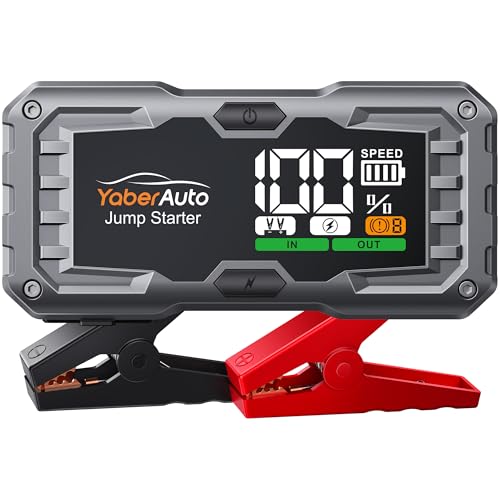
For most cars, a 1000- to 1500-peak-amp jump starter with 12V clamps is enough. V8s, diesels, and cold-weather drivers should look for about 1500 to 2000 peak amps and a higher cranking-amp rating, rather than relying only on the biggest label number. Pick wrong and you may get a unit that struggles in cold weather, won’t start a larger engine, or dies before it can hold a charge in the trunk. This guide compares top-rated options by sedan, SUV, truck, winter use, and storage space.
Top pick and quick picks
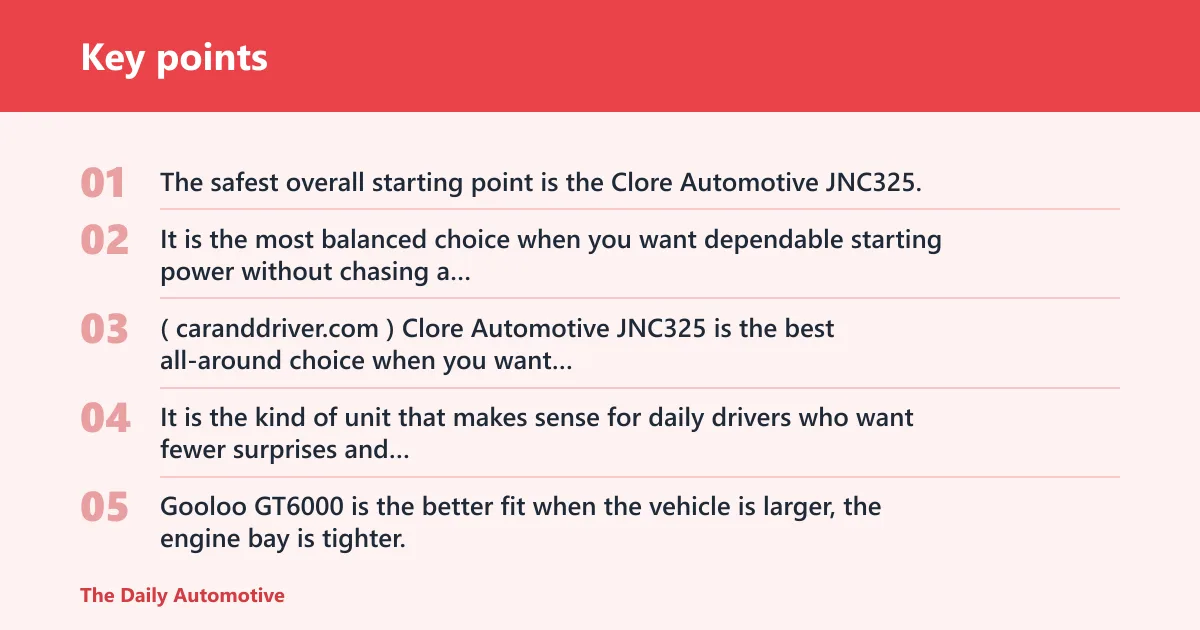


The safest overall starting point is the Clore Automotive JNC325, which Car and Driver named its best overall pick after testing several jump-starters on vehicles with dead batteries. It is the most balanced choice when you want dependable starting power without chasing a huge label number. (Caranddriver)
Quick picks
| Pick | Best for | Key spec or note | Why it fits |
|---|---|---|---|
| Clore Automotive JNC325 | Most drivers | Car and Driver best overall | Balanced sizing for everyday emergency use |
| Gooloo GT6000 | Large engines | Listed for large engines | Better match for bigger gas or diesel applications |
| Strauto Jump-Starter | Budget shoppers | Car and Driver budget pick | Lower-cost route to basic jump-start coverage |
| NOCO Boost Plus GB40 | Compact storage | Car and Driver most compact model | Fits small-storage needs and glovebox-style carry |
Best overall pick
Clore Automotive JNC325 is the best all-around choice when you want a straightforward emergency pack that is not oversized for a compact car yet still belongs in the conversation for real roadside use. It is the kind of unit that makes sense for daily drivers who want fewer surprises and less guesswork.
Best for trucks and SUVs
Gooloo GT6000 is the better fit when the vehicle is larger, the engine bay is tighter, or the engine itself needs more starting reserve. Consumer Tested Ratings ranked GOOLOO at 6000A peak power output, and the same source says it can start 12.0L diesel engines easily.
Best compact option
NOCO Boost Plus GB40 is the compact storage answer. The Consumer’s Guide says it is 1000A and fits in a glovebox, while Car and Driver named the NOCO Boost Plus GB40 its most compact model. That matters when your backup tool has to disappear into a door pocket or small cargo bin.
Best budget option
Strauto Jump-Starter is the budget-oriented pick from Car and Driver. It is the kind of option that fits a driver who wants basic emergency coverage without paying for every extra feature, as long as the vehicle and climate are not pushing the pack near its limits.
Jump starter decision table
This table turns vehicle type into a practical starting point. Use it to size the pack with headroom, not to shop at the edge of the label.
| Scenario | Minimum recommended peak amps | Battery type | Storage size | Safety features | Must-have extras |
|---|---|---|---|---|---|
| Compact sedan | 1000A | Lithium-ion | Glovebox or small door pocket | Spark-proof, reverse-polarity protection | USB-C input, flashlight |
| Midsize SUV | 1500A | Lithium-ion | Small cargo-bin case | Spark-proof, reverse-polarity protection, long clamps | USB-C input/output, flashlight |
| Half-ton truck | 2000A | Lead-acid or larger lithium-ion | Cargo-bin or under-seat storage | Spark-proof, reverse-polarity protection, heavy-duty clamps | Long cables, water/dust resistance |
| Winter commuter | 1500A to 2000A | Lithium-ion with strong cold-weather rating | Cabin-safe storage, not an unheated trunk | Spark-proof, reverse-polarity protection | Fast recharge, flashlight, USB-C |
| Infrequent weekend car | 1000A to 1500A | Lithium-ion if it is topped off regularly; lead-acid if stored like shop gear | Trunk or garage shelf | Spark-proof, reverse-polarity protection | Power bank function, top-off reminder habit |
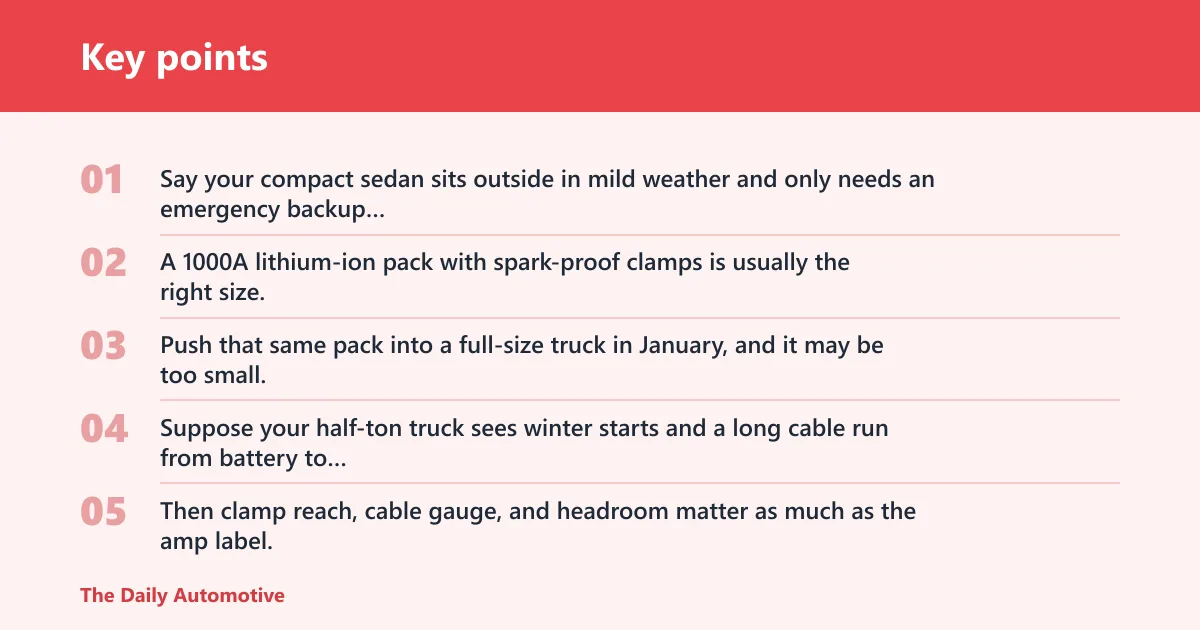
Say your compact sedan sits outside in mild weather and only needs an emergency backup for a dead 12V battery. A 1000A lithium-ion pack with spark-proof clamps is usually the right size. Push that same pack into a full-size truck in January, and it may be too small.
Suppose your half-ton truck sees winter starts and a long cable run from battery to terminals. Then clamp reach, cable gauge, and headroom matter as much as the amp label. A larger pack with heavier cables is the smarter buy, even if it takes more space.

Which jump starter do you need?
The right unit depends on the engine, climate, and where you plan to store it. A compact pack can work well for a small gas car, but a diesel SUV in cold weather needs more reserve and better cable reach. Bigger is not always better. Oversizing can mean a heavier unit that sits uncharged in the trunk.
Gas vs diesel engine fit
Gas engines usually need less starting reserve than diesel engines of the same size. The goal is headroom, not edge-of-limit sizing.
Peak amps vs real starting need
Peak amps are the burst the pack can deliver, not a guarantee that every vehicle will start instantly. A higher peak number can still be a poor fit if the battery is undercharged, the pack itself is not fully charged, or the clamp connection is weak. That is why cable quality and charge retention matter almost as much as the label.
When to size with headroom
If you drive in cold weather, keep the vehicle outside, or start a larger engine infrequently, add margin. A pack that is barely enough on a warm day can feel useless when temperature drops and battery output falls. For that reason, winter commuters and truck owners should shop one step up rather than one step down.
How much peak amps do I need?
For most gasoline cars and crossovers, 1000 to 1500 peak amps is the practical sweet spot. Larger gas engines, diesels, and cold-weather use push the need closer to 1500 to 2000 peak amps. The number on the case matters, but it only works if the pack is charged and matched to the vehicle class.
What peak amps mean in practice
Peak amps describe the short starting burst available to spin the starter motor and wake up a weak battery system. A jump starter with a high peak number still needs solid internal cells, good clamps, and enough stored charge to deliver that burst under load. A dead or half-charged pack can underperform no matter how impressive the label looks.
Why ratings can mislead
Manufacturers can print a large peak number that looks better than the real-world fit. Two packs with similar labels may behave very differently if one has better cables, stronger clamps, or better cold performance. The wrong size is also a problem in the other direction: a tiny pack may start a small sedan once and fail on the next attempt.
Engine displacement guidance
A useful shortcut is to think in terms of gas versus diesel, then engine size. Small and midsize gas engines are usually the easiest case. As displacement rises, or as the engine switches to diesel, you want more headroom. That is why many buyers end up choosing a 1500A or 2000A pack even if a smaller one might technically work on paper.
Safety features that matter
Safety features are not marketing fluff for beginners. They reduce the mistakes that cause most bad starts: reversed clamps, loose contact, and sparks at the battery. If you are buying for roadside emergencies, these protections are worth real attention.
Spark-proof and reverse-polarity protection
Spark-proof protection helps prevent arcing when the clamps touch the battery, and reverse-polarity protection helps block a bad connection if the clamps are attached to the wrong terminals. Together, they make the pack far friendlier for beginners. They also lower the stress of working in a dim parking lot with cold hands.
Clamp quality and cable length
Clamp quality can be the difference between a clean start and a frustrating no-start. Look for firm jaws, insulated grips, and cable length that reaches across crowded engine bays without stretching. Short or thin cables are a common failure point on trucks and some SUVs because the pack cannot sit where the clamps need it.
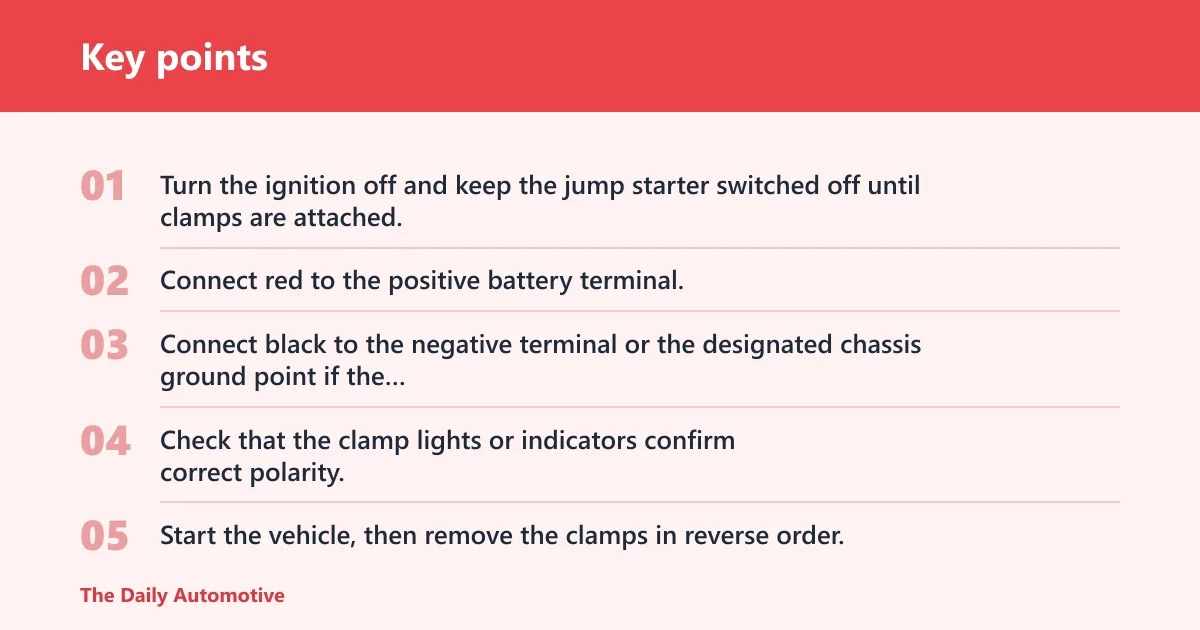
- Turn the ignition off and keep the jump starter switched off until clamps are attached.
- Connect red to the positive battery terminal.
- Connect black to the negative terminal or the designated chassis ground point if the vehicle calls for it.
- Check that the clamp lights or indicators confirm correct polarity.
- Start the vehicle, then remove the clamps in reverse order.
A common first-timer mistake is placing the pack too far from the battery just to save a few inches of cable. That usually leads to strained clamps or a connection that slips under vibration. Better to choose a unit with longer leads than to fight the layout every time.
Flashlight modes and roadside use
A built-in flashlight is useful when you need to read terminal markings, inspect clamp placement, or see into a dark engine bay. Look for multiple modes, especially a steady beam and a flash or emergency mode. It is a bonus feature, not the main reason to buy the pack, but it improves roadside usability.
Lithium-ion or lead-acid?
Lithium-ion jump starters are the compact, glovebox-friendly option. Lead-acid jump starters are heavier and bulkier, but some shop and truck users still prefer them because they can feel more substantial and are often built for repeated hard use. The better choice depends on how often the pack sits unused and where it will live.
Compact storage and charge retention
Lithium-ion packs are easier to store in a glovebox, side bin, or small bag. They also tend to be the better choice for everyday drivers who want something light enough to carry but strong enough to rescue a dead battery. The catch is storage discipline: they still need periodic top-off charging if they sit unused.
Cold-weather performance
Cold weather is where the difference becomes obvious. Lithium-ion remains the compact choice, but winter drivers need to check the stated cold-weather range and keep the pack charged. A pack left in a frozen trunk may not deliver the same performance as one stored in the cabin or recharged often.
Shop and truck use
Lead-acid jump starters are heavier, and that weight is part of the tradeoff. They can suit shop or truck use where the pack may stay in one vehicle, be recharged from routine use, or live on a shelf between jobs. If you need the smallest possible emergency tool, lithium-ion is usually the better match.
What extras are worth paying for?
Extras matter most when they fix a real use case. USB-C, flashlight modes, and water resistance can improve the pack’s usefulness, but none of them make up for the wrong amp rating or poor clamp design. Buy the core capability first.
USB-C charging in and out
USB-C input support can speed recharge time, and USB-C output support makes the jump starter more flexible for modern devices. Some packs can act as a power bank as well, which is handy during roadside delays. Fast recharge potential matters if you forget to top the unit off after use.
Power bank function for phones and tablets
A jump starter that doubles as a power bank can charge a phone, and some can handle tablets or other small electronics. That feature is useful during long waits, storms, or tow situations, but it should be treated as a bonus. The core job is still starting the car.
Water and dust resistance ratings
Water and dust resistance can matter if the pack lives in a trunk, garage, or work truck. An IP rating tells you how well the unit resists dust and water entry. For roadside reliability, that is more useful than glossy marketing language, especially if the pack will sit in dirty or damp storage.
How long does a portable jump starter hold a charge?
Charge retention varies by battery chemistry and storage habits. Lithium-ion packs usually hold their charge better than lead-acid packs over time, but no emergency starter should be treated as a forget-it device. If it lives in the trunk for months, top it off on a schedule rather than waiting for the dead-battery moment.
That matters most for infrequent drivers. A weekend car can have a dead starter battery and a dead jump starter at the same time if both sat untouched. A simple monthly or quarterly recharge habit is easier than discovering the pack is empty when you need it.
Is a jump starter better than jumper cables?
For beginners, a jump starter is usually easier and safer than jumper cables because it does not require a second vehicle and it reduces the chance of connection mistakes. Jumper cables still make sense if you already have roadside help nearby or want the lowest-cost backup option, but they are less forgiving in a dark parking lot.
If you choose cables, you still need another car, enough cable length, and a clear path to make the connection correctly. A jump starter removes that dependency. That is the real advantage, especially for solo drivers, winter commuters, and anyone who may be stranded in a lot after dark.
How to choose
Start with your vehicle class, then add climate and storage reality. A compact gas sedan usually does well with 1000A to 1500A in lithium-ion form. A midsize SUV or winter commuter should move closer to 1500A. A half-ton truck or diesel needs more reserve, better cables, and a pack that does not live on the edge of its rating.
Then check the failure modes that matter in real use. Make sure the pack has spark-proof and reverse-polarity protection, clamps that reach the battery, a flashlight for night work, and enough charge retention to stay useful between emergencies. If you want phone charging too, treat USB-C and power bank function as helpful extras, not the reason to buy the pack.
Frequently asked questions
What jump starter is best for a car battery?
For most car batteries, the best choice is a lithium-ion jump starter in the 1000A to 1500A range with spark-proof and reverse-polarity protection. Car and Driver named the Clore Automotive JNC325 its best overall pick, while the NOCO Boost Plus GB40 is the compact option and the Strauto Jump-Starter is the budget pick.
How many peak amps do I need for my car?
Most gasoline cars are well covered by 1000 to 1500 peak amps. Larger gas engines, diesels, and cold-weather drivers should look closer to 1500 to 2000 peak amps. The key is headroom. A pack that is barely enough on paper can struggle when temperature drops or the battery is very weak.
Will a jump starter work on a dead battery in cold weather?
Yes, but cold weather raises the bar. Battery output falls in low temperatures, so a pack that works in mild weather may feel underpowered in winter. Choose more peak amps than the bare minimum, keep the jump starter charged, and store it where it will not sit frozen for long periods.
Are portable jump starters safe for beginners?
They are usually safer and easier than jumper cables for beginners, especially if they include spark-proof and reverse-polarity protection. Those features reduce the chance of connection errors. Even so, you should connect the clamps in the correct order and keep the pack switched off until it is attached properly.
Can a jump starter also charge phones or laptops?
Many models can charge phones, and some can top up tablets or other small devices through USB outputs. USB-C input can also speed recharging the jump starter itself. That said, power bank function is a bonus feature, not the main reason to choose one model over another.
Products related to this article
Sponsored / affiliate links. As an Amazon Associate I earn from qualifying purchases. I may earn additional commission from eligible campaigns.