Best Jump Starters for Cars (2026): We Compared
For most cars, a 1,000-1,500-amp lithium jump starter is commonly a good buy; consider about 2,000+ amps for larger V6/V8s, diesels, or frequent starts, and choose compact units only for small engines and tight storage. Too little power can leave you stuck when it matters most. This guide compares portable jump starters by engine size, safety features, and storage fit, then points you to the best match.
Top picks by category

The best overall pick is the Clore Automotive JNC325, which Car and Driver named best overall. It costs about $178 to $200, has long cables, and gives you more room to work around the battery than many compact packs.
For large engines, the Gooloo GT6000 is the right kind of high-output option. Car and Driver singled it out for bigger engines, which is the cue to use when you have a V8, a diesel, or a vehicle that needs stronger reserve.
For budget buyers, the Strauto Jump-Starter is the compact, lower-cost choice from Car and Driver. Its Amazon-linked price reference is the draw, but its smaller package also means you should treat it as a fit-for-purpose tool, not a one-size-fits-all answer.
Quick comparison
| Product | Badge | Best for | Price | ||
|---|---|---|---|---|---|
|
NOCO Boost GBX45 1250A UltraSafe Jump Starter, 12V LithiumNOCO | Our pick | 1250A · Lithium · Spark-Proof | $124.95
Price as of 21 Oct 2026
|
View |
 |
DBPOWER Peak 3000A 18000mAh Portable Car Jump Starter (upDBPOWER | Budget pick | 3000A · 18000mAh · Portable | $49.99
Price as of 21 Oct 2026
|
View |
This quick view is about matching the pack to the vehicle, not chasing the biggest number on the box. Peak amps matter, but cable length, clamp quality, case size, and recharge convenience matter too. A stronger pack helps, but only if you can place it, clip it, and store it without hassle.
How we chose
We compared models on four points: engine support, safety features, portability, and charging convenience. The goal was to separate compact packs that fit a glovebox from higher-output units that make more sense for bigger engines and mixed-use households.
Safety mattered just as much as output. Reverse polarity protection, low-voltage detection, and clamp quality can decide whether a jump starts cleanly or refuses to work when the battery is badly discharged.
Storage fit mattered too. A jump starter that lives in a trunk organizer is a different buy from one you want in the glovebox, and a pack with short cables or a bulky case can be awkward in both places.
Extra features were a final tiebreaker. USB charging, flashlights, wall chargers, and carrying cases are useful, but they should not pull attention away from the main job: starting the car.
Jump starter decision table
| Gas or diesel | Engine size band | AGM/start-stop compatibility | Minimum safety features | Ideal form factor |
|---|---|---|---|---|
| Gas | 4-cylinder, small turbo four | Helpful, but not required on every car | Reverse polarity protection, spark-proof clamps, low-voltage detection | Compact glovebox pack |
| Gas | V6 | Recommended if the car has start-stop | Reverse polarity protection, strong clamp jaws, clear status lights | Compact-to-mid-size pack |
| Gas | V8 | Recommended for start-stop and AGM | Reverse polarity protection, low-voltage detection, longer cables | Mid-size or high-output pack |
| Diesel | Small diesel to mid-size diesel | Strongly recommended | Reverse polarity protection, high-crank output, heavy-duty clamps | High-output pack |
| Diesel | Large diesel | Strongly recommended | Reverse polarity protection, low-voltage detection, strong leads | Large high-output pack or combo unit |
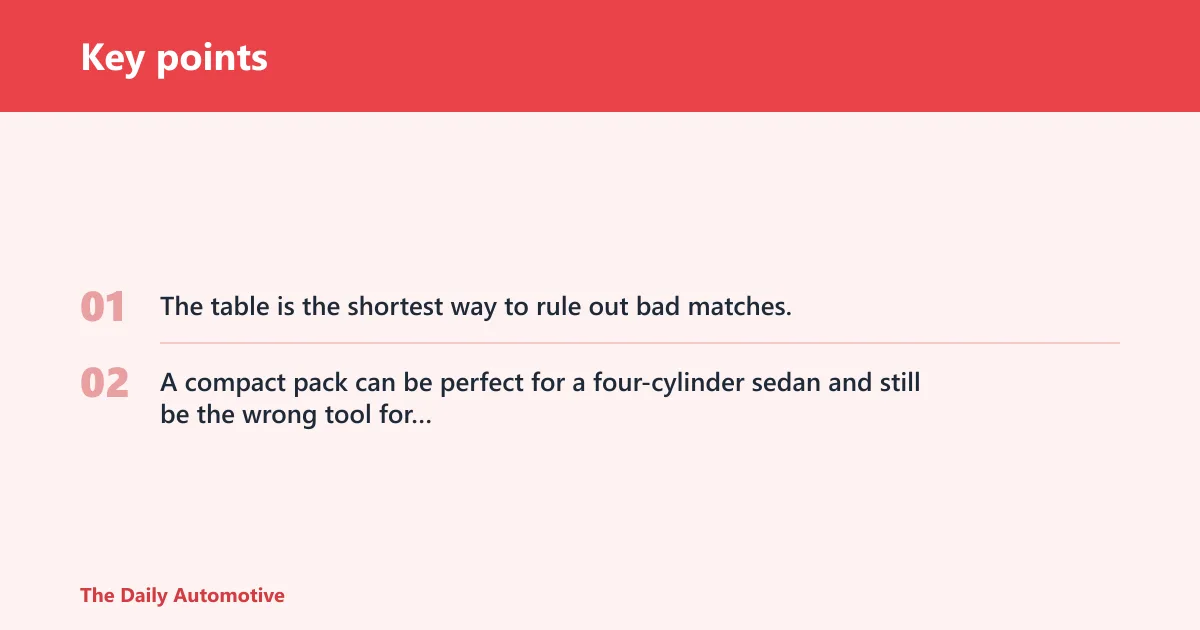
The table is the shortest way to rule out bad matches. A compact pack can be perfect for a four-cylinder sedan and still be the wrong tool for a big V8 or a diesel that needs more cranking reserve.
Clore Automotive JNC325: best overall for most drivers
The Clore Automotive JNC325 is the best overall pick because it balances output, cable reach, and everyday usability. Car and Driver named it best overall, and the price reference around $178 to $200 puts it in the middle of the market rather than at the entry level.
It is a strong fit if you keep the jump starter in the car, not just in the garage. Long cables matter when the battery sits in a tight engine bay or when the terminals are awkwardly placed.
The drawback is simple: it is not the smallest option here. If your first priority is glovebox storage, a smaller pack makes more sense.
Gooloo GT6000: best for large engines
The Gooloo GT6000 is the one to look at when you need high output for bigger engines. Car and Driver named it best for large engines, which makes it the clear choice in this roundup for drivers who care more about cranking reserve than pocket size.
This is the better match for V8s and for diesel-duty use where a compact pack may be outclassed. If you own a truck, SUV, or a performance car with a hungry starter load, the extra output becomes the point.
The tradeoff is portability. A high-output jump starter is usually less convenient to stash, and it is often more pack than a small commuter car really needs.
Strauto Jump-Starter: best budget pick
The Strauto Jump-Starter is Car and Driver’s budget pick, and its compact design is the main reason to consider it. The Amazon-linked price reference keeps it attractive for a driver who wants an emergency tool without paying for a premium pack.
It works best as a low-cost backup for smaller gas engines and short storage needs. If the pack will live in a glovebox or side pocket, the smaller footprint is part of the appeal.
The drawback is capacity headroom. Budget packs can be the first to run out of margin when the battery is weak, the temperature is low, or the engine is larger than expected.
NOCO Boost Plus GB40: best compact pick
The NOCO Boost Plus GB40 is Car and Driver’s most compact pick, and that matters if you want a glovebox-friendly unit. Its UltraSafe protection system is the headline feature, and the small size makes it easy to store where you can actually reach it.
This is the better choice for small cars, compact crossovers, and drivers who value storage more than raw power. It is also the kind of unit that is easiest to keep charged because you are more likely to have it with you instead of buried in a trunk.
The drawback is obvious: compact size limits margin. It is not the first pick for a V8, a diesel, or a vehicle with repeated no-start events.
Which one should you buy?
Start with the vehicle, not the badge. A four-cylinder gas car usually fits the compact end of the market, a V6 benefits from a mid-output pack, and a V8 or diesel should push you toward a stronger unit with longer leads and better clamps.
If you want the safest default recommendation, choose the Clore Automotive JNC325. If your vehicle is larger or you know you need more reserve, move to the Gooloo GT6000. If price matters most, the Strauto Jump-Starter is the value play, and the NOCO Boost Plus GB40 is the one to choose when storage is tight.
Suppose your sedan has a 2.0-liter four-cylinder and you park outdoors in winter. A compact pack can be enough, but only if it includes reverse polarity protection and low-voltage detection, because cold batteries lose cranking ability fast.
Picture a half-ton truck with a V8 that sits for weeks at a time. That vehicle should not be matched to a glovebox-only unit if you want a realistic chance of a clean start after a long parking period.
Weego 22s, Weego 44, and other top-rated alternatives
Wirecutter’s top pick was the Weego Jump Starter 22s, and Wirecutter said it starts most cars and SUVs. Its Smarty Clamps are the feature to note here, because they are designed to help the pack connect correctly and avoid a bad hookup.
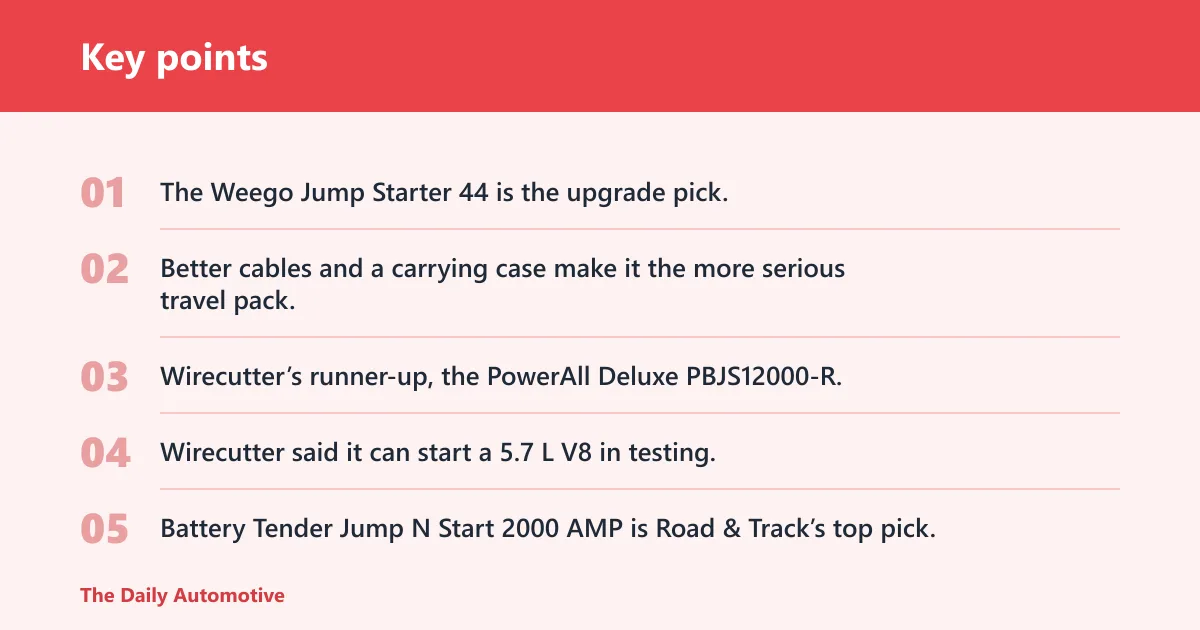
The Weego Jump Starter 44 is the upgrade pick, with support up to a 7 L gas engine or 3.5 L diesel according to Wirecutter. Better cables and a carrying case make it the more serious travel pack, but it is also larger than the 22s.
Wirecutter’s runner-up, the PowerAll Deluxe PBJS12000-R, has larger-engine capability and about twice the capacity of the top pick. Wirecutter said it can start a 5.7 L V8 in testing, which makes it a sensible option when the vehicle is not small.
Battery Tender Jump N Start 2000 AMP is Road & Track’s top pick. It is compact and straightforward, and it includes a USB-C charging cable and wall plug, which cuts down on charger hunting.
Road & Track also rated the Noco Boost X GBX155 at 4250 amps and called it its most powerful pick, with claims for up to 10.0-liter gas and 8.0-liter diesel. That kind of output is aimed at drivers who want a wide safety margin, not a minimalist carry piece.
CTEK CS Free is Road & Track’s most versatile pick. It sits in a different part of the market because versatility can matter more than raw cranking number if you want one device that handles more than one job.
For storage-first buyers, the smallest options are the easiest to live with. For power-first buyers, the larger units pay for themselves in flexibility, especially once a diesel or a bigger V8 enters the picture.
What if the battery is deeply discharged?
A jump starter may fail to detect a deeply discharged battery when the battery voltage is too low for the pack’s safety circuitry to recognize a normal start request. In that case, the unit may refuse to connect, or it may flash a fault and do nothing.
That is not always a product defect. A dead-flat battery can be below the threshold where a jump starter is willing to engage, especially if the battery has sat for a long time or has an internal fault.
When that happens, stop and use a charger instead of forcing repeated jump attempts. Clamp quality, clean terminals, and a battery with at least some residual voltage all matter, because the starter pack needs a stable electrical path to work correctly.
A common first-timer mistake is to blame the jump starter for a no-start when the battery is simply too far gone. If the pack gives no response after a clean clamp connection, the next step is often charging the battery, not buying a bigger pack on the spot.
Deep discharge also changes the risk picture. The wrong clamp connection on a weak battery can trigger protection circuits, but poor contact can also slow the process enough that the car still will not crank.
How many amps do I need in a jump starter for my car?
For a four-cylinder gas car, a compact lithium jump starter in the 1,000-1,500-amp range is often the right starting point.
For V8s and diesels, start at the stronger end of the range and ignore the temptation to buy only for storage size. Diesel engines usually need more power than gas engines, and start-stop systems often pair with AGM batteries that reward a more capable pack.
Peak amps are not the whole story, though. Cable length, clamp bite, and low-voltage handling can matter more than one headline number when the battery is partly dead and the engine bay is crowded.
What safety features should a jump starter have?
Reverse polarity protection should be standard. It prevents the pack from sending power when the clamps are attached to the wrong terminals, which protects both the car and the jump starter from a mistake that is easy to make in a hurry.
Low-voltage detection matters because it keeps the pack from trying to start a battery that is too far below its safe operating range. Spark-proof clamps and clear indicator lights reduce the chance of damage when a connection is unstable.
Clamp design matters more than many buyers expect. A weak clamp can slip, arc, or fail to grip painted or corroded terminals well, and that can turn a simple emergency into a repeated connection problem.
How long does a jump starter hold a charge in the car?
Most jump starters are meant to be recharged periodically so they do not go flat. The practical answer is to check them on a regular schedule and top them off after use, after a long storage period, or after any significant temperature swing.
Storage location matters. A pack kept in a hot trunk or a freezing garage may lose usable charge faster than one stored in a climate-controlled space, so glovebox and cabin storage can be easier on the battery than long-term trunk storage.
Do not assume that a jump starter will sit for a year and still be ready. The safer habit is to inspect the charge indicator every few months and recharge before the pack gets low.
Can a jump starter damage my car battery or electronics?
Used correctly, a modern jump starter should not damage healthy electronics. The main risk comes from wrong clamp connection, forcing a start on a failed battery, or using a pack without reverse polarity protection or other safeguards.
That is why clamp quality and protection circuitry matter. They help prevent a surge, reverse connection, or unstable contact from turning into a problem for the vehicle’s electrical system.
If the battery is badly swollen, leaking, or visibly damaged, do not keep trying. A jump starter is not a fix for a battery that has failed physically.
Which compact jump starter is easiest to store in a glove box?
The NOCO Boost Plus GB40 is the clearest glovebox-friendly pick in this roundup because Car and Driver named it the most compact option. If storage is your deciding factor, compactness wins only after you confirm the pack still matches the engine size.
The Strauto Jump-Starter also makes sense for small storage spaces because it is the budget pick and has a compact design. That said, a small case is only useful if the pack still has enough power for the car you drive most often.
If your glovebox is already crowded, a flat pack with a short case is easier to fit than a taller blocky unit. Cable length still matters, so check whether the clamps can actually reach the battery from where you plan to store the pack.
Are jump starters with air compressors worth it?
They can be worth it if you want one tool for multiple roadside jobs, but they are not automatically the best buy. Compressor-equipped units are usually bulkier, and that added size can get in the way if you want the jump starter to live in the car full time.
Choose a combo unit only if you will use the compressor often enough to justify the tradeoff. If you mostly need emergency starting, a dedicated jump starter is usually the better fit.
There is also a practical penalty: more features can mean more charging to keep track of. If your only mission is starting the car, simpler is easier to maintain.
What is the difference between a jump starter and jumper cables?
Jumper cables need another vehicle and a working battery. A portable jump starter does the same basic job without a second car, which is why it is the better emergency tool for parking lots, roadside stops, and solo travel.
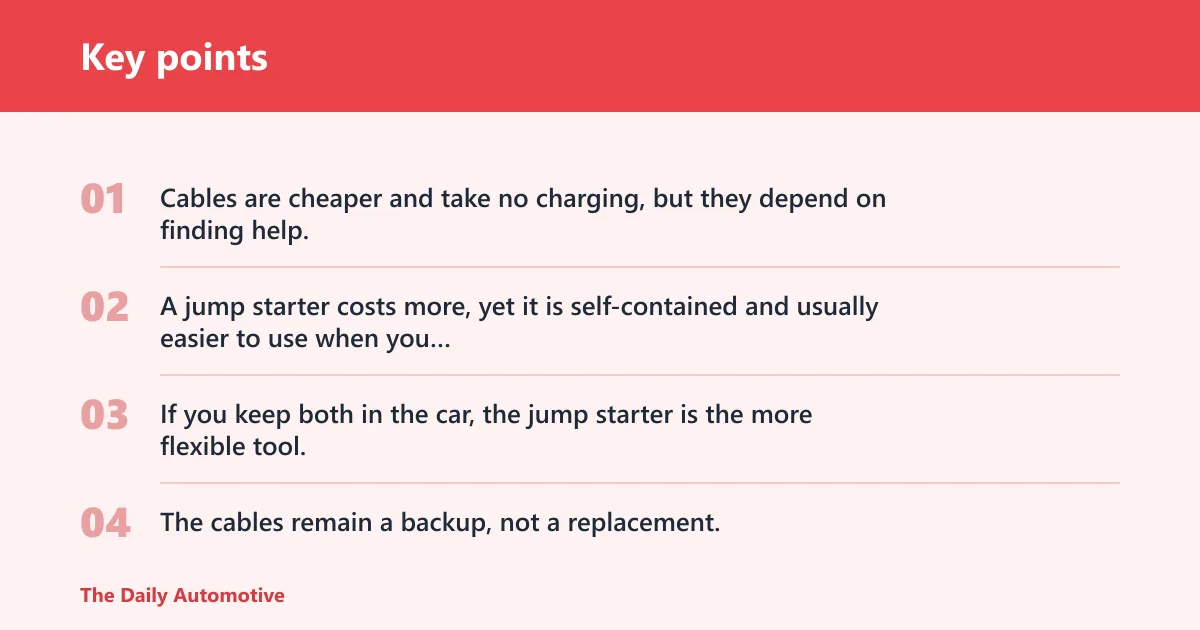
Cables are cheaper and take no charging, but they depend on finding help. A jump starter costs more, yet it is self-contained and usually easier to use when you are alone or when the other vehicle cannot get close enough.
If you keep both in the car, the jump starter is the more flexible tool. The cables remain a backup, not a replacement.
Do I need a jump starter for a car with start-stop technology?
Yes, if you want a portable backup that is ready for an AGM-equipped start-stop car. Start-stop systems can make the battery choice more important, and a stronger pack with better safety features is the safer match.
AGM and start-stop vehicles are more sensitive to weak power and poor connections than a basic older sedan. That means the jump starter should be matched to the vehicle class, not just to the fact that it is “12V.”
A mid-size or high-output pack is the more conservative choice here. It gives you more room for cold weather, short-trip battery wear, and the higher cranking demands that start-stop systems can create.
Frequently asked questions
What is the best battery jump starter for cars?
The best overall pick in the sources used here is the Clore Automotive JNC325. It is a strong middle-ground choice because Car and Driver named it best overall, it has long cables, and its price reference sits around $178 to $200, which puts it in a practical range for many drivers.
Will a portable jump starter work on a V8 or diesel engine?
Yes, if the unit is sized for that job. Wirecutter’s Weego 44 is noted for support up to a 7 L gas engine or 3.5 L diesel, and the PowerAll Deluxe PBJS12000-R can start a 5.7 L V8 in testing. Smaller packs may not have enough reserve.
Products related to this article
Sponsored / affiliate links. As an Amazon Associate I earn from qualifying purchases. I may earn additional commission from eligible campaigns.
 5000A Jump Starter with Air Compressor, Portable Car Battery Jump Starter, 150 PSI Tire Inflator, 12V Jump Box for 8.0L Gas/6.5L Diesel, Auto Shut Off, LCD Display
 Car Jump Starter with Air Compressor, Jump Box Car Battery & 160PSI 45L/Min 3000A Auto Tire Inflator with LCD Display, Lights (8.5L Gas/ 5.5L Diesel)