3 Best Jump Starters for Cars (2026): Based on Specs and Reviews
A common rule of thumb is that a 1,000-2,000A lithium jump starter suits compact cars and SUVs, while trucks and diesels often need about 2,000A or more; clamp quality may matter more than peak-amp marketing. Buy the wrong size and you risk a no-start in cold weather, wasted money, or a unit that is bulky enough to leave behind. This guide ranks three reliable picks by vehicle type, then shows which specs actually matter so you can avoid paying for inflated amp claims.
Quick comparison
| Product | Badge | Best for | Price | ||
|---|---|---|---|---|---|
 |
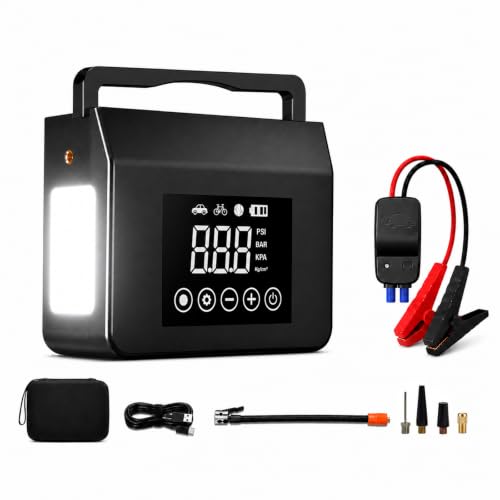
12000mAh Car Jump Starter 1800A with Air Compressor &Tivolara | Our pick | 1800A peak · 12000mAh · 6-in-1 multi-tool | $149.99
Price as of 17 Oct 2026
|
View |
 |
NOCO Boost GB70 2000A UltraSafe Jump Starter, 12V LithiumNOCO | Also great | 2000A peak · UltraSafe · spark-proof | $199.95
Price as of 17 Oct 2026
|
View |
 |
S ZEVZO ET03 Car Jump Starter 4000A Jump Starter BatteryS ZEVZO | Budget pick | 4000A peak · LCD display · storage case | $59.99
Price as of 17 Oct 2026
|
View |
Use the table that follows as a fit check, not an amp contest. Match your vehicle size, where you will store the pack, and how often you face winter starts to the right current rating and cable setup.
How we chose
These picks favor published rankings from Car and Driver and CNN Underscored, then separate useful specs from marketing noise. The main filters are cranking amps, battery capacity, cable length, portability, and safety features such as reverse-polarity protection.
Peak amps can help describe a burst, but they should not be the only number you compare. Cranking amps are more useful for sustained starting power, and watt-hour capacity tells you more about how many jumps a unit may deliver before recharge.
We also weighted real-world fit: a model that lives in a winter emergency kit has different needs than one that rides in a center console. Long cables matter when the battery is buried under trim, and a compact shell matters when you will actually carry the unit.
Jump starter decision table
| Vehicle scenario | Recommended minimum cranking amps | Preferred cable length | Portability priority | Warning sign that rules it out |
|---|---|---|---|---|
| Compact car | 400-800A | Short to medium; easy clamp reach matters more than length | High | Only lists peak amps with no cranking-amp rating |
| SUV | 800-1,200A | Medium | Medium | Bulky case that will not fit under a cargo floor or seat |
| V8 truck | 1,200-2,000A or more | Long | Lower priority than output | Entry-level model with weak cold-weather rating |
| Diesel | 2,000A or more | Long | Medium | Manufacturer excludes diesel use or caps it below your engine size |
| Cold-weather emergency kit | At least 1,000A for small gas engines; more for larger engines | Medium to long | High, but not at the expense of output | No low-temperature guidance and no clamp protection features |
| Occasional use | Match the engine, then add margin for infrequent charging | Medium | Very high | Needs frequent charging to stay ready |
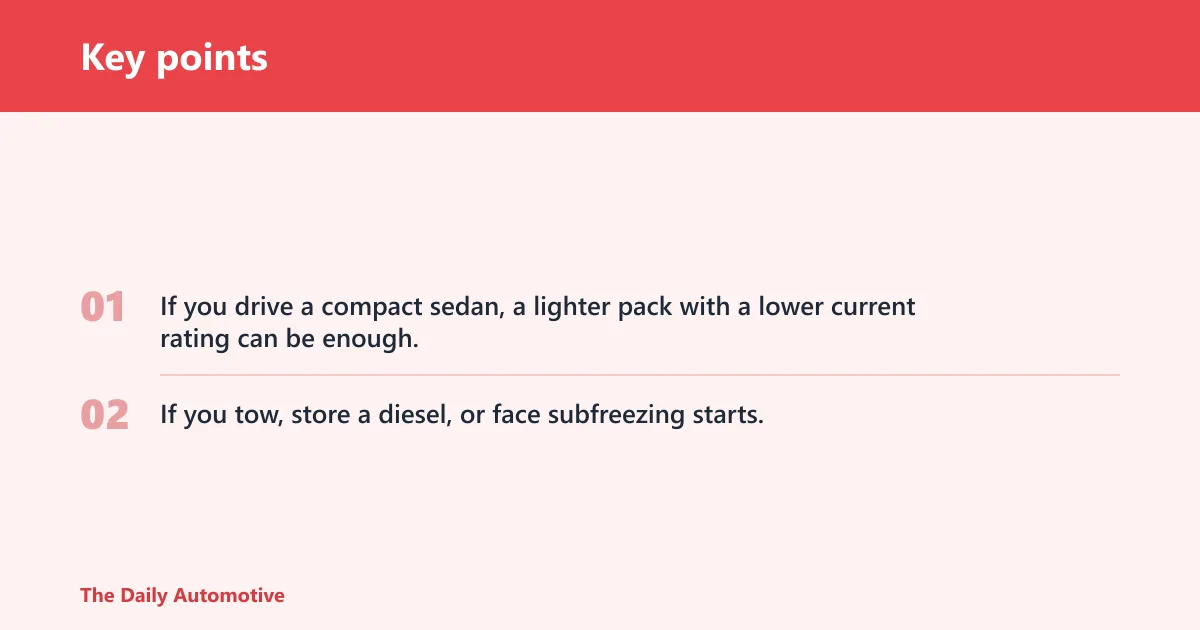
If you drive a compact sedan, a lighter pack with a lower current rating can be enough. If you tow, store a diesel, or face subfreezing starts, size up now rather than hoping a tiny unit can force a weak battery to wake up.
What is the best jump starter for a car?
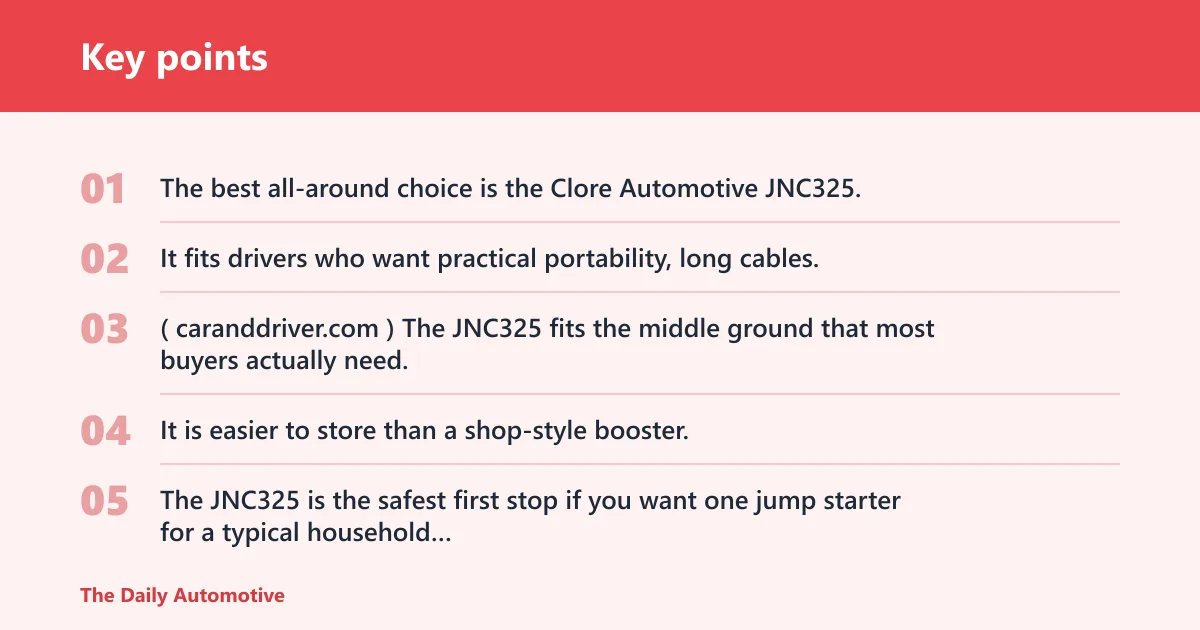
The best all-around choice is the Clore Automotive JNC325, which Car and Driver named its best overall portable jump-starter. It fits drivers who want practical portability, long cables, and enough output for common gas engines without carrying a huge unit that stays in the trunk unused. (Caranddriver)
The JNC325 fits the middle ground that most buyers actually need. It is easier to store than a shop-style booster, but it is not so minimal that it becomes a poor fit for a sedan, small SUV, or everyday emergency kit.
Clore Automotive JNC325: best overall for most drivers
The JNC325 is the safest first stop if you want one jump starter for a typical household vehicle, because Car and Driver named it the best overall portable jump-starter. Its long cables help when the battery sits deep in the engine bay, and that matters more than a flashy peak number on the box.
It is a stronger fit for drivers who value easy clamp placement, clear reach, and a unit that stays practical to store. The drawback is simple: if your vehicle is a large truck or diesel, a general-purpose pick may not give you enough headroom in cold weather.
Which jump starter is most reliable for emergencies?
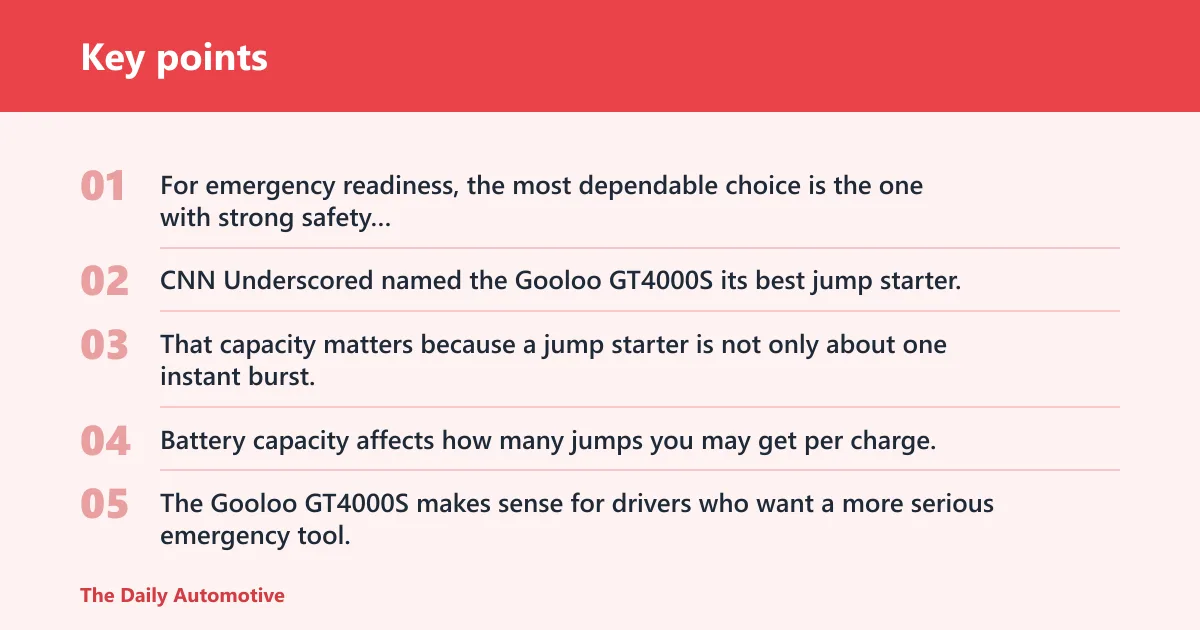
For emergency readiness, the most dependable choice is the one with strong safety protection, enough capacity for more than one attempt, and packaging you can actually reach in a hurry. CNN Underscored named the Gooloo GT4000S its best jump starter; it is rated at 4,000 peak amps, 800 cranking amps, and 74-watt-hour capacity, which gives it a useful balance of output and reserve.
That capacity matters because a jump starter is not only about one instant burst. Battery capacity affects how many jumps you may get per charge, which is why a small pack that reads well on peak amps can still disappoint if it runs out after one weak start.
Gooloo GT4000S: best overall emergency option
The Gooloo GT4000S makes sense for drivers who want a more serious emergency tool, especially when a dead battery may be fully flat. CNN Underscored says it can revive a fully dead battery in most cars, and it also notes an included flashlight for roadside use.
The downside is that its stronger spec sheet can tempt buyers who do not need that much power. If you only drive a compact car and want the smallest possible case, a higher-output unit may be more than you need to carry every week.
How many amps do I need for a jump starter?
For most gas cars, 1,000 to 2,000 amps is the practical shopping band, with larger engines needing more headroom and diesels needing the most. Do not buy by peak amps alone; cranking amps are the more useful comparison, and battery capacity tells you how many starts you can expect before recharge.
A compact car can often do fine with a smaller unit, but a V8 truck or diesel has more rotating mass to overcome, especially in cold weather. That is why a bigger engine needs a bigger starting reserve, not just a larger marketing number.
Gooloo GT6000: best for large engines
Car and Driver named the Gooloo GT6000 best for large engines, and that is the right use case for buyers who need extra starting reserve. High output matters here because trucks, vans, and diesels are far less forgiving when battery state of charge drops.
This is the pick to consider when you are sizing for a large engine first and portability second. The obvious drawback is bulk: high-output jump starters are usually less convenient to toss into a glove box or carry every day.
What is the best budget jump starter?
The best budget pick is the Strauto Jump-Starter, which Car and Driver named its best budget choice. Budget units can be a smart buy for a small car or for a driver who wants backup without paying for long-run reserve or heavy-duty truck capacity.
The risk with bargain units is under-specifying the job. A low-cost model may be fine for a mild climate and a small gas engine, but it can run out of patience fast when the battery is deeply discharged or the weather turns cold.
Strauto Jump-Starter: best budget for light-duty use
The Strauto Jump-Starter is the one to consider if your priority is simple emergency coverage at the lowest practical cost. It fits drivers who need an occasional-start solution rather than a power bank that lives through repeated winter use or large-engine duty.
The honest tradeoff is headroom. Budget models usually give up some reserve, cable length, case quality, or long-term flexibility, so you should spend more if your vehicle is larger than average or your battery tends to sit unused for long stretches.
Which jump starter works for a dead battery?
A jump starter can work on a dead battery if the pack has enough output, the clamps are placed correctly, and the battery is not damaged beyond recovery. A fully discharged battery is different from a failed battery, and some units are better than others at handling a near-zero state of charge.
That is why published claims about reviving fully dead batteries matter. The same source says the Gooloo GT4000S can revive a fully dead battery in most cars, while Car and Driver says it tested several jump-starters on vehicles with completely bricked batteries.
Say your sedan sat for two weeks in freezing weather and now only clicks once. That is the kind of job where a stronger unit with solid cranking output and a healthy battery reserve gives you better odds than a small pack chosen only for price.
Most compact option: NOCO Boost Plus GB40
The NOCO Boost Plus GB40 is the best compact pick in Car and Driver’s ranking, and CNN Underscored named it the best budget jump starter. It is a sensible option when space is tight and you want a small, familiar model that is easier to keep in the car than a larger booster.
The tradeoff is obvious: compact does not mean universal. A small pack can be the wrong call for big engines, diesel use, or repeated winter starts, and buyers should not confuse a low-profile shell with higher actual starting ability.
How do I choose a portable jump starter?
Choose by engine size first, then by storage habits, then by ease of use. If the unit will live in a trunk or cargo bay, size and case shape matter. If it will live in a winter kit, battery reserve and cold-weather confidence matter more than shaving a few inches.
Next, check the spec that tells the most truth for comparison: cranking amps. Peak amps can look impressive, but cranking amps better reflects sustained starting help, and capacity in watt-hours helps you judge whether the unit is likely to be ready for more than one attempt.
Key differences that matter more than peak amps
Peak amps are a marketing-oriented number. They can tell you something about burst output, but they do not tell the whole story about how well the unit will start your vehicle under load.
Cranking amps are more useful because they speak to sustained current. Battery capacity matters too, because a jump starter with more watt-hours can usually support more than one start before you need to recharge it.
- Match the unit to your engine size and climate.
- Check cranking amps before peak amps.
- Look at battery capacity if you want multiple starts per charge.
- Make sure the cables reach the battery without strain.
- Confirm reverse-polarity and spark protection if you are a beginner.
Suppose you keep a midsize SUV in an apartment garage and only drive it on weekends. A compact model may fit the storage space, but if the battery sits too long between drives, you still want enough reserve that the first jump is not the last one the unit can give.
Which one should you buy?
Buy the Clore Automotive JNC325 if you want the best all-around fit for a normal gas car or small SUV. Buy the Gooloo GT6000 if your vehicle is large, heavy, or diesel and you want extra output. Buy the Strauto Jump-Starter if price is the main filter and your engine is small enough to keep the risk low.
If you want the most compact case, the NOCO Boost Plus GB40 remains a sensible small-car choice.
For beginners, start with a model that lists reverse-polarity protection and spark protection, then check that the clamp leads are long enough to reach the battery comfortably. For experienced DIY owners, the bigger question is fit: a model can be powerful and still be the wrong tool if it is too awkward to keep on hand.
A common first-timer mistake is choosing a jump starter with a huge peak-amp rating but ignoring whether it has enough cranking power for the vehicle. That can leave you with a bulky unit that still does not match your engine, your storage space, or your winter starting needs.
Frequently asked questions
Is NOCO or Gooloo better for a jump starter?
Neither brand wins every category. Choose by vehicle size and storage needs, not brand loyalty alone.
Can a jump starter work on large engines?
Yes, but only if the unit has enough sustained output and the manufacturer rates it for that engine size. Car and Driver’s Gooloo GT6000 is the large-engine pick here, and that is the safer direction for trucks, vans, and diesels than a compact all-purpose pack.
What is the safest jump starter to use?
The safest units are the ones with spark-proof and reverse-polarity protection, clear clamp labeling, and enough cable length to avoid strained connections. NOCO’s GB70 is specifically listed with spark-proof and reverse-polarity protection, and similar protections are worth paying for on any model.
Which jump starter is best for beginners?
A beginner should choose a model with protection features, simple status indicators, and a size that is easy to store where it can be found quickly. The NOCO Boost Plus GB40 is a sensible beginner-friendly compact choice, while the JNC325 suits buyers who want an easy all-around pick.
Products related to this article
Sponsored / affiliate links. As an Amazon Associate I earn from qualifying purchases. I may earn additional commission from eligible campaigns.