Best Jump Starters for Dead Car Batteries (2026): Research Shows
For a fully dead car battery, a common rule of thumb is to choose a lithium jump starter with about 600–1,000 peak amps for gas cars and about 1,000–2,000 for many V6/V8 trucks and SUVs, plus a boost or force-start mode for deeply discharged batteries. A weak match wastes time, can drain the pack before the engine turns, or fails to wake the starter circuit at all. This guide sorts the best jump starters by failure mode and vehicle type so you buy the right one for your car, truck, or SUV.
Quick comparison
| Product | Badge | Best for | Price | ||
|---|---|---|---|---|---|
 |
NOCO Boost GB40 12V 1000A UltraSafe Portable Lithium JumpNOCO | Our pick | NOCO GB40 · 1000A · UltraSafe | $99.95
Price as of 23 Oct 2026
|
View |
 |
S ZEVZO ET03 Car Jump Starter 4000A Jump Starter BatteryS ZEVZO | Upgrade pick | ZEVZO ET03 · 4000A · 74Wh | $59.99
Price as of 23 Oct 2026
|
View |
Peak-amp figures help, but brands do not measure them the same way, so vehicle fit matters more than chasing the biggest number on the box. Use the table to match the tool to the failure case: small car, big truck, diesel, or a battery that is so low it may not trigger auto-detection.
How we chose
The picks below are based on published specifications, brand claims, and third-party coverage, including Car and Driver’s vehicle-testing roundup on completely bricked batteries. The goal is not the biggest number on the box. It is the best match for the engine, the storage habit, and the kind of failure you are trying to fix.
- Vehicle fit: Gasoline, diesel, and engine size limits matter more than one headline amp figure.
- Failure mode: Some packs can wake up an ultra-dead battery; others need enough residual voltage to detect a battery.
- Safety: Reverse polarity protection and spark-proof design are must-haves.
- Recharge behavior: Faster recharging helps for winter storage and long trips.
- Portability: Size matters if the unit has to stay in a glove box or cargo bin.
Jump starter decision table
| Vehicle type or failure case | Minimum useful spec | Engine-size range | Safety features to require | When to choose a larger model |
|---|---|---|---|---|
| Small car | About 600–1,000 peak amps | Gas 4-cyl to small V6 | Reverse polarity protection, spark-proof clamps | Cold weather, repeated starts, or a battery that has sat for months |
| SUV | About 1,000–2,000 peak amps | Gas V6 and many V8 crossovers | Reverse polarity protection, spark-proof clamps, force-start or boost mode | Large V8, hybrid with low auxiliary battery, or winter use |
| Truck | At least 1,000 peak amps; more for big engines | Full-size gas V8, heavy-duty applications | Heavy-duty clamps, reverse polarity protection | Large-displacement gas engines, work trucks, or repeated roadside use |
| Diesel | Model rated for diesel use, not just gas | About 3.0 liters and up, depending on the unit | Reverse polarity protection, spark-proof design, strong clamp lead length | Cold starts, larger diesel pickups, or engines with high compression |
| Deep-discharge battery | Force-start, override, or boost mode | Any 12V vehicle with a battery too low to auto-detect | Manual override with protection circuitry | If the pack will not recognize the battery or the car shows no response |
| Winter use | Go one size up from the summer minimum | Same as vehicle type, but with extra margin | Cold-rated storage guidance, reverse polarity protection | Always, if temperatures regularly fall below freezing |
| Emergency-only storage | Compact lithium pack with periodic recharge | Light-duty gas cars and occasional roadside use | Battery-status indicators, spark-proof clamps | If the car is larger than a compact sedan or the pack may sit for months |
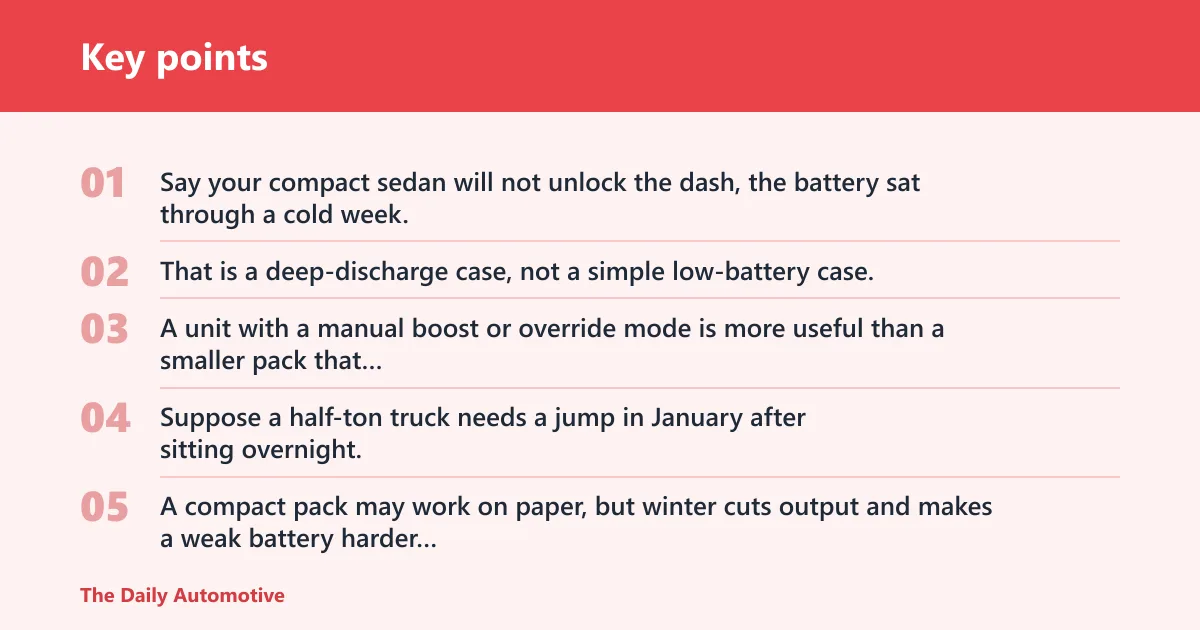
Say your compact sedan will not unlock the dash, the battery sat through a cold week, and the jump pack shows little or no response at first. That is a deep-discharge case, not a simple low-battery case. A unit with a manual boost or override mode is more useful than a smaller pack that depends on automatic detection.
Suppose a half-ton truck needs a jump in January after sitting overnight. A compact pack may work on paper, but winter cuts output and makes a weak battery harder to wake. That is where stepping up to a higher-output model or a traditional-duty pack pays off.
NOCO Boost Plus GB40: best compact all-rounder
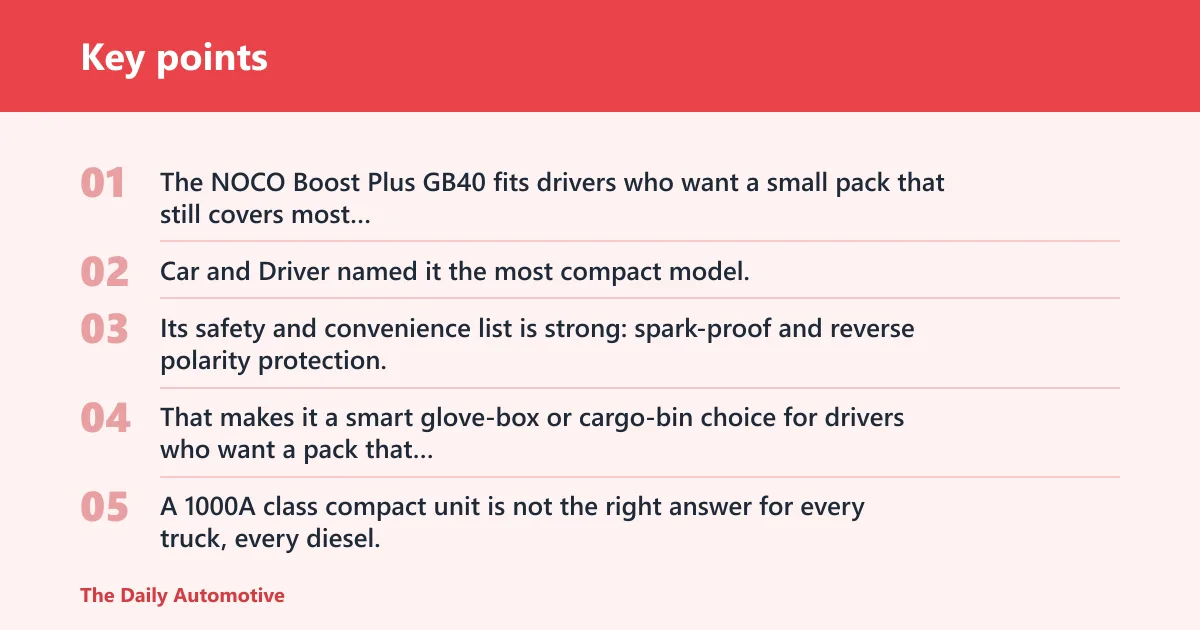
The NOCO Boost Plus GB40 fits drivers who want a small pack that still covers most gasoline cars and many light-duty SUVs. Car and Driver named it the most compact model, and the published specs say it provides up to 20 jump starts per charge, supports gasoline engines up to 6.0 liters, and supports diesel engines up to 3.0 liters.
Its safety and convenience list is strong: spark-proof and reverse polarity protection, USB-C charging, and IP65 water resistance. That makes it a smart glove-box or cargo-bin choice for drivers who want a pack that stays ready without much fuss.
The drawback is simple. A 1000A class compact unit is not the right answer for every truck, every diesel, or every battery that has been deeply discharged for a long period. It is a broad fit, not a universal one.
Clore Automotive JNC325: best traditional-duty pick
Car and Driver named the Clore Automotive JNC325 its best overall pick. It uses a traditional jump-starter format with long cables, which matters when the battery is buried under a hood brace, tucked in a trunk, or mounted where a compact lithium pack feels awkward.
That cable reach and conventional design make it attractive for roadside use where placement is difficult and the user wants less dependence on a tiny pack’s battery-management logic. It is the kind of tool many drivers want when they care more about access and cable length than pocket size.
The tradeoff is portability. Traditional-duty jump starters are usually bulkier than compact lithium packs, so they are less attractive if the unit has to live in a small storage cubby every day.
Large-engine options
Large engines change the equation. The issue is not only peak amps; it is whether the pack can deliver enough margin for a bigger gas V8, a diesel, or a vehicle that needs extra startup help in cold weather. For those cases, the Gooloo GT6000 and Battery Tender Jump N Start 2000 AMP are more relevant than compact all-rounders.
Car and Driver picked the Gooloo GT6000 as best for large engines, which is the right clue if you need high-output jump-starting for bigger vehicles. The Battery Tender Jump N Start 2000 AMP stands out for bundled charging options: an included USB-C charging cable, an included wall plug, and an included 12-volt auto adapter.
The Gooloo makes more sense when output is the priority. The Battery Tender makes more sense when you want flexible recharging on the road or at home. Neither should be treated as a tiny-car default.
High-output and fast-charge options
Noco’s Boost X GBX155 is the high-output option on this list. Its published claims include 4250 amps, support for up to a 10.0-liter gas engine, support for up to an 8.0-liter diesel engine, fast-charging capability, and reverse polarity protection. That is the kind of spec sheet that belongs in a larger garage or a bigger vehicle profile.
Weego’s 44S is another strong high-capacity choice. Weego says it can jump gas engines up to 7 liters, diesel engines up to 3.5 liters, serves as a power bank, and recharges in 2.5 hours.
These are the models to consider when compact size stops being the main goal. If the vehicle is large, the battery may be old, or winter is part of the equation, extra margin is often more useful than a smaller shell.
Which one should you buy?
If you want the best compact all-rounder, start with the NOCO Boost Plus GB40. It is the easiest fit for most gas cars, many crossovers, and drivers who want a unit that is small enough to store without thinking about it every week.
For diesel and deep-discharge cases, the safer answer is usually the bigger pack, not the smallest one on sale.
If the battery may be completely flat and the pack may not detect it, favor a model with boost or manual override behavior. That is the failure case compact convenience models miss most often.
For budget buyers, the Battery Tender Jump N Start 2000 AMP makes sense if the included charging accessories matter more than a tiny footprint. For winter storage, choose the model that you are most likely to keep charged and ready, because a dead jump starter is no help at all.
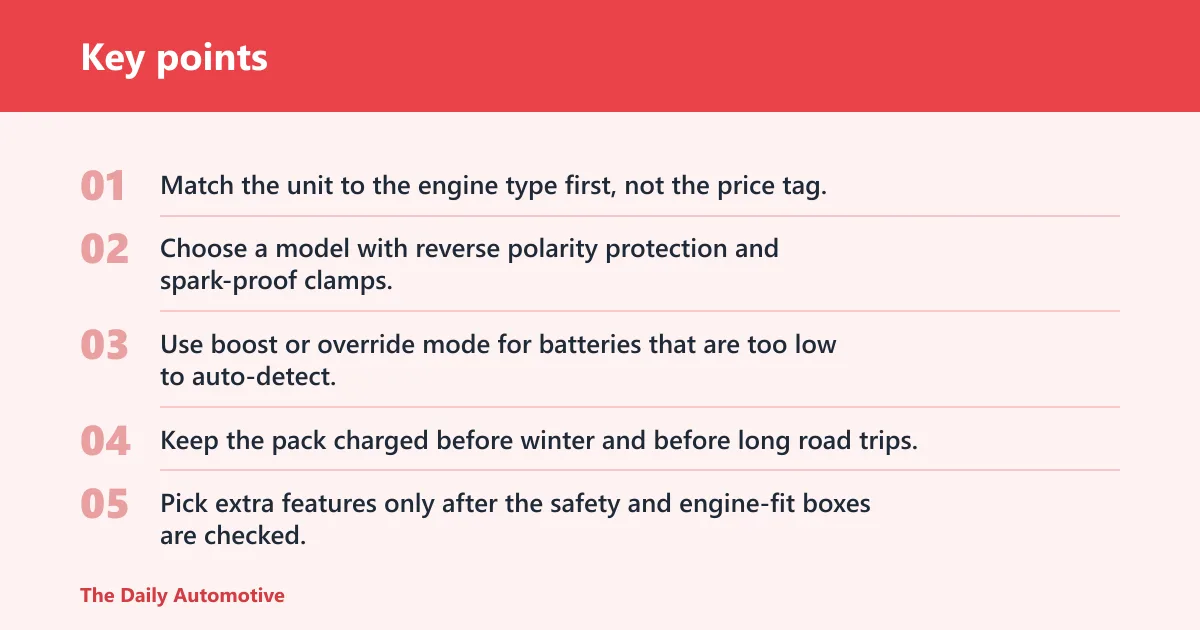
- Match the unit to the engine type first, not the price tag.
- Choose a model with reverse polarity protection and spark-proof clamps.
- Use boost or override mode for batteries that are too low to auto-detect.
- Keep the pack charged before winter and before long road trips.
- Pick extra features only after the safety and engine-fit boxes are checked.
A common first-timer mistake is buying a tiny pack because the box says “portable,” then finding it underpowered for a V8 SUV in freezing weather. Portability only matters if the pack can still deliver enough current when the battery is truly flat.
Extra features are nice, but they are not the main event. A flashlight helps at night. USB ports help your phone. An air compressor helps tire pressure. None of them substitutes for enough starting output, proper clamp protection, and a recharge schedule that keeps the pack ready.
Frequently asked questions
How to jump start a dead car battery
Connect the clamps exactly as marked, wait for the unit to confirm readiness, and try the start only after the pack has established a safe connection. If the battery is too low for auto-detection, use the unit’s boost or override function. Then recharge the pack soon after use.
What’s the best car battery jump starter
For most drivers, the best car battery jump starter is the one that fits the vehicle first and the storage plan second. A compact model like the NOCO Boost Plus GB40 suits many gas cars, while bigger trucks and diesels need more margin, longer cables, or a higher-output pack.
What is a good car battery jump starter?
A good car battery jump starter has reverse polarity protection, spark-proof clamps, enough output for the engine size, and a recharge schedule you will actually follow. If the battery can go fully flat, a boost or manual override mode is especially valuable because auto-detection can fail.
Which jump starter is best for a completely dead battery?
For a completely dead battery, the best choice is usually a model with boost or force-start behavior rather than the smallest compact pack. That matters because some batteries are so low-voltage that the jump starter will not detect them automatically. High-output models are safer bets.
How many amps do I need for my car or truck?
Use engine size, diesel compatibility, and cold-weather margin as better guides than one number alone.
What features make a jump starter safer to use?
Reverse polarity protection and spark-proof design are the main safety features to require. Those features help reduce user error during roadside use. After that, clear indicator lights and a readable battery status display are useful, but they are secondary to the protection circuitry.
How often should I recharge a jump starter?
Recharge it before winter, before long road trips, and anytime the indicator shows a low state of charge. Lithium jump starters are meant to sit ready, not empty. If the unit has been unused for months, check it before you need it, not after the car fails to start.
Is a compact jump starter strong enough for a dead battery?
Sometimes, yes. For a small gas car, a compact lithium pack is often enough. For a larger SUV, truck, diesel, or deeply discharged battery, compact size can become the limitation. If the engine is big or the weather is cold, choose a larger model.
Should I buy a jump starter with extra features like a flashlight or air compressor?
Only if the core jump-start specs already fit the vehicle. Flashlights, USB ports, and compressors are useful add-ons, but they do not make an underpowered unit suitable for a truck or diesel. Buy for starting ability first, then treat extras as convenience features.
How to jump-Start a car with a dead battery – Consumer Reports — How to jump-Start a car with a dead battery
Follow the same basic sequence Consumer Reports outlines: safe connection, correct clamp order, then a start attempt after the pack is ready. The useful takeaway is that a jump starter should be used as a controlled power source, not as a guess-and-hope accessory. Safety comes first.
Products related to this article
Sponsored / affiliate links. As an Amazon Associate I earn from qualifying purchases. I may earn additional commission from eligible campaigns.