Trash Bin for Car: Tested & Reviewed (3 Picks)
The best car trash bin depends on where it sits and how much trash it must hold: use about 1-2 liters for solo daily clutter, about 3-5 liters for family duty, and a leakproof hanging pouch for road trips with drinks and snacks. Buy too small, and waste piles up fast. Buy too large, and you get a bin that spills, shifts, or eats legroom. This guide starts with format and fit, then reviews three bins for tiny daily trash, family mess, and spill-prone travel.
Quick verdict and top pick
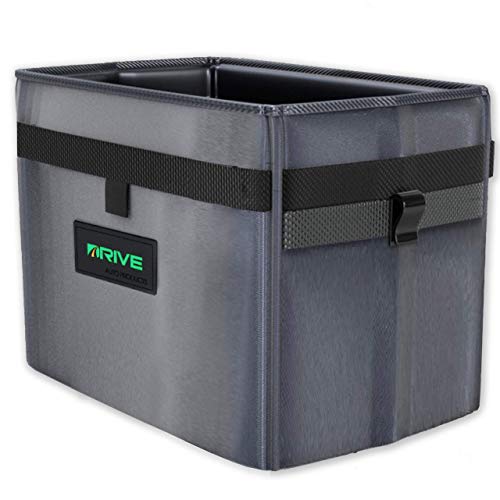


The Hotor two-gallon bag is the best overall pick for most drivers because it balances capacity, stability, and cleanup, with a self-sealing rubber top, external webbed pockets, and magnet-mounted straps that help it stay in place. It fits daily commuting better than a huge specialty bag, yet holds far more than a mini cupholder can.
If your trash is mostly receipts, snack wrappers, and parking stubs, start smaller. If your back seat collects snack cups, tissues, and water bottles, go up a size. For camping or overlanding, skip the everyday formats and move to a spare-tire bag instead.
Quick picks at a glance
- Best for tiny daily clutter: Oudew cupholder can, roughly 16 ounces / about 600 ml, with a snap-in-place lid and spring-loaded flap.
- Best for family mess: Hotor hanging bag, available in one-, two-, and three-gallon capacities; the tested pick was the two-gallon option. (Caranddriver)
- Best for spill-heavy road trips: Rhino USA Spare Tire Trash Bag, a specialty choice for camping and overlanding.
Which trash bin fits your car?
Start with the cabin layout, then pick capacity. A mini bin fits a narrow console or door pocket. A hanging pouch fits the back of a seat or the side of a console. A floor bin works when seat-back mounting is awkward, while a spare-tire bag belongs outside the cabin entirely.
| Vehicle type | Mounting location | Typical waste type | Minimum capacity | Leak risk | Recommended bin style |
|---|---|---|---|---|---|
| Solo commuter sedan or compact hatchback | Cupholder, door pocket, or center console side | Receipts, gum wrappers, tissues, parking stubs | 16 ounces to 600 ml | Low if you are only tossing dry trash | Cupholder-style mini trash can |
| Family SUV or minivan | Seat back, headrest strap, or rear console | Snack wrappers, cups, tissues, small food packaging | 2 to 2.5 gallons | Moderate because spills and loose lids are more likely | Hanging seat-back trash can |
| Pickup, crossover, or vehicle with awkward rear-seat access | Floor, footwell edge, or between seats | Mixed commuter trash, some bottles, light spill risk | 2 gallons or larger | Moderate unless the liner is waterproof | Floor-mounted anchored bin |
| Truck or SUV used for camping and overlanding | Exterior spare tire | High waste loads, campsite trash, snack packaging, damp refuse | Large specialty capacity | Higher, because weather exposure and wet waste are common | Spare-tire trash bag |
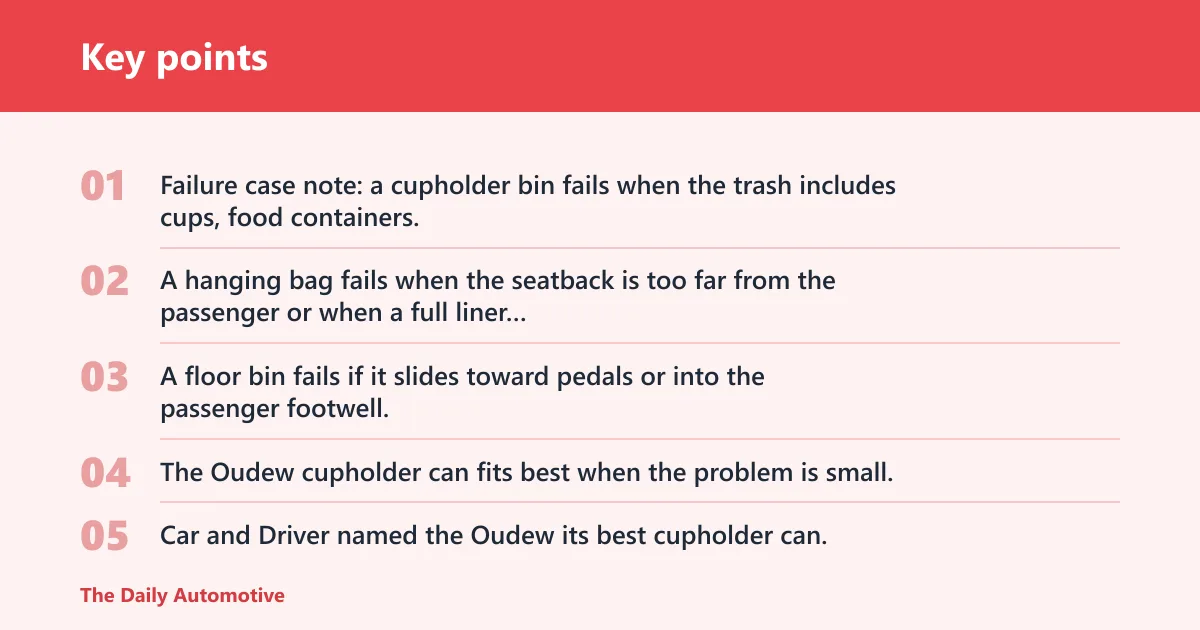
Failure case note: a cupholder bin fails when the trash includes cups, food containers, or any item taller than the opening. A hanging bag fails when the seatback is too far from the passenger or when a full liner makes the lid hard to close. A floor bin fails if it slides toward pedals or into the passenger footwell.
Best compact cupholder bin
The Oudew cupholder can fits best when the problem is small, frequent clutter rather than bulk. Car and Driver named the Oudew its best cupholder can, and the listing describes it as roughly 16 ounces or approximately 600 ml, about 3.6 inches wide. That size suits receipts, wrappers, and tissue scraps.
Its snap-in-place lid with a spring-loaded flap helps keep trash out of sight and reduces the chance that loose scraps blow back into the cabin. The tradeoff is obvious: once the bin is half full, the opening can feel restrictive. That is a capacity limit, not a defect.
Best fit notes: choose this style for front-seat cupholders, deep door pockets, or a narrow console cubby. Skip it if you regularly toss drink lids, food cartons, or anything that needs a wide opening.
Best hanging seat-back bin
The Hotor bag suits family use because it carries more volume than a mini bin and stays reachable from the rear seat. Car and Driver listed the Hotor bag as its best overall pick and tested the two-gallon option. It is also available in one-, two-, and three-gallon capacities.
Its self-sealing rubber top matters more than the shape alone. The opening lets passengers drop trash with one hand, while the sealed top helps conceal odor and keep loose waste from spilling back out during braking. External webbed pockets add a place for tissues or extra liner bags.
The liner is held by four magnets attached to straps, which is a useful example of mounting hardware doing real work. Adjustable straps, hook-and-loop closures, and magnetic liner holders all help, but only if the bag stays taut and does not swing into the passenger’s knees.
Best fit notes: use this for minivans, SUVs, and back seats that see snacks, wrappers, and bottled drinks. It is better than a cupholder can when trash volume climbs, but it still needs secure anchoring so the bag does not shift with every stop.
Best floor-mounted bin
A floor-mounted anchored bin is the right choice when seat-back mounting is inconvenient or when you want trash lower and closer to the hand that creates it. Hook-and-loop stabilizers, a non-slip base, or an anchoring strap can keep the bin from sliding, which matters more on hard stops than raw capacity does.
This format works best in a rear footwell, behind a center console, or beside a seat where it will not interfere with pedals, passenger legroom, airbags, or controls. The bin should stay inside the footwell footprint, not protrude into the driver’s reach path.
Best fit notes: choose this when the rear seat has no useful headrest strap point or when a hanging bag would sit too high. Avoid it if the floor area is already crowded with child seats, tote bags, or loose cargo.
Should you get a cupholder bin or a hanging one?
Choose the cupholder bin for daily solo driving and the hanging bin for shared rides or family use. The mini format wins when the load is tiny and the cabin is tight. The hanging style wins when waste volume rises enough that a 16-ounce container fills too quickly and starts to look untidy.
For a 20-minute commute, a small bin can be enough if you mainly discard receipts and wrappers. For school runs, errands, and weekend drives with kids, the larger hanging pouch is easier to live with because it handles a mix of dry trash and light spill risk without constant emptying.
Say your sedan has one open cupholder left and you only toss gum wrappers, coffee receipts, and one tissue packet a day. A cupholder bin fits that pattern. Suppose the same car now carries two kids, snack bags, and drink cups on every trip; the small bin will feel full before the drive ends.
How do you keep trash bins from leaking or smelling?
Use a waterproof or sealed liner, then pick a lid that closes consistently. A leakproof lining limits carpet contamination when a bottle drips or a snack leaks. It also makes cleanup easier, because you can wipe or rinse the interior instead of scrubbing fabric that holds odor.
Material matters here. ABS plastic and silicone are usually easier to wipe clean. Oxford polyester and 600D fabric are lighter and often more flexible, but they can hold smells longer unless they include a PEVA lining or another sealed inner layer. That difference becomes obvious after a spilled drink or food residue.
Lid style matters as well. Spring-loaded flaps, elastic openings, and X-shaped rubber openings all support one-handed access, but they behave differently when the bin gets full. A tight lid keeps the contents hidden, yet it can become annoying if the trash pile rises to the opening and blocks the closure.
- Empty the bin before wet waste sits overnight.
- Rinse or wipe the liner as soon as you notice residue.
- Check that the lid still opens freely when the bin is half full.
- Replace liner bags or inserts before odor becomes noticeable.
- Let the bin dry fully before reinstalling it.
Where should you place a car trash bin?
Place the bin where it is easy to reach without crossing into driving controls or blocking visibility. Front-seat locations work when the driver can drop trash without leaning, but the bin must not touch the brake pedal area, steering column, or airbag zones. Rear-seat placement is safer for bulk.
Console placement can work in larger vehicles, especially if the bin uses a non-slip base or strap. The passenger footwell is acceptable only when the bin stays against the sidewall and does not slide toward feet. Never place a trash bin where it can roll under the pedals or interfere with the seat track.
Picture a compact SUV with a front passenger footwell and a low center console. A floor bin may fit beside the console, but only if it stays clear of the driver’s leg swing and the passenger’s shoes. Move it an inch too far inward, and the safety margin disappears fast.
How do you choose the right size and mount?
Match capacity to trash volume first, then choose hardware that keeps the bin from moving. A 1-2 liter bin covers solo commuting. A 2 to 2.5 gallon hanging pouch fits families. A larger specialty bag makes sense only when the trash load is unusually high, as in road trips or camping.
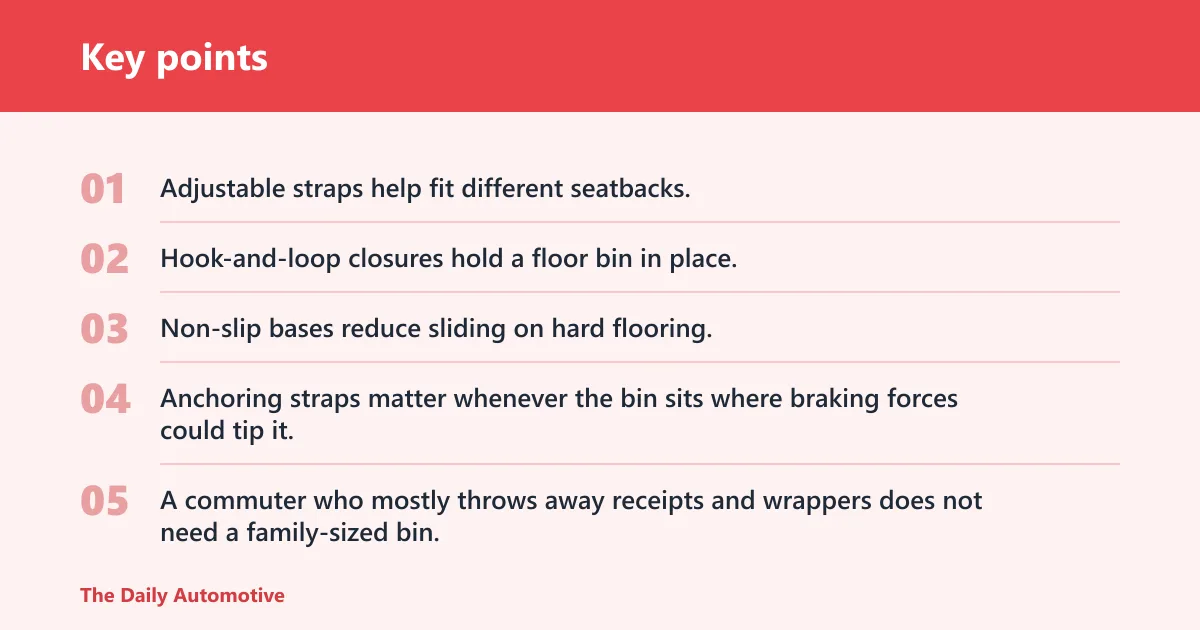
Mounting hardware is not a small detail. Adjustable straps help fit different seatbacks. Hook-and-loop closures hold a floor bin in place. Magnetic liner holders keep the bag aligned. Non-slip bases reduce sliding on hard flooring. Anchoring straps matter whenever the bin sits where braking forces could tip it.
Pick by trash volume
A commuter who mostly throws away receipts and wrappers does not need a family-sized bin. A family that generates snack packaging and paper cups will outgrow a mini can quickly. A high-waste travel day with food containers and damp trash justifies a leakproof pouch with more usable volume.
Pick by construction and cleaning
ABS plastic is rigid and easy to wipe. Silicone is flexible and usually simple to rinse. Oxford polyester and 600D fabric are more common in hanging bins, but they need a sealed liner to resist odor and stains. PEVA lining adds a barrier that matters when liquids enter the bag.
Pick by failure mode
A common first-timer mistake is buying the largest bin that fits on paper, then discovering it blocks legroom or becomes too awkward to empty. Another is choosing a lid that looks tidy but is frustrating to open with one hand. The best bin is the one you can actually use every day.
Frequently asked questions
What is the best trash bin for a car?
The best trash bin for a car depends on volume and placement, not just brand. For most drivers, a hanging bag with a sealed top is the most flexible choice. For tiny daily clutter, a cupholder can works better because it occupies unused space and is easy to reach.
Should I get a cupholder car trash can or a hanging one?
Get a cupholder can if you mostly toss receipts, gum wrappers, and tissues. Get a hanging one if passengers create more waste, if you need a larger opening, or if you want a bin that handles family traffic better. Capacity and reach are the deciding factors.
What size car trash can do I need for daily driving?
For daily solo driving, about 1-2 liters is usually enough. That covers the small, dry waste that builds up on commutes and errands. If the bin starts filling before you end the day, move up to a hanging format rather than forcing a tiny bin to do a bigger job.
How do you keep a car trash can from leaking or smelling?
Choose a waterproof or sealed liner, then empty it before liquids sit. Wipe-clean plastic or silicone is easier to maintain than fabric alone, and a self-sealing or rubber opening helps contain odor. If the bin includes fabric, look for PEVA or another sealed inner layer.
Where should a car trash bin be placed for safety?
Place it where it cannot block pedals, airbags, visibility, or controls. Front-seat locations should stay clear of the driver’s foot path. Rear-seat and console mounting are often safer for larger bins, but only if the bin does not slide into a footwell or interfere with passenger movement.
Are car trash cans good for road trips and families?
Yes, but not every format works. Families and road trips usually need a hanging or larger floor-mounted bin with a leakproof liner and a wider opening. Mini cupholder bins fill too quickly for long drives and are not a good fit for drink cups or heavier snack waste.
Products related to this article
Sponsored / affiliate links. As an Amazon Associate I earn from qualifying purchases. I may earn additional commission from eligible campaigns.