Best Leather Cleaners for Cars (2026): We Compared Top Picks
For most car interiors, the best leather cleaner is a pH-balanced cleaner-only spray for routine care, plus a conditioner kit for dry or neglected leather; choose wipes for quick upkeep and an all-in-one formula only for light maintenance. Use the wrong product and you can leave residue, darken stitching, or dry out finished leather, which shortens seat life and can hurt resale value. This guide ranks top picks by condition and use case, then gives a simple decision path for seats, steering wheels, door panels, and stitched surfaces.
Quick comparison
| Product | Badge | Best for | Price | ||
|---|---|---|---|---|---|
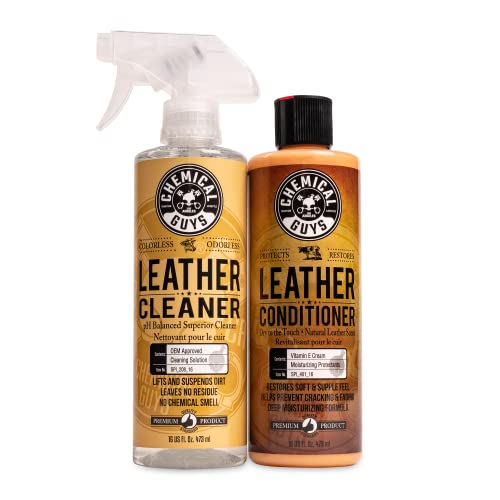 |
Chemical Guys, Leather Cleaner & Conditioner Kit for Cars &Chemical Guys | Our pick | 2 x 16 oz · two-step · cleaner + conditioner | $27.99
Price as of 27 Oct 2026
|
View |
 |
Leather Cleaner & Conditioner Kit by Lexol for Furniture,Lexol | Also great | 16 oz each · two-step · includes sponges | $22.97
Price as of 27 Oct 2026
|
View |
 |
Meguiar’s Gold Class Rich Leather Cleaner & Conditioner –Meguiar’s | Upgrade pick | 15.2 oz · one-step · 6-pack spray | $54.99
Price as of 27 Oct 2026
|
View |
 |
Leather Honey Leather Cleaner – Non-Toxic & Made in the USALeather Honey | Budget pick | Leather cleaner · non-toxic · fragrance-free | $16.99
Price as of 27 Oct 2026
|
View |
 |
SONAX Leather Foam, Car Leather Cleaner and ConditionerSONAX | Our pick | $15.99
Price as of 7 Nov 2026
|
View |
Use this section as the fast filter. The best choice changes with leather condition, not brand fame, and the finish you want matters almost as much as cleaning strength.
Finished leather, perforated inserts, steering wheels, and bolsters can all need different products. A spray may fit one area and be too much for another.
How we chose
We compared products against four practical filters: leather safety, cleaning strength versus residue risk, value over repeat use, and coverage on seats, steering wheels, stitching, and trim.
We also separated maintenance cleaning from deeper rescue work. That matters, because a light-duty wipe can work for a dusty seat and fall short on darkened bolsters or oily touchpoints.
Value was judged by format, refill use, and how often you would need to rebuy. Kits can cost more upfront but sometimes make more sense for dry leather than buying a single bottle repeatedly.
Which leather cleaner fits your car?
Match the product type to the leather’s condition first. Light dust, oily contact points, and neglected seats do not need the same cleaner strength, and over-cleaning can do more harm than missing a spot.
| Leather condition | Product type | Risk level | Finish preference | Best use case |
|---|---|---|---|---|
| Lightly dusty seats | Wipes or a light spray | Low | Natural, OEM-style | Weekly or biweekly upkeep with minimal effort |
| Oily steering wheels | Cleaner-only spray | Medium | Dry, residue-free | Removes hand oils without leaving a slick film |
| Neglected or darkened bolsters | Cleaner plus conditioner kit | Medium to high | Softer, protected finish | Deep-cleaning with follow-up protection |
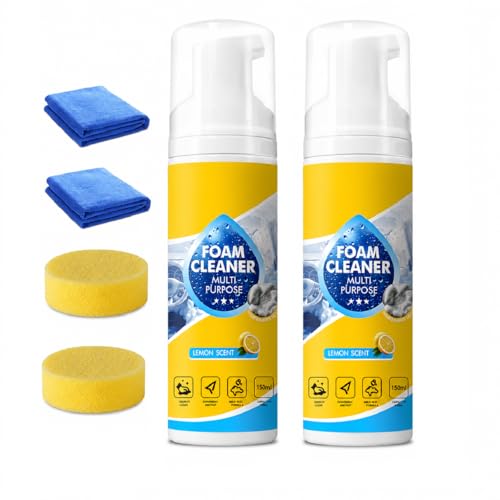
| Family cars with spills | Heavy-duty all-in-one cleaner | Medium | Clean, uniform finish | Mixed interior mess on leather, fabric, and vinyl |
| Quick maintenance between details | Wipes | Low | Dry to lightly conditioned | Fast touchups for seats, armrests, and door inserts |
| Leather that feels dry after cleaning | Cleaner plus conditioner | Medium | Soft, non-greasy | Adds moisture support after dirt removal |
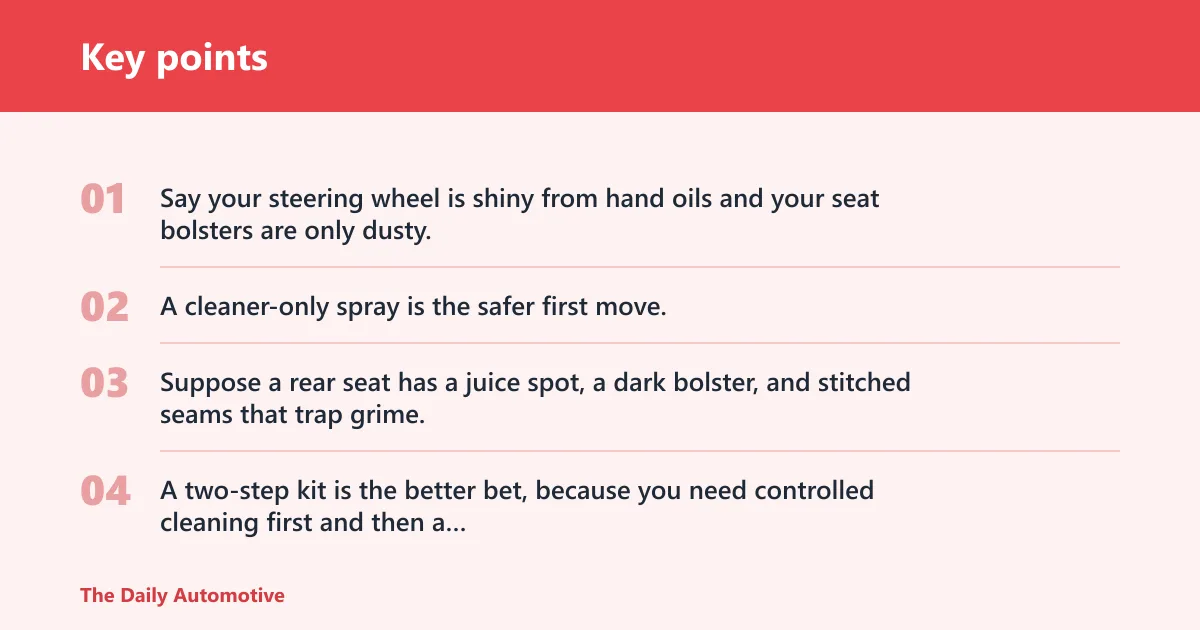
Say your steering wheel is shiny from hand oils and your seat bolsters are only dusty. A cleaner-only spray is the safer first move, because the wheel needs degreasing and the seat just needs a light wipe-down.
Suppose a rear seat has a juice spot, a dark bolster, and stitched seams that trap grime. A two-step kit is the better bet, because you need controlled cleaning first and then a protective layer after the surface is clear.
Leather Honey Leather Cleaner: best for fragrance-free cleaning
Leather Honey is the best fit when you want a non-toxic, fragrance-free cleaner for finished leather seats and upholstery. Based on the product details, it is positioned for deep cleaning dirt, oil, and grime without needing scrubbing after application, and it is specifically described as safe for car seats, faux leather, and vinyl, except suede.
That makes it a strong choice for drivers who dislike perfume-heavy interiors or want a simple cleaner for light to moderate soil. It is also the pick here that most clearly suits buyers who want cleaner-only performance, not a conditioner in the same bottle.
The drawback is clear: you still need a separate conditioner if the leather is dry, and it is not the best match for suede. If you want one bottle to do everything, this is not that product.
Chemical Guys total interior cleaner and protectant: best for all-in-one use
This is the better pick when you want one product for leather plus other cabin materials. Chemical Guys frames it as a two-part kit, but its total-interior approach is the main reason to consider it: it is built to clean and protect leather, vinyl, plastic, rubber, and more, with quick spray-and-wipe use and no rinsing or extra buffing.
It fits daily-driver interiors well, especially if you want a budget-minded product that also helps guard against fading or cracking. The convenience is real, and the multi-surface reach helps if your seats, door panels, console, and trim all need attention at once.
The tradeoff is that all-in-one products are not always the best choice for neglected leather. If the surface is heavily soiled or sticky, a dedicated cleaner or a two-step kit usually gives you more control.
Furniture Clinic Large Leather Care Kit: best for two-step care
For leather that needs more than a quick wipe, the two-step route is the cleanest answer. Good Housekeeping names Furniture Clinic Large Leather Care Kit as best for leather, and that fits the use case here: cleaner first, then a protective layer for seats and other leather items.
This format makes sense when the surface looks dry, feels tired, or has built-up grime in high-touch areas. The advantage is control. You can clean more carefully, then add protection only where the leather needs it.
The drawback is time and cost. A kit takes longer than a spray, and if your seats only need maintenance cleaning, it can be more product than necessary.
CAR GUYS Super Cleaner: best for heavy stains
CAR GUYS Super Cleaner is the best fit when the job is bigger than leather alone. It is rated 4.5 and positioned as an all-in-one interior cleaner, with use on leather, fabric, and vinyl and a reputation for heavy-duty stain removal without harsh chemical odors.
That makes it useful for family interiors where spills, scuffs, and mixed materials show up together. If the car has car-seat leather, cloth inserts, and vinyl trim, one cleaner can simplify the process.
The drawback is the same one that affects many multi-surface products: it is not a specialist conditioner. If the leather is dry or wants added protection after cleaning, you may still want a separate conditioner.
Meguiar’s Gold Class 3-in-1: best for quick conditioning
Meguiar’s Gold Class Rich Leather Cleaner and Conditioner 3-in-1 Spray is the pick for drivers who want cleaner, conditioner, and protectant in one step. It is described as a non-greasy spray with advanced UV protection, which makes it appealing for regular maintenance on seats and touchpoints.
This is a practical choice if you want one bottle for upkeep and do not want to build a separate cleaning and conditioning routine every time. The finish is aimed at looking clean rather than shiny or oily.
The drawback is the same limitation that comes with any 3-in-1 formula: it is convenient, but it is not usually the strongest answer for neglected leather. If a seat is badly darkened, a dedicated cleaner plus conditioner can be more effective.
Which one should you buy?
Start with the leather’s condition, then pick the format that matches the job. If the seats are only dusty, choose a wipe or light spray. If they are dry, neglected, or darkened, move to a two-step kit. If the cabin has mixed materials and light soil, an all-in-one cleaner is the easiest path.
For value, look beyond the sticker price. A bottle that covers more seats, lasts longer, or can be refilled often may cost less per use than a cheap wipe pack. Wipes are convenient, but they usually give less cleaning strength per dollar than a spray or kit.
Price-per-ounce matters most when you clean often. A larger bottle or kit can be better for repeat maintenance, while wipes are best when portability and speed matter more than total cleaning power.
Failure cases are worth treating seriously. Over-cleaning can dry out finished leather. Too much product can leave a sticky residue on steering wheels and armrests. Aggressive scrubbing can also increase dye transfer risk on older or worn surfaces.
Stitching and perforations need more restraint. Spray into a cloth first when possible, then work across the surface with light pressure. That reduces the chance of product pooling in seams or soaking through perforated leather.
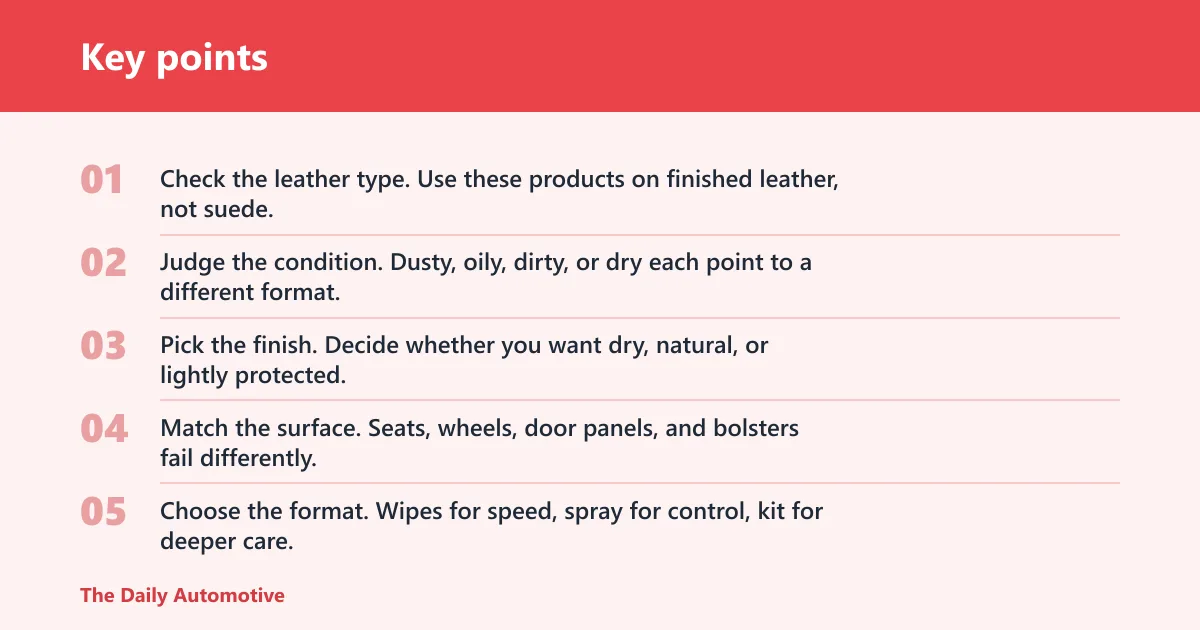
- Check the leather type. Use these products on finished leather, not suede.
- Judge the condition. Dusty, oily, dirty, or dry each point to a different format.
- Pick the finish. Decide whether you want dry, natural, or lightly protected.
- Match the surface. Seats, wheels, door panels, and bolsters fail differently.
- Choose the format. Wipes for speed, spray for control, kit for deeper care.
A common first-timer mistake is trying to solve a dark bolster with a single quick wipe and then repeating the wipe until the area feels tacky. That usually leaves more residue, not less, and it still may not remove the embedded grime.
Should you buy wipes, a cleaner, or a kit?
Buy wipes when you need fast maintenance and portability. They work best for light dust, fingerprints, and quick touchups on steering wheels, armrests, and door inserts. They are the least capable option for deep cleaning, but the easiest to keep in the glovebox.
Choose a spray when the leather is visibly dirty or oily. A cleaner-only spray gives you more control, more cleaning strength, and better reach on seat bolsters, stitching, and perforated sections. It is the best middle ground for routine care.
Choose a two-step kit when the leather is dry, neglected, or in need of added protection after cleaning. That is where Leather Conditioner earns its keep, because it helps support moisture, reduce future cracking risk, and improve the finish after dirt is removed.
Choose an all-in-one formula when the goal is convenience across several interior materials. It is the right call for light maintenance, not the deepest rescue job.
Frequently asked questions
What is the best leather cleaner for car seats?
For most finished leather seats, the best choice is a pH-balanced cleaner-only spray for regular use, or a two-step cleaner and conditioner kit if the seats are dry or neglected. Leather Honey, Chemical Guys, and Furniture Clinic each fit different conditions, so the “best” option depends on how dirty the leather is.
Do I need a leather cleaner or a cleaner and conditioner?
If the leather is only dusty or lightly soiled, a cleaner-only product is often enough. If the seats feel dry, look tired, or need protection after cleaning, a cleaner and conditioner is the better route. Conditioner is useful, but it is not required after every cleaning job.
Can I use leather cleaner on steering wheels and door panels?
Yes, if the cleaner is made for finished automotive leather and used carefully. Steering wheels collect oils faster than seats, so avoid over-application. Door panels may include leather, vinyl, or plastic, which makes an all-in-one interior cleaner useful when you need one product for mixed materials.
How do I clean leather car seats without damaging them?
Start with the mildest product that matches the dirt level. Spray onto a cloth, not directly into seams, and use light pressure. Wipe residue away before it dries, especially on stitching and perforated leather. Avoid harsh chemicals, greasy residue, aggressive scrubbing, and repeated wet passes that can lead to residue or discoloration.
What leather cleaner is best for dirty or neglected seats?
A two-step kit is usually best for dirty or neglected leather because it gives you controlled cleaning followed by protection. A heavy-duty all-in-one cleaner can also help if the car has mixed materials and visible spills. For badly darkened bolsters, a simple wipe is usually not enough.
Is a 3-in-1 leather cleaner worth it?
Yes, if you want convenience and regular maintenance in one bottle. A 3-in-1 can clean, condition, and protect without making the routine complicated. It is less compelling for neglected leather, where separate steps usually do a better job of lifting grime and restoring the finish.
Products related to this article
Sponsored / affiliate links. As an Amazon Associate I earn from qualifying purchases. I may earn additional commission from eligible campaigns.