UV Light for Car: 3 Picks for Stains and a/C Leaks
For car stain spotting or A/C leak checks, choose a 365–395 nm UV light with a focused beam, UV-safe glasses, and the right dye-reactive accessory; a 395 nm compact light is often fine for casual stain checks, while 365 nm is commonly preferred for faint leaks. Wrong wavelength choices miss dye, waste time, and can send you after false positives. This guide covers the 3 best UV lights for each job, plus beam type, wavelength, and accessories to buy with them.
365 nm vs 395 nm
The main trade-off is contrast. 365 nm sits closer to near-invisible output, so fluorescent dye usually stands out better in darker conditions, especially with a filter lens. 395 nm is brighter to the eye and common in budget lights, but it can wash out faint dye and some light-colored stains under shop lighting.
Which wavelength fits A/C dye?
365 nm is the safer first choice for refrigerant dye tracing because it gives the best chance of seeing weak fluorescence without flooding the area with purple spill. GoCarLife describes 365 nm as the gold standard for making dye glow, and that matches how leak work is usually done: maximize contrast, then narrow the field with a lens or a tighter beam.
That matters when the leak is small. Say your A/C condenser has a slow seep and the dye mark is thin, not heavy. A 395 nm light may make the plastic trim look purple before the dye pops, which hides the faint trail. A 365 nm light with a filter lens makes the dye line easier to separate from the background.
Which wavelength fits stains and upholstery?
395 nm is often enough for pet urine, drink spills, and general interior stain checks because it is bright and easy to aim across carpets, mats, and seat fabric. It is also the more common budget choice. The limit is contrast: some pale stains do not stand out as cleanly, especially in daylight or under bright bay lighting.
For upholstery, the target is not “more purple.” The target is a visible reaction from the stain against the surrounding material. A blacklight flashlight can work well on carpets and mats, but it should be treated as a locator, not proof of what caused the mark. Many fluids fluoresce.
Car UV light decision matrix
Pick the tool for the task, not the label on the box. A narrow leak light helps you isolate fluorescent dye on hard parts and under the hood. A wider blacklight flashlight is usually better for scanning carpet, cargo liners, and seat bottoms where stains can be spread out. LED count matters less than wavelength quality and beam control.
| Task | Best wavelength | Beam type | Accessory needs | Likely failure mode | Recommended minimum spec |
|---|---|---|---|---|---|
| A/C refrigerant dye leak tracing | 365 nm | Narrow or focused | Filter lens, UV-safe glasses | Faint dye gets lost in purple spill | 365 nm light with contrast control |
| Pet urine on carpet or mats | 395 nm or 365 nm | Wide scan beam | None required, glasses helpful in bright areas | False positives from other residues | Portable blacklight flashlight with even spread |
| Mixed-use owner, one tool for both jobs | 365 nm preferred | Adjustable or medium beam | Filter lens and glasses | Too much spill for leaks, too little coverage for stains | 365 nm, USB-C rechargeable, compact body |
| General stain checks in daylight or a lit garage | 395 nm | Wide beam | None required | Contrast loss under strong ambient light | Bright 395 nm light with enough output to scan quickly |
How do you test a UV light for car stains or leaks?
Test it in a controlled, darkened space with a known fluorescent target, such as dye already added to an A/C system or a known stain-reactive cleaner on an inconspicuous fabric sample. Judge contrast, hotspot shape, and working distance, not purple glow alone. If ambient light floods the area, faint fluorescence disappears.
- Darken the cabin or work bay as much as possible.
- Start with a known fluorescent target, not an unknown stain.
- Hold the light at a short, safe distance and scan slowly.
- Look for sharp contrast, not a bright violet wash.
- Check how far the beam spreads and whether the center hotspot hides edges.
- Repeat under brighter conditions to see what contrast survives.
A common first-timer mistake is checking a leak under a strong overhead lamp and assuming the dye is weak. Often the issue is the room, not the light. Reflective plastic, clear coat, and glossy trim can throw stray light back at the eye, so move the beam angle before you blame the dye.
What should you look for in a car UV light?
Start with beam shape, then wavelength, then power features. For leak tracing, you want a more controlled beam that does not flood nearby surfaces. For stains, you want coverage across a wider patch of carpet or upholstery. LED count can help as a rough brightness proxy, but it does not tell you whether the light sits at the right wavelength.
Beam shape matters more than raw LED count
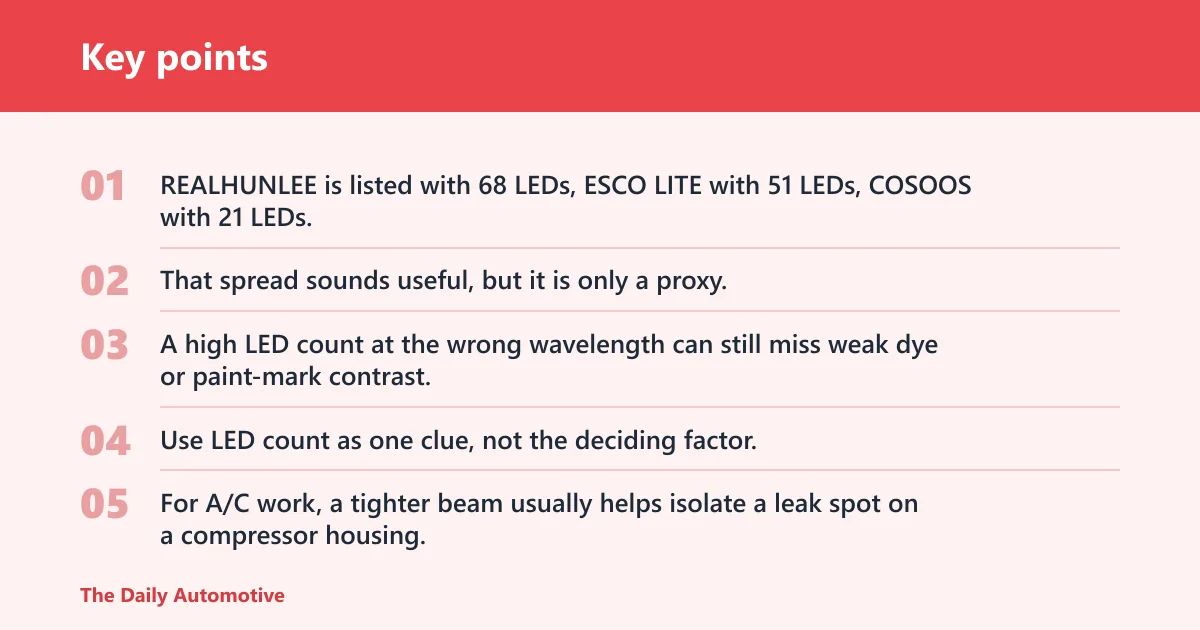
LED count ranges widely across the category. REALHUNLEE is listed with 68 LEDs, ESCO LITE with 51 LEDs, COSOOS with 21 LEDs, and Vansky with 100 LED beads. That spread sounds useful, but it is only a proxy. A high LED count at the wrong wavelength can still miss weak dye or paint-mark contrast.
Use LED count as one clue, not the deciding factor. For A/C work, a tighter beam usually helps isolate a leak spot on a compressor housing, hose crimp, or evaporator drain area. For carpets, a broader beam saves time because you are scanning large surfaces.
USB-C rechargeable batteries are easier to live
USB-C rechargeable battery support matters because glovebox storage is better when the light can be topped up quickly. DARKBEAM is listed as USB-C rechargeable, which fits a keep-it-in-the-car use case. GoCarLife also lists the Streamlight Stylus Pro UV as rechargeable with a 2.5 hrs runtime, showing that battery convenience is a real buying factor.
Runtime and charging method affect how often the light is ready when you need it. A compact light that charges easily is more likely to stay in the car. A dead tool is useless, even if its wavelength is perfect. For a glovebox or door-pocket kit, recharge speed often matters more than a long spec sheet.
Housing, switch, and grip still matter
Aluminum bodies are worth seeking out because they hold up better in a trunk or tool bag. A compact aluminum-body leak detector with about 21 LEDs fits that logic. A secure switch and a body you can hold with gloves on are practical details that matter in dim spaces and awkward angles.
Suppose you are checking under a dash with one hand on a trim panel and the other on the light. A slippery shell or a stiff switch slows the job and can shift the beam away from the exact leak point. Small design choices can matter more than a bigger LED number.
Do you need protective UV glasses?
Yes, protective glasses are worth having, especially for leak kits and brighter work conditions. They help reduce eye strain and can improve visibility by cutting stray light. REALHUNLEE includes protective glasses, which is a useful sign that the kit is built for dye work rather than casual novelty use.
When glasses help the most
Glasses are most useful when you are working near reflective plastics, chrome, wet surfaces, or bright garage lighting. They are also helpful when the source light is stronger and spill is higher. A filter lens on the light and protective glasses on the user do different jobs, and both can help with contrast.
That does not make them optional for every tiny task, but they are the right call whenever you are tracing dye around glossy parts or peering into a cramped engine bay. Eye safety should not depend on how short the scan seems.
Choose 365 nm if… / Choose 395 nm if…
Choose 365 nm if your main job is A/C leak tracing, if you want better dye contrast, or if you plan to use a filter lens and inspect in darker conditions. Choose 395 nm if you mostly want a bright, inexpensive light for stains, mats, and casual checks where wide coverage matters more than faint-dye separation.
Choose 365 nm if…
Pick 365 nm when the leak is faint, the vehicle is already serviced with fluorescent dye, or the inspection area has enough control to let near-invisible output work. uvBeast New V3 MINI is described as a pocket-sized 365 nm UV light, and DARKBEAM is listed by GoCarLife as a 365 nm pick with USB-C rechargeability.
365 nm also makes sense for mixed-use owners who want one light to cover more than one job. It is the safer compromise when you care more about finding weak fluorescence than lighting up the cabin purple. Add glasses and, for leak work, a filter lens.
Choose 395 nm if…
Pick 395 nm if you want a common budget light for pet urine, upholstery checks, and general stain spotting. The same source notes that cheaper lights often use 395nm and cast a purple glow. That is fine for broad scanning, but it can lose contrast on some stains and dye marks.
DARKBEAM is listed with a 395 nm beam and about 1300mW output, which suggests a stronger budget-style option on paper. It can be useful for wide scanning and casual leak work, but 395 nm still is not the first choice when the dye is faint or the background is bright.
UV light picks for car jobs
The three best fits below are selected by job match, not by LED hype. One is better for tight leak work, one fits mixed-use buyers, and one is the simpler choice for general stain spotting. Source details are included so you can verify the specs before buying.
| Pick | Wavelength | Beam type | Battery type | Runtime | Charging method | Accessory bundle | Best use case |
|---|---|---|---|---|---|---|---|
| uvBeast New V3 MINI | 365 nm | Pocket light | Not stated in source | Not stated in source | Not stated in source | Not stated in source | Faint A/C dye checks and compact carry |
| DARKBEAM | 395 nm | Compact beam | USB-C rechargeable | Not stated in source | USB-C | Not stated in source | Budget stain spotting and casual leak searches |
| REALHUNLEE detector | 385–395 nm | Detector-style | Not stated in source | Not stated in source | Not stated in source | Protective glasses included | Leak kit use when eyewear is part of the package |
uvBeast New V3 MINI
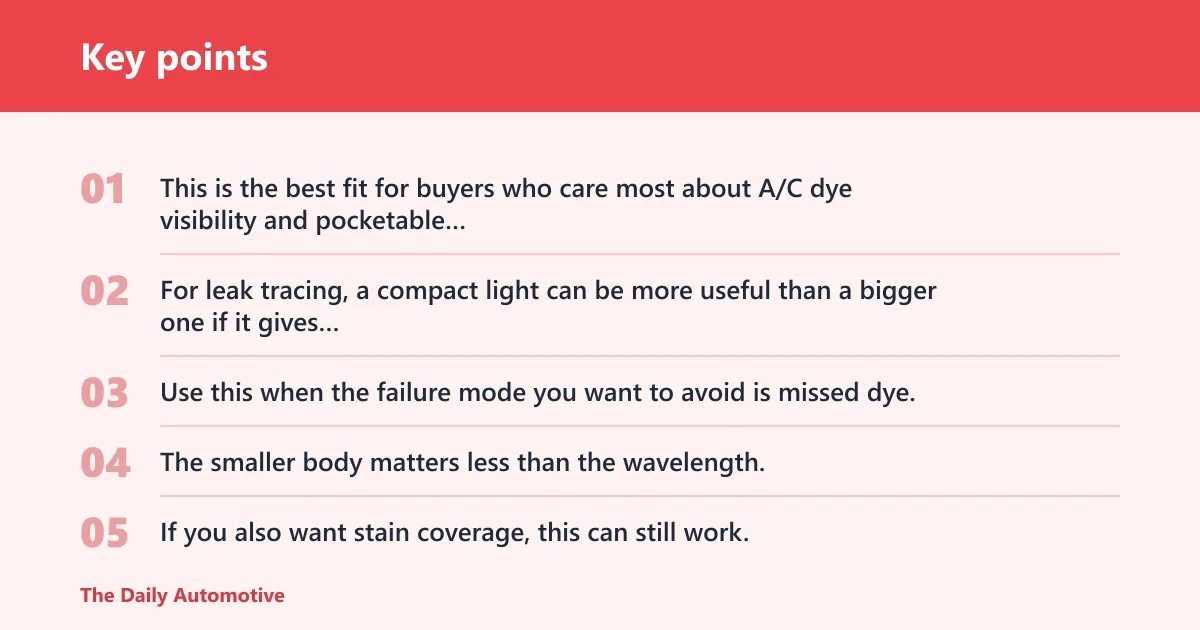
This is the best fit for buyers who care most about A/C dye visibility and pocketable size. The 365 nm wavelength is the key point here. For leak tracing, a compact light can be more useful than a bigger one if it gives cleaner contrast and slips into the glovebox without effort.
Use this when the failure mode you want to avoid is missed dye. The smaller body matters less than the wavelength. If you also want stain coverage, this can still work, but you may prefer a broader scan light for large seat or carpet areas.
DARKBEAM
This is the practical budget pick for general car use. The source data ties it to a 395 nm beam, about 1300mW output, and USB-C rechargeability. That makes it useful for quick scans, easy charging, and glovebox storage, especially when you want one light for casual inspections and stain work.
The trade-off is contrast. A 395 nm light can be very usable, but it is not the first pick for faint A/C dye in a bright bay. If you buy it for mixed use, treat it as a broad utility light rather than the sharpest leak tracer.
REALHUNLEE detector
This is the best fit when you want a leak-detector bundle with eyewear included. The listed 68 LEDs and protective glasses make it a more complete kit for refrigerant dye work. Automotive Guides Hub also notes a 385–395 nm range, and General Auto Pro lists it at 12.3W.
That range is still closer to the purple end than a true 365 nm leak tool, so it is not the strongest choice for the faintest dye trails. But for buyers who want a ready-to-use kit with glasses and a broad detector setup, it is the clearest package among the three.
Choose uvBeast New V3 MINI if… / Choose DARKBEAM if… / Choose REALHUNLEE detector if…
Choose uvBeast New V3 MINI if you want the cleanest A/C dye visibility, the smallest carry size, or a light that leans toward leak work first. Choose DARKBEAM if you want a USB-C rechargeable budget light for stain checks and occasional leak tracing. Choose REALHUNLEE if you want a detector-style kit with glasses included.
Choose uvBeast New V3 MINI if…
- You care most about dye contrast on refrigerant leaks.
- You want a pocket-sized light for glovebox storage.
- You are willing to trade broad stain coverage for better leak visibility.
Choose DARKBEAM if…
- You want a rechargeable 395 nm light for general car use.
- You need a compact, easy-to-top-up tool.
- You mostly inspect mats, carpet, and visible stains.
Choose REALHUNLEE detector if…
- You want a kit with protective glasses included.
- You prefer a detector-style light for dye work.
- You want a broader LED layout for general leak checking.
Which UV light for which car job?
This matrix turns the buying decision into a job-tool match. The main point is simple: pick the wavelength and beam that fit the failure mode you are trying to avoid. Leak work wants contrast and control. Stain work wants coverage and enough brightness to scan quickly.
| Task | Best wavelength | Beam type | Accessory needs | Likely failure mode | Recommended minimum spec |
|---|---|---|---|---|---|
| Faint A/C dye on engine bay parts | 365 nm | Narrow | Filter lens, UV-safe glasses | Missed dye in bright spill | 365 nm with controlled output |
| Pet urine on rear seat carpet | 395 nm | Wide | Glasses helpful, not required | False positives from other fluorescing residues | Portable blacklight flashlight |
| Fast scan of floor mats | 395 nm | Wide | None required | Uneven coverage from a hotspot beam | Even beam spread |
| Mixed-use owner who wants one light | 365 nm | Medium | Filter lens and glasses | Compromise beam that does neither job well | USB-C rechargeable compact light |
Frequently asked questions
How are UV lights rated for automotive use?
Automotive UV lights are usually described by wavelength, LED count, output, beam shape, and charging method. Wavelength matters most. LED count can hint at brightness, but it is only a rough proxy. For real car work, beam control and contrast matter more than a large LED number.
What wavelength is best for car A/C leak detection?
365 nm is the best starting point for A/C leak detection because it is closer to near-invisible output and usually gives better dye contrast. A filter lens can help further by blocking stray visible light. A 395 nm light may work, but it is easier to lose faint dye in the spill.
Is 365nm better than 395nm for a car UV light?
For leak tracing, yes. For broad stain spotting, not always. 365 nm is usually better when you need contrast and faint-dye visibility. 395 nm is often better when you want a brighter, cheaper light for carpets, mats, and casual interior checks.
What should I look for in a UV light for pet urine in a car?
Look for a wide beam, enough brightness to scan quickly, and a light you can hold steadily over upholstery and carpet. A 395 nm blacklight flashlight is often fine for this job. Keep in mind that UV can reveal many fluorescing substances, so it locates stains without proving the source.
Do I need protective glasses when using a UV light on a car?
They are smart to have, especially for leak kits and brighter work. Protective UV glasses help reduce eye strain and can improve visibility in mixed lighting. They are especially useful near reflective trim, wet surfaces, and tight engine bays where stray light bounces back at you.
How do battery life and charging type affect UV light performance?
Battery life decides whether the light is ready when you need it, and charging type affects how easy it is to keep it ready. USB-C rechargeable batteries are convenient for glovebox storage and quick top-ups. A good wavelength with a dead battery still gets no job done.
Can one UV light handle both stain detection and A/C leak tracing?
Yes, but it is a compromise. A 365 nm compact light is the better mixed-use choice because it leans toward leak visibility while still working for stains. A 395 nm light is better for broad stain work, but it can give up some contrast on faint refrigerant dye.
Products related to this article
Sponsored / affiliate links. As an Amazon Associate I earn from qualifying purchases. I may earn additional commission from eligible campaigns.