Car Battery Charger vs Battery Maintainer
For storage under about 30 days, use a battery maintainer; for a dead battery, a deeply discharged battery, or any recovery job, use a charger; avoid a basic trickle charger unless the battery and charge rate are closely matched. Get it wrong and you can strand the car, overcharge an AGM or lithium battery, or shorten battery life. This guide shows which tool fits your parking pattern, battery state of charge, and battery chemistry.
| Factor | Car Battery Charger | Battery Maintainer | Winner |
|---|---|---|---|
| Primary job | Restores a discharged or dead 12V battery | Holds charge during storage and low-use periods | Tie |
| Typical current | From a few amps to over 25 amps | Usually low-amperage, often 2A or less | Car Battery Charger |
| Automatic behavior | Smart models may stop, taper, or switch modes on their own | Turns on and off as needed to avoid overcharging | Battery Maintainer |
| Best parking window | Hours to a couple of days for recovery | Weeks or months, including seasonal storage | Battery Maintainer |
| Best battery state | Low state of charge, below-threshold, or dead | Healthy battery that only needs top-off support | Car Battery Charger |
| Can cover both jobs | Yes, if it is a smart charger with maintenance mode | Only for small top-offs, not true recovery | Car Battery Charger |
What each tool does
A car battery charger is the recovery tool. It is meant to put energy back into a discharged or dead 12V battery, and consumer and parts sources describe output that can run from 2A to 25A or more. A battery maintainer is the storage tool. It stays on a healthy battery and cycles on and off to hold charge without pushing it too far.
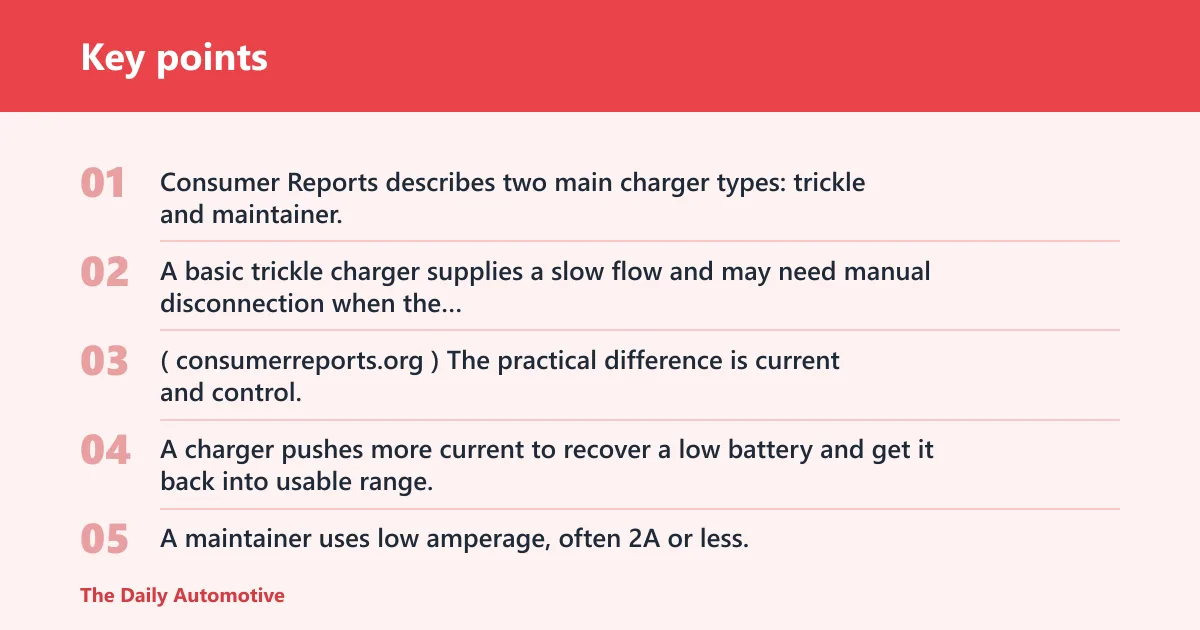
Consumer Reports describes two main charger types: trickle and maintainer. That is where the confusion starts. A basic trickle charger supplies a slow flow and may need manual disconnection when the battery is topped off, while a maintainer is built to watch the battery and switch on only as needed. (Consumerreports)
Charger vs maintainer at a glance
The practical difference is current and control. A charger pushes more current to recover a low battery and get it back into usable range. A maintainer uses low amperage, often 2A or less, and is built for long idle time rather than fast recovery.
That is why a smart charger can cover both jobs in some cases. A microprocessor-controlled unit may charge, sense battery condition, and then drop into maintenance mode. If the manual lists AGM or lithium profiles, it can be a better buy than a one-function device.
When should you use a charger?
Use a charger when the battery is dead, deeply discharged, or too low for a maintainer to begin a normal cycle. That is the right tool after a jump-start, after lights were left on, or when a vehicle has sat long enough that the battery no longer starts the engine. A maintainer is not a recovery device.
Some smart chargers include repair, boost, engine-start, and temperature-compensation modes. Consumer Reports also notes that some chargers include de-sulfation for traditional flooded batteries. That can help on a neglected battery, but it does not promise recovery if the battery is severely damaged.
Use a charger for recovery jobs
Say your sedan sat for six weeks and now only clicks. That is a charger job, not a maintainer job. If the battery is below the level where the maintainer recognizes a normal charge cycle, the maintainer may never begin charging at all.
For charge rate, Parwatt Parts lists 4A to 8A for everyday passenger vehicles and 10A to 15A for faster charging for cars and SUVs, while 2A is listed for maintenance and motorcycles. Higher-output chargers can shorten recovery time, but only if the battery chemistry and charger mode match.

When should you use a maintainer?
Use a maintainer for seasonal storage, infrequent driving, and batteries that sit for weeks or months. The same source says maintainers are for cars parked for weeks or months at a time, and that is the cleanest use case. If the vehicle starts reliably but spends long stretches parked, a maintainer is the better fit. (Caranddriver)
Borderline parking patterns matter. If a car sits 7 to 21 days and still starts sometimes, a maintainer is usually the safer default. If the battery is already low, though, a charger should come first. The maintainer preserves; it does not rescue a weak battery.
How to connect a maintainer for storage
- Check the owner’s manual for charging limits and battery type.
- Use the supplied clips for short-term access, or install a pigtail or quick-connect lead on the battery for stored vehicles.
- Route the lead away from belts, hot exhaust parts, and sharp edges.
- Plug in the maintainer only after the clamps or eyelets are secure.
A pigtail or quick-connect lead is often the cleaner setup for a car, motorcycle, or classic that sits for weeks. It avoids repeated clamp use and makes unplugging fast. Eyelet-style connectors are also easier to keep in place under a seat or near the battery box.
Which one do you need?
| Parking pattern | Battery state | Battery chemistry | Recommended tool | Safe connection duration | Warning signs the tool is wrong |
|---|---|---|---|---|---|
| Daily driver with short trips | Starts normally, but charge falls between drives | Flooded lead-acid | Battery Maintainer | Can stay connected between use cycles if the manual allows it | Battery is already too low, or the charger never enters maintenance mode |
| Weekend car | Healthy, but sits 5 to 10 days | Flooded lead-acid or AGM | Battery Maintainer | Weeks at a time on an approved smart maintainer | Frequent need for jump-starts suggests a recovery charger is needed first |
| Winter storage | Fully charged before storage | AGM or flooded lead-acid | Battery Maintainer | Weeks or months, if the device is designed for storage | Heat, swelling, or repeated full-charge alerts mean the battery or charger profile is wrong |
| Dead battery | Dead or deeply discharged | Flooded lead-acid or AGM | Car Battery Charger | Until the battery reaches normal charge, then switch to maintenance if supported | Maintainer never begins charging, or the battery will not hold any recovery |
| AGM vehicle | Low after sitting or repeated short trips | AGM | Car Battery Charger | Until full, then use AGM maintenance mode if available | No AGM setting, high heat, or overcharge symptoms |
| Motorcycle | Small battery, low draw, stored often | AGM, flooded lead-acid, or lithium if specified | Battery Maintainer | Long-term, with a low-current model matched to the battery | Charge rate is too high for the battery, or the unit lacks the correct chemistry mode |
| Car with high parasitic draw | Battery drains while parked | Flooded lead-acid or AGM | Car Battery Charger | Recovery first, then a maintainer only if the draw issue is fixed or the car is plugged in continuously | Battery keeps dropping despite maintenance, which points to a draw problem |
| Long-term storage | Charged and parked for months | Flooded lead-acid or AGM | Battery Maintainer | Weeks to months, with an approved smart maintainer | Dumb trickle charging, no automatic shutoff, or an unlabeled chemistry mode |
Decision rules that settle the borderlines
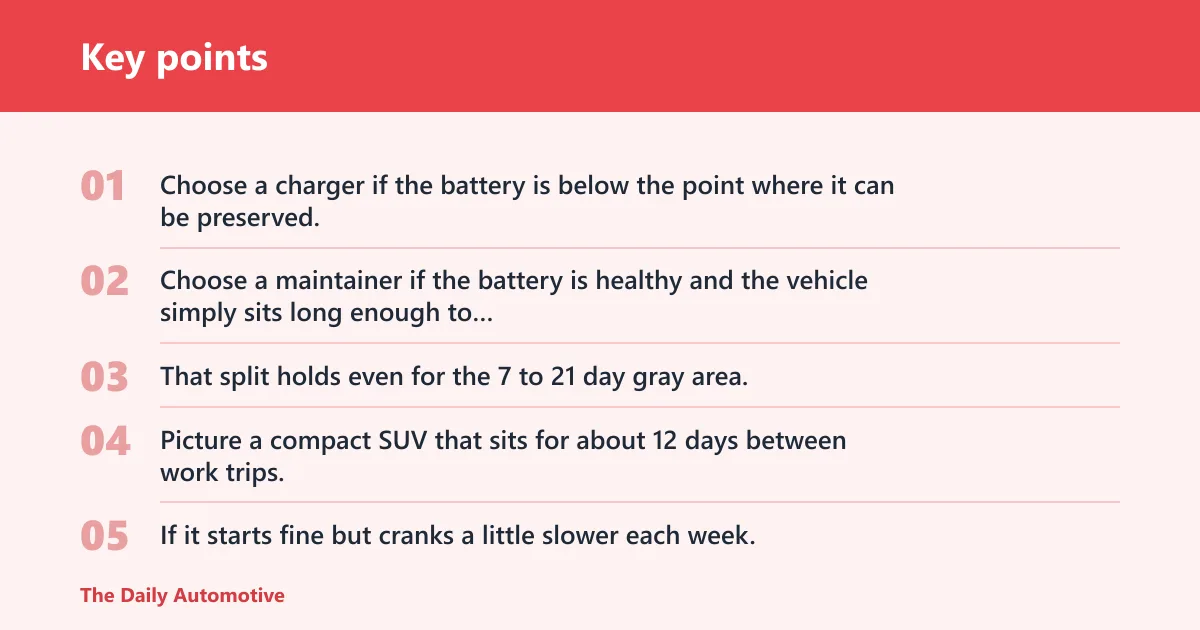
Choose a charger if the battery is below the point where it can be preserved, if it has gone flat, or if it needs recovery after sitting. Choose a maintainer if the battery is healthy and the vehicle simply sits long enough to self-discharge. That split holds even for the 7 to 21 day gray area.
Picture a compact SUV that sits for about 12 days between work trips. If it starts fine but cranks a little slower each week, a maintainer fits better than repeated jump-starts. If it already needs a boost, the first move is a charger with the correct battery profile.
Choose Car Battery Charger if… / Choose Battery Maintainer if…
Choose Car Battery Charger if: the battery is dead, deeply discharged, or below the level a maintainer can recognize; you need recovery after a jump-start; or you want one smart unit that can charge first and then switch to maintenance mode. It also makes more sense for high parasitic draw cases, where the battery needs periodic recovery rather than simple top-off.
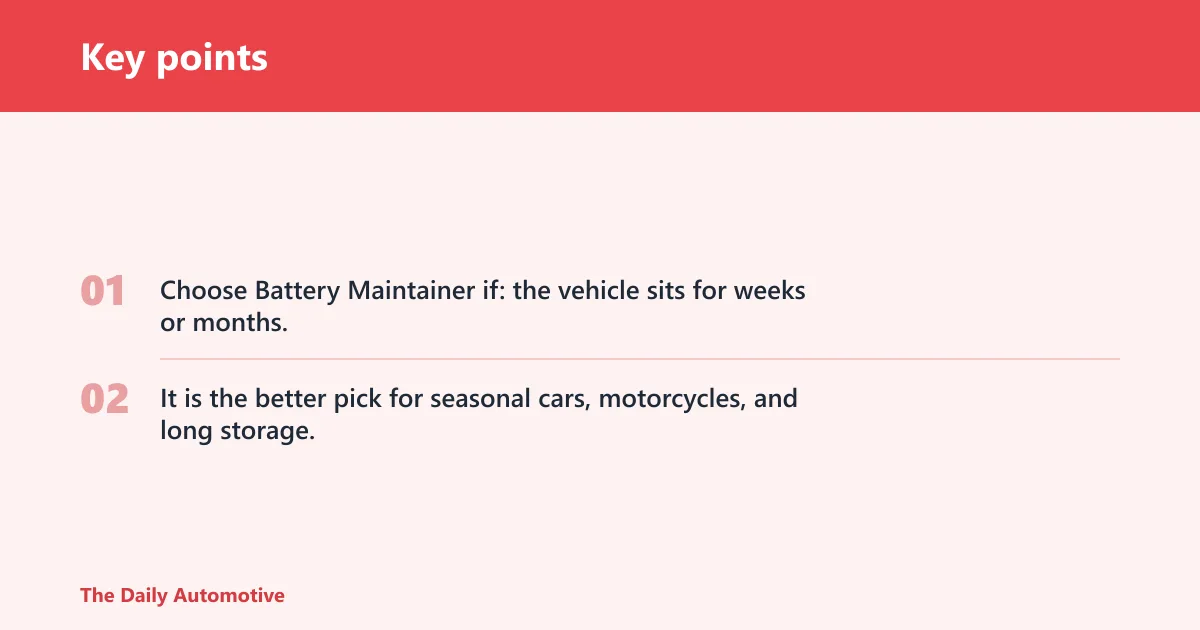
Choose Battery Maintainer if: the vehicle sits for weeks or months; the battery is already healthy; or you want a low-amperage device that can stay connected without overcharging. It is the better pick for seasonal cars, motorcycles, and long storage, as long as the battery chemistry and the maintainer profile match.

Battery chemistry and safety checks
Match the tool to the chemistry. Lead-acid batteries include flooded and AGM variants, while gel, EFB, and lithium need the right charger profile or mode. AGM batteries are common in modern vehicles and storage use, and they need a charger or maintainer with an AGM mode or profile to avoid undercharging or overcharge stress.
The same source says advanced maintainers often include AGM modes, and some chargers include de-sulfation for traditional flooded batteries. That matters because sulfation can build up when a lead-acid battery sits discharged. It does not mean every weak battery can be saved.
Safety features that matter at home
Look for reverse polarity protection and spark-proof connections. Those are basic but useful safety features when you are clipping leads in a garage or driveway. Temperature compensation is another strong check, especially for winter storage or hot-shed charging, because charging behavior should change with ambient temperature.
If you are using clips, keep them clear of moving parts and metal-to-metal contact. If you are using a pigtail, inspect the routing before leaving the car parked. A good setup should make the connection simple, not precarious.
Frequently asked questions
What is the difference between a car battery charger and a battery maintainer?
A car battery charger is used to restore a discharged or dead battery. A battery maintainer is used to preserve charge over time and turns on and off as needed. If the battery is weak or flat, start with a charger. If the battery is healthy and parked for weeks, use a maintainer.
Is a battery maintainer the same as a battery charger?
No. A maintainer is a low-amperage storage tool, while a charger is a recovery tool. Some smart chargers combine both functions, but they are not the same thing by default. The key test is whether the device can recover a low battery or only keep a charged one topped off.
What is the difference between a battery tender and a battery maintainer?
“Battery tender” is often used as a generic phrase for a maintainer, but the important distinction is function, not the nickname. A true maintainer senses the battery and cycles as needed. A basic trickle charger may look similar from the outside, yet it can require manual monitoring and disconnection.
What is the difference between a trickle charger and a battery maintainer?
A trickle charger is a slow replenishment device, but it may not automatically stop or cycle the way a maintainer does. The same source says basic trickle chargers need manual disconnection when topped off. A maintainer is designed for unattended storage use, while a trickle charger can overcharge if left on the wrong battery or model.
Can I leave a battery maintainer connected all winter?
Yes, if the maintainer is designed for that use and the battery type matches the profile. The same source says maintainers are for cars parked for weeks or months at a time, which covers winter storage. Check the manual first, and avoid assuming every smart device is safe for indefinite connection.
Will a battery maintainer charge a dead battery?
Usually no, not in the way a charger does. A maintainer is meant to preserve a charged battery, not recover a dead one. If the battery is below the maintainer’s start threshold, it may never begin charging, which is why a recovery charger comes first for flat or deeply discharged batteries.
Do I need a special charger for AGM batteries?
You need a charger or maintainer with an AGM mode or profile, or at least explicit AGM compatibility. Many smart chargers and maintainers offer that setting, and Consumer Reports notes that advanced maintainers often include AGM modes. Without it, the battery may not charge correctly or may be stressed by the wrong profile.
What charger or maintainer should I use for a car in long-term storage?
Use a battery maintainer, not a recovery charger, if the car is already fully charged before storage. A maintainer can stay connected for weeks or months and keep the battery ready without constant overcharge. If the car starts storage with a low battery, charge it first, then switch to maintenance.
Car battery charger vs maintainer
For recovery, choose the charger. For storage, choose the maintainer. The charger is the right tool when the battery is dead, sulfated, or low enough that the car will not start. The maintainer is the right tool when the car sits and the battery just needs to be held at full charge.
Car battery charger vs tender
In plain use, “tender” usually means a maintainer, not a fast charger. The better question is whether the device automatically monitors charge and turns on and off as needed. If it does, it acts like a maintainer. If it only drips current and needs manual attention, it is closer to a trickle charger.
Is a battery maintainer the same as a battery charger?
No. A maintainer keeps a healthy battery ready for storage or infrequent use, while a charger is built to bring a low or dead battery back up. Some smart chargers can do both jobs, but that depends on the model and its modes, not the label on the box.
Products related to this article
Sponsored / affiliate links. As an Amazon Associate I earn from qualifying purchases. I may earn additional commission from eligible campaigns.