Battery Tender Cost
Battery Tender prices are often around $35 for a basic 12V maintainer and can reach about $100 to $120 for higher-current, multi-bank, or lithium-ready models; for many car owners, the $40 to $60 range is often the best value. Skip maintenance, and batteries can fail early, which can cost far more than the charger. Here’s how Battery Tender prices compare, which features justify the jump, and when the extra cost is worth it.
Battery tender cost ladder


Battery Tender pricing makes more sense when you sort it by use case, not by brand name alone. A low-cost maintainer can handle seasonal storage, while higher-priced units buy faster charging, wider battery support, and tighter safety control. A higher price makes sense only when those extras fit the battery in your vehicle.
| Cost tier | Typical price band | Battery type fit | What justifies the price | Who should skip it |
|---|---|---|---|---|
| Entry | About $35 to under $40 | Basic 12V lead-acid maintenance | Low price, float / maintenance mode, automatic shutoff | Drivers who need faster recovery, lithium support, or display readouts |
| Budget | About $40 to $60 | Lead-acid, AGM, gel on model | Better current output, easier long-term storage use, stronger all-around value | People who only need a one-season backup for a small battery |
| Midrange | About $60 to $100 | Wider battery chemistry support, 6V and 12V on some units | Multi-stage charging, reverse polarity protection, spark-proof connection | Owners of simple maintainer-only jobs who will never use the extra modes |
| Premium | About $100 to $120 | Higher-output, chemistry-flexible charging | More amperage, faster charging, more convenience for frequent use | Anyone leaving a car parked only a few days at a time |
| EV-level charging gear | Starts at $454.95 | High-output charging gear, not a maintainer for ordinary storage | 8 to 32 amp adjustable current, 7.6 kW max power, 24.5-foot cable, Energy Star and UL certification | Most passenger-car owners looking only to maintain a 12V battery |
📊 Battery Tender Junior includes a 5-year limited warranty. Source: Batterytender.
What a battery Tender
A Battery Tender is a smart charger and maintainer, not a dumb trickle charger. That matters because a maintainer can switch into float mode, monitor voltage, and lower the chance of overcharging during storage. A plain trickle charger often lacks that electronic control.
Smart charger versus trickle charger
A trickle charger can look cheaper at checkout, but Battery Tender says trickle chargers may reach unsafe voltage levels above 16 VDC. That is the risk difference shoppers should care about. A maintainer is built to stay attached for storage without pushing the battery beyond a safe float charge.
Battery Tender Junior and Plus both use float / maintenance charging mode. That feature keeps the battery topped off without turning long-term storage into a charging problem. It also explains why a branded maintainer costs more than a basic charger with fewer controls.
Why maintenance chargers cost more than basic units
More cost usually buys control, safety, and compatibility. Higher-priced Battery Tender units may add more amperage, wider chemistry support, displays, or faster recovery after a low-voltage event. Those features matter most when the battery is larger, the vehicle sits longer, or the owner wants less guesswork.
How much does a Battery Tender cost?
Most branded Battery Tender units sit in the sub-$40 to roughly $120 zone, depending on output and features. Costco-style pricing gives a useful reference point: one branded Battery Tender can cost under $40, and one forum post said a Costco sale price was $29. That is the low end; it is not the normal ceiling.
Typical retail price bands
The buying question is less “What does Battery Tender cost?” and more “What does the right model cost for your battery?” A small maintainer for storage can land in the low end, while a 3 AMP smart charger or higher-output unit costs more because it can do more work and support more battery types.
Where Costco pricing fits
Costco pricing matters because it sets a realistic deal threshold. If a branded maintainer is under $40, that is already competitive for a basic unit. A $29 sale is an especially strong price for someone who only needs simple maintenance on a 12V battery.
What a sale price changes
A sale does not change what the charger can do. It only changes how much value you get for the feature set. If a cheaper unit still has float mode, automatic shutoff, and the right chemistry support, the lower price can make it the better buy.
Which Battery Tender do you need?
The right model depends on battery size, how long the vehicle sits, and whether you need simple maintenance or broader charging support. For many passenger cars, the lower-output units are enough. For more chemistry options or more charging speed, the price jump can be justified.
Battery Tender Junior for simple storage maintenance
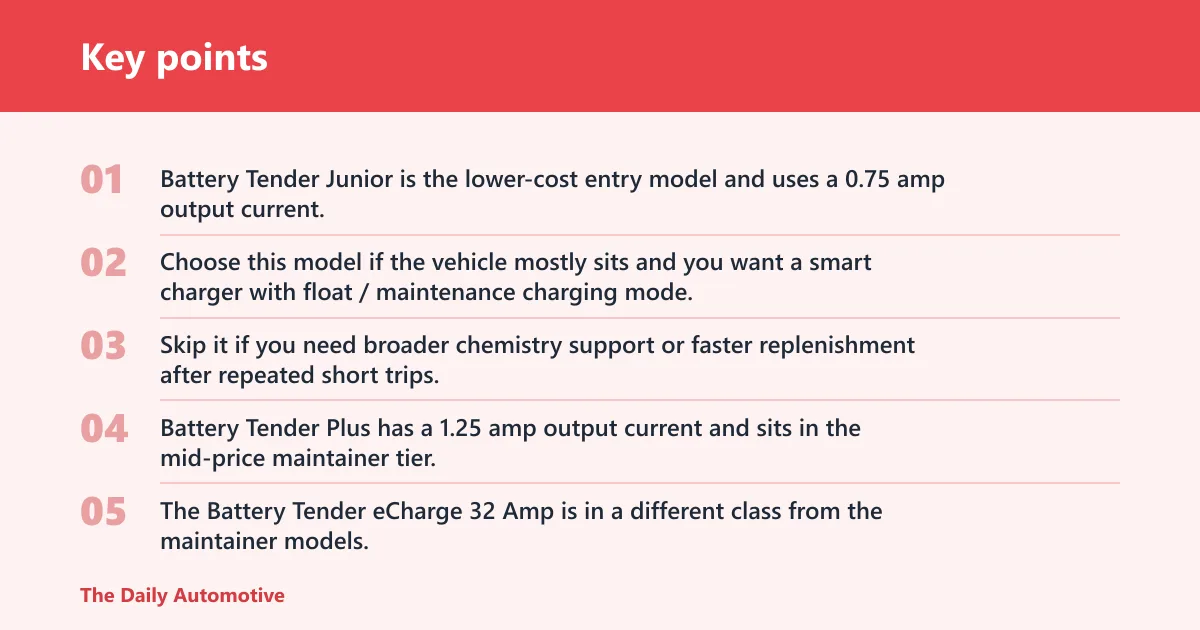
Battery Tender Junior is the lower-cost entry model and uses a 0.75 amp output current. It also includes a 5-year limited warranty. That combination makes it a practical pick for basic long-term storage on a small 12V battery when fast charging is not the point.
Choose this model if the vehicle mostly sits and you want a smart charger with float / maintenance charging mode. Skip it if you need broader chemistry support or faster replenishment after repeated short trips.
Battery Tender Plus for long-term battery care
Battery Tender Plus has a 1.25 amp output current and sits in the mid-price maintainer tier. Think of it as a lower power version of the Plus family approach: still aimed at maintenance, but with a bit more output than the Junior. It is a strong choice for long-term battery care on a normal car battery. (Batterytender)
Battery Tender 3 AMP smart charger for broader chemistry support
The Battery Tender 3 AMP smart charger is a better fit when you need 6V and 12V support plus broader battery chemistry coverage. It supports lead-acid, AGM, gel, and some lithium batteries, and it includes spark-proof connection, reverse polarity protection, and multi-stage charging.
That feature set is worth the extra cost if your garage includes more than one battery type. It is wasted money if all you need is a basic maintainer for a single seasonal car.
Battery Tender eCharge 32 Amp for higher-output charging
The Battery Tender eCharge 32 Amp is in a different class from the maintainer models. It starts at $454.95, offers adjustable current from 8 to 32 amps, has a maximum power output of 7.6 kW, includes a 24.5-foot cable, and is Energy Star certified and UL Safety certified.
That is charging gear for a very different use case. Most car owners comparing Battery Tender prices should skip it unless they truly need high-output equipment.
What features justify the price?
The price gap only makes sense when the features solve a real problem. Amperage can shorten charge time. Chemistry support determines which batteries you can safely use. Safety features cut risk. Warranty length and brand trust matter when the charger may stay connected for months.
Amperage and charging speed
Battery Tender Junior at 0.75 amp is fine for maintenance. Battery Tender Plus at 1.25 amp gives a bit more current. A 3 AMP smart charger is more versatile. Higher current matters when you need to recover a low battery or spend less time waiting between uses.
Battery chemistry support
Battery chemistry support is a major reason to pay more. Lead-acid, AGM, gel, and LiFePO4 / lithium batteries do not all want the same charging behavior. If your vehicle uses a modern lithium battery or a 6V setup, the right model matters more than the lowest sticker price.
Safety features and certifications
Reverse polarity protection and spark-proof connection are worth paying for because they reduce avoidable mistakes during hookup. On higher-output gear, Energy Star certification and UL Safety certification add another layer of confidence. These features matter more than a plain bargain charger with little electronic control.
Warranty length and brand trust
Battery Tender Junior’s 5-year limited warranty is a clear value point for a low-cost model. That does not make every unit indestructible, but it does give buyers a more concrete basis for comparing cost to own. A longer warranty can matter as much as a small price difference.
Is Battery Tender a good brand? For this category, yes, if you want a widely recognized maintainer with clear model separation and safety-focused features. Brand trust is not magic. It matters because the company publishes specific output figures, charging modes, and battery compatibility rather than leaving buyers to guess.
-
Match the battery type.
Start with lead-acid, AGM, gel, or LiFePO4 / lithium compatibility, plus 6V or 12V if your vehicle needs it. The charger should fit the battery first, then the budget. -
Pick the job, not the price tag.
Choose Junior for basic storage, Plus for long-term maintenance, 3 AMP for broader chemistry support, and eCharge only for high-output charging needs. Paying more for unused output is wasted money. -
Use permanent wiring.
For convenience, install ring-terminal wiring and leave the lead in place if the manual allows it. That makes seasonal hookup faster and reduces the chance of bad clamp placement.
How much does a Battery Tender cost to run?
For normal maintenance use, the running cost is usually minimal. A maintainer is designed to sip power, not draw much of it. In practical terms, the electricity cost is small enough that the real financial question is whether the charger helps avoid an early battery replacement.
Electricity use in practical terms
A float charger is not a high-energy appliance. It may stay connected for weeks or months, but the current tapers once the battery is full. That is why most owners should think of running cost as minor, not as a meaningful recurring expense.
When higher-output gear changes the math
Higher-output charging gear can use more power because it is doing more work. That does not mean it becomes expensive to run in the everyday sense. It means the cost to own rises mainly through purchase price, not through the electric bill.
Battery Tender compatibility and use cases
Battery Tender fits storage, winter parking, and infrequent driving best. Those are the cases where battery drain keeps showing up. If a vehicle sits for long stretches, a smart maintainer can help prevent the slow discharge that shortens battery life.
Say your coupe sits for three weeks at a time. A basic 0.75 amp maintainer can keep the battery topped up without constant attention, which is exactly where a cheaper Battery Tender makes sense.
Suppose your SUV uses AGM and you also keep a motorcycle with a small 12V battery. In that case, a model with broader chemistry support may be worth the higher price because one charger can cover more than one battery type.
Lead-acid, AGM, and gel batteries
Lead-acid remains the most common fit for these maintainers, but AGM and gel batteries also matter. The key is not assuming every charger treats them the same. A smart charger with the right mode can be much safer than a generic unit with a single output style.
LiFePO4 and lithium support
LiFePO4 / lithium support is where the price difference starts to matter more. If the charger is not meant for that chemistry, do not assume it will work safely just because it plugs in. Use the model that explicitly lists lithium support.
Storage, winter, and infrequent driving
A common first-timer mistake is buying a charger that is too powerful for simple storage. If the vehicle only sits through winter, a maintainer is usually the right tool. Faster charging is nice, but it is not a substitute for correct battery chemistry support.
Frequently asked questions
How much do battery tenders cost?
Costco-style deals can go under $40, and one forum report placed a sale at $29. That makes basic maintenance models the best value for most drivers.
How much battery charger cost
A basic battery charger can cost less than a smart maintainer, but the cheaper unit may not protect the battery the same way. If you only need a one-time top-off, a plain charger may look cheaper. If you need long-term maintenance, the smarter charger is usually the better value.
Is Battery Tender a good brand?
Yes, if you want a maintainer with clear model choices, float / maintenance charging, and known safety features. The Junior’s 5-year limited warranty adds value at the entry end. The brand’s pricing makes sense when you compare it against battery-life protection, not against the cheapest charger on the shelf.
What is the difference between a Battery Tender and a trickle charger?
A Battery Tender is a smart charger/maintainer with float mode and automatic shutoff. A trickle charger lacks that level of control and can rise above safe voltage, which Battery Tender says may exceed 16 VDC. For storage, the smart maintainer is the safer and more useful tool.
How long does a Battery Tender last?
Lifespan depends on use, storage, and cable care, so no one can promise a fixed number for every unit. The practical point is that a maintainer with a longer warranty and simple float charging can give years of useful service if used according to the manual and kept dry, clean, and properly connected.
Products related to this article
Sponsored / affiliate links. As an Amazon Associate I earn from qualifying purchases. I may earn additional commission from eligible campaigns.