Car Battery Recycle Fee Cost
Many drivers pay about $0 to recycle a car battery when they return a used battery to a retailer, parts store, or recycler. A replacement battery often carries a refundable core charge of about $10 to $30. Miss the details, and you can pay extra or lose a refund. This article separates the fee, core charge, and payout cases so you know what leaves your pocket.
Core charge vs. recycling fee
A core charge is a refundable deposit added to many lead-acid car batteries at purchase. A recycling fee is separate from a core charge. It is a separate charge that some retailers or local rules may add for handling the old battery. A scrap-yard payout is another money flow entirely, where the yard pays you for the used battery itself.
What a core charge
Most automotive batteries are lead-acid batteries, and many sellers attach a core charge to them because the old battery has value for recycling. You usually get that money back when you return the spent battery and provide the receipt or core receipt required by the store. Amounts vary by retailer and state.
When a separate recycling fee appears
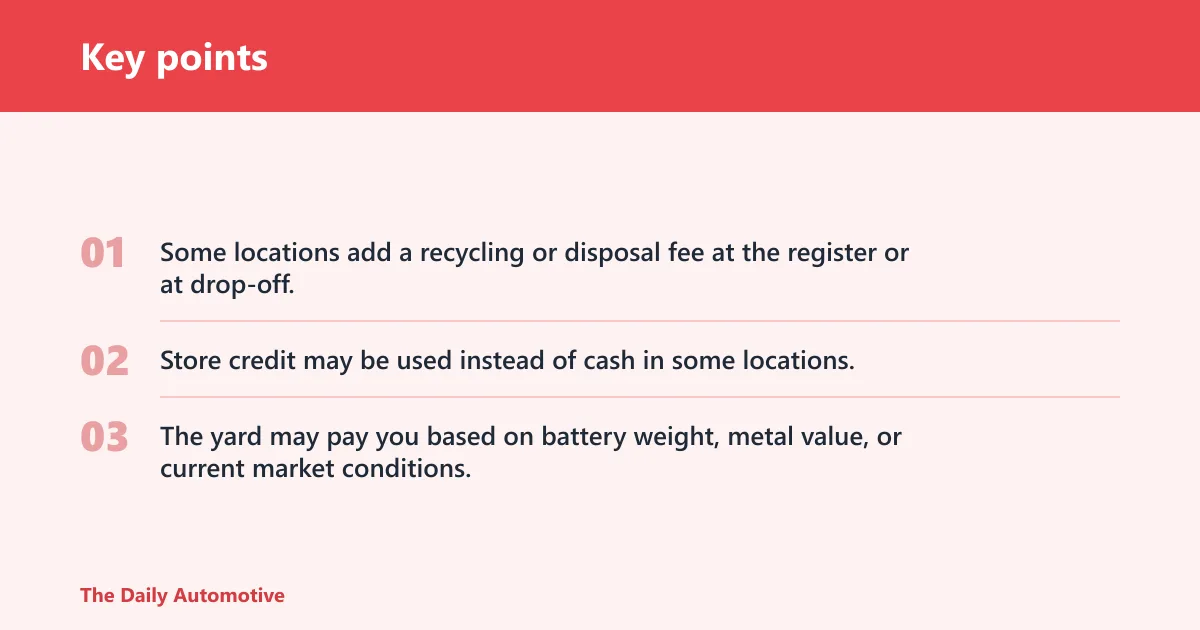
Some locations add a recycling or disposal fee at the register or at drop-off. That fee is not the same as the core charge, and it may not be refundable. The store can set it under its own policy, or local rules can determine whether it is charged and how it appears on the bill.
How store credit and refunds differ
A core charge refund usually means the seller gives back the deposit once the old battery is returned within the store’s window. Store credit may be used instead of cash in some locations. A scrap-yard payout is different again. The yard may pay you based on battery weight, metal value, or current market conditions.
How much does recycling cost?
For many drivers, recycling a car battery costs nothing out of pocket when the old battery is returned to the seller or recycler the same day. The more common surprise is the core charge on the replacement battery, which is refunded after the return. If the battery is dropped off without the right paperwork, a separate fee or lost deposit can apply.
Typical out-of-pocket outcomes at retailers
At auto parts retailers, the usual outcomes are simple: pay the battery price plus a core charge, then get the core charge back after returning the old unit. Some stores accept the used battery at the counter when you buy a replacement. Others require the battery to be returned later, along with a receipt or core receipt.
When recycling is free
Recycling is often free when the retailer or recycler accepts the battery as part of a purchase return. Some locations also take used batteries without charging a recycling fee. Acceptance depends on local policy, battery condition, and whether the seller is taking back the same type of lead-acid battery.
When you may be paid instead
Scrap metal recyclers may pay for used car batteries, especially if the battery is intact and accepted under the yard’s rules. The payout is usually modest and can move with market conditions. Damaged, swollen, or leaking batteries may be refused or priced differently because they create handling and cleanup issues.
Car battery fee decision table
This table maps the most common return situations to the likely money outcome. Treat it as a decision tool, not a fixed price list. Store policy, state rules, and battery condition can change the result.
| Scenario | What you pay | What you get back | What proof is needed |
|---|---|---|---|
| Buying a new battery | Battery price plus a core charge; sometimes a separate recycling fee | Nothing yet, unless the store applies instant core credit | Sales receipt and any fee line shown at checkout |
| Returning the old battery the same day | Usually $0 extra if the store accepts the return with the sale | Core charge refund or credit, often about $10 to $30 | Receipt, battery core receipt, or original invoice |
| No receipt | May lose the refund or face a store-policy hold | Sometimes store credit, sometimes nothing | Store may ask for ID, phone number, or purchase record |
| Recycling at a scrap yard | Usually $0 to drop off, but some yards have rules or fees for bad units | Possible payout based on weight and market conditions | Photo ID, yard intake form, and battery acceptance check |
| Leaking battery | Could be refused; some sites send you elsewhere | Usually no payout until the yard or recycler approves it | Call-ahead approval and safe transport details |
| Local fee area | May include a separate recycling or disposal fee | Core refund may still apply if rules are met | Receipt showing the local fee and the return terms |
Where can you return a used battery?
Most drivers can return a used lead-acid car battery to an auto parts retailer, a battery recycling center, or a scrap metal recycler. Acceptance rules differ by chain and location, and some places limit damaged batteries or require identification. City or county household hazardous waste programs may also take them under local disposal rules.
Auto parts retailers
Auto parts retailers often accept old batteries when you buy a replacement battery. The return can trigger the core refund, but the store may require a receipt or battery core receipt. Chain policy matters. One location may credit the deposit at once, while another needs the original invoice and a short return window.
Scrap metal recyclers
Scrap yards may buy used batteries for their lead content. Payment can depend on battery weight, market conditions, and whether the battery is accepted in the first place. Some yards require photo identification. Others refuse leaking or broken units because they are harder to handle under hazardous waste rules.
Battery recycling centers and local drop-off sites
Battery recycling centers usually focus on safe intake and compliant processing. Some allow free drop-off, while others charge a fee or limit acceptance to certain battery types. Municipal sites may have specific hours, quantity limits, and packaging rules, so check local disposal requirements before you load the battery into the car.
How to get the core charge back
To reclaim a core charge, you usually need the original sale receipt or battery core receipt, plus the return within the store’s allowed time. If the battery comes back late or without proof, the refund may be denied. The store’s policy decides whether you receive cash, store credit, or no credit at all.
-
Keep the original receipt.
The receipt or invoice should show the battery purchase and any core charge line. If the store uses a separate core receipt, keep that too. Without proof, many retailers will not release the refund.
-
Return the battery on time.
Some retailers set a short return window, and that window can be tied to the original sale date. If you wait too long, the core charge may expire under store policy even if the battery itself is still accepted.
-
Match the store’s policy.
Ask whether the return must go to the same location, whether a new battery purchase is required, and whether store credit is offered instead of cash. That avoids the common problem of arriving with the battery but not the right paperwork.
Say your receipt shows a $20 core charge and you bring the old battery back two hours later. If the store’s policy allows same-day return, the refund is usually straightforward. If the same battery is returned three weeks later without the invoice, the store may refuse the credit even though the battery is still usable for recycling.
Picture a driver buying a replacement battery in one state and trying to return the old battery in another. The second location may still accept the battery, but it may follow different proof rules or fee handling. Local and state rules can affect the refund, so keep the paperwork with the battery until the return is complete.
How to handle a leaking or damaged battery
Leaking, swollen, cracked, or heavily corroded batteries may be refused by some retailers and recyclers. Call ahead and ask what the site accepts. Because lead-acid batteries contain lead and sulfuric acid, damaged units need careful handling and may fall under hazardous waste rules at the local level.
-
Keep the battery upright.
Set the battery in a sturdy box, tray, or plastic tub that holds it level. Upright transport helps reduce acid leakage and keeps the terminals from contacting metal objects in the vehicle.
-
Cover the terminals.
Use terminal caps or nonconductive tape if the battery is intact and dry enough to handle safely. That lowers the chance of shorting if the posts touch tools, cargo, or another battery during transport.
-
Separate it from loose items.
Do not place the battery where it can tip against luggage, jumper cables, or coins. A stable load protects the battery and reduces the chance of sparks or acid contact.
-
Call before drop-off.
Ask whether the site accepts leaking or damaged batteries, whether it charges a special fee, and whether it needs advance notice. Some locations have special handling procedures and may direct you to a hazardous waste site instead.
Frequently asked questions
How much does it cost to recycle a car battery?
Many drivers pay nothing to recycle a car battery when they return it to a retailer, scrap yard, or recycling center that accepts it under normal rules. The more common charge is a refundable core charge on the replacement battery, often about $10 to $30. Local fees can change that outcome.
What is a core charge fee for a battery?
A core charge is a refundable deposit added to many lead-acid car batteries at purchase. It gives the seller a reason to collect the old battery for recycling. If you return the used battery within the store’s rules and with the right proof, the charge is usually refunded or credited back.
Do you get money for recycling car batteries?
Sometimes. A scrap metal recycler may pay for a used car battery, especially if it is intact and accepted by the yard. At a retailer, you are more likely to get back a core charge refund than new money. The outcome depends on where you return it and what proof you bring.
How much for recycling car batteries at AutoZone, Advance Auto Parts, or Costco?
Those retailers commonly take old batteries, but the exact refund or fee depends on store policy, state rules, and whether you bought a replacement battery there. Some stores offer core credit tied to the sale; others may require the original receipt. Always confirm the local return process before you go.
Can you recycle a car battery for free?
Yes, often. Free recycling is common when a retailer accepts the old battery with a replacement purchase, or when a recycling center offers no-charge drop-off. Free does not mean universal, though. Damaged batteries, late returns, or local disposal rules can add a fee or block acceptance.
What happens if I return my old battery late or not at all?
If the return is late, the store may deny the core refund because the return window expired. If you never return the battery, you usually forfeit the refundable deposit and may end up paying the full core charge. Keep the receipt and ask about the deadline before you leave the store.
Products related to this article
Sponsored / affiliate links. As an Amazon Associate I earn from qualifying purchases. I may earn additional commission from eligible campaigns.