Exterior Lighting for Cars: Tested & Reviewed (3 Picks)
Choose between legal white or amber auxiliary lights for visibility, low-profile RGB strips for show use, or sealed off-road pods for hard weather. Choose wrong, and you can get glare, poor wiring, water intrusion, or a ticket. This guide compares exterior lighting picks by legality, mounting zone, power source, weather exposure, and control type.
Top pick by use case
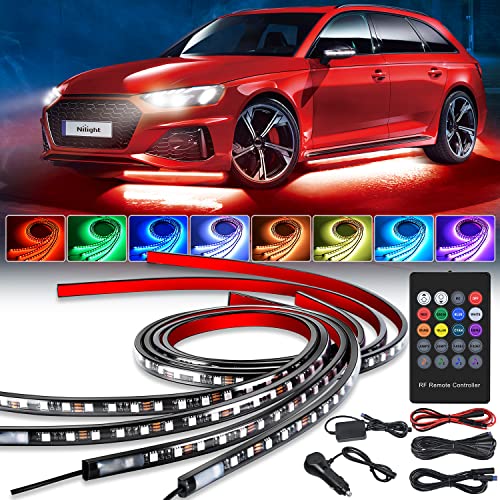

Best overall: Nilight 4Pcs Car Underglow Neon Accent Strip Lights. It uses four strips, 252 LEDs, eight color modes, sound-active lighting, wireless remote control, and IP68 waterproofing. That mix fits underbody mounting better than a rock light kit, while staying simpler than app-heavy RGBIC setups.
Best for legal visibility
TEKSHINNY dual-color strip lights are the cleaner fit when you want auxiliary front lighting rather than neon-style underbody glow. The 2×24-inch strips use white and yellow output, include DRL-style function, and can integrate with turn signals. They are not a license to ignore local lighting rules, but they line up better with on-road use than strobe kits.
Best for show-car styling
Govee RGBIC underglow is the styling pick if you want the widest color control. It supports 16 million colors, smartphone app control, scene modes, music synchronization, and segment-level color control. That makes it a choice for controlled display use rather than a basic remote-only strip kit.
Best for trucks and SUVs
YiLaie RGB LED Rock Lights fit lifted vehicles because they mount near the wheels and frame rather than only along the rocker panels. The kit uses four light pods with 15 LEDs per pod, app or remote control, a brake warning function, and IP68 waterproofing. That layout stands up better to wheel-well spray and trail debris.
Quick picks by need
| Need | Pick | Key spec | Best fitment zone |
|---|---|---|---|
| Best overall underglow kit | Nilight 4Pcs Car Underglow Neon Accent Strip Lights | 252 LEDs, eight color modes, sound-active lighting, IP68 | Underbody |
| Best rock light kit | YiLaie RGB LED Rock Lights | Four pods, 15 LEDs per pod, brake warning function | Wheel wells / frame rails |
| Best app-controlled RGBIC kit | Govee RGBIC underglow | 16 million colors, app control, scene modes, segment-level color control | Underbody |
| Best visibility-focused strip | TEKSHINNY dual-color strip lights | 2×24-inch strips, white and yellow output, turn signal integration | Front fascia / DRL area |
A common first-timer mistake is buying a strip kit for a lifted truck when the real need is wheel-well lighting. The strip can look fine on the bench, then get buried by tire spray and road grime once it is mounted under a tall chassis.
Which exterior lights are legal?
Legality depends more on placement and use than on brightness, color variety, and weather resistance. White or amber auxiliary lighting may be allowed in some places, while colored underglow, rear-facing lighting, and any strobe effect can draw attention quickly on public roads. The exact rule set changes by state, province, and city.
Why placement matters more than color alone
Lighting mounted low on the body, especially under the vehicle, is easier to see from a distance and easier to mistake for nonstandard road lighting. Front-mounted white or amber helper lights generally create less risk than multi-color strips aimed at the pavement or wheels.
Where underglow and strobe lights create legal risk
Underglow is usually the highest-risk category for on-road use because the light is visible outside the body line. Strobe kits are even riskier on normal street vehicles. A 4PCS wireless strobe kit can offer eight colors and ten modes, but that kind of output is typically suited to off-road display, event grounds, or nonpublic use only.
How to check local rules before you buy
- Check whether colored exterior lighting is allowed while driving.
- Confirm whether lights may face forward, rearward, or only downward.
- Look for rules on flashing, strobe, or rotating patterns.
- Verify whether the kit must be switchable off from the driver seat.
- Choose the kit for the exact mounting zone you plan to use.
What is the difference between underglow and rock lights?
Underglow is meant to wash light along the ground and body line. Rock lights mount higher, usually in the wheel wells or on the frame, and are built to light suspension parts, tires, and the ground immediately around the vehicle. That difference matters for clearance, debris, and legal exposure.
Mounting zone and what each kit lights up
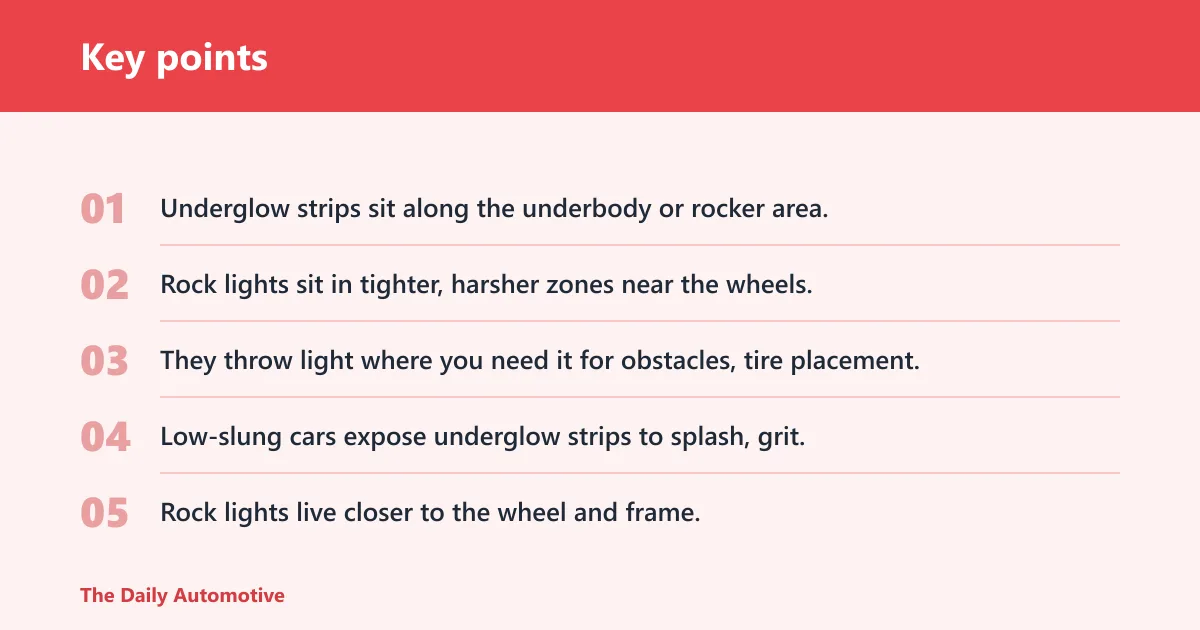
Underglow strips sit along the underbody or rocker area. They create a broad halo under the vehicle. Rock lights sit in tighter, harsher zones near the wheels. They throw light where you need it for obstacles, tire placement, or showing suspension detail on a truck.
Ground clearance, debris exposure, and use case
Low-slung cars expose underglow strips to splash, grit, and scraping during driveway entries. Rock lights live closer to the wheel and frame, so they face more direct impact from stones and mud, but they are often the better choice for lifted trucks and SUVs.
Cars versus trucks and SUVs
For a sedan or coupe, underglow usually gives the cleaner visual effect. For a truck or SUV, rock lights often make more sense because they stay visible above the road spray and can be aimed where the chassis needs light most.
Exterior lighting decision matrix
This table maps the major exterior lighting types to legality risk, mounting zone, power method, weather exposure, and likely failure point. Use it before you buy. It keeps you from matching the wrong kit to the wrong vehicle.
| Type | Use case | Legality risk | Mounting zone | Power method | Weather exposure | Likely failure point |
|---|---|---|---|---|---|---|
| LED underglow strip kit | Show styling | High on public roads | Underbody / rocker panels | 12V vehicle power | High splash, grit, road salt | Adhesive lift or moisture ingress |
| Rock lights | Off-road visibility and wheel detail | Medium to high, depending on use | Wheel wells / frame rails | 12V vehicle power | Very high debris and spray | Wire damage or pod impact |
| Wireless strobe lights | Visibility on controlled property | Very high for road use | Grille / roof / body panels | USB rechargeable battery | Moderate, depending on mounting | Battery fade or control limits |
| Dual-color DRL strips | Front auxiliary lighting | Lower if installed and used legally | Grille / bumper / headlamp edge | 12V vehicle power | Moderate heat and water exposure | Heat damage or poor routing |
How to choose the right kit
Start with the mounting zone, then choose the power method and control style. A kit can look impressive online and still fail the job if the wire path crosses heat, the adhesive lands on a dirty surface, or the lighting pattern is not legal where you drive.
12V power and fuse protection
Most car exterior lighting kits are built for the 12V automotive electrical system. That does not mean every kit should share a random circuit. Use fuse protection sized for the kit, and decide early whether you want a cigarette-lighter feed for a temporary setup or a hardwired connection for a cleaner install.
Hardwired kits usually look tidier and can be more secure, but they need better planning. Cigarette-lighter power is easier to remove, yet it can limit routing options and may leave you with visible wiring.
App control versus remote control
App control helps when you want more colors, scene modes, or finer segment control. Govee RGBIC underglow is the clearest example here, with 16 million colors and segment-level color control. Remote control is simpler and often faster for basic color changes, as seen on the Nilight kit and the wireless strobe kit.
Suppose you want a weekend show setup for a coupe that sits low and rarely sees rain. A strip kit with app control makes sense. Suppose you want a trail truck with muddy wheel wells and quick daytime adjustment. Rock lights with a simple remote may be the better call.
Waterproofing, adhesion, and wire routing
IP68 means the maker has specified the product as dust-tight and protected against water immersion under the stated conditions. It does not fix bad mounting. A clean surface, proper zip-tying, and careful routing away from moving parts still decide whether the kit holds up.
Adhesive lift is common on underbody strips when the surface is oily or uneven. Moisture ingress often follows poor sealing at connectors. Wire routing near exhaust parts, brake hardware, or sharp edges creates another failure path that waterproofing alone cannot solve.
Heat and debris clearance
Keep strips and pods away from exhaust tubes, brake components, and suspension travel. Heat can weaken adhesive and plastic housings. Debris from the road can cut wires, especially where the cable hangs below the frame or crosses a wheel well without protection.
Best picks by product
Nilight 4Pcs car underglow neon accent strip lights
Nilight is the underglow pick for buyers who want a straightforward strip kit. It uses 252 LEDs across four strips, includes eight color modes plus sound-active lighting, and carries an IP68 waterproof rating. That combination gives it the right feature set for a low-profile underbody install.
It is for owners who want a show-oriented look without moving up to a phone-first control system. The wireless remote helps with basic operation. The main watchouts are the same ones that apply to most strip kits: adhesive quality, connector sealing, and whether the vehicle’s underside has enough clean mounting surface.
YiLaie RGB LED rock lights
YiLaie is the fit when the vehicle needs lighting in the wheel wells or around the frame. The kit uses four light pods with 15 bright LEDs each, supports app or remote control, and adds a brake warning function. That makes it more practical for trucks and SUVs than a standard underglow strip.
Rock lights handle harsher exposure than underglow in many builds because they are placed where the vehicle already needs illumination. The tradeoff is greater exposure to direct splash and impact, so wire protection matters more here than with a simple body-line strip.
Govee RGBIC underglow
Govee RGBIC underglow is the pick for buyers who care about color control more than simplicity. It supports 16 million colors, smartphone app control, scene modes, and segment-level color control. That gives it more visual range than a basic eight-mode strip kit.
This is the pick for a controlled show setup, not the easiest route for a one-button install. App control usually adds more flexibility, but it also adds setup steps and depends on the phone interface working the way you want.
Wireless LED strobe lights
TEKSHINNY dual-color strip lights
TEKSHINNY’s 2×24-inch exterior strips are built around white and yellow output, which makes them the most road-oriented option in this group. The DRL-style function and turn signal integration can work well on the front of a vehicle when installed within local lighting rules.
The heat dissipation focus matters because front-end mounting often sits near lamps, grilles, and warmed bodywork. That makes routing and placement more important than with a rearward show strip. Use this type when you want functional front accent lighting rather than colorful underglow.
Frequently asked questions
What are the best exterior lights for cars right now?
The best choice depends on the job. Nilight is the underglow pick for basic show styling, Govee RGBIC is the pick for app-based color control, YiLaie fits trucks and SUVs better, and TEKSHINNY is the road-oriented option for white and yellow front auxiliary lighting.
Are underglow lights legal on cars?
Sometimes, but not everywhere. Legality depends on where the lights are mounted, what color they emit, whether they flash, and whether they are used while driving. Underbody lighting is often the riskiest style on public roads, so you need to check local rules before installation.
Which car exterior lights are waterproof?
Many exterior kits list IP68 waterproofing, including the Nilight underglow kit and the YiLaie rock light kit. That rating means dust-tight protection plus maker-specified water immersion protection. Even so, waterproofing does not protect bad connectors, poor routing, or weak adhesive from real-world failure.
How do I install LED underglow lights safely?
Mount the strips on a clean, dry surface, keep them away from exhaust heat and moving suspension parts, and route the wiring through protected paths. Use fuse protection on the 12V circuit, seal connectors, and confirm that the mounting zone will not scrape on driveways or speed bumps.
Do app-controlled exterior lights work better than remote-controlled ones?
App control is better when you want more colors, scene modes, or segment-level effects. Remote control is simpler and often faster for basic operation. If you only need on-off, color changes, or a few patterns, a remote can be easier and less distracting than a phone interface.
Products related to this article
Sponsored / affiliate links. As an Amazon Associate I earn from qualifying purchases. I may earn additional commission from eligible campaigns.