Best Music Horns for Cars (2026): Based on Specs and Reviews
Pick a 12V musical horn kit with a compressor and multiple tone options if you want maximum sound flexibility; choose a single-trumpet air horn kit if you want simpler wiring, a louder blast, and better durability. Choose poorly, and you can end up with weak output, electrical trouble, or a horn that is illegal or impractical for local roads. This guide compares both horn styles by fit, install difficulty, sound output, durability, and where each one makes sense.
Quick comparison
| Product | Badge | Best for | Price | ||
|---|---|---|---|---|---|
 |
FARBIN Horns Auto Horn 12V Car Horn Loud Dual-ToneFARBIN | Our pick | 12V · 130dB · dual-tone | $16.99
Price as of 24 Oct 2026
|
View |
 |
12V 24V Car Horn Controller with 10 Sounds – ElectronicKlanata | Also great | 12V/24V · 10 sounds · controller kit | $16.99
Price as of 24 Oct 2026
|
View |
The right choice depends less on raw volume and more on how much sound control you want and how much wiring you can handle. Electronic kits suit drivers who want more tones and easier packaging, while air-horn melody kits make more sense when the priority is a louder, simpler alert with weather-tough hardware.
How we chose
This comparison focuses on four things that decide whether a musical horn works in the real world: 12V fit and power match, sound options and tone style, install complexity and relay needs, and weather resistance of the housing.
That keeps the buying decision practical. A horn that looks impressive on a listing can still be the wrong pick if it needs more space than your vehicle has, or if its wiring is too heavy for the circuit it is connected to.
Musical horn decision matrix
| Vehicle type | Install complexity | Sound style | Best pick |
|---|---|---|---|
| Car or SUV with room for wiring and a control unit | Moderate | Many tones, mode switching, novelty sounds | Vixen Horns VXS6200 |
| Truck, motorcycle, or bus with a 12V system | Lower to moderate, depending on mounting space | Simple loud alert with fewer choices | Cenzhiwen 10-tone horn kit |
| Vehicle used mostly for events or show use | Higher | Air-horn melody with trumpet sound | Air-horn melody kit such as La Cucaracha or Dixieland |
| Vehicle exposed to rain, snow, or road salt | Lower if the housing is sealed well | Any style with corrosion-resistant parts | Cenzhiwen 10-tone horn kit |
Vixen Horns VXS6200: best for sound flexibility
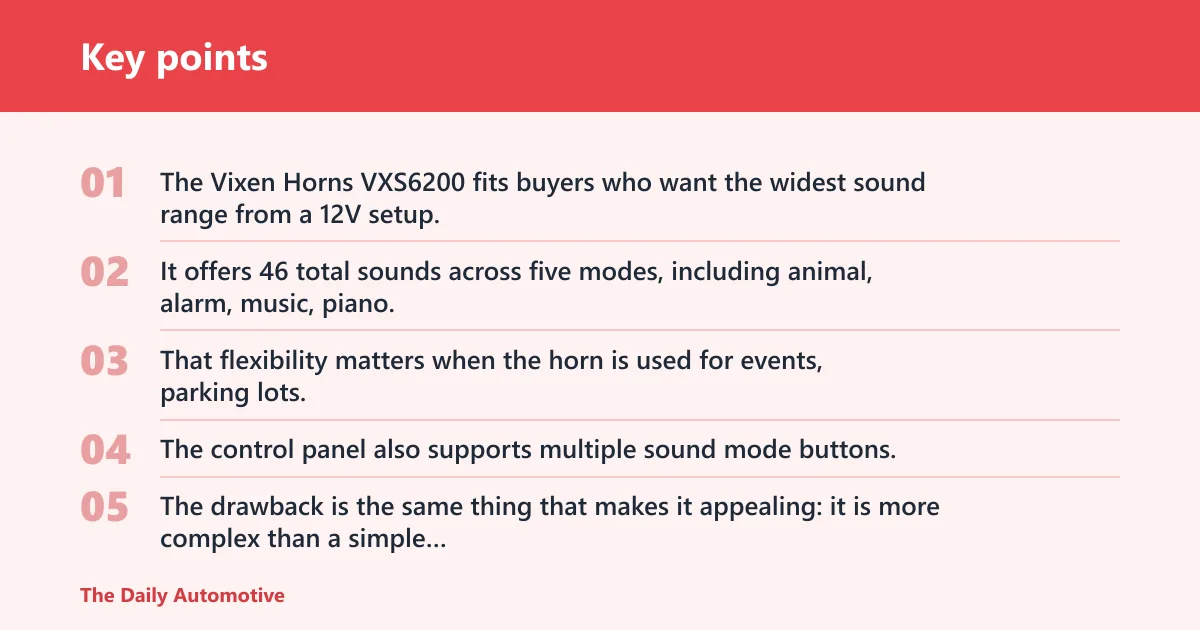
The Vixen Horns VXS6200 fits buyers who want the widest sound range from a 12V setup. It offers 46 total sounds across five modes, including animal, alarm, music, piano, and microphone modes, plus a 15W speaker and a PA microphone for speaking or announcements.
That flexibility matters when the horn is used for events, parking lots, or novelty setups where one tone is not enough. The control panel also supports multiple sound mode buttons, so the interface is built for switching sounds rather than just blasting one alert.
The drawback is the same thing that makes it appealing: it is more complex than a simple loud horn. More modes usually mean more buttons, more wiring to sort out, and more temptation to treat it like a public-road toy instead of a road-use device that still has to fit local rules.
Who should buy it?
Choose this kit if you want variety first and loudness second. It suits drivers who want more than a single warning tone, and it makes sense when the vehicle has enough room for an electronic control setup and the owner is comfortable matching the wiring to a 12V DC system.
It is also the better fit when sound choice matters more than speed of installation. Someone who wants a horn for shows, meetups, or a project car will usually get more use from 46 sounds than from a basic blast-only setup.
Install and fitment notes
The Vixen Horns unit operates on 12V DC, so it belongs on the same class of vehicle electrical systems used by most aftermarket musical horn kits. That includes cars, trucks, motorcycles, and some buses when the mounting space and power delivery line up.
Do not assume a 12V label alone is enough. You still need correct wiring, enough mounting room for the speaker and control hardware, and a clean path for the microphone and control panel if you plan to use the PA function.
Cenzhiwen 10-tone horn kit: best for loudness and durability
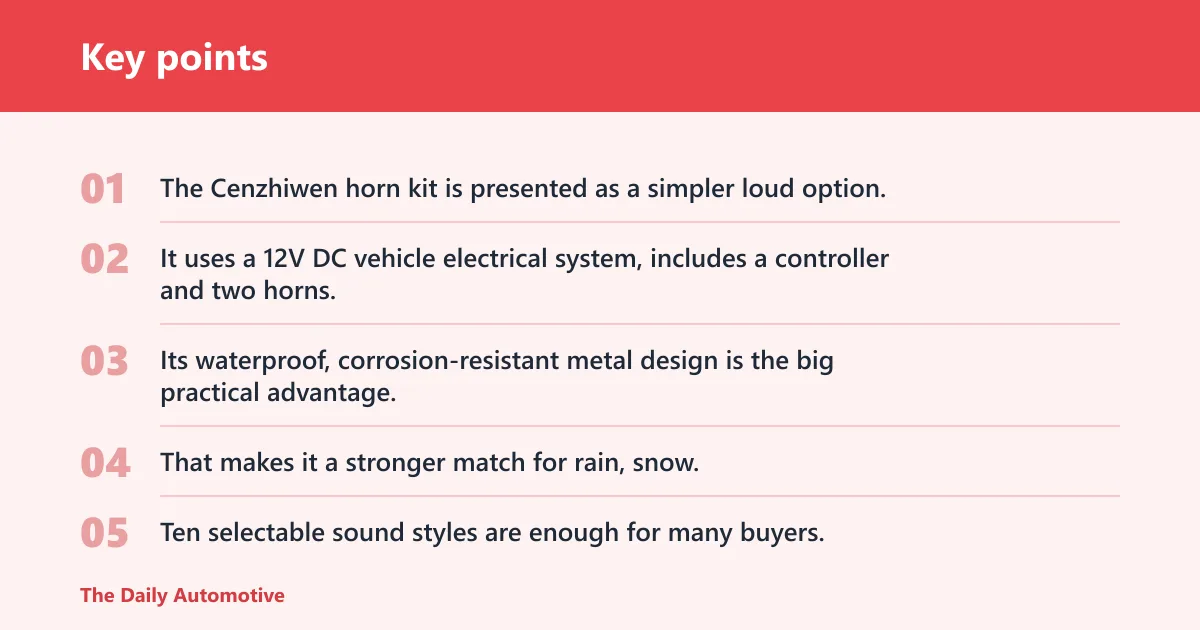
The Cenzhiwen horn kit is presented as a simpler loud option. It uses a 12V DC vehicle electrical system, includes a controller and two horns, and is described as a horn kit with around 10 to 12 tones and about 130 dB volume for drivers who want strong output without a complicated sound library.
Its waterproof, corrosion-resistant metal design is the big practical advantage. That makes it a stronger match for rain, snow, and road salt than a kit with a lighter housing, especially if the vehicle spends time outside or sees winter use.
The tradeoff is sound choice. Ten selectable sound styles are enough for many buyers, but they are still fewer than the Vixen kit’s 46 total sounds, so this is not the right pick if you want a wide menu of melodies and effects.
What is the difference between an air horn and an electric horn?
An air horn uses compressed air to drive one or more trumpets, while an electric horn uses an electrical speaker or tone generator to create the sound. Air-horn melody kits usually need more hardware, including a compressor, relay wiring, and air hose routing. Electric kits are usually easier to package and wire.
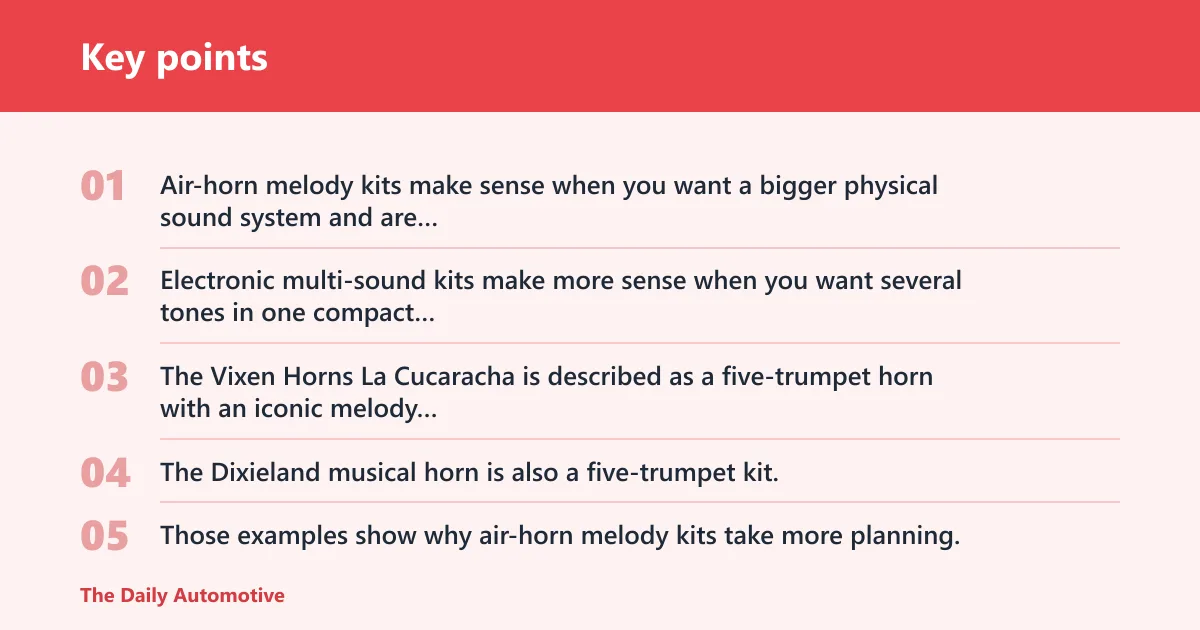
That difference changes the buying decision. Air-horn melody kits make sense when you want a bigger physical sound system and are willing to deal with the added parts. Electronic multi-sound kits make more sense when you want several tones in one compact control box.
La Cucaracha and Dixieland as air-horn examples
The Vixen Horns La Cucaracha is described as a five-trumpet horn with an iconic melody and an attention-grabbing novelty sound. The Dixieland musical horn is also a five-trumpet kit, but it is compressor-based and includes a relay and air hose, which is a more traditional air-horn layout.
Those examples show why air-horn melody kits take more planning. Trumpets, compressor, relay wiring, and hose routing all have to fit together. If the engine bay or underbody space is tight, the install can become much more involved than a compact electronic kit.
Relay wiring and air hose requirements
Relay wiring kits matter because they help the horn draw current safely, especially on air-horn kits and other higher-current setups. A relay keeps the control side separate from the heavier load side, which helps reduce wiring mistakes and limits stress on the switch circuit.
Air hose routing is the other major difference. If the hose is kinked, poorly secured, or placed where heat and moving parts can damage it, the horn may not sound as intended. That is one reason air-horn kits are better for buyers who are comfortable planning the installation before buying parts.
When an air horn makes more sense
Choose an air-horn melody kit when the priority is a novelty sound with a more physical horn setup and you have room for the compressor and trumpet layout. It also makes sense if you want a road presence that feels more like a traditional horn package than an electronic sound module.
Suppose a truck owner wants a louder, more theatrical horn for off-road meets and has space under the hood for a compressor. That is a better air-horn use case than a small commuter car with limited mounting room and a desire for quick wiring.
Choose Vixen Horns VXS6200 if… / Choose Cenzhiwen 10-tone horn kit if…
Choose the Vixen Horns VXS6200 if you want the widest sound range, a built-in PA microphone, and a horn system that can move between animal tones, alarms, music, piano notes, and special effects. It is the better pick when sound variety matters more than simple loudness.
Choose the Cenzhiwen 10-tone horn kit if you want a more direct loud horn, weather-resistant metal housing, and a package that stays simpler to understand. It is the better fit for drivers who want 130 dB output and fewer setup headaches.
If your vehicle is mostly for commuting, the simpler horn is often the safer purchase. If the vehicle is for events, show use, or public-address style playback, the Vixen kit gives you more ways to use it.
Are musical car horns legal to use on public roads?
Legality varies by jurisdiction and by how the horn is used. Many places restrict novelty sounds, melodies, or attention-grabbing tones on public roads, even if the horn itself is legal to install. Check local horn-use rules before mounting anything that might be heard outside private property or event settings.
The safe approach is to separate installation from street use. A horn can fit a 12V vehicle and still be a poor choice for public-road use if local rules allow only standard warning tones or limit how loud and how often the horn may be used.
How loud should a musical car horn be?
For road use, louder is not always better. A horn should be loud enough to get attention without becoming a nuisance, and the right level depends on where the vehicle is driven, how close traffic is, and whether the horn is meant for warning or novelty use.
As a buying cue, 130 dB is the kind of figure sellers use to signal serious output, but the number alone does not decide fit. Sound style, directional spread, and legality matter too, especially if the horn will be used in neighborhoods or on crowded roads.
Can I install a musical car horn myself?
Many buyers can install a musical horn themselves if the kit is truly 12V, the mounting space is available, and the wiring is clear. The job gets harder when the kit needs a relay, a compressor, or hose routing, because those parts add more steps and more places for mistakes.
A simple electronic kit is usually more approachable than a full air-horn setup. Still, if the install requires cutting into factory wiring, running heavy-gauge power, or finding weather-safe mounting spots, a careful installer should plan the work before starting.
Do I need a relay to wire a new musical car horn?
Often, yes. A relay is common for safer horn wiring, especially with air horn kits and higher-current setups. It helps keep the control circuit separate from the power load and reduces the chance of overheating a switch or undersized wire.
Even when a kit does not include a relay, adding one is often the cleaner route if the horn draws more power than the factory circuit was built to handle. A relay is not the flashy part of the install, but it is one of the parts that keeps the setup reliable.
Can I put a musical horn on a truck or motorcycle?
Yes, if the kit matches the vehicle’s 12V electrical system and there is enough room for mounting and wiring. Many aftermarket musical horns are marketed for cars, trucks, motorcycles, buses, and even boats, but the real limit is not the badge on the listing. It is fitment and power match.
Motorcycles usually have tighter space, so compact electronic kits are often easier to place than air-horn trumpet packages. Trucks have more room, but they still need correct relay wiring and weather protection if the horn is mounted where spray and debris can reach it.
What makes a musical horn weather-resistant?
Weather resistance usually comes from a sealed or coated housing, corrosion-resistant materials, and connectors that are less likely to let water in. Waterproof or corrosion-resistant housing matters most for rain, snow, road salt, and long-term outdoor parking.
That is why metal and plastic builds are both used in this category. The important question is not only what the shell is made of, but whether the seams, terminals, and mounting points can survive repeated wet and dirty use without failing early.
Quick comparison
The Vixen Horns VXS6200 wins on flexibility. The Cenzhiwen 10-tone horn kit wins on straightforward loudness and weather-tough construction.
If you want a horn that acts more like a sound board, choose Vixen. If you want fewer parts, a louder single-purpose alert, and easier long-term durability, choose Cenzhiwen.
Which one should you buy?
If you want the most sound options, choose the Vixen Horns VXS6200. Its 46 total sounds across five modes make it the stronger match for buyers who want variety and a microphone-based PA function in one kit.
If you want the simpler loud option, choose the Cenzhiwen 10-tone horn kit. Its 10 selectable sounds, 130 dB output, waterproof metal design, and included controller make it the more direct pick for a driver who values loudness and easier upkeep.
If the vehicle is a daily commuter in a city, a simpler electronic horn is often the safer choice because it is easier to control and less likely to tempt public-road misuse. If the vehicle is for events or novelty use, the more flexible kit earns its keep.
For a buyer deciding between air and electronic styles, think about space first, then wiring skill, then how often the horn will be used on public roads. That order prevents most of the common regret purchases.
Frequently asked questions
What is the best musical horn for a car?
The best musical horn depends on the use case. For maximum sound flexibility, the Vixen Horns VXS6200 is the stronger pick. For a simpler loud setup with stronger weather resistance, the Cenzhiwen 10-tone horn kit is the better fit. Public-road legality still depends on local rules.
Which musical horn is easier to install, air or electronic?
Electronic horns are usually easier to install. They avoid the compressor and hose routing that air-horn melody kits need, so there are fewer parts to mount and fewer points where wiring or air delivery can go wrong. Air kits can still work well, but they demand more planning.
Which musical horn has the most sound options?
Among the two top picks here, the Vixen Horns VXS6200 has the most sound options with 46 total sounds across five modes. It also includes animal, alarm, music, piano, and microphone modes, which makes it the better choice when variety matters more than simple loudness.
Products related to this article
Sponsored / affiliate links. As an Amazon Associate I earn from qualifying purchases. I may earn additional commission from eligible campaigns.